
Malta's medical school is older than most of Europe's, and it began inside a hospital. Formal teaching started in December 1676, when Grand Master Nicholas Cotoner established a School of Anatomy and Surgery at the Sacra Infermeria in Valletta, as the University of Malta's faculty history records. Three and a half centuries later, the island hosts a handful of routes into medicine whose names blur together: an MD, an MBBS, a franchise degree, and two preparatory courses that don't make anyone a doctor.
That's why this roundup doesn't rank schools. It sorts them by what you receive: who awards the degree, how you enter, and whether the course is a medical degree or a stepping stone toward one. Some options here are five or six years of clinical training. Others are a single preparatory year. One is an admissions route into a programme that already appears on this list under a different heading.
Get the category right first, then compare the details inside it. The rest of the decision gets considerably easier.
Table of Contents
- 1. Medical School Programs A-Z
- 2. University of Malta, Doctor of Medicine and Surgery
- 3. Queen Mary University of London, Malta MBBS
- 4. MediCampus Europeo, Medical Degree
- 5. University of Malta, Foundation Studies Pathway
- 6. Queen Mary University of London, Malta Clinical Foundation Studies
- 7. Queen Mary University of London, Malta MBBS Route for International Graduates
- Malta medical school options at a glance
- Choosing the Right Malta Route Before You Apply
1. Medical School Programs A-Z
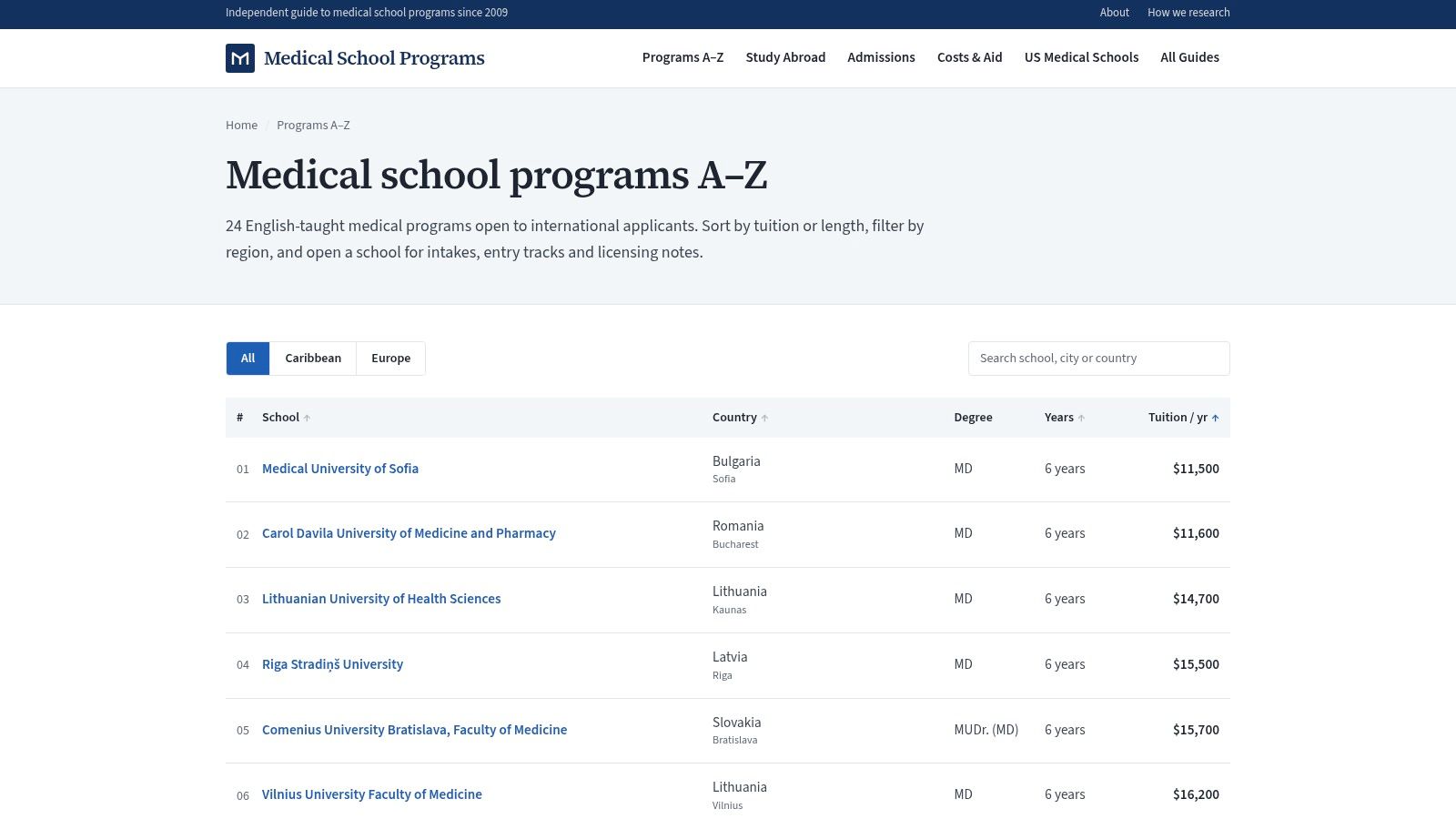
Start here, because a Malta shortlist only makes sense against the alternatives. Medical School Programs A-Z is an independent directory of 24 English-taught medical programs in Europe and the Caribbean, run by a publication that began in 2009 as a blog about nursing and medical school programs and now pairs a sourced directory with practical guides on admissions, costs and licensing.
The listings do one job well. Each entry shows tuition, program length and licensing notes taken from official sources, with facts checked against each school's own pages and dated, and updated when a school changes its fees or requirements. The team works from school websites and bodies such as the World Directory of Medical Schools, ECFMG, NRMP and national accreditation agencies. Schools can't pay to change a listing.
Why the benchmark matters for Malta. The island offers a very small number of English-taught medical degrees, so the meaningful comparison is against other countries. The median yearly tuition across the listed European programs is $17.1k, against $61.2k across the listed Caribbean programs. Riga Stradiņš University in Latvia runs a six-year MD at $15,500 a year; Masaryk University in Brno charges $18,100 for its six-year MUDr.
What the directory is best at
- Browsing by school rather than by ranking. Location, teaching language and admissions information sit in one place, which is the fastest way to spot a country you hadn't considered.
- Keeping European and Caribbean routes side by side. The Caribbean entries are four-year, US-style MD programs with clinical rotations at affiliated hospitals mostly in the United States, so the comparison isn't like for like and the directory doesn't pretend it is.
- Poland as a volume test. With 4 listed English-taught programs, Poland has more entries than any other European country, which makes it the obvious second market after Malta.
Practical limit: the directory covers a defined set of 24 programs. A school missing from it isn't necessarily wrong for you, and a school inside it isn't automatically a safe licensing bet.
Admissions rules move year to year. Treat every listing as a dated starting point and confirm on the institution's own pages before you apply.
2. University of Malta, Doctor of Medicine and Surgery

This is the degree every other option on the island gets measured against, and the one with the least ambiguity about who awards it. The University of Malta's Doctor of Medicine and Surgery runs five years full time and carries 300 ECTS, taught in English, with an optional intercalated year after the first two.
The structure is conventional and clearly published. The ASIIN accreditation report on the University of Malta programme describes two pre-clinical years followed by three clinical years, with clinical education delivered primarily through placements at Mater Dei Hospital rather than solely within university facilities.
What the cohort numbers tell you
Between 2012 and 2018, annual MD intake ranged from 142 to 202 students, and non-Maltese students made up approximately 12% to 40% of accepted cohorts, according to the same accreditation report. That's a wide band. Ask for the current year's split rather than assuming you'll land in a large international group.
Cohort size matters practically. A bigger intake spreads clinical placement capacity thinner, and a smaller one can mean fewer study partners and less peer teaching. The programme's international intake has drawn from the United Kingdom, other EU countries, Gulf states and further afield, so the teaching culture is used to students arriving from different school systems.
The trade-offs are real. Entry requirements are specific and competitive, and Maltese-language preparation matters in patient-facing contexts even though the degree is taught in English. Tuition and eligibility should be checked for the intake you're targeting, not a previous year's. Intercalation adds a year and a fee, and it's worth doing only if the extra qualification serves a specialty you're pursuing.
3. Queen Mary University of London, Malta MBBS
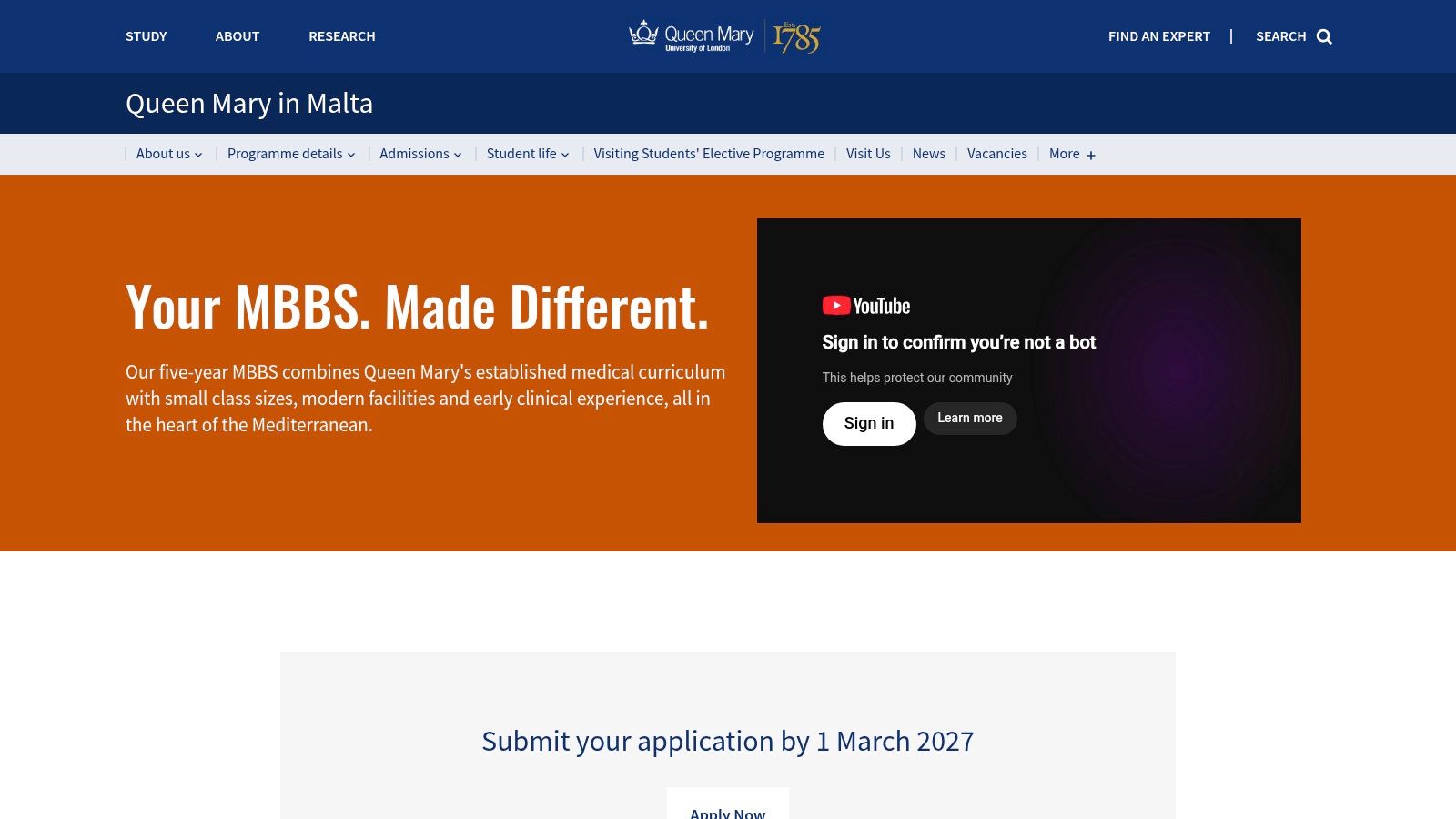
Here the awarding body sits in London and the campus sits in Malta, which changes what you're buying. Queen Mary University of London delivers a five-year MBBS in Malta through Barts and The London School of Medicine and Dentistry, taught in English, following the same core curriculum as QMUL's London A100 programme, with early patient contact and clinical-skills teaching. UCAT is part of the admissions process, and that's the first filter to plan around.
This is a full medical degree, not a pathway into one. The parchment says Queen Mary University of London, and that distinction matters when you compare it against the foundation routes listed elsewhere in this roundup.
What clinical training in Malta actually looks like
The pre-clinical years run on the Malta campus, and the clinical phase moves into Malta's hospital and community settings, with placements arranged through the school. The island is small, so placement sites are limited in number. What you lose in variety of systems you gain in continuity: the same supervisors, the same wards, and a cohort that stays together through the clinical years.
A concentrated placement network gives you depth in the settings it covers and little exposure to how other health systems operate. Test that against your intended specialty before you commit.
The academic thresholds are demanding, and UCAT preparation isn't optional. The bigger trap is assuming the degree travels. A UK-awarded MBBS does not automatically confer the right to practise in every country, so confirm the recognition picture for the country where you plan to work. Fees and placement arrangements also change between intakes, and the school itself is the only reliable source for the year you're applying to.
4. MediCampus Europeo, Medical Degree

Read this entry by the awarding body first. MediCampus Europeo is a franchise-delivered medical degree in Malta, with Trakia University named as the university that awards the qualification, so the certificate line matters more than the campus branding.
That makes it a different category from a foundation route: the intended outcome is a medical degree, but the Malta delivery site and the degree-awarding institution are not the same entity. Franchise arrangements are used in European medical education and are not automatically a problem. They do mean your diploma carries the awarding university's legal name, so the paperwork belongs at the front of your checklist rather than after enrolment.
Verify registration before you pay a deposit
The Medical Council Malta's registration procedures are explicit that the Council is the sole authority determining whether graduates are registrable, and that institutions cannot promise Maltese registration or EU professional equivalence without the Council's completed assessment. Provisional registration follows completion of medical studies and approval for the Foundation Programme. Registration gives you the right to seek employment, not a job.
Build the file before you enrol:
- Awarding institution: the exact legal name on the degree certificate.
- Exact qualification: the title as it will appear, not the marketing name.
- Medical Council decision: written confirmation naming the specific programme and awarding university.
- Provisional registration eligibility: what the Council requires after you graduate.
- Foundation School requirements: the local training step, and whether you would qualify.
- Intended country of practice: a separate regulator assessment, because Maltese registration and recognition elsewhere are distinct decisions.
This option is less established than the University of Malta or QMUL Malta, and recognition claims should be tested as conditions to satisfy, not read as licensure outcomes. If you are weighing franchise-delivered degrees against public-university routes, our guide to medical schools in Europe taught in English explains how the entry routes differ. Confirm fees and payment arrangements directly.
5. University of Malta, Foundation Studies Pathway

This entry exists to prevent an expensive misunderstanding. The University of Malta's foundation courses prepare students for admission to medicine or dentistry. They are not medical degrees, and finishing one does not make you a doctor.
They're aimed at applicants whose secondary qualifications don't meet direct-entry requirements, and they're run by the same institution that awards the MD. That's the genuine advantage: you're inside the system, with access to staff who can tell you how your qualifications map onto the entry criteria. Progression is not automatic, so confirm which course fits your background and whether it satisfies MD admission requirements for your intake.
The recognition question comes first
Before you spend a year and its fees, check the destination degree, not just the pathway. The Medical Council Malta's 2023 annual report records 135 provisional medical-practitioner registrations and 173 principal-register registrations during the year, with 2,858 practitioners on the principal register at 31 December 2023. The same Council advises anyone entering a medical or dental programme licensed in Malta to confirm the course is registered for graduate recognition.
So the order is: identify the degree you're aiming at, get written confirmation of its recognition, then decide whether a preparatory year earns its place. A foundation year buys eligibility, not entitlement, and it adds time and cost before the medical degree begins. If you're comparing this route with direct entry elsewhere, our list of medical schools that accept international students shows how other countries handle the same qualification gaps.
6. Queen Mary University of London, Malta Clinical Foundation Studies
QMUL has described a Certificate in Clinical Foundation Studies at its Malta campus for students preparing for medical study. It leads to a certificate rather than the five-year MBBS, and it does not qualify anyone to practise medicine.
That makes it a stepping stone, not a destination. The draw is the connection to a university that also runs a Malta medical degree, and that same connection is the reason to read the fine print, because proximity to the MBBS is not a place on it. Before you commit, confirm the current course length, whether it is running for your intake, and the fees on QMUL's own Malta admissions pages.
How it differs from the University of Malta route
The University of Malta pathway sits inside the faculty that awards the MD. The QMUL certificate is a separate qualification with its own conditions, sitting alongside the MBBS rather than inside its admissions chain. Ask specifically whether it is running for your intake year and what, if anything, completing it changes about your application.
Check this in writing: ask admissions whether the certificate carries any guaranteed progression or conditions attached to the MBBS, and get the answer for your specific intake year, not a general one.
If the course fits your situation, use it well. It gives you time to strengthen your UCAT position, sort documentation for a clinical programme, and test whether the workload and study style suit you before you commit to the full degree and the fees that come with it. What it won't do is shorten the medical degree itself.
7. Queen Mary University of London, Malta MBBS Route for International Graduates
Already hold a degree? This is not graduate-entry medicine. QMUL publishes admissions guidance for applicants who already hold a university degree, and that route leads into the same five-year Malta MBBS, not a shorter programme.
That distinction costs people a year of planning when they get it wrong. A prior degree doesn't compress the curriculum or exempt you from the standard selection process. What it can do is give you a different entry conversation, with documentation requirements that some international degree-holders need to satisfy.
Expect the usual filters to remain in place. UCAT and English-language requirements may still apply, and some applicants will need evidence of prior degrees alongside school qualifications. Eligibility depends on your qualifications and the current admissions policy, which is exactly the sort of thing to confirm before you spend money on test preparation.
Prepare the paperwork early:
- Degree transcripts for every qualification you're relying on.
- School-leaving certificates, because graduate status doesn't always replace them.
- English-language evidence if your degree wasn't taught in a recognised medium.
- A written answer on eligibility from admissions, tied to your intake year.
If you're weighing whether a second degree abroad justifies the cost, our piece on whether studying medicine abroad is worth it works through the trade-offs. The short version for this route: you get a recognised UK-awarded degree delivered on a small island, and you take on a competitive entry process plus a licensing question that's answered by your destination country, not by the campus.
Malta medical school options at a glance
| Item | Degree and length | Teaching language | Admissions gateway | Best for |
|---|---|---|---|---|
| Medical School Programs A–Z | Directory of 24 programs; no degree | Lists English-taught programs | Compare school-specific requirements | Browsing medical study options across Europe and the Caribbean |
| University of Malta, Doctor of Medicine and Surgery | MD, five years, 300 ECTS | English | Competitive, specific entry requirements | A public-university medical degree with clinical training in Malta |
| Queen Mary University of London, Malta MBBS | MBBS, five years | English | UCAT and academic requirements | A UK-university degree with early patient contact in Malta |
| MediCampus Europeo, Medical Degree | Medical programme, six years, 360 ECTS | Advertised as English-taught | Check provider requirements and verify recognition independently | Applicants considering an English-taught programme in Malta |
| University of Malta, Foundation Studies Pathway | Preparatory pathway; length not specified | Confirm with the university | Course suitability depends on qualifications; progression is not automatic | Applicants who may not meet direct-entry requirements |
| Queen Mary University of London, Malta Clinical Foundation Studies | Preparatory certificate, one year | Confirm current course details | Confirm availability and progression conditions | Applicants seeking a defined preparatory year before medical study |
| Queen Mary University of London, Malta MBBS Route for International Graduates | Same MBBS, five years; not a separate or shorter degree | English | Graduate eligibility review; UCAT and English requirements may apply | Degree-holders assessing eligibility for the Malta MBBS |
Choosing the Right Malta Route Before You Apply
Sort every option into three groups before you compare anything else. Full medical degrees: the University of Malta MD, the QMUL Malta MBBS, and the MediCampus Europeo programme awarded by Trakia University. Preparatory courses: the University of Malta foundation pathway and the QMUL Certificate in Clinical Foundation Studies. Graduate application routes: QMUL's guidance for applicants who already hold a degree, which feeds the same five-year MBBS. Mixing those categories is where most application plans go wrong.
Inside each group, check the same six things. Degree-awarding body. Length in years and ECTS. Teaching language. UCAT or other test requirements. Current fees for your intake. And the Medical Council's position on that specific programme, in writing, before a deposit leaves your account.
Where most applicants get caught
The licensing question is separate from the admissions question, and it's the one that decides whether the degree does what you need. Registration in Malta doesn't automatically produce recognition in the UK, the US, Canada or another EU state. Each destination regulator sets its own language, internship and examination requirements, and those rules can change while you're studying.
Language is the second quiet risk. English-taught lectures don't mean English-only wards. Patient-facing work in a Maltese hospital will involve local language exposure, and it pays to ask current students how much and how soon.
Cost is the third. A five-year degree with an optional intercalated year has a different total from a six-year programme, and living costs on a small island aren't trivial. Compare totals, not headline annual tuition.
For the benchmarking stage, Medical School Programs A-Z is a sensible starting point: 24 English-taught medical programs across Europe and the Caribbean, with program facts checked against official school sources and dated, so you can see how Malta's options stack up against Latvia, Poland, the Czech Republic and the Caribbean before you commit to one country.
Malta rewards applicants who read carefully, and that's the gap Medical School Programs exists to close. Our directory lists 24 English-taught medical programs across Europe and the Caribbean with tuition, program length and licensing notes drawn from official sources, so you can put the Malta options beside Riga, Brno or a Caribbean campus and compare on facts rather than brochures. Start with the Medical School Programs directory before you shortlist, then take each Malta programme's recognition question to the Medical Council in writing.