
In 2025, 1,390 applicants whose legal residence was outside the United States applied to U.S. medical schools, and 105 matriculated, according to the AAMC 2025 enrollment announcement. That narrow U.S. route is why many applicants compare medical schools that accept international students in the Caribbean and Europe instead. The headline tuition gap is wide. Published figures for the seven schools below range from roughly US$11,500 a year in our wider European listings to more than US$370,000 for a full MD at the top end, and neither figure tells you the full cost.
Program length changes the maths. A six-year European degree entered from secondary school spreads a lower annual fee over more years of living costs. A four-year, U.S. style Caribbean MD concentrates higher tuition into fewer years, then adds U.S. clinical phase travel, housing, and insurance. MCAT policy, entry tests, start dates, and where you'll do clinical training matter as much as the tuition line. Read each total below for what it excludes, not just what it includes.
Table of Contents
- 1. St. George's University School of Medicine (SGU)
- 2. Ross University School of Medicine (RUSM)
- 3. Saba University School of Medicine
- 4. American University of Antigua College of Medicine (AUA)
- 5. American University of the Caribbean School of Medicine (AUC)
- 6. University of Nicosia Medical School
- 7. Vita-Salute San Raffaele University International MD Program
- Published Tuition, Program Length and Location at a Glance
- Matching Your Budget and Timeline to the Right Medical Degree
1. St. George's University School of Medicine (SGU)
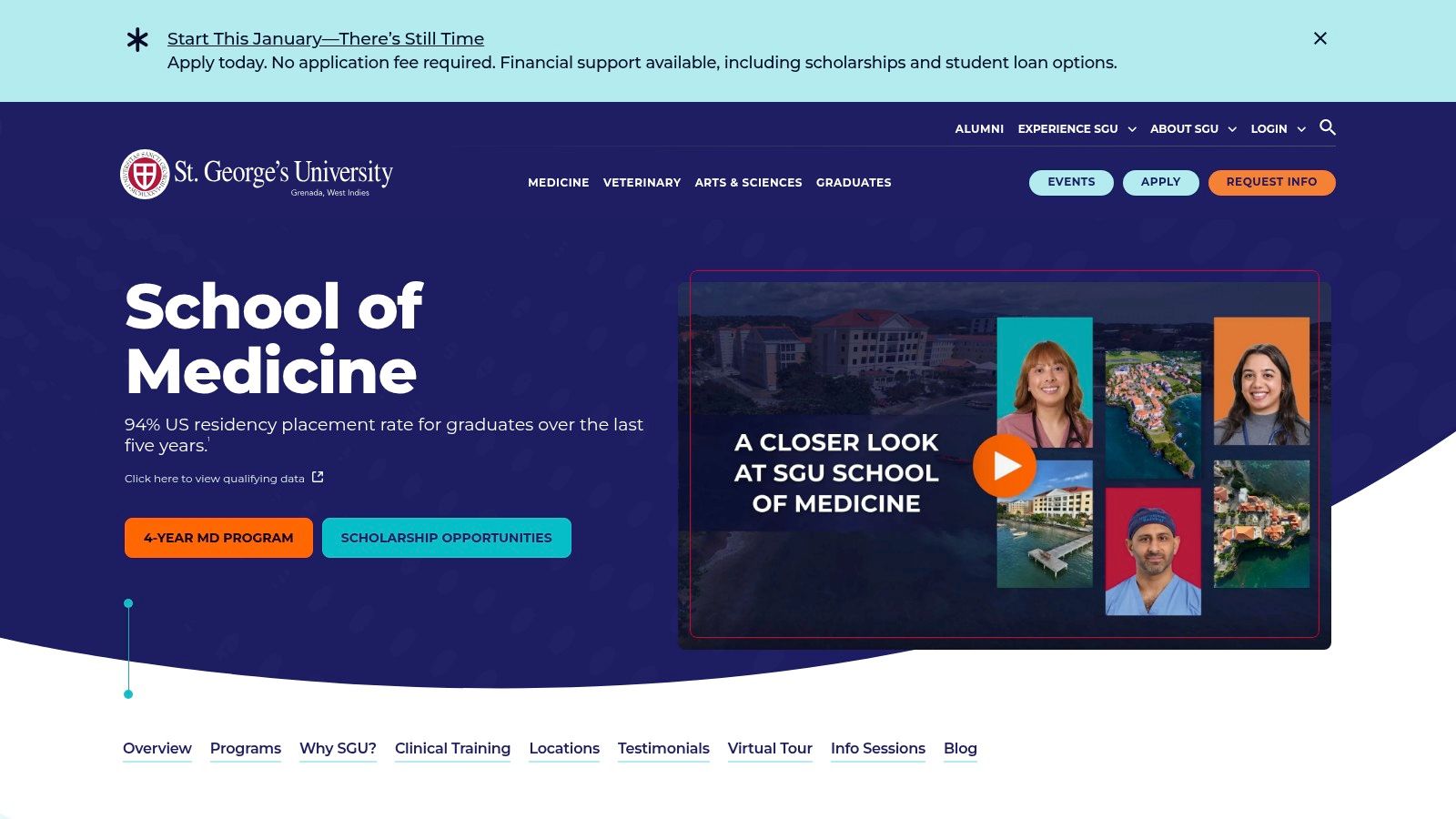
Based in Grenada, SGU is structured around entry point rather than a single start. Graduates with a bachelor's degree can take the four-year MD, while students who need more preparation use five, six, or seven-year tracks. The program is taught in English and includes opportunities for U.S. based clinical training, which is central to its appeal for applicants targeting U.S. residency.
That flexibility comes at the highest published total in this list. The school's 2025 to 26 tuition and administrative fees for the four-year MD total approximately US$376,986, before living and other costs, as published by St. George's University School of Medicine. Longer tracks add years of fees and living costs on top of that base, so you shouldn't compare the four-year figure to a six-year European annual fee without multiplying both out.
Who This Route Suits
- No MCAT outside North America: International applicants from outside North America aren't required to submit an MCAT score, which removes a major barrier for secondary school and non U.S. graduates.
- Three start dates: January, April, and August starts reduce waiting time if you miss a traditional autumn intake.
- Support to check carefully: International recruitment support and possible scholarships or need based bursaries exist, but they're not guaranteed and won't close a gap of this size on their own.
English testing may still be required depending on your background, and admission doesn't guarantee residency placement or eligibility to practice in a particular country. If you're comparing Grenada with other island options, our Caribbean medical schools guide places SGU alongside the other four-year routes so you can compare structure before price.
2. Ross University School of Medicine (RUSM)
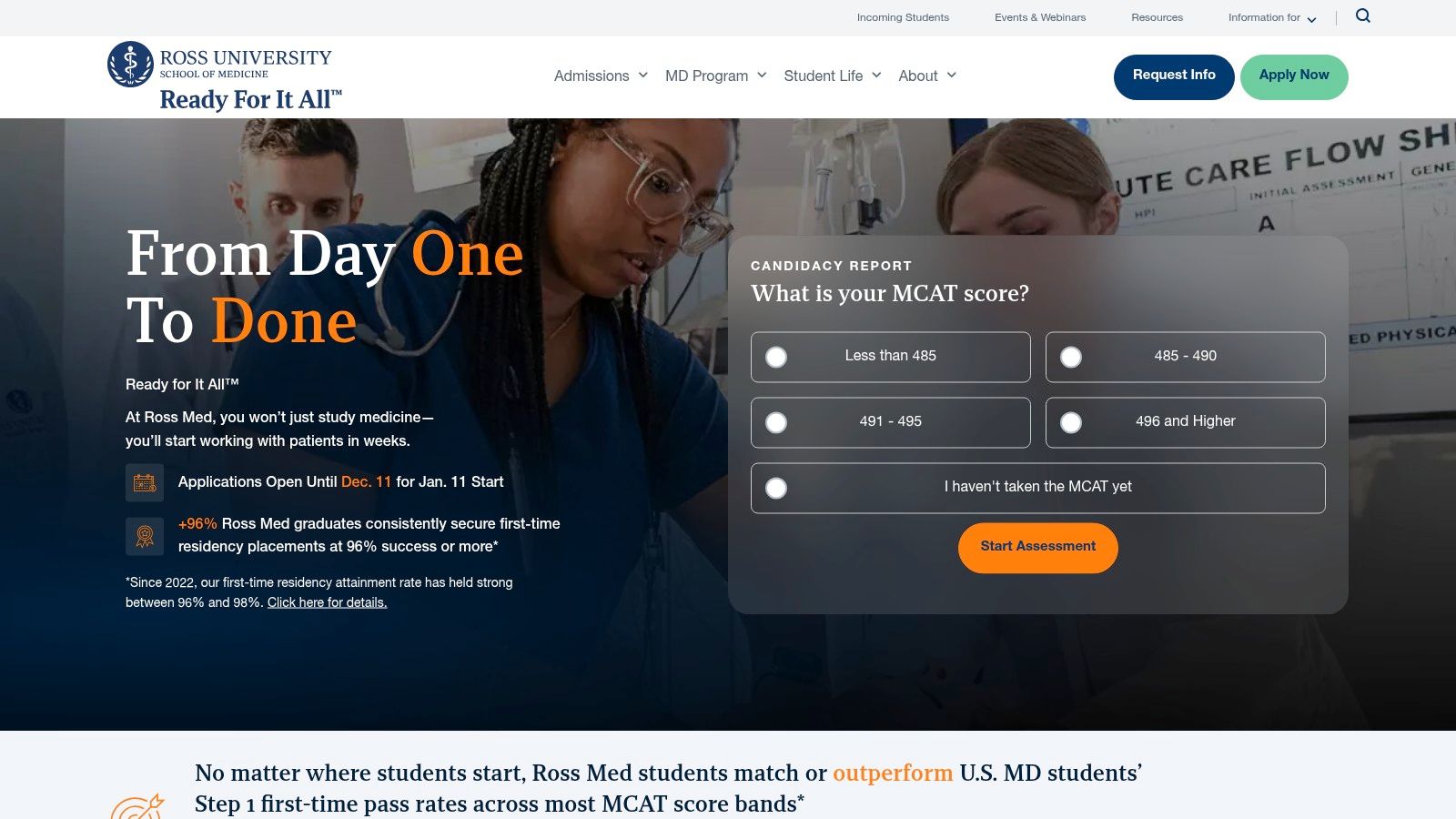
Ross runs a four-year, US-style MD across two locations, and your budget has to cover both. You complete the Medical Sciences phase in Barbados, then move to clinical education at affiliated hospitals, including opportunities in the United States. That move creates a second housing market, travel costs, and clinical phase expenses that a single semester rate never captures.
The published 2026 to 27 Medical Sciences tuition rate is US$25,811 per semester, excluding fees, according to Ross University School of Medicine. Multiplying that rate across the phase still gives only part of the degree price. Semester fees, Barbados housing, flights, and the cost of relocating for clinical training all sit outside the headline figure.
Budget rule: A per semester Medical Sciences rate is not a degree price. Ask for Medical Sciences and clinical tuition together, plus fees, before you compare Ross with a school that publishes a full program total.
The admissions offer aimed at international applicants is unusually concrete. Ross states that international applicants aren't required to submit MCAT scores, offers several start dates during the year, and charges no application fee on its international applicants page. The school also lists an International Scholar Award combining tuition and housing support for eligible students. Eligibility is limited and the award isn't guaranteed, so treat it as a discount to confirm in writing rather than as part of the price.
The clinical link to affiliated U.S. hospitals is the practical draw if U.S. residency is your goal. Admission still doesn't guarantee residency placement or licensure, so the route's value depends on the same match outcome as every other Caribbean option here.
3. Saba University School of Medicine

Saba publishes one of the clearest full totals in this group, which makes comparison easier. The published tuition and administrative fees for students beginning in September 2026 total US$298,750, before personal and living expenses, as listed by Saba University School of Medicine. That figure sits below SGU's four-year total, and it still covers tuition and administration only, on a small island where housing and travel choices are limited.
The structure is a 10 semester MD taught in English. You spend about 20 months on basic sciences on Saba, then move to clinical rotations in North America. Budget for that move as its own line item, since the island total says nothing about housing, travel or living costs once you leave Saba.
Admissions Details That Affect Cost and Timing
- Three start dates: January, May, and September intakes, with rolling admissions and no application fee, let you apply through the year subject to available seats.
- Targeted scholarship: An International Student Scholarship is listed for eligible citizens or permanent residents outside the United States and Canada, so confirm the current award amount and eligibility criteria with the school before counting it against the published total.
- Documentation support: The school gives guidance on application documents, English proficiency, MCAT policies, tuition, and international payments, which helps if you're paying across currencies.
English testing may be requested if English isn't your first language. Before you rely on the North America rotations, confirm the actual placement locations available for your cohort and whether they fit the licensing jurisdiction you intend to enter. A defined pathway is useful only if its clinical sites serve your end goal.
4. American University of Antigua College of Medicine (AUA)
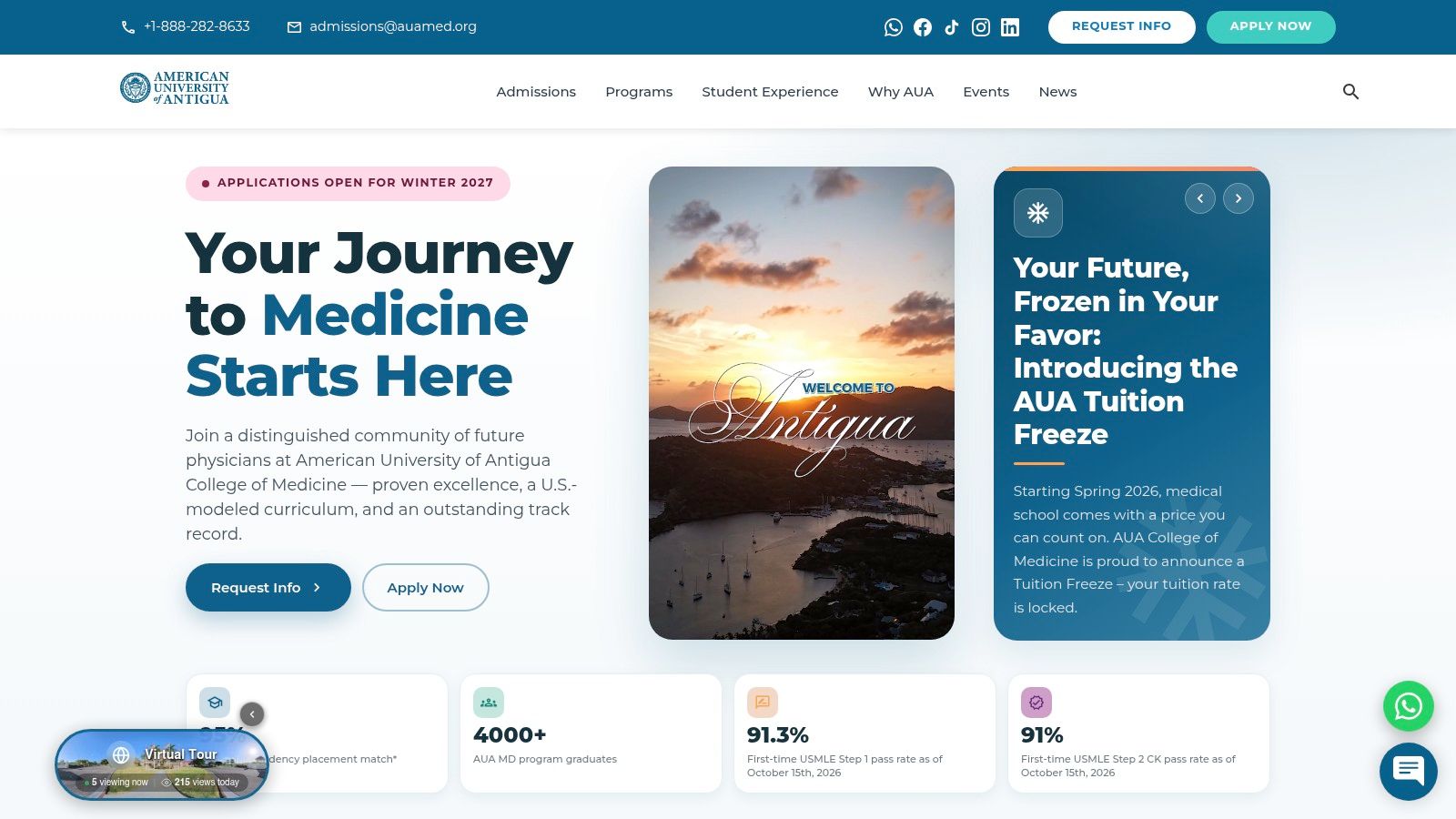
AUA's distinction is breadth of clinical geography. The U.S. modeled MD puts preclinical studies in Antigua and clinical clerkships at affiliated hospitals, with rotation opportunities described in the United States, Canada, and the United Kingdom by American University of Antigua College of Medicine. For applicants who haven't fixed a country of practice, that spread looks attractive, but availability can vary and should be confirmed for your start date.
The route in is a four-year MD for students with the required prior college coursework, with additional premedical pathways for those who need them. International admissions guidance covers credential evaluation and English translations of foreign language documents, two steps that cause delays when schools leave them vague. AUA explains them upfront, so you can order evaluations early and budget for translation.
Its MCAT position is also clearly split by status. International applicants who aren't U.S. citizens or permanent residents generally don't need to submit an MCAT score. That clarification matters because many Caribbean policies sound identical until you read the citizenship condition.
A U.S. modeled curriculum is a teaching structure, not a residency outcome. It doesn't guarantee U.S. residency or licensure in any of the countries where rotations are offered.
Scholarships and grants are available subject to award specific conditions, so ask for the conditions, renewal rules, and duration. Then request a complete estimate covering tuition, housing, insurance, travel, and clinical phase costs, because AUA's multi country clinical model can move you between very different cost bases.
5. American University of the Caribbean School of Medicine (AUC)

AUC makes the cost jump between phases visible, and that transparency is analytically useful. For 2026 to 27, tuition is US$23,909 per medical sciences semester and US$31,275 per clinical sciences semester, before additional expenses, according to American University of the Caribbean School of Medicine. The clinical phase, which students often budget last, is the more expensive phase per semester.
Based in Sint Maarten, AUC offers a four-year, U.S. modeled MD with two years of medical sciences followed by clinical training. Clinical training options include the United States or United Kingdom, and there's a UK track option for the early part of training. That gives you a location decision inside the same degree, which changes housing, travel, and permit costs.
What the Semester Figures Leave Out
- Housing and insurance: The school handbook gives further detail on insurance and housing, both of which can materially increase the total.
- Travel and permits: Moving between Sint Maarten and a clinical site adds flights, visas or permits, and short term housing.
- Track differences: A UK track and a U.S. clinical route don't cost the same to live through, even when tuition is published side by side.
Semester by semester publishing supports early budgeting better than a single headline total, because you can model cash flow year by year. Use it that way. Then check recognition and licensing requirements in your intended country, since a choice between U.S. and UK clinical sites has consequences beyond accommodation.
6. University of Nicosia Medical School
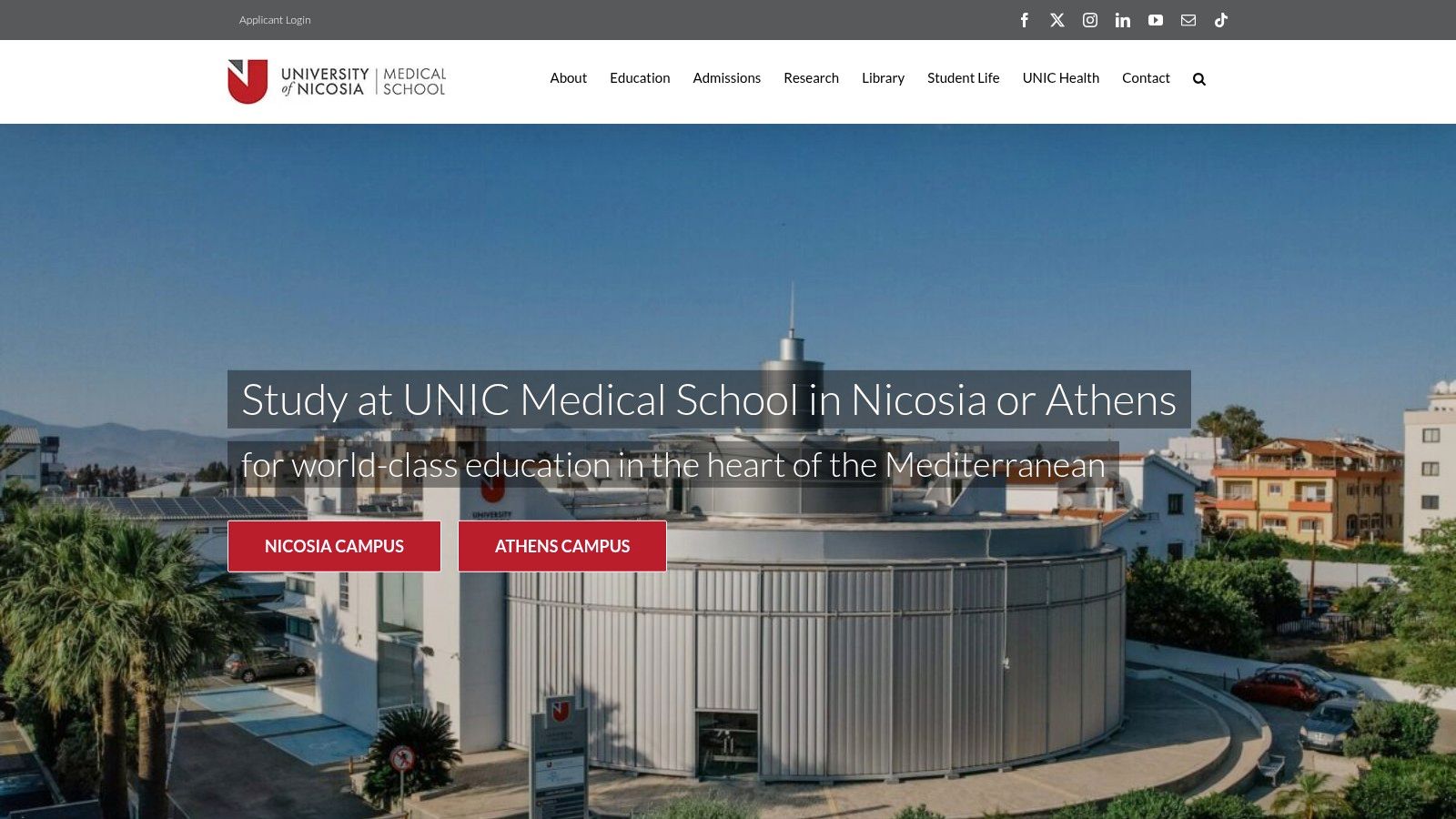
Nicosia reverses the Caribbean maths. The annual fee is far lower, but you pay it for six years. Published tuition for the six-year MD is €24,000 per year and the school estimates minimum living costs in Nicosia at €12,000 per year, with other charges and possible clinical training supplements also applying, as published by University of Nicosia Medical School. On those published lines alone, tuition plus minimum living costs reach €36,000 a year before supplements. Multiply that by six and the commitment reaches €216,000 before the extra charges, so the annual fee underrepresents what the degree costs.
The school, located in Cyprus, offers a six-year, English taught MD for high school graduates totaling 360 ECTS credits, plus a separate graduate entry MD. That direct route from secondary school is the structural difference that matters against the bachelor's first Caribbean model: no prior degree required, but six years of fees in one system rather than four.
The student body is explicitly international, and clinical training may take place at international partner institutions, which broadens experience while adding travel and supplement costs the annual figure does not capture. Need-based scholarships are available subject to the school's terms. A tuition discount leaves the €12,000 living cost line untouched either way.
If Cyprus is on your shortlist, compare it with nearby European options in our guide to medical schools in Cyprus. Then verify how the degree and any partner placements align with licensing rules where you plan to practice.
7. Vita-Salute San Raffaele University International MD Program
San Raffaele is the most selective entry model in this list. Based in Milan, Italy, it offers a single cycle Medicine and Surgery degree taught in English in the European style. Places are limited and admission requires an entry test, so accessibility isn't the selling point. Certainty about the structure is.
The university lists first-year tuition of €20,690 for 2026 to 27 under the applicable published fee information, according to Vita-Salute San Raffaele University. That is a first-year figure for a six-year program, so confirm whether later years change and what enrollment charges sit outside tuition. Milan living costs aren't in that number.
Entry Conditions to Verify Early
- Non Italian qualifications: Applicants with non Italian secondary school qualifications may apply subject to credential review, so document recognition is part of admissions, not an afterthought.
- Entry test and limited places: Unlike rolling Caribbean intakes, you compete for a capped cohort in a published admission cycle.
- Direct school leaver route: The six-year structure suits applicants applying after secondary school who want a European university setting.
The university has published a 2026 to 27 admission call with current tuition and enrollment information, which gives you dated terms to work from. Review test, documentation, and international enrollment requirements in that call before you assume eligibility.
For a wider view of this route type, see our overview of medical schools in Europe taught in English. San Raffaele fits applicants who can pass a competitive test and prefer six years in Italy over a four-year graduate MD abroad.
Published Tuition, Program Length and Location at a Glance
The rows are not like-for-like: some quote totals, others quote semesters or years.
| Item | Location | Program Length | Published Tuition Figure |
|---|---|---|---|
| St. George's University School of Medicine (SGU) | Grenada | Four years; longer tracks also available | Approximately US$376,986 in tuition and administrative fees for the four-year MD |
| Ross University School of Medicine (RUSM) | Barbados | Four-year MD with Medical Sciences and clinical phases | US$25,811 per Medical Sciences semester for 2026–27 |
| Saba University School of Medicine | Saba | 10 semesters | US$298,750 in tuition and administrative fees for a September 2026 start |
| American University of Antigua College of Medicine (AUA) | Antigua | Four-year route; additional pathways available | No published full-program total; tuition follows the school's current schedule |
| American University of the Caribbean School of Medicine (AUC) | Sint Maarten | Four years | US$23,909 per Medical Sciences semester and US$31,275 per Clinical Sciences semester for 2026–27 |
| University of Nicosia Medical School | Cyprus | Six years; graduate-entry MD also available | €24,000 per year for the six-year MD |
| Vita-Salute San Raffaele University, International MD Program | Milan, Italy | Six years | €20,690 for first-year tuition in 2026–27 |
Matching Your Budget and Timeline to the Right Medical Degree
Start by sorting on structure, not headline price. If you're leaving secondary school and don't want a bachelor's degree first, the six-year routes at Nicosia and San Raffaele fit your timeline, but you'll fund six years of living costs. If you already hold a degree and want U.S. clinical exposure, the Caribbean four-year programs fit, but their published totals carry the highest tuition and a costly relocation for rotations.
Then test the end point, because admission is only the first selection. The ECFMG summary of the 2025 Main Residency Match reports that 9,761 international medical graduates obtained first-year positions in accredited U.S. graduate medical education programs in 2025. That's a substantial pipeline, but it's a competitive second stage governed by examinations, credential verification, immigration status, and program selection.
The match rate gap shows why school choice can't stop at acceptance. The NRMP 2025 Main Residency Match results release reports a 58.0% PGY-1 match rate for non U.S. citizen international medical graduates and 67.8% for U.S. citizen international medical graduates. Those are rates among active applicants, not a guarantee for any school's graduates, so ask each school for its own outcomes by specialty.
The wider competition is tighter still. The NRMP Main Match Results and Data 2025 report records 47,208 active applicants across 43,237 PGY-1 and PGY-2 positions in the 2025 Main Residency Match. Build a contingency plan for examinations, U.S. clinical experience, and recommendation letters before you enroll, not in your final year.
Cross-border study itself isn't marginal, which helps you judge support services realistically. The OECD full report on recent trends in international migration of doctors, nurses and medical students reports that more than 270,000 international students were enrolled in health-related fields in OECD countries in 2016. Large flows don't make any individual degree automatically recognised where you want to work.
Before you apply, ask each shortlisted school for a full cost estimate covering tuition, housing, insurance, travel, and clinical phase expenses for every year, in writing. Confirm that the degree and clinical placements meet the licensing rules of your intended country, check scholarship renewal conditions, and verify every figure against the school's official pages. We check program facts against each school's official pages and date them, and we update them when a school changes its fees or requirements, but the school's current call or fee schedule is the document that binds you.
Medical School Programs lists 24 English-taught medical programs across 16 countries, with tuition, program length, and licensing notes you can compare side by side for European six-year degrees and Caribbean four-year MDs. Use the directory and cost guides to turn the seven routes above into a priced shortlist, then confirm each figure with the school before you apply. Visit Medical School Programs to start that comparison.