
Why do so many guides to medical schools in Cyprus list close to a dozen options when only a handful are realistic, accredited, English taught routes you can enter this year? That gap matters because Cyprus mixes established private universities, a public university option, a newly announced English taught undergraduate degree, and faculties in Northern Cyprus with very different recognition profiles. Some programs suit school leavers. Others require a prior degree, a relocation to Turkey for clinical years, or checks with a foreign regulator before they'll ever lead to practice. This roundup maps seven options by entry route, teaching language, and where clinical training takes place. It also flags what you should confirm in writing, with the school and with your intended licensing regulator, before you commit a six year budget to any of them. Don't start with the brochure. Start with who each program admits and what you can verify today.
Table of Contents
- 1. Medical School Programs A-Z
- 2. University of Nicosia Medical School - 6-Year MD
- 3. University of Nicosia Medical School - Graduate-Entry MD
- 4. European University Cyprus - School of Medicine
- 5. University of Cyprus - School of Medicine
- 6. Eastern Mediterranean University - Faculty of Medicine
- 7. Near East University - Faculty of Medicine
- Medical schools in Cyprus at a glance
- Choosing Between Cyprus Medical Schools Your Next Steps
1. Medical School Programs A-Z
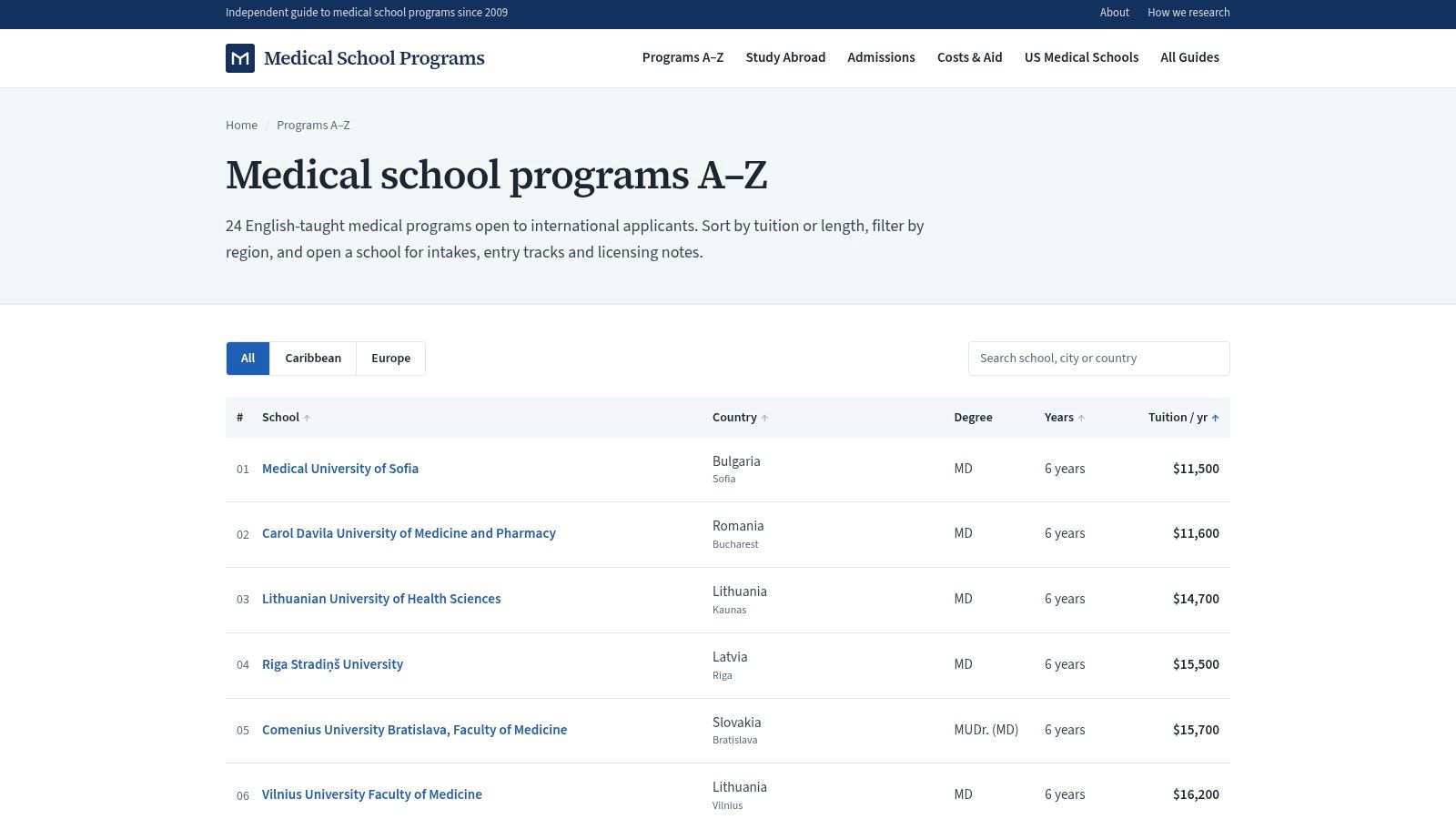
You don't need seven open tabs and seven different fee tables to make a first shortlist. Medical School Programs A-Z puts 24 programs across 16 countries in one alphabetized directory, so Cyprus sits beside comparable English taught degrees in Europe and the Caribbean rather than in isolation. That context changes the decision, because a six year European MD and a four year Caribbean MD imply different entry points, clinical models, and total living costs.
What you can compare in one place
Each listing gives you the facts you'll use to eliminate options quickly, including school location, degree title, program length, and annual tuition. Our directory checks those facts against official school sources and dates them, and schools cannot pay to change their listing. Related guidance on admissions, costs, and residency then helps you test whether a shortlisted degree fits where you want to practise, not just where you want to study.
- Centralized comparison: Bring 24 international programs into one directory instead of rebuilding the same spreadsheet from school sites.
- Consistent fields: Compare location, degree, duration, and annual tuition across Europe and the Caribbean.
- Linked decisions: Move from browsing to admissions requirements, total costs, and post graduation pathways without losing the thread.
Pros: A broad 16 country view, standardized comparison details, and connected admissions and residency guidance.
Cons: A directory is a starting point, not a licensing decision. Program details change, so you still need to confirm current fees and requirements with each school, and a listing alone doesn't establish that a degree meets residency or licensing rules in your target country.
Practical rule: Use the directory to cut 24 programs to three credible finalists, then spend your verification time only on those three.
2. University of Nicosia Medical School - 6-Year MD
If you're leaving secondary school and want a direct route, this is Cyprus's longest established private option. Cyprus's modern medical school sector began in 2011, when the University of Nicosia education pages record the country's first medical school, and by the mid 2020s the school reported more than 1,000 students from 90 countries. That's relevant because you're not joining an experimental cohort, although scale alone doesn't guarantee your clinical placements.
The University of Nicosia 6-Year MD is an English taught, undergraduate entry Doctor of Medicine in Nicosia. It includes early clinical exposure and Greek language lessons, a pairing you should take seriously. Lectures in English won't remove the need to communicate with patients during Cyprus based training.
Who this suits and what to check
Before you apply, read our guide to applying to medical school and then confirm current tuition, grade expectations, and English requirements directly with UNIC.
- Features: Six year MD, English instruction, early clinical exposure, Greek lessons during the program.
- Pros: Direct entry for school leavers, early patient facing preparation, published program and admissions information.
- Cons: Six years of tuition and living costs, Greek needed for clinical communication, and no automatic guarantee of licensing eligibility outside Cyprus.
Ask for the clinical placement model in writing, including when ward based training starts and which hospitals are guaranteed for your cohort.
3. University of Nicosia Medical School - Graduate-Entry MD
Already hold a university degree? Don't apply to a school leaver program and hope for advanced standing. UNIC runs a separate graduate entry MD for eligible degree holders, taught in English, with clinical training across healthcare settings and academic and career support described by the school.
The cost picture is clearer here than on many program pages. For the graduate entry MD, the University of Nicosia 5-year MD page states annual tuition is €25,000 and estimates minimum annual living costs in Nicosia at €12,000, figures the university published in 2025. Add insurance, travel, exams, and any overseas placement costs to that baseline before you compare it with a four year North American style program.
Accreditation also needs a precise reading. The University of Nicosia accreditation page explains that the graduate entry MD is accredited by CYQAA, whose recognition status with the World Federation for Medical Education means it's assessed against WFME standards. That's a quality assurance signal, not a promise that every regulator will license you.
Visit the graduate entry MD program page and weigh is studying medicine abroad worth it against your degree background.
- Pros: A real alternative for graduates, distinct from the six year route, with program specific admissions information.
- Cons: Not open on secondary school qualifications alone, and you must verify duration, placements, fees, and recognition for your target country.
4. European University Cyprus - School of Medicine
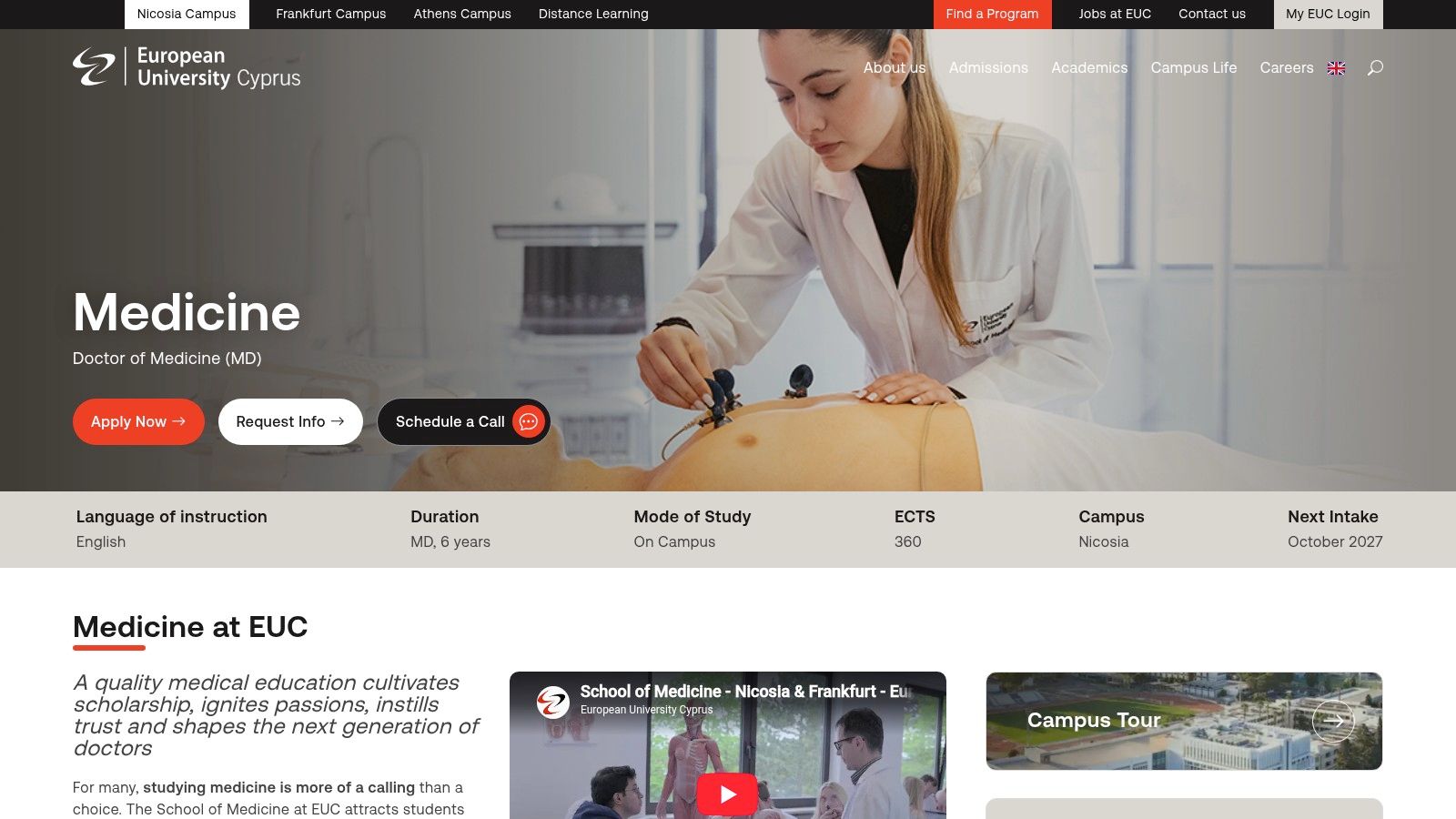
European University Cyprus sells breadth of clinical geography. You need to test whether that breadth is guaranteed training or optional mobility. The EUC Doctor of Medicine program is a six year, English taught MD requiring at least 360 ECTS, equivalent to approximately 5,500 hours of theoretical and practical education, with tuition reported at €23,000 per year for 60 ECTS. Over six years that's about €138,000 before accommodation, insurance, or any U.S. clinical training charges.
Clinical sites are the real differentiator
EUC introduces clinical relevance in year one and uses simulation and laboratory facilities alongside hospital training. The EUC Frankfurt medicine page describes training in public and private hospitals in Cyprus, Greece, Germany, and the United States, plus summer externships in 10 countries. Compare that model with other medical schools in Europe taught in English, but confirm which sites are core clerkships, which are electives, and who assesses you.
- Pros: Direct entry for school leavers, early clinical relevance, official program information.
- Cons: A long six year budget, placement availability to confirm, and separate licensing rules in your destination country.
5. University of Cyprus - School of Medicine
This entry sits apart from the two private Nicosia schools. The University of Cyprus is a public university, and its School of Medicine spans medical education, healthcare delivery, and research. For international applicants, the development that matters is a newly announced English taught undergraduate MD, with intake dates, fees, and clinical arrangements still to be confirmed by the university.
An announced program, an accredited program, and a program with mature clinical infrastructure are three different things. Get the status in writing.
The institution behind the announcement is established. In 2025, the University of Cyprus School of Medicine page reported a ranking position of 401 to 500 in its displayed ranking information. The school also runs English language postgraduate programs, though none of them replaces an undergraduate medical degree for an applicant who does not yet hold one. That distinction decides who this entry is for: if you need a first medical degree, only the new MD is relevant, and its admissions route remains the open question.
Check the University of Cyprus School of Medicine for official updates on rollout and admissions. Before budgeting anything, ask where clinical training will take place and who arranges placements, because a public medical school's hospital network typically differs from the private multisite model described elsewhere in this list.
- Features: Public university setting, newly announced English taught undergraduate MD, separate English language postgraduate programs.
- Pros: Adds a public option for English speaking applicants and a direct source for rollout details.
- Cons: Intake, accreditation of the new degree, tuition, and placements all require confirmation.
If your start date is fixed, this is a watchlist option rather than a firm application.
6. Eastern Mediterranean University - Faculty of Medicine
Location split is the whole story here. Eastern Mediterranean University offers a six year medical program taught in English jointly with Marmara University in Turkey. You spend the first three years at EMU in Northern Cyprus and the remaining three at Marmara, so you're choosing two campuses, two living situations, and a clinical phase in Turkey from day one.
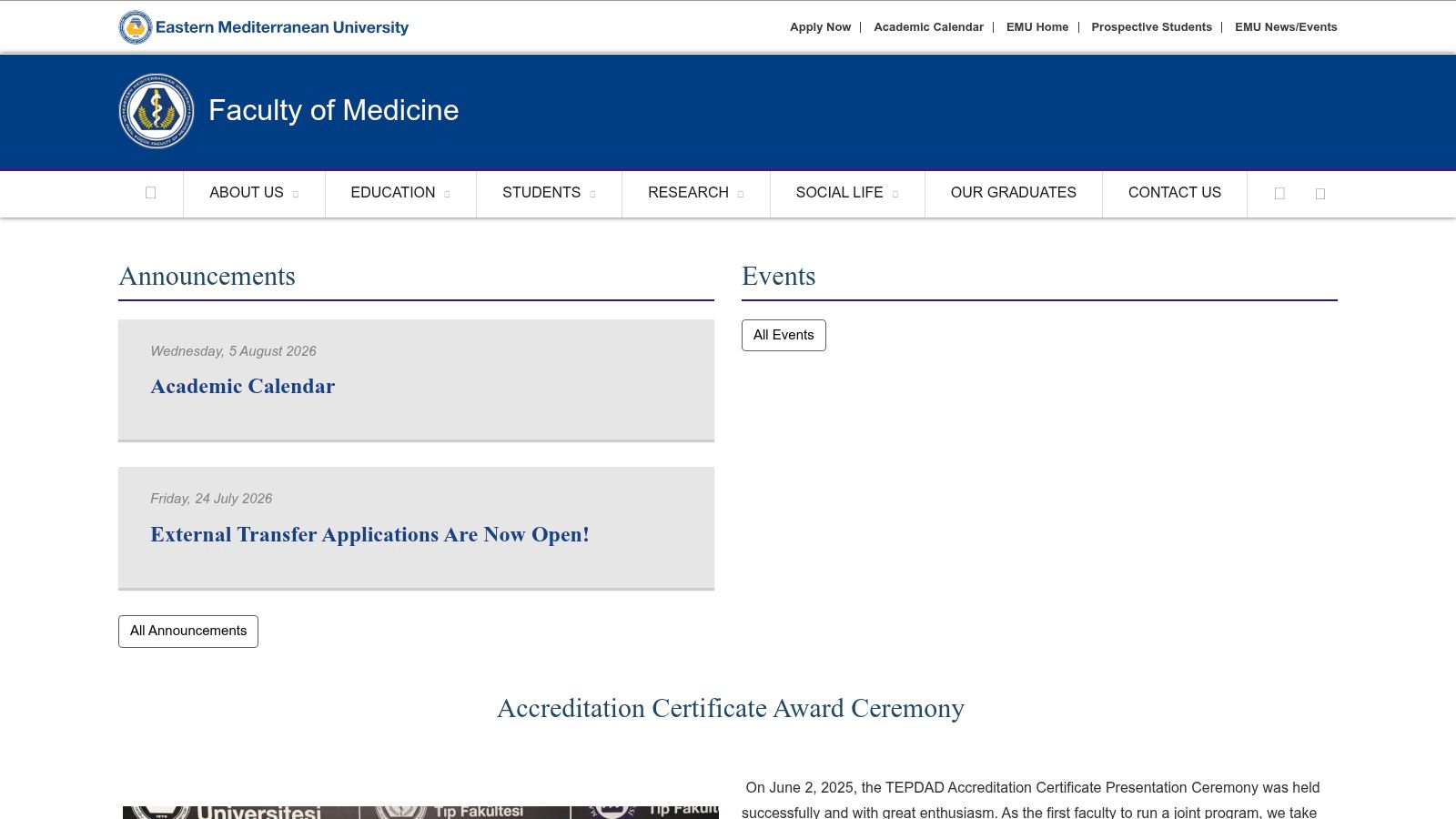
The program uses problem based learning and clinical skills development, with Turkish language study to support communication with patients during hospital training. English instruction therefore doesn't mean English only practice. If you won't commit to Turkish, your clinical years will suffer.
Review the Eastern Mediterranean University Faculty of Medicine for its description of the split and its accreditation information, then check recognition with the regulator in the country where you intend to practise.
- Pros: Study at a Turkish partner university, a clearly described three plus three structure, problem based learning.
- Cons: Mandatory relocation to Turkey, Turkish required for patient communication, and recognition implications that sit outside the Republic of Cyprus system.
Ask who awards the final qualification, how it's recorded, and whether your destination regulator accepts graduates from this exact joint pathway.
7. Near East University - Faculty of Medicine
Near East University in Northern Cyprus offers a six year medical degree with English language instruction options and admits international students. Don't evaluate it on curriculum length alone. The decisive issue is recognition.
The World Directory of Medical Schools states that the school is not recognized by the government of Cyprus while noting recognition by Turkish authorities. A directory listing describes that a school exists and operates. It isn't an endorsement and it doesn't guarantee licensing eligibility in the United States, the United Kingdom, the EU, or anywhere else.
What to verify before any deposit
Contact the Near East University Faculty of Medicine about curriculum and fees, but direct the recognition question to your intended regulator and get the answer in writing.
- Features: Six year curriculum, English language program options, international admissions, Northern Cyprus location.
- Pros: The World Directory describes the faculty as long running and operational, and English instruction is listed.
- Cons: The recognition caveat may affect practice outside the Turkish system, and a listing doesn't establish licensing eligibility.
If your plan depends on practising in the Republic of Cyprus or another jurisdiction that takes a different view of Northern Cyprus institutions, resolve that conflict before you enrol, not in your final year.
Medical schools in Cyprus at a glance
Five of the six programs below run about six years, so length alone does not separate them. The main differences sit in who each school admits, where the clinical years happen, and how much of the licensing risk falls on the student rather than the school.
| School | Entry route | Program | Language and location | What to verify before paying |
|---|---|---|---|---|
| University of Nicosia Medical School | Undergraduate entry after secondary school | 6-year MD | English-taught in Nicosia; includes Greek-language lessons | Current tuition, admissions requirements, and licensing eligibility |
| University of Nicosia Medical School | Graduate entry for applicants with a university degree | Graduate-entry MD | English-taught in Nicosia; includes clinical-training opportunities; annual tuition of €25,000 | Entry criteria, placement structure, and recognition in your target country |
| European University Cyprus School of Medicine | Undergraduate entry, including applicants with secondary-school qualifications | 6-year MD | English-taught in Nicosia; clinical training in public and private hospitals | Fees, placement details, and licensing and residency requirements |
| University of Cyprus School of Medicine | Undergraduate entry | Announced MD program | English-taught at the public University of Cyprus; its postgraduate programs are separate | Intake dates, accreditation status, entry requirements, tuition, and clinical arrangements |
| Eastern Mediterranean University and Marmara University | Joint program entry | 6-year joint degree, 3+3 structure | English-taught; first three years in Northern Cyprus, final three in Turkey; includes Turkish-language study | Recognition and licensing with the regulator where you intend to practise |
| Near East University Faculty of Medicine | International admissions | 6-year medical degree | English-language options in Northern Cyprus | Recognition and licensing, confirmed in writing by your intended regulator |
Two patterns stand out once the programs are laid out this way. The three Nicosia-based schools offer the most conventional route, an English-medium degree in the Republic of Cyprus with local clinical exposure, while the two Northern Cyprus options trade straightforward geography for a recognition question that only a regulator, not the school, can resolve. The University of Cyprus occupies a third category: a public-university brand that is attractive on paper, but whose announced status makes written confirmation of accreditation and intake dates the first step rather than a formality.
Choosing Between Cyprus Medical Schools Your Next Steps
Most of the undergraduate options above ask for about six years of your life, so treat verification as part of the application itself. Confirm tuition and every extra clinical fee, intake dates, language expectations for ward-based years, and accreditation status with each school in writing. Then check the licensing pathway with the regulator in your intended country of practice before you pay any deposit, because a school can be legitimate in Cyprus and still be the wrong vehicle for U.S., UK, or EU practice.
The choice splits by entry route, and each route carries a different verification burden. School leavers weigh several six-year degrees, including one joint program whose final three years run in Turkey. Graduates have a shorter route in Nicosia, while the public university's newly announced program has no published length yet, so its intake dates and accreditation status become the first items to confirm.
Capacity deserves the same scrutiny as rankings. A Politis report on how many medical schools Cyprus needs says Cyprus reportedly has four operating medical schools, that the national quality assurance agency warned existing clinical structures may not be sufficient for new ones, and that Frederick University's planned Limassol school is scheduled to launch in 2028 pending program accreditation. More schools mean more choice. They do not automatically create more supervised placements or patient volume.
Ask each finalist four specific questions before you commit. Where do core rotations happen, and are they guaranteed for your cohort? How many learners share each site, who assesses you, and are placements in Cyprus or abroad? Which language will patients expect, and what level must you reach? What extra charges apply to overseas clinical training, insurance, exams, and travel?
To shortlist efficiently, start with Medical School Programs A-Z, an independent editorial guide published since 2009 that lists 24 English-taught medical programs across Europe and the Caribbean, with program facts checked against official school sources and bodies such as the World Directory of Medical Schools, ECFMG, and national accreditation agencies. Its admissions and residency guides help you judge where each degree can take you after graduation.
Compare Cyprus finalists against the directory's wider European and Caribbean listings, check tuition, duration, and licensing notes side by side, and use the admissions and residency guides to test each route before you apply. Visit Medical School Programs to build a shortlist you can verify with schools and regulators before you pay a deposit.