
You may be comparing a U.S. MD program with an English-taught degree in Europe or the Caribbean, trying to decide whether your grades, test plans, and budget make one route more realistic than another. Don't start by sending applications everywhere. First check whether you're eligible, then build a calendar that keeps every route open only as long as it makes sense. If you're considering an international degree, also ask the harder question now: will it support the residency path you want after graduation?
Table of Contents
- Check Your Eligibility for Each Route
- How to Build Your Application Timeline
- How Your Numbers Compare to Accepted Students
- Plan Residency Outcomes, Not Just Admission
- How Many Schools to Apply To and Why
- Confirm Your Next Step Before You Apply
Check Your Eligibility for Each Route
| Route | Usual entry point | Degree length | Admission test | First check |
|---|---|---|---|---|
| US MD through AMCAS | Bachelor's degree with science prerequisites | 4 years | MCAT | School-specific course list |
| European English-taught MD | Usually after secondary school | 6 years | Set by each school | Recognition of the degree for licensing |
| Caribbean US-style MD | Usually a bachelor's degree | 4 years | MCAT | Affiliated clinical hospitals and their locations |
These routes aren't interchangeable. U.S. MD programs through AMCAS generally expect an undergraduate degree, required coursework, and an MCAT score. English-taught European programs are often six-year degrees entered after secondary school, while Caribbean programs generally follow a four-year U.S.-style structure with clinical rotations at affiliated hospitals, often in the United States.
Read the table against your own record
Start with each school's official course list. Don't assume that a general premedical checklist satisfies every program's rules: lab requirements, accepted course formats, and policies on online classes can differ. A biology graduate with a 3.4 GPA but no chemistry lab, for example, may have a missing prerequisite that delays an application cycle. Find that gap before spending weeks polishing a personal statement.
For a U.S. route, compare your GPA and MCAT with each school's published ranges, not just a national average. For European and Caribbean programs, check the stated academic entry requirements and how the degree fits your intended licensing pathway. You can use this medical-school prerequisites and MCAT guide to organize the questions you need to verify directly with schools.
Check documents and restrictions early
If you studied outside the country where you're applying, ask how the school evaluates foreign transcripts and whether it requires a formal credential evaluation. Confirm whether English-language testing is required for your background, and whether citizenship, residency, or visa rules affect eligibility. These are screening questions, not paperwork to leave until after you've chosen a school.
If you're considering UK-style medicine, put the application calendar at the top of your eligibility check. Medicine applications go through UCAS's early October deadline, not the standard January deadline. For the 2026 UCAS medicine cycle, 5,040 international applicants were recorded by the October deadline, including 4,120 applicants from outside the EU and 920 EU applicants, according to the UCAS 2026 medicine-cycle figures. More applications don't mean more places, so plan well before the deadline.
Finish by choosing the route that fits your current education stage, listing what's missing, and deciding what you can complete before the next cycle.
How to Build Your Application Timeline
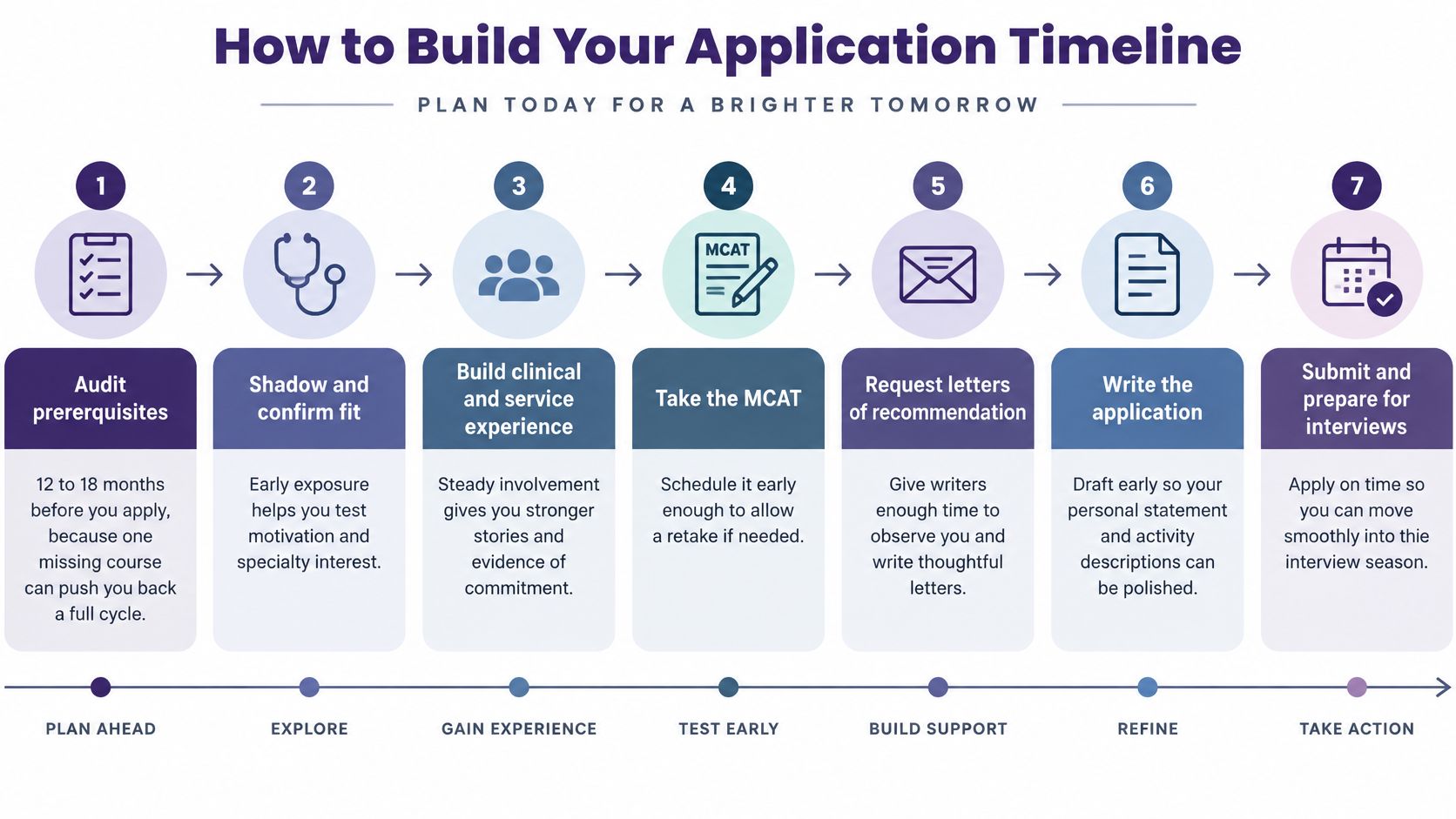
A strong application calendar starts with prerequisites and ends with a complete, confirmed file. The AAMC's application and acceptance protocols make clear that submitting the primary application isn't enough: transcripts, letters, fees, and secondary applications must also arrive by the relevant deadlines. Build your schedule around the last required item, not the first form you submit.
Audit prerequisites 12 to 18 months before applying. Compare each school's course requirements with your transcript and note missing labs or other requirements. A course you can't finish in time can push your application back a full cycle.
Request transcripts and start foreign credential evaluation. Contact every college or university you attended, including institutions where you took only a few courses. For a foreign degree, find out what evaluation is accepted early, since waiting for documents can hold up the rest of your file.
Choose evaluators before application season gets busy. Ask science faculty who know your academic work and someone who has supervised your clinical or service experience. Give each evaluator a concise activity list, the programs you're applying to, and the deadlines for submitting their letter.
Submit the primary application as early as the cycle allows. Early submission gives you room to identify and fix an error in coursework, activities, or contact information. Check your application carefully before sending it; a rushed submission can create avoidable follow-up.
Return each secondary application within its published window. A submitted primary application doesn't make your file complete at an individual school. Track every school's questions and deadline separately, then leave time to tailor your answers instead of sending generic essays.
Manage the details in one spreadsheet. Use columns for the school, required materials, due date, payment, submission date, and confirmation number. Check the sheet regularly so a missing transcript or unpaid fee doesn't stop your application from moving forward.
Prepare for interviews while secondaries are pending. Review your personal statement and activities so you can explain your choices consistently and give specific examples. Practise answering questions aloud, especially about why you want medicine and how your experiences prepared you.
Practical rule: A file isn't ready because you pressed submit. It's ready when each school has the documents and materials it requires.
Use national figures to understand the competition, not to set personal cutoffs. In the AAMC's 2025 applicant pool, the mean GPA was 3.67 for applicants and 3.81 for matriculants, while the mean MCAT was 506.3 and 512.1, respectively, according to the AAMC's application-protocol guidance. Those figures describe cohorts; they don't replace school-specific ranges or a full review of your experiences and writing.
At submission, aim to have every transcript received, each letter confirmed, secondary applications scheduled, and a buffer of at least two weeks before your earliest deadline. If any of those pieces is still uncertain, treat it as unfinished.
How Your Numbers Compare to Accepted Students
| Metric | All applicants | Matriculants |
|---|---|---|
| Number of people | 54,699 | 23,440 |
| Mean GPA | 3.67 | 3.81 |
| Mean MCAT score | 506.3 | 512.1 |
| Share of women | 57.2% | 55.0% |
| Share of first-time applicants | 76.5% | Not reported |
| Non-U.S. residents | 1,390 | 105 |
The AAMC's report on U.S. medical-school enrollment says 54,699 people applied to U.S. MD-granting schools in the 2025–2026 cycle, and 23,440 matriculated. Don't call the resulting comparison an acceptance rate. Applicants can apply to multiple schools, and some people who are accepted don't enroll, so the number of matriculants isn't a direct measure of each applicant's chance of admission.
Compare your record without treating averages as cutoffs
Put your GPA and MCAT beside both columns, then check each school's own published ranges. A file near the matriculant averages may be competitive at some schools, but those averages don't guarantee an interview. If your numbers are well below them, strengthen the rest of your application with a clear academic explanation where needed, a credible upward trend, and schools whose missions fit your experiences.
The applicant mean and matriculant mean are useful comparison points, not pass-or-fail lines. An admissions committee reviews your coursework and testing alongside your activities, writing, recommendations, and fit with the program. Averages can show where to investigate; they can't tell you whether a particular school will value your full application.
Make the reapplication story concrete
First-time applicants made up 76.5% of the pool, according to the AAMC report. If you're reapplying, don't apologize for being a reapplicant or resubmit the same file unchanged. State what changed: stronger academic preparation, more meaningful clinical exposure, clearer writing, or a more realistic school list.
International applicants need an especially careful list. The report records 1,390 applicants whose legal residence was outside the United States and 105 matriculants. Before paying application fees, verify that each school accepts applicants with your status and check what documents it requires. This guide to international applicants and medical-school admissions can help you frame those checks. Choose schools using their own criteria and your full profile, not one national average.
Plan Residency Outcomes, Not Just Admission
An international medical degree can lead to a U.S. residency application, but getting into medical school doesn't guarantee a smooth route into residency. In the 2025 NRMP Main Residency Match, active U.S.-citizen international medical graduates had a 67.8% PGY-1 match rate, and international medical graduates represented 6.0% of matched applicants, according to the NRMP's 2025 Match results. Those are cohort figures, not promises. Specialty, citizenship, graduation year, exams, and application quality all matter.

Before paying a deposit, work through these checks in order:
- Get the recognition answer in writing. Confirm that the school is recognized for the specific licensing route you intend to pursue.
- Ask for graduate outcomes by specialty. Review examination and certification results, clinical-rotation locations, and residency outcomes. An institution-wide headline rate can hide differences among specialties.
- Request recent school-specific match information. Compare what the school reports with national match information, and ask how it defines and measures its outcomes.
- Verify current requirements directly. Check with ECFMG, NRMP, and relevant licensing bodies rather than relying on a recruiter or an old brochure.
- Map the years after graduation. Include licensing exams, U.S. clinical experience, recommendations, application timing, and possible visa or screening requirements.
The mistake is to treat “English-taught” as shorthand for “portable.” A program may offer instruction in English while still leaving graduates with additional certification, visa, screening, and competitiveness hurdles. Our program data comes from official school websites and authoritative bodies such as the World Directory of Medical Schools, ECFMG, NRMP, and national accreditation agencies. We date program facts and update them when a school changes its fees or requirements, but you should still confirm the current licensing rules before committing.
For a closer look at match routes and barriers, use this guide to residency matching for international medical graduates. Then keep the written recognition statement and the date you received it with your admissions records.
This overview can help you frame questions about match outcomes and licensing:
How Many Schools to Apply To and Why
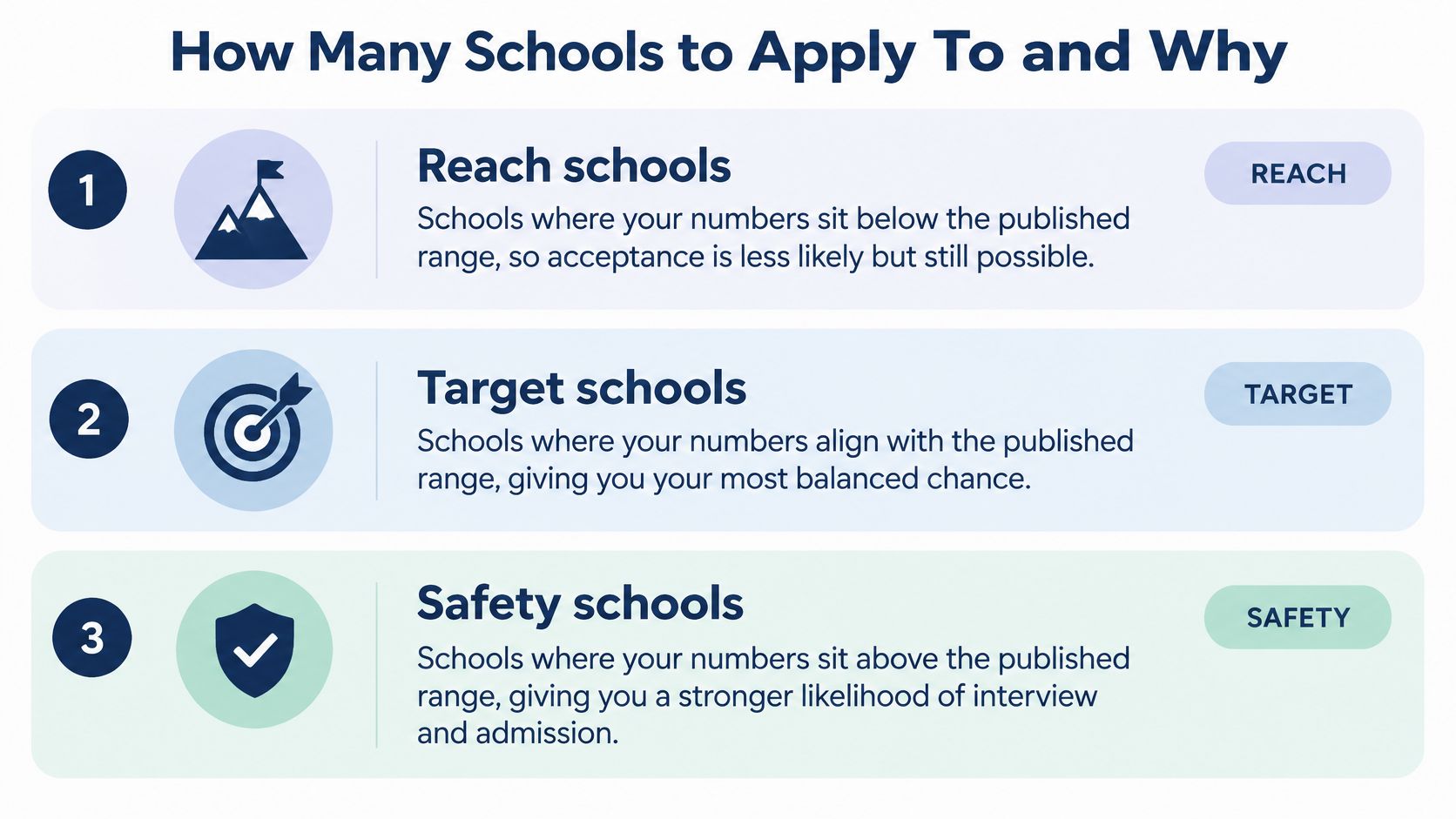
Don't choose a school count first and then fill the list at random. Build a balanced list from each program's published ranges, mission, and eligibility rules. In the latest U.S. cycle described by the AAMC, 54,699 applicants submitted 1,066,896 applications, an average of 19.5 school designations per applicant, according to its medical-school class statistics. That average describes what applicants did; it isn't a target you should copy.
Sort schools into three groups:
- Reach schools: Your numbers fall below the school's published range, so an interview is less likely, though your broader profile may still make the program worth considering.
- Target schools: Your numbers sit within the published range, making these the core of a balanced list.
- Mission-fit schools: The school's location, service priorities, or language and applicant policies align with your background and goals.
Make every school earn its place
For example, a candidate with a 3.5 GPA, a 508 MCAT, and a rural clinic background might start with four reach schools, eight targets, and four mission-fit options. Those counts are a planning example, not an admissions formula. The candidate should check each school's own ranges, whether the rural experience connects to its priorities, and whether each program accepts applicants with the candidate's citizenship or residency status.
A broad list can add opportunities, but weak-fit applications consume money and attention. Every secondary application brings another fee and another set of essays to research and write. If you can't explain why a school's mission or training environment fits your goals, remove it rather than submitting a generic response.
Before adding another school, ask whether it adds a realistic option for your profile, geography, and budget, or just another set of fees and essays.
Reapplicants should change the list as deliberately as they change the application. Add programs that value experience you've gained since the last cycle; remove schools that rejected the same profile if you have no new reason to think the fit has changed. Don't confuse a large list with a strong strategy. If you can't name one specific reason you want a school, it doesn't belong on your list.
Confirm Your Next Step Before You Apply
This week, choose three schools whose published GPA and MCAT ranges are plausible for your record. Open each official admissions page and write down its prerequisites, deadlines, English-language rules, and policies for international applicants. Then email each admissions office one specific question about whether the degree supports your intended residency and licensing pathway, and save the reply with its date.
Put every deadline in one calendar, starting with the earliest. Use a directory to compare program length, tuition, and licensing notes side by side, but confirm the details with the school because requirements can change. Our admissions guide covers eligibility, transcripts, the MCAT, English tests, visas, funding, and schools that accept international students; our careers guide covers residency match rates, screening filters, salaries, alternative pathways, and how to judge a school for international medical graduates.
Resolve residency recognition before you pay a deposit.
Medical School Programs helps you compare English-taught medical degrees in Europe and the Caribbean alongside admissions and residency guidance. Use Medical School Programs to narrow your options, then verify the school's current requirements and residency pathway before you apply.