
Studying medicine abroad is worth it only when the degree leads to a licence and residency in the country where you plan to practise, and the 2025 residency results show the US route working for some groups at 67.8% and 58.0%, not for everyone. Those two percentages reframe the question. Tuition is visible on day one. Eligibility, exams, and a training post decide whether you ever earn as a doctor. Judge every programme by the probability-weighted total cost of reaching independent practice, including a second application cycle if the first fails.
Table of Contents
- Who Studying Medicine Abroad Actually Pays Off For
- Real Advantages of Studying Medicine Abroad
- What the Degree Costs Beyond Tuition
- US Licensing and Residency Hurdles That Decide the Outcome
- Destination Bottlenecks After the Medical Degree
- Verify Each Programme and Decide Before Paying
Who Studying Medicine Abroad Actually Pays Off For
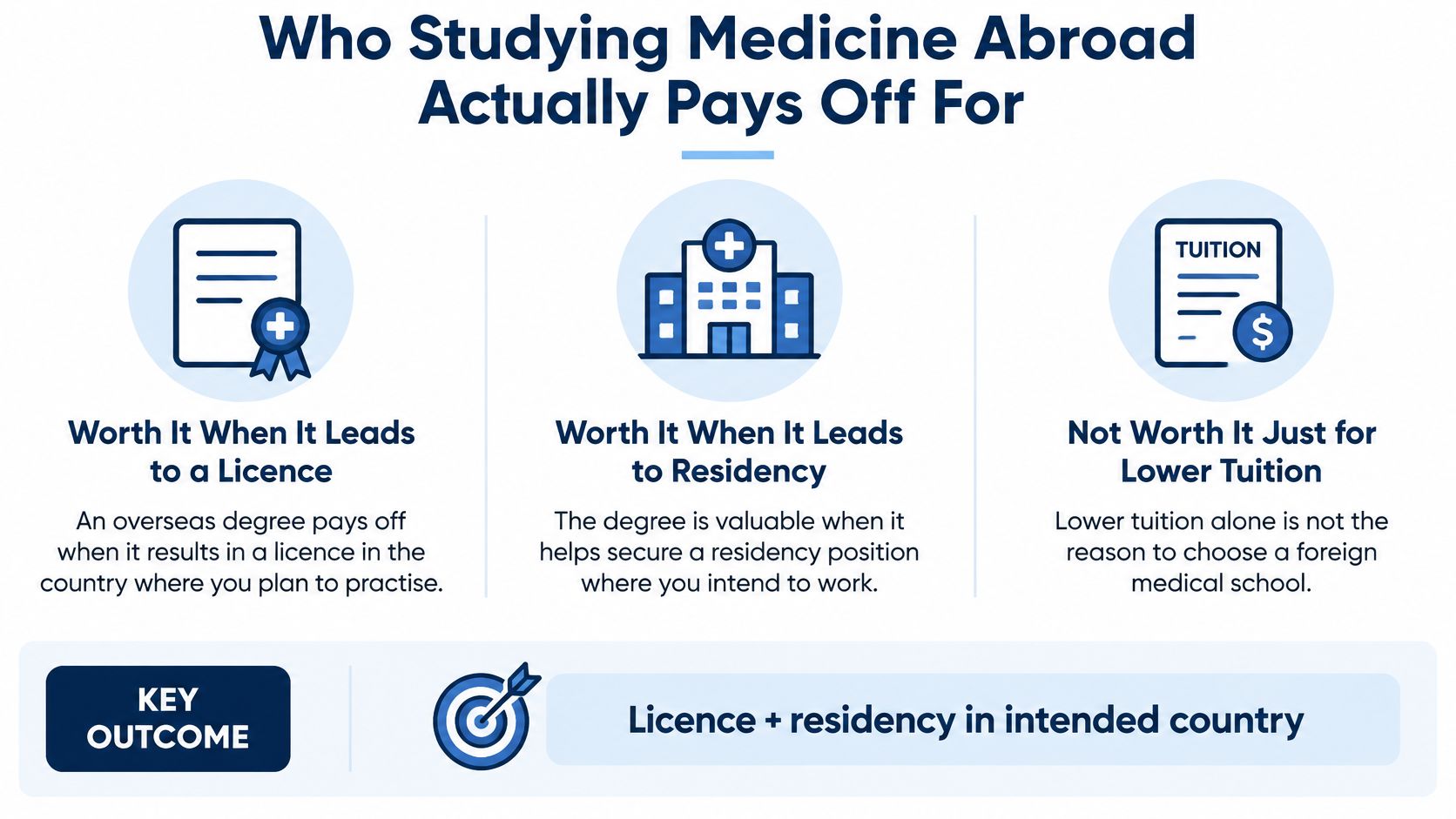
An overseas medical degree is worth it when it leads to a licence and a residency in the country where you intend to practise, not because tuition is lower.
Verdict by Career Goal
| Your goal | Likely verdict | Condition that decides it |
|---|---|---|
| US primary care or internal medicine | Usually worth it if eligibility is confirmed | ECFMG certification, strong USMLE results and US clinical experience |
| Narrow, highly competitive US specialty | Risky and hard to predict | Exceptional exam scores, research and several contiguous ranks in the preferred specialty |
| Practice in a home country that recognises the degree | Worth it if recognition is confirmed in writing | Written confirmation from the national licensing body before enrolment |
| Practice in a destination country with few residency places | Often poor value | Access to local residency posts and clear priority rules for non-citizens |
The National Resident Matching Program 2025 Main Residency Match results reported that among 4,587 active U.S.-citizen IMGs, the PGY-1 match rate was 67.8%. Non-U.S.-citizen IMGs had a 58.0% match rate among 11,465 active applicants, and 9,761 IMGs secured first-year positions overall.
Those averages describe groups, not your individual odds. Citizenship category, exam performance, clinical experience, and specialty choice move an applicant well above or below them. That's why is studying medicine abroad worth it has no universal answer.
Today the site focuses on the question of where applicants can study medicine and what each path really involves. Start with one question before any tuition comparison. Which country will issue your licence, and does this degree qualify for it?
Real Advantages of Studying Medicine Abroad
The strongest advantage is entry access, but only when the school you can enter connects to the licence you want. Many English-taught European programmes admit students straight from secondary school, so you can start medical training without completing a separate undergraduate degree first. That saves years. It doesn't save you if the curriculum leaves you underprepared for the licensing exams you'll face later.
Language of instruction is a real, narrower benefit. English-taught lectures and exams remove an immediate barrier if you don't speak the host country's language. Clinical training is different. You'll take histories, explain risks, and document care with local patients and teams, so ask what clinical language level the hospitals expect and when you'll need it. A programme that's accessible in year one can become difficult in year four if language support stops at the classroom door.
Clinical Exposure and Seat Availability
Some programmes offer clinical exposure you couldn't easily get at home. Caribbean schools with rotations at affiliated US hospitals can give you experience in a US-style system, with US faculty references and familiarity with how teams present patients and document care. European hospital placements can show you a different funding model, referral pattern, and scope of primary care. The condition is relevance. Rotations help most when they produce supervised experience, assessments, and references that residency directors in your target country recognise.
Seat availability also matters. If home-country competition would shut you out of medicine entirely, an accredited seat abroad keeps the career possible. That isn't a guarantee of a good outcome. It's an option whose value depends on what happens after admission.
Training across health systems can build adaptability. You'll see different guidelines, drug availability, and expectations for patient autonomy, and you'll learn to work where resources and referral routes differ. Employers value that flexibility, but they still hire licensed doctors with completed residency training first.
Think of the degree as a bridge. Its near end is admission. Its far end has to land on licensing eligibility and a residency post. If the far end doesn't connect, earlier entry, English instruction, and extra seats are conveniences, not a career. The advantage that matters most is simple. You can convert the degree into permission to train and practise where you plan to live.
What the Degree Costs Beyond Tuition
A lower tuition bill can still lead to a higher cost of reaching independent practice. For an international graduate, the relevant comparison includes exams, clinical experience, applications, interview travel, and the cost of an additional residency cycle if the first application does not succeed.
Costs Beyond Tuition for a US-Bound Applicant
| Cost item | Typical amount | When it applies |
|---|---|---|
| USMLE Step 2 CK fee | $1,020 | US-bound applicants sitting the exam |
| Sub-internships or observerships | More than $10,000 | Competitive US surgical pathway, per a 2025 analysis |
| Interview expenses | About $400 to $7,000 per applicant, median near $3,000 | Each application season; varies with the number of interviews |
| Total application-related costs | Above $15,000 | Competitive surgical pathway, excluding tuition and living costs |
| Tuition and living costs | Varies by school; compare annual tuition and estimate living costs for the full programme | Full programme length; check the school's current fee schedule |
The 2025 analysis of costs in a highly competitive US surgical pathway estimated total application-related costs above $15,000. It included a $1,020 USMLE Step 2 CK fee and more than $10,000 for sub-internships or observerships. Interview expenses ranged from about $400 to $7,000 per applicant, with a reported median near $3,000.
The total depends on the route and the outcome. Applying broadly can add programme fees and interview travel; an observership may also mean travel, housing, insurance, and unpaid time away from work. A repeat exam brings another fee. If you need another residency application cycle, budget for renewed application costs and living expenses during the delay, as well as any additional clinical experience you pursue.
Consider two schools. School A costs less over the full programme, while School B costs more but includes structured US rotations and exam preparation in the timetable. If School A's lower tuition leads to substantial spending on observerships, exam attempts, and another application cycle, its initial saving may not make it the lower-cost route to practice. The comparison is probability-weighted: estimate the costs under both a successful first application and a delayed outcome, then account for how likely each path is for you.
Use current figures rather than an old admissions brochure. Tuition is shown in the school's own currency where available, with an approximate US-dollar figure for comparison. The guide to international medical school costs covers tuition, living costs, and additional fees to include in your budget.
Worst-case budget formula: full-programme tuition and living costs, plus examinations and applications, plus one additional residency cycle.
If that scenario would require crisis borrowing, the programme may be unaffordable even when its headline tuition appears low.
US Licensing and Residency Hurdles That Decide the Outcome
The US system rewards eligible, well-prepared applicants in specialties where international medical graduates, or IMGs, already train in large numbers. It is much less forgiving if your specialty goal is narrow.
This image captures the point in the process where programme choice becomes a residency outcome.

US Match Benchmarks 2025
| Applicant group | Match rate | Context |
|---|---|---|
| US-citizen IMGs | 67.8% | 4,587 active applicants, up 0.8 points from 2024 |
| Non-US-citizen IMGs | 58.0% | 11,465 active applicants, despite a 14.4% rise in participation |
| US MD seniors | 94% | Domestic comparison group |
| US DO seniors | 93% | Domestic comparison group |
The NRMP 2025 Main Match Results and Data report states that programs offered 43,237 positions, including 40,041 PGY-1 positions, which were 1,734 and 1,547 more than in 2024, respectively. More capacity helps at the margin. It doesn't erase the gap between IMG applicants and US MD or DO seniors, because programmes still screen on exams, clinical experience, references, and visa needs.
Specialty concentration is the clearest warning. In 2025, 65.9% of matched U.S.-citizen IMGs obtained positions in Internal Medicine, Family Medicine, or related high-IMG specialties, according to the same report. IMGs are a substantial part of internal medicine training. They're far less represented in dermatology, orthopedic surgery, and plastic surgery, where US graduates with home-school mentors, research networks, and audition rotations compete for few places.
That pattern leads to a conclusion many applicants miss. A school can have respectable overall match numbers because its graduates aim at internal medicine and family medicine. Those numbers tell you little if you will accept only one competitive surgical specialty in one city. Ask for outcomes by citizenship and specialty, and compare them with your actual goal.
The NRMP Charting Outcomes analysis for international medical graduates evaluates competitiveness using USMLE Step 2 CK performance, the number of contiguous ranks in the preferred specialty, specialty breadth, research, work and volunteer experience. Contiguous ranks matter because they show how many programmes in your preferred specialty interviewed and ranked you consecutively. A long rank list in one specialty usually reflects a stronger application to that specialty than scattered interviews.
This video adds context on how the residency application and matching process works in practice.
Follow the cause-effect chain before you enrol. Weak basic-science teaching can lower exam performance. Limited US clinical experience can mean fewer US references. Fewer interviews can mean fewer contiguous ranks. Then a lower-cost degree produces a weaker residency application. You control part of this through preparation and specialty strategy. You can't control how many places exist or whether a programme sponsors your visa.
Use our guide to residency matching for international medical graduates to map the process, then run three checks. Confirm your school supports ECFMG certification eligibility. Compare outcomes by citizenship and specialty. Decide whether you'd still enrol if your realistic options were primary care, internal medicine, or another high-IMG field.
Destination Bottlenecks After the Medical Degree
A country can welcome your tuition and still offer you almost no route into local specialty training.
The group in this photo represents the stage applicants often plan too late, the move from graduation into supervised training.
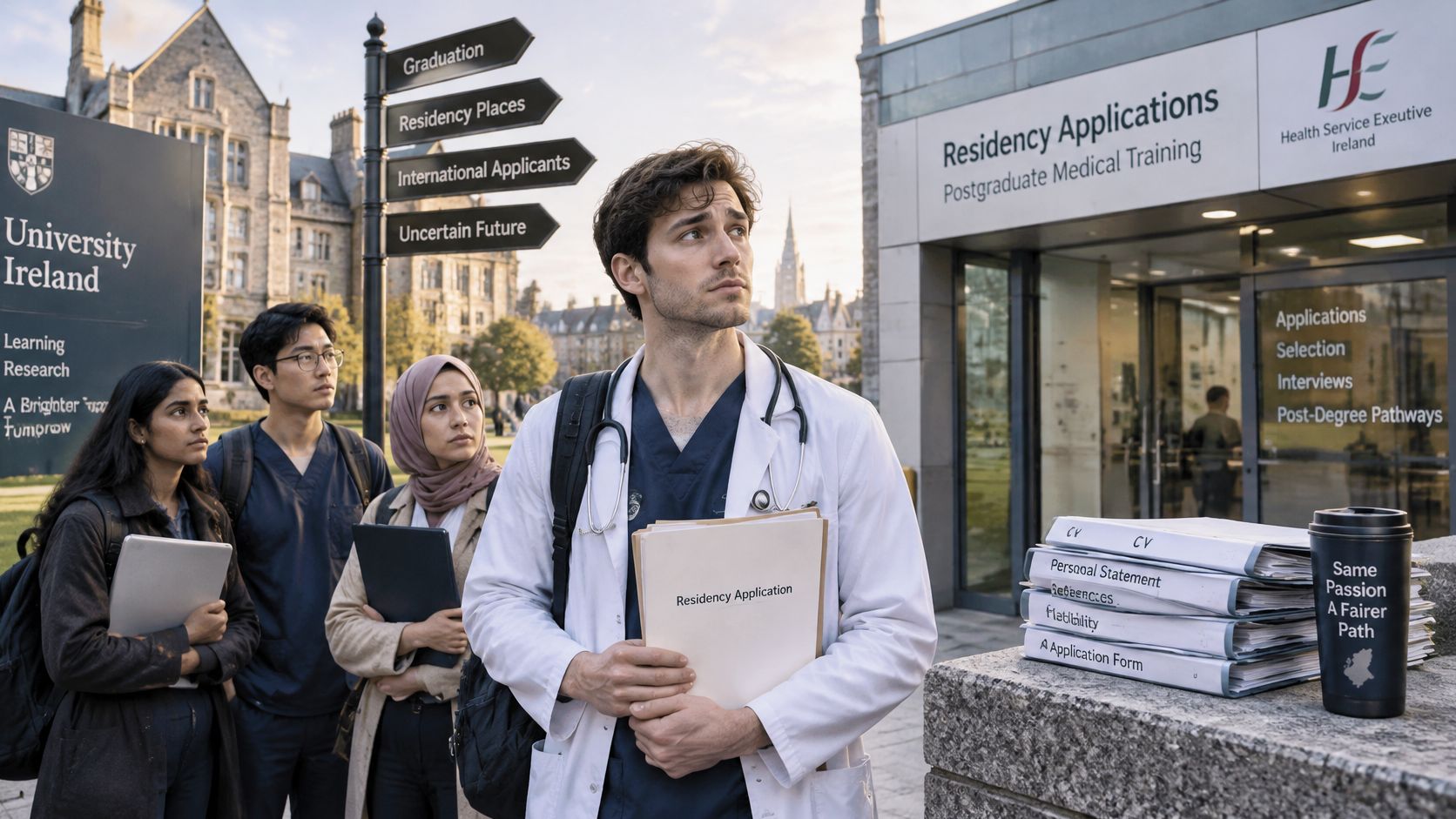
The OECD International Migration Outlook 2025 chapter on health professionals uses Ireland to illustrate the problem, noting that foreign students help expand medical-school capacity, but limited residency posts and preference for Irish/EU citizens mean many leave after the medical degree rather than enter local specialty training. It also notes that countries may recruit international students without creating enough postgraduate places or long-term career incentives to retain them.
That's the contrarian point. Studying abroad can increase educational access while reducing your local postgraduate opportunity. The host country gains students and fees. You may gain a degree and then have to start again in a second country's licensing system, with new exams, documents, and deadlines.
Destination Pathway Map
Complete this map before you accept a seat outside the US route.
- Degree recognition: Will the licensing body in your target country accept this exact degree from this exact school?
- Licensing exams: Which exams, in which language, and at what stage?
- Visa status: Does your status allow internship and residency, not just study?
- Clinical language: What level do hospitals require for patient-facing training?
- Internship eligibility: Are non-citizens eligible for the required first postgraduate post?
- Residency priority: Do citizens or regional applicants get ranked ahead of you, and by what rule?
Post-study rules also diverge. Some governments streamline work routes for health graduates. Others tighten student visas, dependant rules, or access to public training posts. A pathway that worked for an earlier cohort can narrow before you graduate.
Our analysis of how international medical graduates fare in finding employment is useful background, but ask the worst-case question yourself. If your first residency cycle fails, can you legally remain for clinical training, work, and a second attempt? If the answer is no, price in relocation to another system.
Verify Each Programme and Decide Before Paying
A figure is only as reliable as its source and its date. Medical School Programs does not publish figures it cannot verify. Program data comes from schools' official websites and authoritative bodies such as the World Directory of Medical Schools, ECFMG, NRMP and national accreditation agencies. Apply the same standard to every claim a school or agent makes to you.
Pre-Enrolment Verification Checklist
| Check | What to confirm | Where to verify |
|---|---|---|
| Licensing eligibility | Degree is accepted by the licensing body of your target country | Licensing authority and the school's official website |
| US certification | Eligibility for ECFMG certification | ECFMG published requirements |
| Residency outcomes | Match results by citizenship and specialty, not overall graduation rate | NRMP match data |
| Accreditation | Recognition by the national accreditation agency | Agency register and the World Directory of Medical Schools |
| Tuition and fees | Dated fee schedule in local currency with a US-dollar approximation | School's official fee page |
| Visa and post-study rules | Route that allows clinical training after graduation | Destination immigration authority |
Start with licensing eligibility, because it can invalidate everything else. Email the licensing body with the school name, degree title, campus, and expected graduation year. Ask whether graduates from that programme can enter its licensing process. Save the reply. A school saying its degree is "recognised worldwide" isn't evidence. Recognition is granted by specific authorities for specific purposes, and it can differ for internship, residency, and full registration.
For a US plan, check ECFMG certification next. Confirm the school's status against published requirements and ask how the school verifies credentials, supports exam applications, and handles clinical rotation documentation. If the admissions office can't explain the process clearly, treat that as useful information. You'll need precise paperwork for years, and weak administration becomes your problem at graduation.
Then examine residency outcomes at the right level. Don't accept an overall graduation rate as a career outcome. Graduation means students completed the course. It doesn't mean they passed licensing exams, matched, or entered your specialty. Ask for recent match results split by citizenship and specialty. Ask how many graduates entered the match, not only how many matched. A high percentage from a tiny, selected group can mislead you.
Three Red Flags
- No dated fee schedule: You can't build a worst-case budget from an undated estimate or a single first-year figure. Ask for tuition by year, mandatory fees, exam charges, clinical placement fees, refund terms, and the currency you'll pay.
- No written licensing answer: Verbal reassurance won't help when a regulator asks for documents. If neither the school nor the authority will confirm eligibility in writing, pause the application.
- Outcomes without denominators: Testimonials and celebration posts show that someone succeeded. They don't show your odds. You need cohort size, match participation, specialty, and citizenship breaks.
Don't pay a deposit to resolve uncertainty. Resolve uncertainty, then decide whether the deposit is justified.
Decision Path
- Name the practice country: Write down where you want to hold your licence and complete residency. If you have two target countries, run the checklist twice.
- Confirm eligibility in writing: Get answers from the licensing body and, for the US, confirm the ECFMG route. Keep names, dates, and reference numbers.
- Set a realistic specialty range: List your preferred specialty and two acceptable alternatives where IMGs commonly train. If you have no acceptable alternative, your risk is higher.
- Build the worst-case budget: Include full tuition and living costs, exams, credential checks, rotations or observerships, applications, interviews, and one extra residency cycle.
- Check the training visa: Confirm you can stay for internship or residency, not only for the degree. Check what happens during a gap year.
- Compare like with like: Put two or three programmes through the same six checks. Score evidence, not marketing. Note where a school refuses to provide data.
- Make the go or no-go call: Proceed only if eligibility is confirmed in writing, the specialty plan is realistic, and the worst-case cost is affordable. Otherwise choose a home-country route or a different destination.
If steps two and five fail, tuition savings don't matter. You'd be funding a degree that doesn't lead to supervised practice in your chosen country. If step four fails, you may graduate and then stall because you can't afford exams, US clinical experience, or a second cycle. Both failures are predictable before enrolment, which is why this decision belongs at the start.
Use the programme directory to compare tuition, length, and licensing notes side by side. Use the admissions guidance for documents, English tests, MCAT questions where they apply, and visa preparation. The careers guide covers residency match rates, screening filters, salaries, alternative pathways and how to judge a school for international medical graduates. Together, those resources let you test whether is studying medicine abroad worth it for your specific licence, specialty, and budget rather than for an average student.
Do one concrete thing this week. Request written eligibility confirmation from both the school and the licensing body for your target country. Don't send tuition until you have it. That single reply can protect years of work and a very large amount of money.
Visit Medical School Programs to compare English-taught medical programmes by tuition, length, location, and licensing notes from official sources. Use the directory and guides to test your target licence, residency route, and worst-case budget before you apply.