
You're finishing high school abroad, and a European medical degree looks affordable until you start adding the costs around it. The tuition figure doesn't tell you what you'll spend on entrance exams, document translations, language preparation, visa paperwork, or the payment required before the university issues enrollment documents.
The European programs in our directory are six-year medical degrees taught in English, usually entered straight from high school. That's a different starting point from a graduate-entry pathway. But English instruction doesn't mean you can complete patient-facing training without learning the local language, and admission doesn't guarantee that you'll qualify for residency wherever you want to work.
When comparing medical schools in Europe taught in English, focus on what you must do to enroll and progress: pass the right exam, meet clinical-language requirements, make the upfront payments, and document your training for a future licensing authority.
The seven entries below aren't a prestige ranking. The first is the directory used to compare and cross-check the other six against their official pages. Each university then presents a different decision, from preparing for biomedical English to budgeting in another currency. Where a current fee or admissions detail needs confirmation, treat that as a task to complete before paying, not a detail to resolve after arrival.
Table of Contents
- 1. Medical School Programs
- 2. Semmelweis University, Budapest, Hungary
- 3. University of Debrecen, Debrecen, Hungary
- 4. University of Pécs, Pécs, Hungary
- 5. University of Szeged, Szeged, Hungary
- 6. Medical University of Warsaw, Warsaw, Poland
- 7. Masaryk University, Brno, Czech Republic
- How the seven English-taught programs compare on length, tuition and admissions
- Verify Three Details Before You Commit to Any Program
1. Medical School Programs
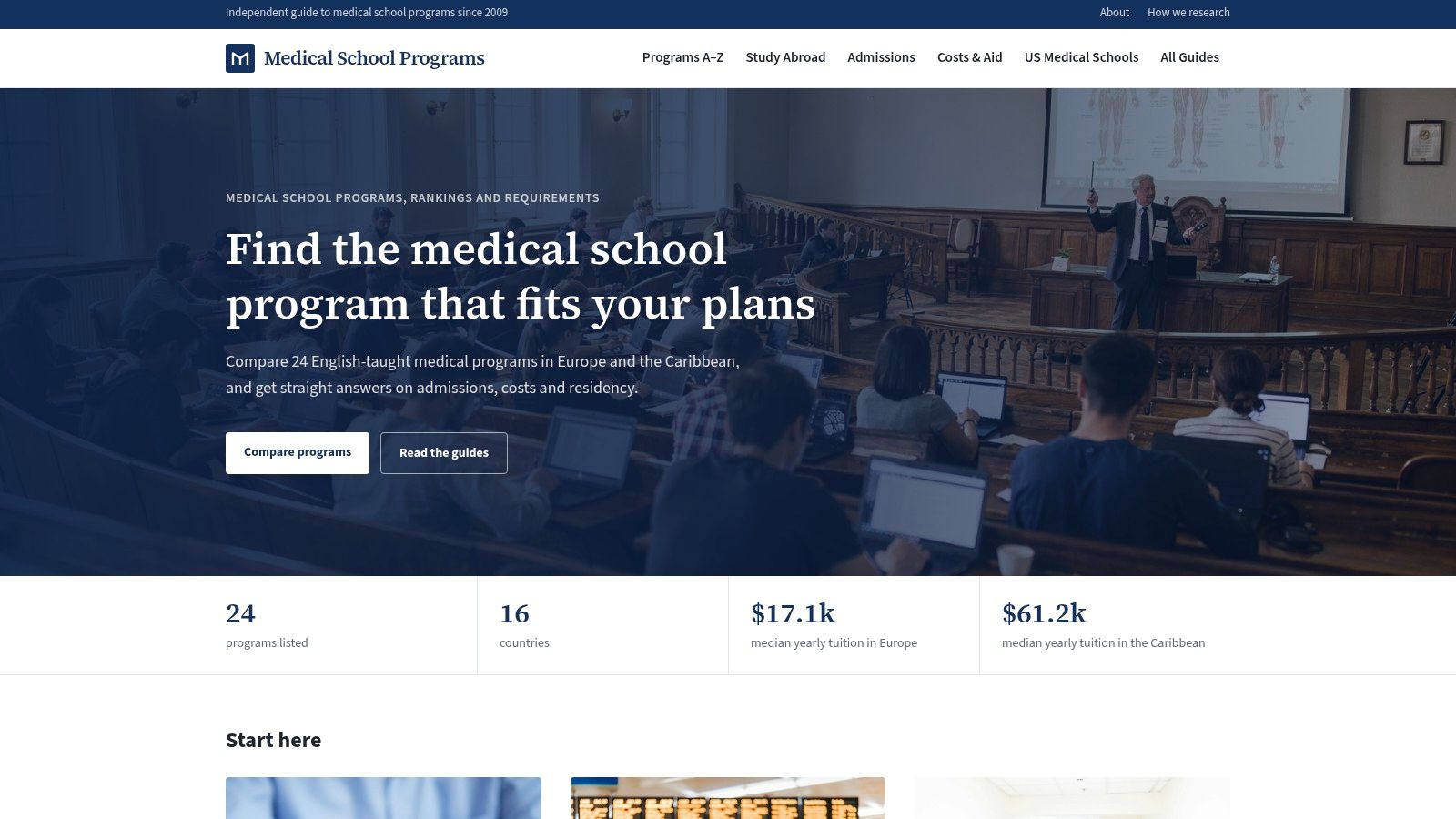
Start with a comparison tool, not an application payment. Medical School Programs is our independent editorial guide, not a medical school, recruitment agency, or placement service. We've covered medical education pathways since 2009, and schools can't pay to change their listing.
Our sortable directory brings together 24 English-taught programs across 16 countries, showing location, degree, duration, annual tuition, and licensing notes. Alongside it, our guides address admissions documents, exams, English tests, visas, living expenses, funding, and international-graduate career pathways. That makes it useful for building a shortlist before you start navigating separate university portals.
The distinction between European and Caribbean pathways matters. A school-leaver comparing those destinations should examine entry qualifications and clinical arrangements, rather than treating every English-language MD as the same product.
Use the directory to narrow choices, then verify
We check program facts against official school pages, date them, and update them when institutions change requirements or fees. The university's current offer and payment terms still control your application. A directory entry isn't an admission decision or a promise of licensing eligibility.
Use a spreadsheet alongside your shortlist:
- Entry route: Record required school subjects, entrance tests, interviews, and any preparation course.
- Cash before arrival: Separate application charges, deposits, tuition installments, and visa-related payments.
- Clinical language: Record the language you'll need with patients and how the university assesses it.
- Career destination: Identify the regulator whose requirements you must satisfy after graduation.
The limitation is coverage: a selected directory isn't an exhaustive register of every European medical faculty. It also can't determine whether your particular school certificate, citizenship, or previous study meets a university's rules.
Practical rule: Use a directory to compare possibilities. Use the university's written response to decide whether to pay.
This approach keeps attractive tuition figures from dominating a decision that also depends on exam readiness, payment timing, and your willingness to learn another language.
2. Semmelweis University, Budapest, Hungary
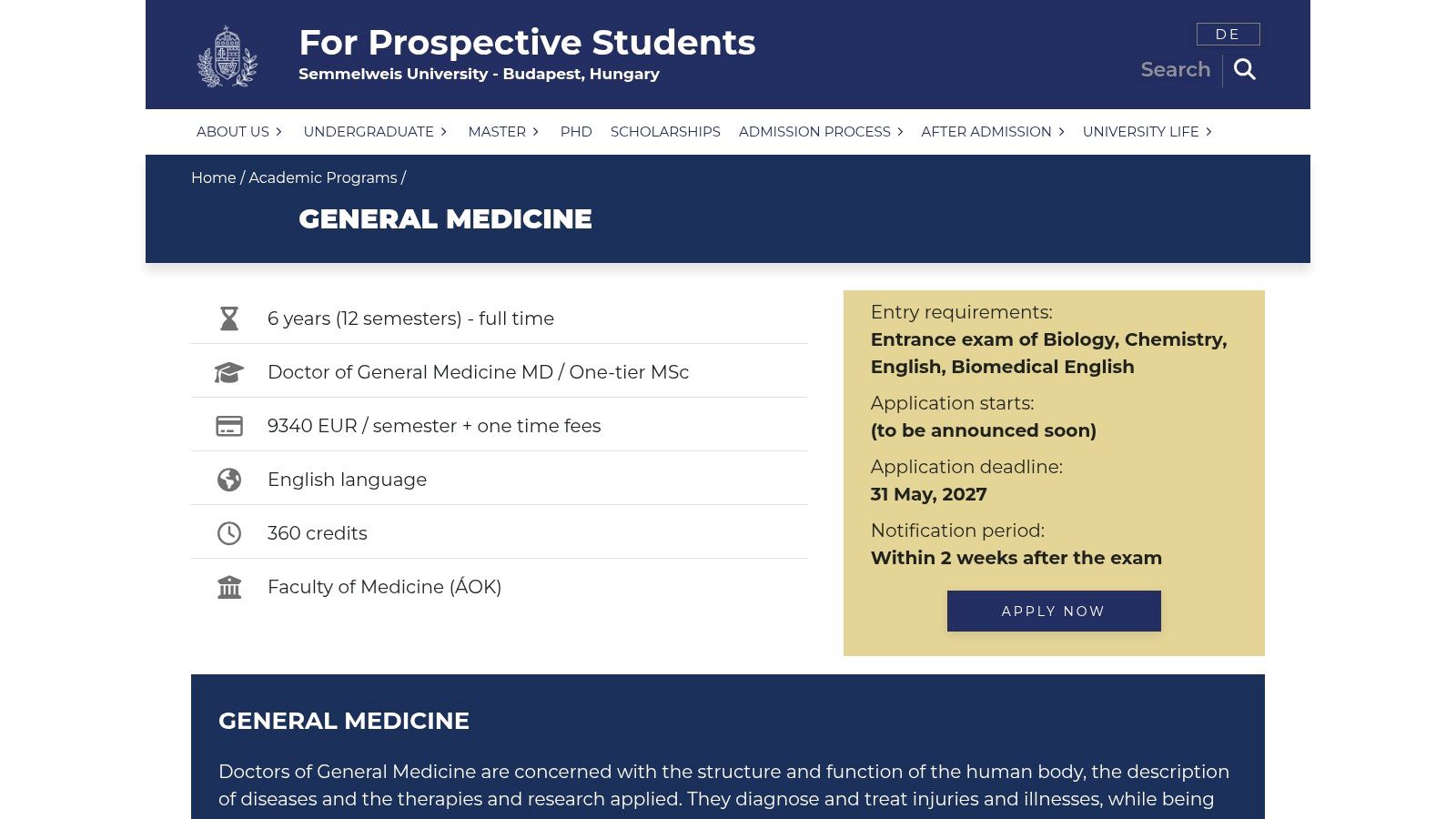
Semmelweis suits applicants who can prepare for science and English together. Its General Medicine admissions page describes an English-language route with written assessments in biology, chemistry, English, and biomedical English, followed by an interview.
Don't prepare as though this is only a science multiple-choice test. You need to understand scientific terminology, explain your reasoning aloud, and discuss your motivation clearly. Strong classroom English doesn't automatically mean you're comfortable answering a biomedical question under exam conditions.
Resolve the fee currency before accepting
The applicable tuition amount needs written confirmation. The program information and separate fee information described for applicants use different currencies and amounts, so don't assume one is a conversion of the other.
Ask admissions for the fee schedule attached to your entry cohort, including the payment currency, installment dates, entrance-exam charge, and any enrollment payment. Also establish what happens to each payment if your visa is refused or you withdraw.
- Main advantage: The admissions information gives you defined subjects around which to build a preparation schedule.
- Main trade-off: You're preparing for both academic content and language assessment, while managing a substantial tuition commitment.
- Clinical question: Ask when Hungarian becomes necessary for patient contact and which language assessments affect progression.
Our guide to studying medicine in Hungary provides country-level context, but your Semmelweis offer must answer the payment and eligibility questions.
I'd shortlist Semmelweis if you're ready for a structured entrance process. I wouldn't choose it on the assumption that an international program removes local-language obligations or guarantees access to overseas residency.
3. University of Debrecen, Debrecen, Hungary
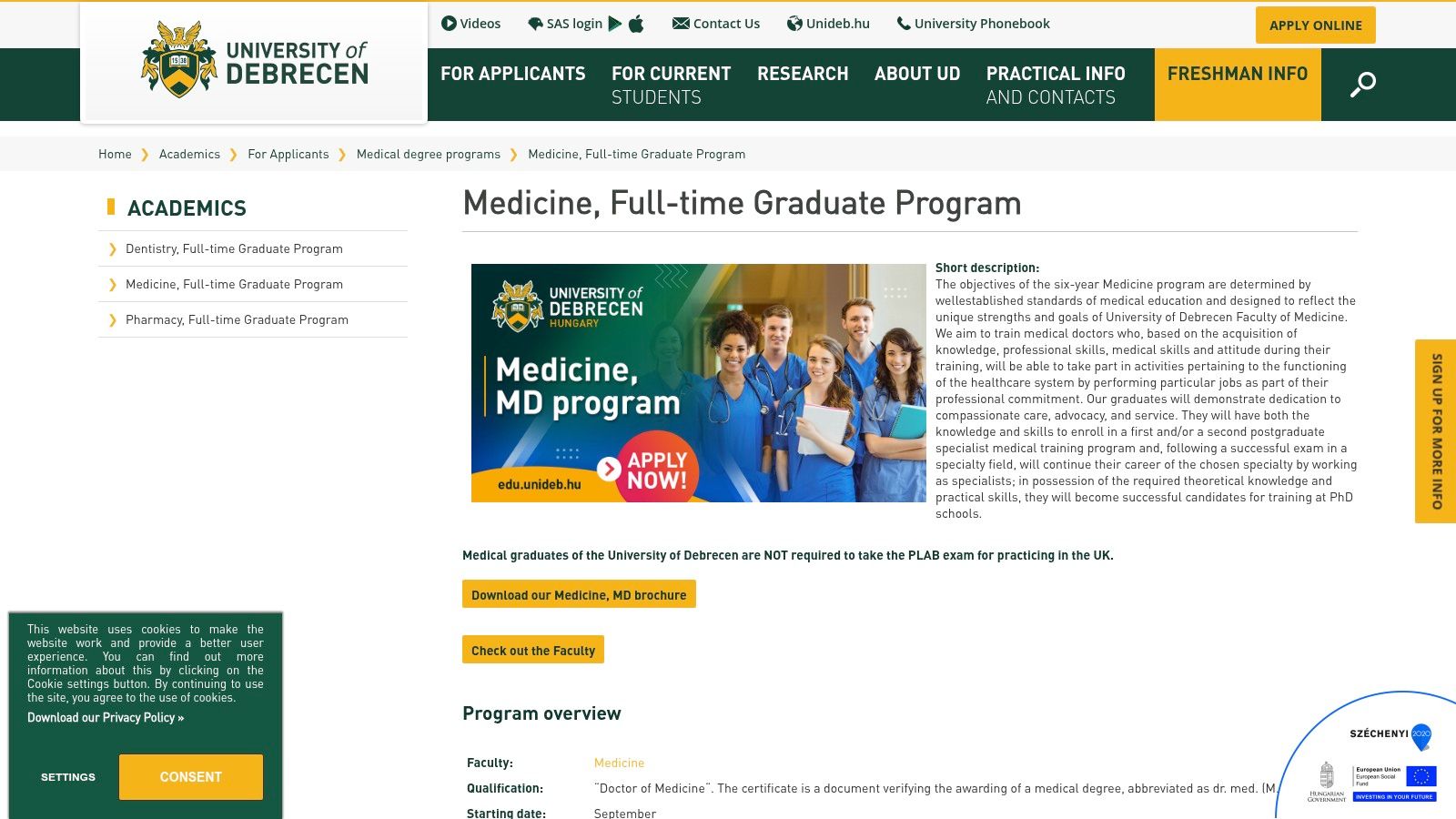
At Debrecen, your immediate decision is whether to apply directly or strengthen your science foundations first. The Medicine program page describes admission based on a secondary-school certificate and written and oral examinations in biology and either physics or chemistry, with English assessed during the examination.
Choose the optional science subject according to demonstrated ability, not which syllabus looks shorter. Practise explaining answers aloud as well as solving written questions. The oral component requires you to communicate knowledge, not just recognize the correct answer.
Debrecen also offers a Basic Medicine Course for applicants who need preparation. Before enrolling, establish its separate cost and the conditions for progressing to medicine. A preparation course shouldn't be treated as an unconditional degree place.
Check availability before paying
Confirm that applications remain open for your intended intake before paying an examination or application charge. Don't rely on a general application calendar when a program may stop accepting candidates earlier.
The other practical issue is cash flow:
- Included expenses: Tuition information identifies health insurance, a medical check-up, and a student card as included items. Confirm their scope.
- Upfront payment: Request the amount needed before visa-support documents are released.
- Patient communication: Basic Hungarian forms part of clinical preparation, so include language study in your workload.
A payment needed to release visa documents affects when you need the money, even if it isn't an additional tuition charge.
Current tuition and the pre-arrival payment schedule need confirming directly. Debrecen is worth considering if its science-subject choice matches your strengths, but the workable option is the one whose preparation and payment requirements you can meet.
4. University of Pécs, Pécs, Hungary
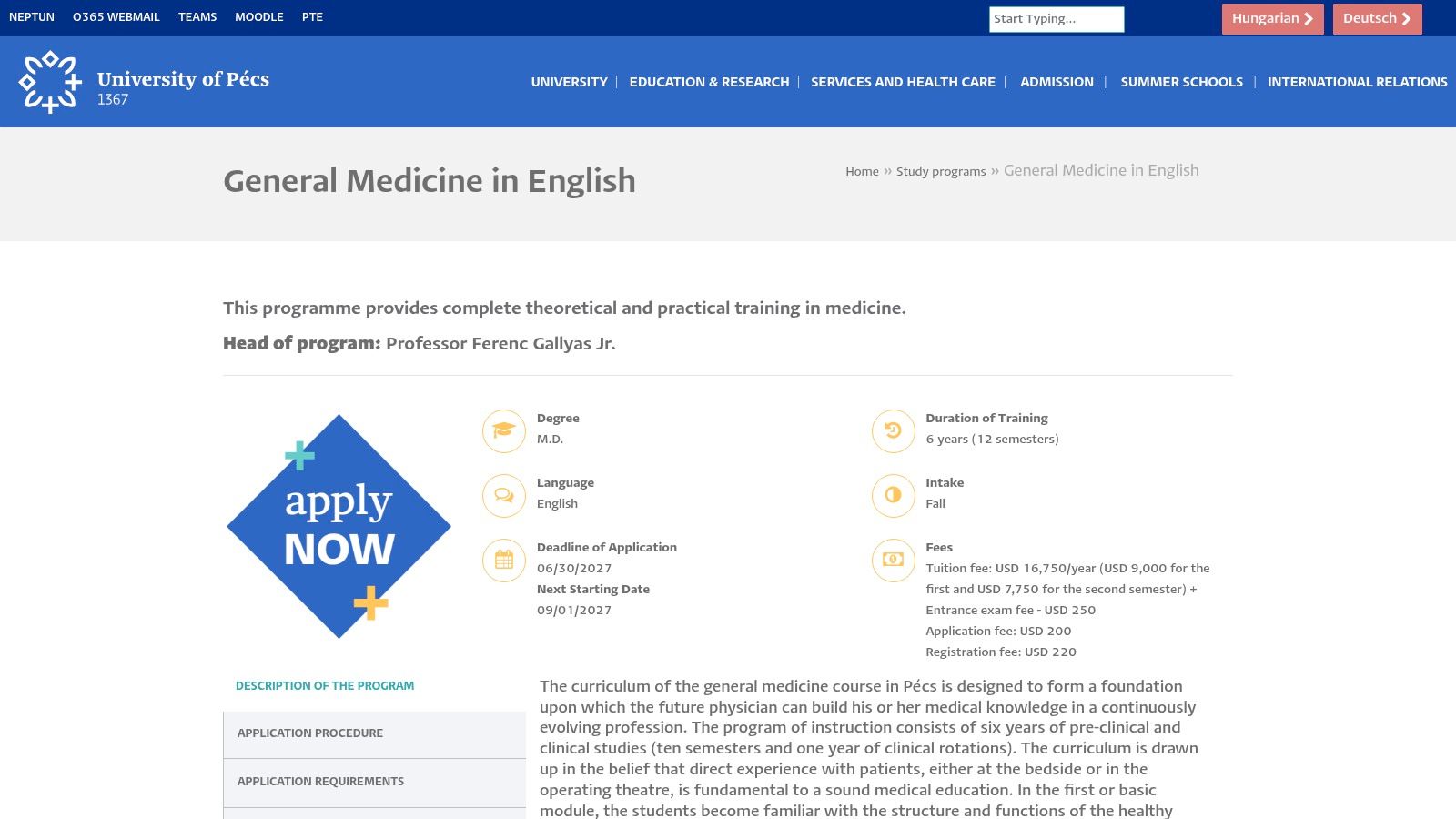
Pécs is worth examining if you want the curriculum and admissions requirements in one place. Its English-language General Medicine page brings together the academic route, entrance requirements, and fee information. The program progresses through basic and preclinical sciences into clinical study and supervised rotations.
Applicants need a high-school diploma, suitable English proficiency, and written and oral entrance assessments. Online examinations may be available, but confirm the arrangement for your application rather than budgeting on the assumption that you won't need to travel.
Separate admission costs from study costs
Pécs identifies application, registration, and entrance-exam charges separately from tuition. Confirm the current amounts and when each becomes nonrefundable. Those charges matter most when you're applying to several universities and paying before you know which offer you'll accept.
Build your budget around distinct stages:
- Before an offer: Application processing, examination, document translation, and any required certification.
- After acceptance: Registration, tuition payments, accommodation arrangements, and visa paperwork.
- During study: Living expenses, study materials, and travel connected with practical training.
The preparation route may help if your science background needs work. Ask what successful completion establishes and whether admission still depends on another assessment.
Pécs's practical curriculum is a reason to investigate, not a substitute for clinical-language checks. Ask admissions how Hungarian teaching connects with ward access and whether a language assessment must be passed before particular placements.
Best fit: An applicant who wants to compare a defined preparation route with direct admission. The trade-off is that the headline tuition doesn't settle the full cost of getting enrolled and completing clinical study.
5. University of Szeged, Szeged, Hungary
Check whether you qualify for an entrance-exam exemption before paying to prepare for one. The Szeged General Medicine page identifies exemption possibilities for applicants with specified A-levels, IB credentials, or relevant science degrees.
The important word is specified. Having an international qualification or a science degree doesn't automatically make you exempt. Submit your subjects, grades, and supporting documents, and obtain confirmation that the exemption applies to your application.
Szeged also offers an English-language foundation route. That can be useful if you need structured science revision, but it changes both the study timeline and the budget. Confirm the foundation course's progression requirements separately from the medical degree's admission conditions.
Look beyond included insurance
Szeged's fee information distinguishes tuition coverage from expenses such as accommodation, living costs, and textbooks. Some clinical placements or student practices may also carry additional charges, so request a breakdown for the training you expect to complete.
- Exam decision: Get an exemption confirmed before abandoning an entrance-exam study plan.
- Insurance decision: Check the policy's coverage, exclusions, and whether it meets your visa requirements.
- Clinical decision: Ask which practices attract extra fees and whether travel or temporary accommodation is necessary.
Budget safeguard: Included insurance doesn't mean every health-related expense is covered.
Current tuition, foundation fees, and placement charges need confirmation for your cohort. Ask separately about Hungarian requirements for patient communication, including assessment and progression rules.
Szeged is particularly useful to compare if you already hold qualifications that might change your entry route. Its advantage disappears if you assume an exemption without approval or treat optional preparation as part of the standard tuition price.
6. Medical University of Warsaw, Warsaw, Poland
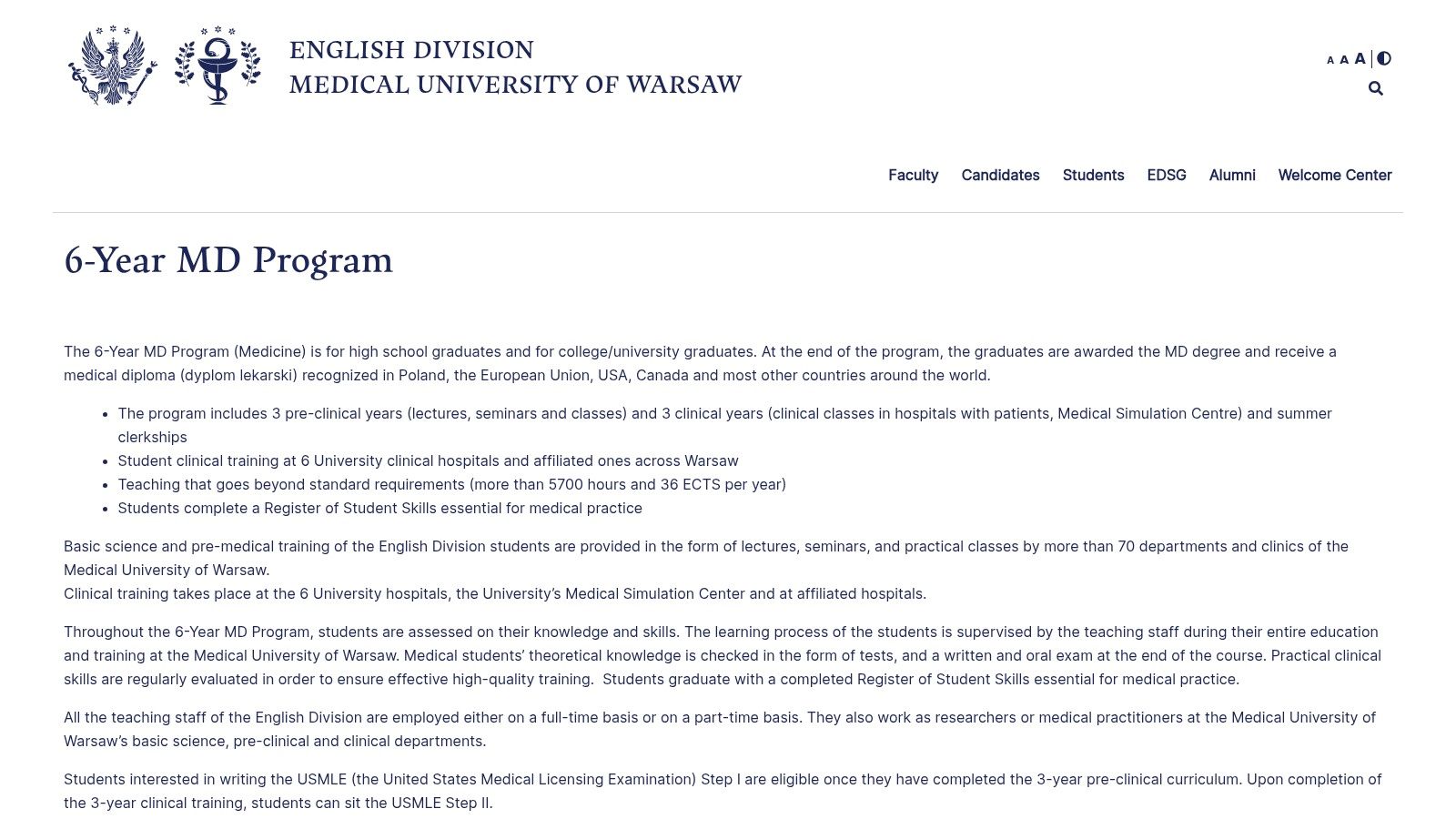
Warsaw's main attraction is hospital-based training within a substantial clinical network. The English Division's candidate information describes a route for school-leavers and university graduates, with preclinical study followed by clinical education, hospital training, and summer clerkships.
A previous degree shouldn't be taken to mean accelerated entry. Ask whether it changes your eligibility, assessment route, or curriculum obligations before assuming that prior study will shorten the program.
Establish your admissions route first
The entrance-exam format applicable to your qualification needs direct confirmation. Request the current candidate rules and establish whether selection involves a university examination, assessment of external results, or another qualification-specific route.
For a non-EU applicant, the practical comparison should include:
- Selection requirements: Accepted school credentials, science subjects, English evidence, and assessment format.
- Payment timing: Current tuition, acceptance payments, refund terms, and the documents released after payment.
- Clinical language: When Polish is required, how it's taught, and how readiness for patient contact is assessed.
- Summer obligations: Clerkship approval, travel, accommodation, and documentation costs.
Confirm current recruitment availability before spending money on the application. An English Division page can remain accessible even when a particular recruitment round has closed.
Our guide to studying medicine in Poland helps frame the destination choice, but Warsaw must confirm your individual route and fees.
I'd consider Warsaw for its clinical training opportunities, not because a capital-city location guarantees a better outcome. The trade-off is managing a demanding study budget while preparing to communicate with patients in Polish.
7. Masaryk University, Brno, Czech Republic
At Masaryk, Czech-language study is part of the commitment, not an optional extra. The Faculty of Medicine's General Medicine admissions page describes English instruction alongside Czech study and language examinations that support patient communication.
Its practical appeal includes early training and the SIMU simulation center, where students practise procedures, communication, and teamwork before clinical settings. Simulation is a useful learning environment, but you still need to establish how supervised patient contact develops through the curriculum.
Budget in the billing currency
Tuition is paid in Czech koruna. Our listed annual comparison figure is approximately $18,100, but that isn't a fixed dollar invoice: exchange-rate movements and transfer charges can change what you pay from abroad.
Request the current koruna-denominated tuition schedule, payment deadline, application and examination charges, and refund conditions. Keep the school's invoice separate from your home-currency budget.
- Entrance assessment: Confirm the current science subjects, test format, sitting arrangements, and any exemption rules before booking.
- Language progression: Ask which Czech examinations must be passed before clinical activities.
- Scholarship planning: Treat merit support as conditional, not as money available to fund your initial enrollment.
Masaryk offers conditional merit scholarships, but eligibility is assessed as students progress. Don't build your essential tuition budget around receiving one.
Our guide to studying medicine in the Czech Republic provides destination context for comparing Brno with other options.
Masaryk is a sensible shortlist choice if simulation-based preparation appeals to you and you're willing to take Czech seriously. It's less suitable if you need a guaranteed scholarship or a predictable home-currency payment throughout your degree.
How the seven English-taught programs compare on length, tuition and admissions
| Item | Location | Program length | Annual tuition | Admissions notes |
|---|---|---|---|---|
| Medical School Programs | Online guide covering Europe and the Caribbean | Not a degree program | No guide tuition; reports median school tuition of $17,100 in Europe and $61,200 in the Caribbean | Informational directory; verify requirements and fees with schools |
| Semmelweis University, Budapest, Hungary | Budapest, Hungary | 6 years | €18,680 per year listed; a separate fee page lists US$20,900 per year for 2026 entrants | Written biology, chemistry, English and biomedical English exams, followed by an interview |
| University of Debrecen, Debrecen, Hungary | Debrecen, Hungary | 6 years | Not stated in provided details | Secondary-school certificate; written and oral exams in biology and physics or chemistry; English assessed |
| University of Pécs, Pécs, Hungary | Pécs, Hungary | 6 years | Not stated in provided details | High-school diploma, upper-intermediate English, and written and oral entrance exams |
| University of Szeged, Szeged, Hungary | Szeged, Hungary | 6 years | Not stated in provided details | Some applicants with qualifying A-levels, IB credentials or science degrees may qualify for an entrance-exam exemption |
| Medical University of Warsaw, Warsaw, Poland | Warsaw, Poland | 6 years | €18,800 per year for 2026/27 | Open to high-school and university graduates; check current intake availability |
| Masaryk University, Brno, Czech Republic | Brno, Czech Republic | 6 years | Not stated in provided details | English-taught program; Czech-language study and examinations are required |
Verify Three Details Before You Commit to Any Program
An admission offer answers whether a university will accept you. It doesn't answer whether you can finance the required payments, progress through patient-facing training, or enter your preferred licensing pathway. Resolve those questions while you can still compare offers without losing a deposit.
Confirm the total first-year cost in writing
Ask for a dated statement covering tuition, entrance exams, application and registration charges, insurance, and any visa-support fees. Separate additional charges from tuition that must be paid earlier. Include document legalization, translations, housing deposits, travel, and bank charges in your own budget.
Request the refund policy alongside the payment schedule. You need to know what happens if your visa is refused, your final school results don't satisfy the offer, or you withdraw before enrollment.
Confirm the language required for patient contact
Ask specifically about Hungarian, Polish, or Czech, rather than asking whether the degree is taught in English. Establish when language teaching starts, which examinations are compulsory, and what happens if you haven't met the standard before a clinical placement.
English-medium education and local-language clinical interaction can coexist. The OECD's account of international medical education in Romania illustrates why applicants must distinguish classroom instruction from the language needed with patients.
Confirm your intended licensing and residency route
Check the school, qualification, accreditor, and clinical-training requirements with the authority responsible for your intended destination. Accreditation isn't a residency guarantee: the review of international medical education published through NCBI supports examining accreditation systems as a quality-control consideration, not treating them as automatic permission to practise.
For a US pathway, use this certification guidance for IMG residency applicants to identify questions, then verify the applicable requirements with the responsible bodies.
Save the university's answers, fee schedule, and admissions rules with dates. Program facts change, so check every quoted figure against the school's own current page before paying a deposit. A clear written answer is more useful than a reassuring general statement.
Medical School Programs brings English-taught European medical degrees into a comparable directory, with guidance on admissions, costs, and licensing considerations. Visit Medical School Programs to build your shortlist, then use the official university pages to confirm the exam route, clinical language, and payments for each application.
Created with the Outrank app