
The most repeated advice about medical school no MCAT is to work down a list of schools that don't ask for the exam. That advice fails most readers, because the waiver usually isn't written for them. At the Caribbean schools below, the exemption applies to applicants who aren't U.S. citizens, nationals, or permanent residents. If you hold a U.S. passport or a green card, you're still sitting the MCAT.
The genuine U.S. exception sits at the other end of the timeline. UMKC's combined B.A./M.D. admits students from high school, not from a completed bachelor's degree, and the Association of American Medical Colleges' guidance on baccalaureate–MD programs reports that in its 2018 Medical School Graduation Questionnaire, approximately 97% of students had completed an undergraduate degree before entering an MD program, while only 2.6% pursued a joint baccalaureate–MD route.
So the seven options below split into two very different products: one selective American high-school-entry pathway, and six island programs whose MCAT rules turn on your citizenship. Read the eligibility line before the tuition line, and get every waiver confirmed in writing for your own status and entry term.
Table of Contents
- 1. UMKC School of Medicine, Six-Year B.A./M.D.
- 2. St. George's University School of Medicine (SGU)
- 3. Ross University School of Medicine (RUSM)
- 4. American University of the Caribbean School of Medicine (AUC)
- 5. Medical University of the Americas (MUA)
- 6. University of Medicine and Health Sciences (UMHS)
- 7. St. Matthew's University School of Medicine (SMUSOM)
- How the 7 Pathways Compare on MCAT Policy, Length, and Study Location
- Verify Eligibility Before You Apply
1. UMKC School of Medicine, Six-Year B.A./M.D.
UMKC's six-year B.A./M.D. program is the cleanest no-MCAT route in the United States, and the narrowest. Students admitted from high school are admitted to the medical school itself: no MCAT, no second application cycle. The trade is that you commit to medicine as a secondary school applicant, and you keep that place only while you hold the academic standing the school requires.

What replaces the MCAT here
The screening moves upstream rather than disappearing. UMKC weighs ACT or SAT scores, the school academic record, essays, references, and interviews, then layers integrated medical coursework and early clinical exposure onto the undergraduate years. If you're still comparing American schools with strong science advising and clinical access, our guide to good colleges for doctors is a sensible parallel read.
- Who it fits: high-school seniors certain about medicine and ready for an accelerated schedule.
- Who it doesn't: graduates who already hold a bachelor's degree, since this isn't a graduate-entry shortcut.
- What to confirm: international eligibility directly with UMKC, plus progression rules in writing.
A published admissions design and a temporary accommodation aren't the same thing. In an AAMC survey of the 2021 admissions cycle, only one medical school reported implementing a limited test-optional policy for the 2022 application cycle.
Cost planning needs the same discipline. UMKC publishes first-two-year tuition rates for 2026–27 that vary by residency, and those rates aren't the price of the full six years. Ask for the later-year schedule before you treat the accelerated timeline as a saving.
2. St. George's University School of Medicine (SGU)
SGU shows how misleading the phrase "medical school no MCAT" can be. The School of Medicine admissions page states that applicants from outside North America aren't required to submit an MCAT score, while U.S. applicants do need one. Canadian applicants generally aren't required to submit a score unless they've already taken the test or hold a test date. That is a conditional exemption, not a waiver for every North American applicant.

The structure also differs from UMKC's high-school-entry B.A./M.D. route. SGU offers a four-year MD in Grenada taught in English on a U.S.-style model, with five-, six-, and seven-year tracks for applicants who need more preparation. Several starting points each year give applicants more entry dates, while individual review of academics and experience still shapes the decision. There's no application fee for the School of Medicine, and tuition schedules and scholarship information are published online. Our breakdown of Caribbean medical school requirements covers the prerequisite and documentation side in more detail.
Accreditation and the downstream chain
Accreditation and licensing deserve more attention than the admissions headline. An MCAT exemption can widen access to the application stage, while it says nothing about later registration, residency eligibility, or practising rights in a chosen country. The sensible check is the current status published by the relevant authorities, then a separate check of the licensing rules where you intend to train and practise.
Practical rule: an admissions waiver says nothing about certification, residency, or licensure. Graduates must satisfy each requirement in the country where they intend to practise, and a degree doesn't reserve a residency place.
Treat cost and eligibility as linked questions. A four-year schedule can look faster than a six-year European degree, but the total path still includes clinical years, travel, living costs, and licensing steps. Applicants outside the waiver group should assume the MCAT requirement applies until the school confirms otherwise in writing. Policies change, and the current admissions page is the point to start, not a cached summary or a marketing claim.
3. Ross University School of Medicine (RUSM)
Ross draws the line by status and by stage. Its international applicant requirements list 2026–27 basic-science tuition at $25,811 per semester, excluding fees, and report a 96% first-time residency attainment rate for the school's 2025–26 graduates. International applicants aren't required to submit MCAT scores, though RUSM encourages a score if you have one. U.S. citizens, nationals, and eligible permanent residents must submit scores before the admissions interview.
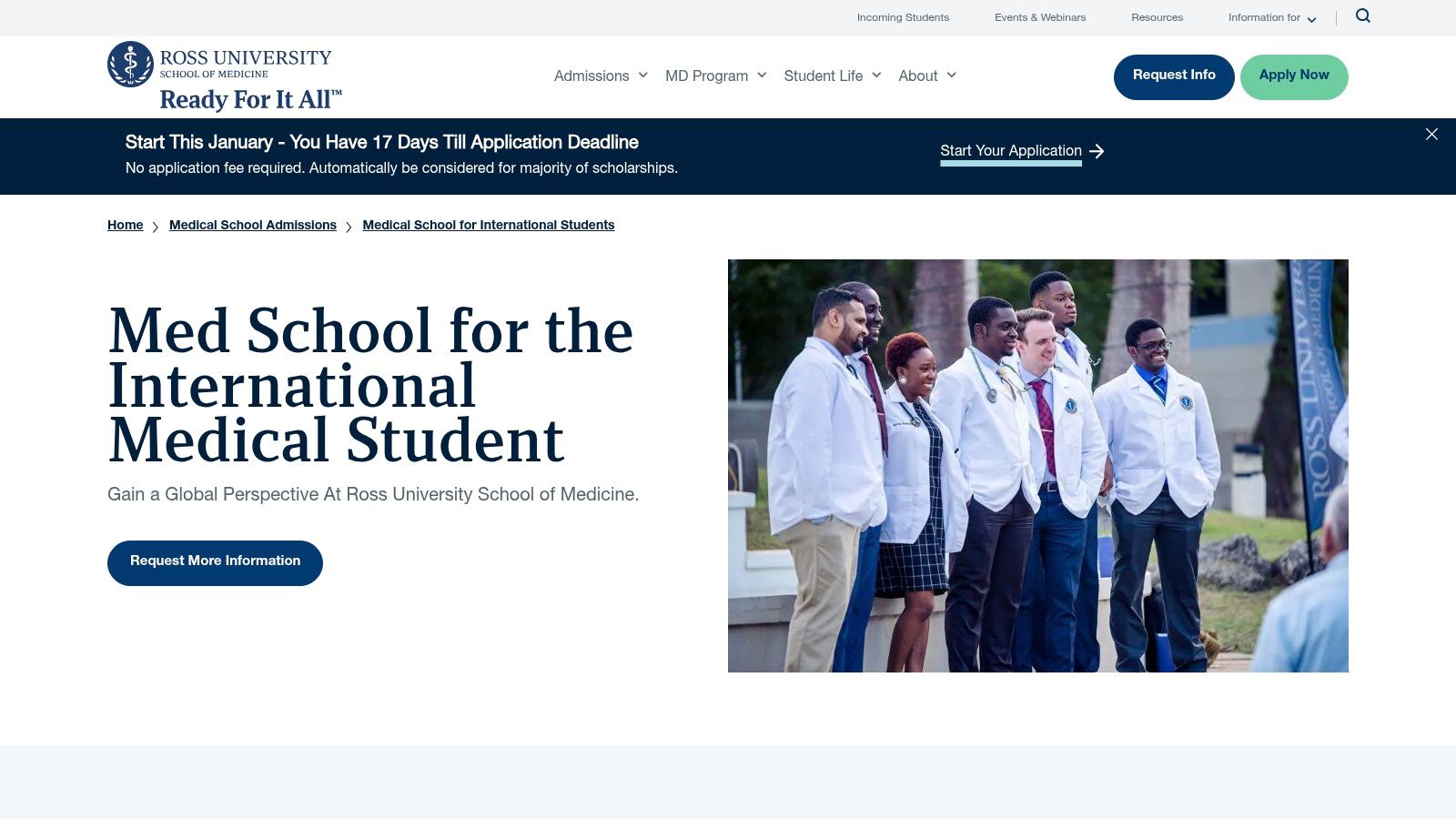
That interview trigger matters for scheduling. You can begin the file without a score, but if you're a U.S. applicant, an interview slot depends on the exam being done, so build your test date backwards from the term you want.
Read the residency figure like an analyst
RUSM publishes the methodology behind its attainment figure, which is more than many schools do. Read the denominator before you compare it with another school's number: first-time attainment and eventual placement aren't the same measure, and neither is a promise about your own outcome.
- Accreditation status: CAAM-HP lists the school as "Accredited with Conditions until the next site visit", so ask what the conditions are and when the visit falls.
- Structure: basic sciences on the Barbados campus, then clinical education at affiliated U.S. hospitals, with careful review of prerequisite grades, references, personal statement, and interview.
- Budget: there's no application fee, but per-semester tuition is only one line in a multi-year total, as our Caribbean medical school cost guide explains.
Graduates apply to U.S. residency as international medical graduates. Neither the match nor a licence is assured.
4. American University of the Caribbean School of Medicine (AUC)
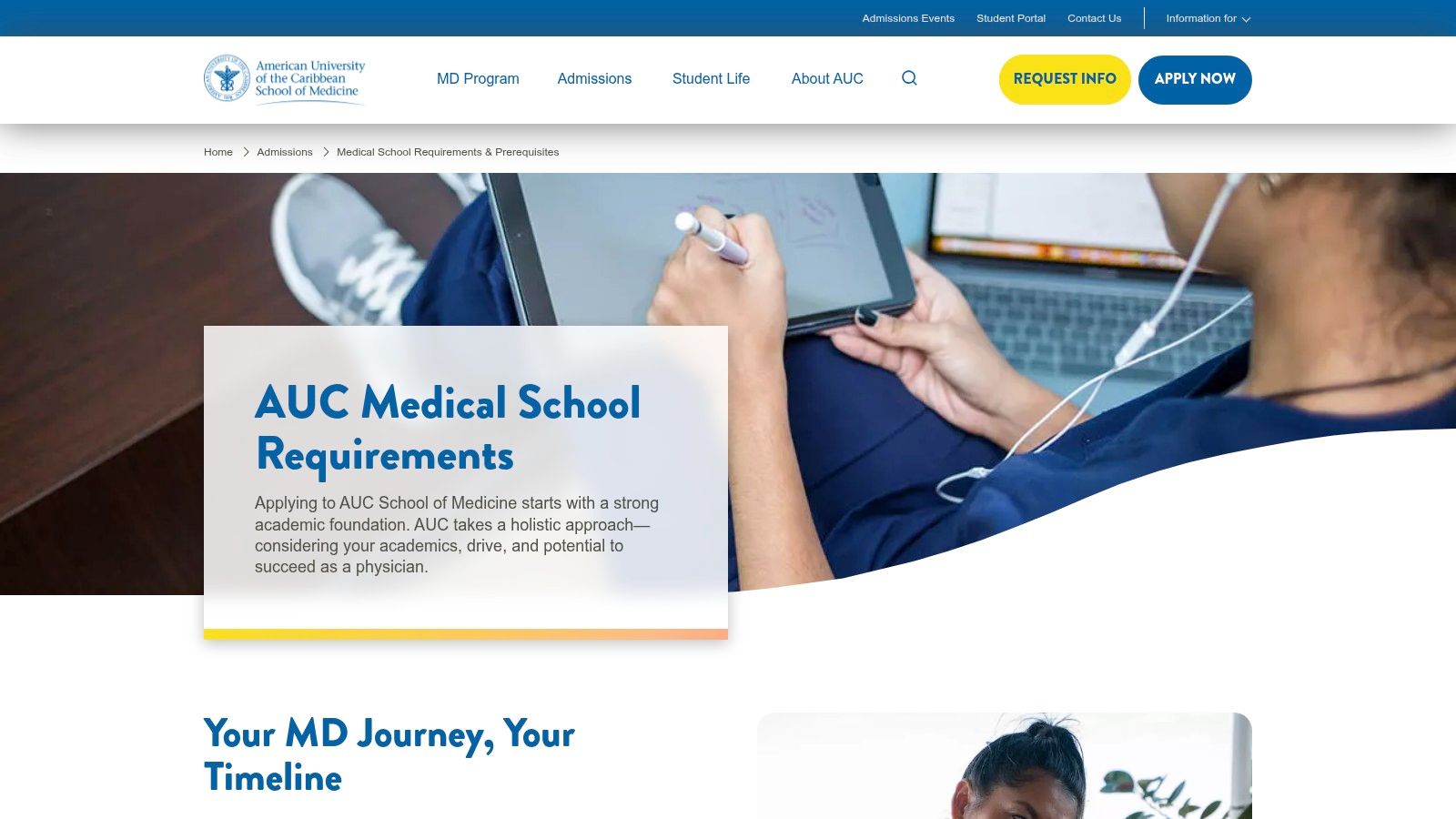
AUC is the clearest case of a waiver that replaces one screen with another. Read it narrowly: the flexibility sits outside the U.S. citizen, national, and permanent resident group, while that U.S. group still has to put an MCAT score in the file. Accepted substitutes and evidence can shift by intake, so treat the waiver as a policy to confirm, not a permanent feature.
Two phases, two price points
AUC's admissions requirements page publishes 2026–27 tuition of $23,909 per medical-sciences semester and $31,275 per clinical-sciences semester, before other costs. The step-up between phases is the detail applicants miss when they multiply one semester's rate by the length of the degree.
The four-year MD runs through medical-sciences and clinical-sciences phases, and AUC offers a UK-based study track alongside its Sint Maarten program. Where you spend the clinical phase shapes your visa planning, travel budget, and the letters you eventually carry into a residency application, so confirm the placement pattern for your intake rather than assuming the brochure default.
Removing a standardized test shifts competition to filters you can't see as easily. The AAMC's report on 2025 U.S. medical school enrollment records 54,699 applicants to U.S. MD schools in 2025, with a mean MCAT of 506.3 for applicants and 512.1 for matriculants.
That gap explains why a waived MCAT is not a weaker filter. If the exam disappears for part of the pool, grades, prerequisite trends, English evidence, and interview performance carry more weight, and U.S. citizens, nationals, and permanent residents remain inside the MCAT economy anyway.
ACCM accreditation should be read as current but time-limited; check the accreditor's active listing for the expiry that covers your graduation date. Scholarships are available for eligible Canadian and international students, and the right comparison is the award against the clinical-phase rate, not the cheaper medical-sciences semester.
5. Medical University of the Americas (MUA)
MUA serves applicants whose profile is not yet ready for a direct four-year MD route. Alongside the 10-semester MD with January, May, and September starts, it offers five- and six-year BSc/MD pathways for eligible students who need pre-medical study first. That extra time changes the calculation. A longer route can solve an eligibility gap, but it should be costed across the full sequence rather than judged by the first invoice.
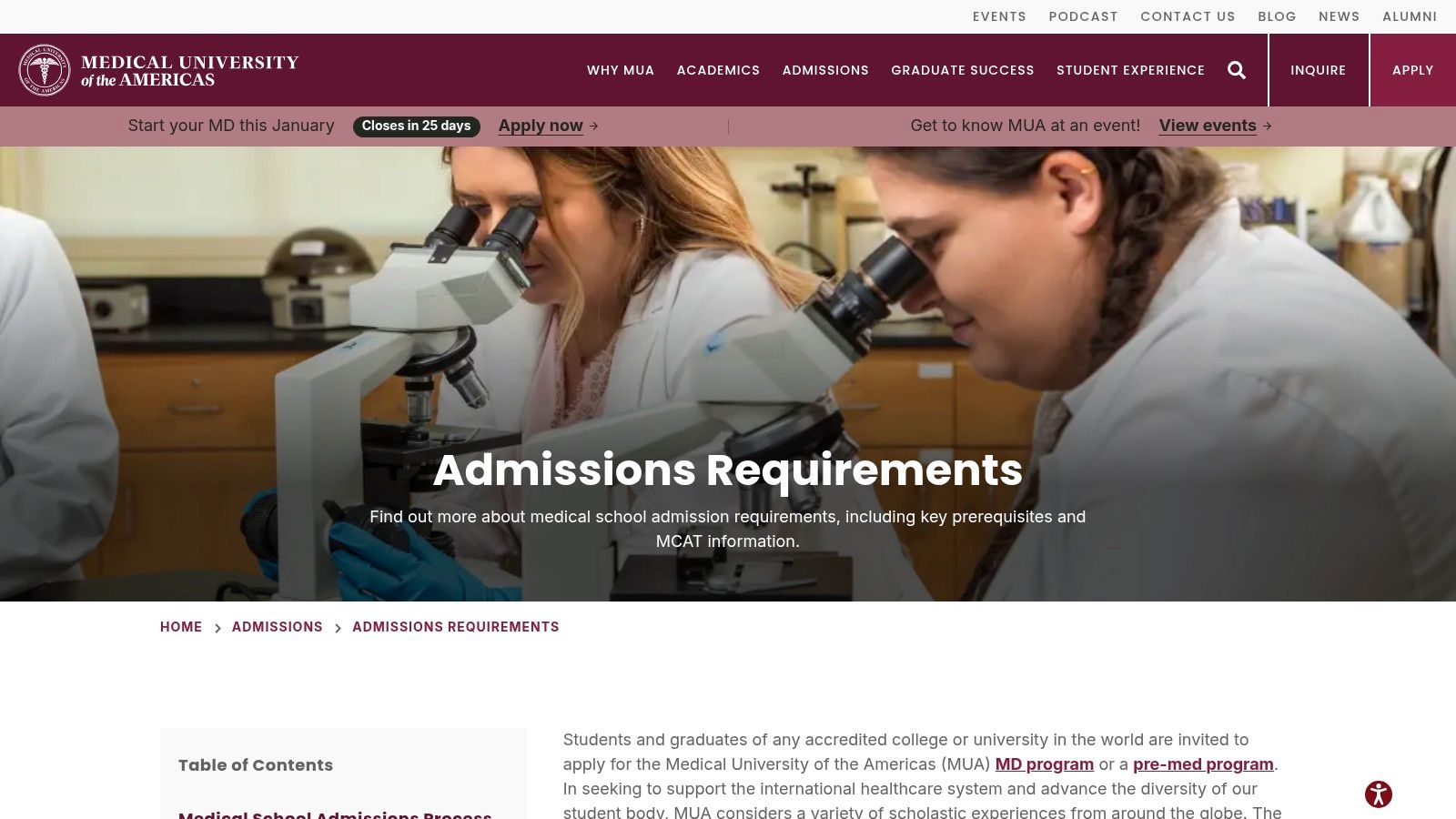
The MCAT policy is narrow. MUA's admission requirements do not require scores from applicants other than U.S. citizens, nationals, and permanent residents, who must submit them. Everyone else is encouraged, but not required, to provide a score. Review considers the whole application and includes an interview. There is no application fee, and a shared application option with St. Matthew's and Saba can place a file before more than one school. Accreditation is listed through June 30, 2032.
What holistic review actually measures
"no MCAT" does not mean "no academic screen." A retrospective cohort study of 1,898 applicants at the Lebanese American University School of Medicine, published in JMIR Medical Education, examined admissions during periods when the MCAT was unavailable. It found that a structured, well-rounded process built on detailed GPA review and interviews maintained short-term student quality. That finding is institution-specific and short-term. It says little about residency or licensing outcomes, and it should not be treated as proof that every waiver works the same way.
Ask MUA for a current, program-specific cost breakdown covering the clinical phase and living expenses. Request progression and attrition data by entry route as well. Admission guarantees neither a residency place nor a licence, and policies can change.
6. University of Medicine and Health Sciences (UMHS)
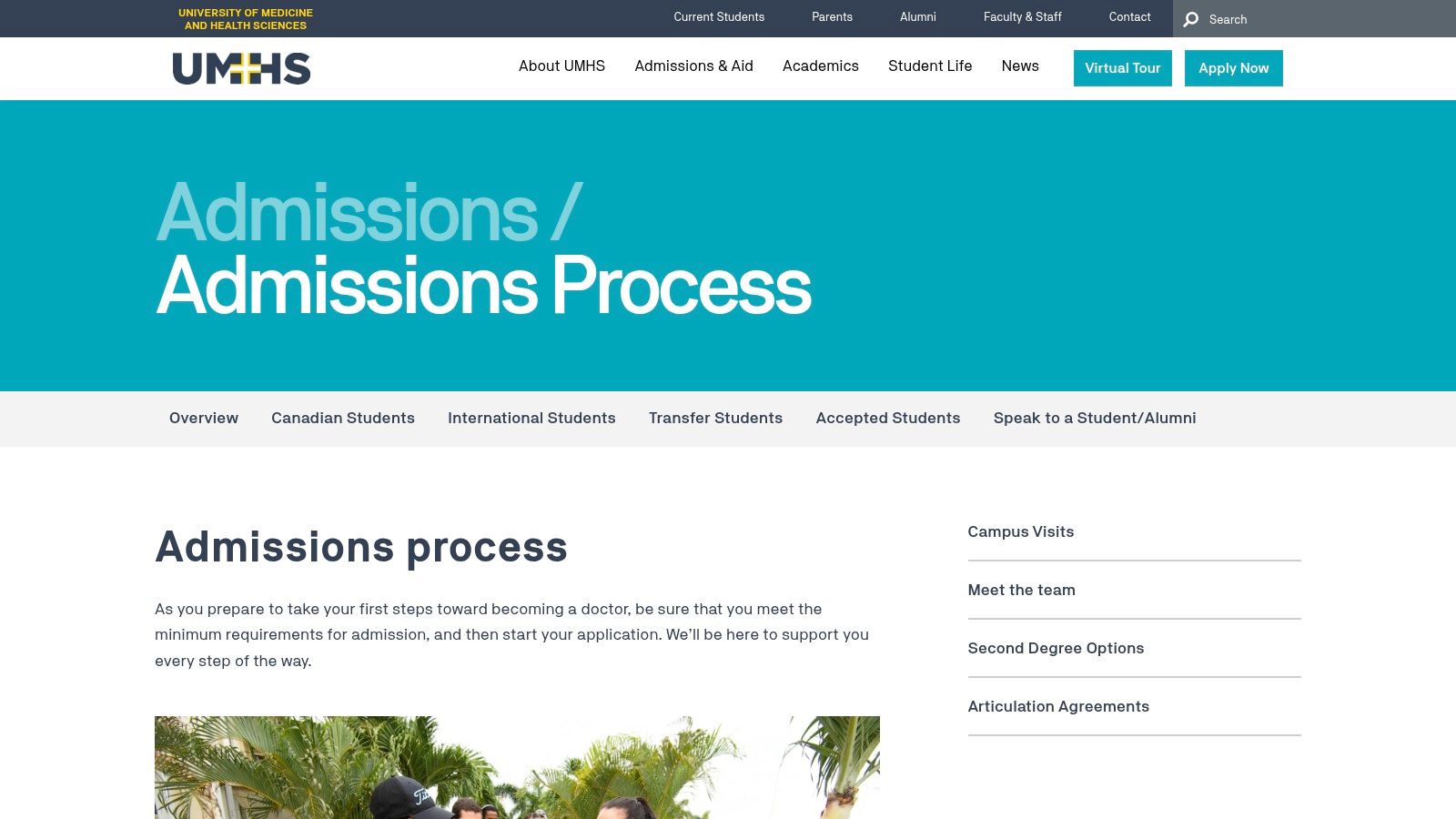
UMHS makes the MCAT rule more specific than a simple citizenship test. The school requires the MCAT from U.S. citizens and permanent residents and from applicants who completed their undergraduate education in the United States. That second clause changes the analysis. A Canadian or other international applicant who studied at an American university can fall inside the requirement, even without U.S. status. Treat education location as a screening factor, then map nationality against it before assuming a waiver applies.
Where the waiver holds, and what it costs
Canadian and other international applicants outside that clause don't have to submit a score, although UMHS recommends one. Its admission process page lists September 2026 basic-science tuition at $18,550 per semester and clinical-science tuition at $21,200 per semester, before other expenses. The practical point is straightforward: a waiver may remove one test requirement while leaving a much larger cost decision intact.
- Curriculum choice: Standard and Extended Basic Science options, which change both your timeline and your total tuition exposure.
- Timing: January, May, and September terms with rolling review, so a delayed document can move you a whole term.
- Structure: four-year MD with basic sciences on St. Kitts and clinical training in North America.
ACCM lists accreditation through a stated future end date, so confirm the current term before relying on it. UMHS publishes course prerequisites, application steps, and residency-match information, which gives you material to question directly. Check current clinical placement locations, visa rules, and licensing requirements for the country where you intend to work before you commit to a start term.
7. St. Matthew's University School of Medicine (SMUSOM)
SMUSOM shows why "recommended, not required" isn't a promise. The MCAT is generally recommended rather than required for applicants other than U.S. citizens, nationals, and permanent residents, who must submit it. But the school may also demand a score from some non-U.S. applicants, including those with outdated science coursework, community-college science courses, or grades of C or lower in required sciences.
Audit your transcript before you assume you're exempt
Say you finished your biology sequence eight years ago at a community college with a C in the second semester. On paper you're an international applicant at a school that doesn't require the MCAT. In practice you may hit every exception at once. Pull your transcript, date each science course, and send it to admissions for a written ruling before you pay for anything.
The program is a four-year MD with five basic-science semesters on Grand Cayman and five clinical-medicine semesters, rotations in the United States with select Canadian electives, three start dates a year, and rolling admissions. There's no application fee, and a shared application covers SMUSOM, MUA, and Saba. ACCM lists accreditation through June 30, 2031.
SMUSOM's admissions requirements and fee information puts tuition and administrative fees for students beginning in September 2026 at $279,860, before additional fees and living costs. That's the most useful number here, because it's a program total rather than a per-semester teaser. Residency and licensure still depend on exam performance, clinical experience, and the rules of each jurisdiction.
How the 7 Pathways Compare on MCAT Policy, Length, and Study Location
| School | MCAT policy | Program length | Study location | Key caveat |
|---|---|---|---|---|
| UMKC School of Medicine, Six-Year B.A./M.D. | No MCAT after admission | Six years | Kansas City, Missouri, United States | Competitive pathway for eligible high-school applicants; generally unsuitable for bachelor's degree holders |
| St. George's University School of Medicine (SGU) | Not required for applicants outside North America; required for U.S. applicants; generally not required for Canadians | Four-year MD; five-, six-, or seven-year tracks | Grenada | MCAT waiver depends on applicant category; residency and licensure are not guaranteed |
| Ross University School of Medicine (RUSM) | Not required for international applicants; required for U.S. citizens, nationals, and eligible permanent residents | Four years | Barbados for basic sciences; affiliated U.S. hospitals for clinical education | Graduates apply as international medical graduates; accreditation is listed with conditions |
| American University of the Caribbean School of Medicine (AUC) | Not required for non-U.S. applicants; required for U.S. citizens, nationals, and permanent residents | Four years | Sint Maarten or UK-based track, with clinical-sciences training | Verify clinical locations and licensing requirements for the intended destination |
| Medical University of the Americas (MUA) | Not required for most non-U.S. applicants; required for U.S. citizens, nationals, and permanent residents | 10-semester MD; five- or six-year BSc/MD pathways | Caribbean campus; clinical training in affiliated hospitals mostly in the United States | Request a current full cost breakdown; admission does not guarantee residency or licensure |
| University of Medicine and Health Sciences (UMHS) | Not required for Canadian and other international applicants; required for U.S. citizens, permanent residents, and applicants educated in the U.S. | Four years | St. Kitts for basic sciences; North America for clinical training | Check current clinical placement, visa, and licensing requirements |
| St. Matthew's University School of Medicine (SMUSOM) | Generally not required, except for U.S. applicants; some non-U.S. applicants may also need it | Four years | Grand Cayman for basic sciences; United States for clinical rotations, with select Canadian electives | MCAT may be required for some non-U.S. applicants based on coursework or grades |
The useful split is sharper than the phrase “medical school no MCAT” suggests. UMKC is the genuine high-school-entry B.A./M.D. model, with a six-year structure and no MCAT after admission. The Caribbean routes are mostly four-year MD programs for applicants who already meet degree and course prerequisites, and their waivers often turn on citizenship, residency, or where the applicant studied. That makes the label useful only after the eligibility category is clear.
Length also separates the pathways. UMKC takes six years. SGU offers a four-year MD plus five-, six-, or seven-year tracks. RUSM, AUC, UMHS, and SMUSOM are four-year routes in the comparison. MUA lists a 10-semester MD and five- or six-year BSc/MD pathways. Those labels matter less than the point of entry: a six-year track that starts from high school and a six-year pathway layered onto prior study are different commitments.
Study location is the third filter. UMKC is based in Kansas City, Missouri. SGU is in Grenada, RUSM uses Barbados for basic sciences, AUC uses Sint Maarten or a UK-based track, UMHS uses St. Kitts, and SMUSOM uses Grand Cayman. MUA has a Caribbean campus, with clinical training in affiliated hospitals mostly in the United States. For most Caribbean programs here, the clinical phase sits in affiliated U.S. hospitals, while options in Canada or North America depend on the school and placement rules.
The non-obvious conclusion is that “no MCAT” rarely means “no screening.” It shifts screening to status, academic history, clinical placement, and licensing destination. Applicants should compare the table as a set of conditions: who qualifies for the waiver, how long the path takes, where each phase happens, and which rules govern the intended practice location. Policies change, so each field should be confirmed for the specific intake before money is spent.
Verify Eligibility Before You Apply
Run four checks before you spend money on an application, and do them in this order.
- Status first: ask admissions to confirm in writing whether the MCAT waiver covers your citizenship, residency, and the country where you studied, for your specific entry term.
- Accreditation and clinical sites: check the current accreditor decision and its expiry date, then ask where the clinical semesters happen for your intake.
- Total cost: add clinical-phase tuition, fees, travel, credential evaluation, English testing, deposits, and visa processing to the published rate.
- Licensing destination: test the rules of the country you intend to practise in, not the country where the campus sits.
The fallback route hasn't loosened. The American Association of Colleges of Osteopathic Medicine's application process guidance states that colleges of osteopathic medicine require official MCAT scores, released through the AACOMAS application service. If your plan is "no MCAT anywhere", the DO side doesn't provide an escape hatch either.
Access is the other claim worth testing. In the AAMC's 2025–26 applicant table, women represented 31,292 of 54,364 applicants, compared with 23,072 men, which should stop anyone assuming that a lower-test pathway automatically widens opportunity for a particular group. Ask instead whether a school publishes completion, licensing, and residency outcomes for the students it admits without the MCAT. Missing outcome reporting is a decision risk, not a neutral gap.
For wider comparison, we list 24 English-taught medical programs across Europe and the Caribbean, and our admissions guide covers eligibility, transcripts, the MCAT, English tests, visas, and funding. Our program data comes from schools' official websites and bodies including the World Directory of Medical Schools, ECFMG, NRMP, and national accreditation agencies, and schools can't pay to change a listing. Policies move year to year, so treat every figure here as a starting point for a dated confirmation from the school itself.
Medical School Programs has been an independent guide to medical school programs since 2009, with a directory that shows tuition, program length, and licensing notes taken from official sources, plus a careers guide covering residency match rates, screening filters, and how to judge a school as an international medical graduate. Use it to compare the Caribbean MD pathways above against six-year European degrees entered straight from high school, then take your citizenship, transcript dates, and budget to each admissions office for written confirmation. Start at Medical School Programs and shortlist by eligibility before you shortlist by price.