
Which requirement on a Caribbean medical school's list decides whether you'll practise medicine in the United States? It isn't the GPA cut-off, and it isn't the MCAT waiver. It's a line in a directory entry that most applicants never open.
Requirement pages answer a narrow question: what do I submit to get in? They rarely answer the one that costs real money when you get it wrong. The same degree can be perfectly admissible in your first semester and blocked from the US licensing pathway by the time you sit your final board exam, because eligibility follows the school's listing and the year you graduate.
This guide walks the requirements in the order you'll meet them, from transcripts to ECFMG certification, and pairs each one with the check that tells you whether clearing it still leads to a US residency.
Table of Contents
- Caribbean Medical School Requirements at a Glance
- Academic Prerequisites and GPA Expectations
- MCAT, English Tests and Score Expectations
- Transcripts and Application Documents Step by Step
- ECFMG Eligibility and the Four-Year Credit Rule
- Accreditation and Clinical Rotations to Check
- Residency Competitiveness Beyond Admission
- Confirm Eligibility Before You Pay a Deposit
Caribbean Medical School Requirements at a Glance
The one-sentence version: a Caribbean medical school typically asks for prior university study, a slate of science prerequisites, a competitive GPA, proof of English proficiency if you're not a native speaker, official transcripts, two or three recommendation letters, a personal statement and an interview.
The table below is the checklist to hold against each school's current requirements page. Read a cell as a prompt, not a verdict. The value that matters is the one printed by the school you're applying to this cycle, on the date you read it.
| Requirement | Typical expectation | What to verify |
|---|---|---|
| Prior education | Bachelor's degree, or at least three years of university study depending on the school | Whether credit-only applicants are accepted |
| Prerequisite courses | Biology, general chemistry, organic chemistry and physics, often with labs; some add biochemistry or English | Exact course list and lab format |
| Minimum GPA | Published minimum, plus a separate science GPA at many programs | Whether overall and science GPA are checked separately |
| Official transcripts | Sent from every institution attended | Whether translation or credential evaluation is needed |
| Recommendations and personal statement | Usually two or three letters and one statement | Number of letters and whether a physician letter is required |
| Interview | Often required before admission | Whether it is online or on campus |
Two rows deserve a second look before you read further. The MCAT is required by some programs and waived by others, so the table sends you to each school's current policy rather than to one regional rule. Prior education is equally elastic: plenty of schools accept three years of university credit instead of a finished bachelor's degree, and the cut-off is set school by school.
The Caribbean listings we maintain cover programs in Antigua and Barbuda, Barbados, Grenada, Saba, Saint Kitts and Nevis, Saint Vincent and the Grenadines, and Sint Maarten, so requirements can be compared across islands rather than inside one brand.
None of these items tells you whether the degree will carry you into a US residency. That's a separate set of conditions, and it starts with ECFMG eligibility.
Three things to do this week:
- Open the current requirements page for every school on your shortlist and save a dated copy.
- Match each item to a row in the table and write the school's own wording into the cell, not a summary of it.
- Give every gap a deadline, including the last safe test date and the last term in which a missing course can be finished.
Academic Prerequisites and GPA Expectations
Grades are the one part of the file you can still move, which makes them worth auditing before you fall for a campus.
Most programs expect a set of laboratory science courses taken at an accredited institution:
- General biology with lab. Usually a full year, though a few schools accept a single combined sequence.
- General chemistry with lab. The year-long sequence for science majors, not the one-semester survey course.
- Organic chemistry with lab. The course that screens out the most applicants, and the one admissions committees read hardest.
- Physics with lab. Algebra-based is normally accepted; calculus-based never hurts.
- Biochemistry or English composition. Which one appears on the list depends on the school, and it changes more often than you'd expect.
Repeated courses are handled in two different ways. Some schools record the latest grade and leave the earlier attempt out of the calculation; others average every attempt, which pulls a recovered grade back down. Ask which method applies before you plan a retake, because the answer decides whether repeating organic chemistry helps you.
Pass/fail grades, online labs and transfer credit are the three places where credit fails to count. A community college course is usually accepted when it's graded and transferable to a four-year institution. A "pass" from a summer online lab rarely satisfies a prerequisite that specifies a lab.
The distinction that decides outcomes: the published minimum is a screening floor, not a target. A file that clears the floor gets read. A file that clears it with room to spare gets an interview.
Before you enrol in a course you still need, request a written prerequisite check from the admissions office. Send the course code, the syllabus and the credit hours. A course that doesn't transfer costs you a semester, not just a fee.
Run a grade audit before you apply
Sit down with every transcript and build one list:
- Every prerequisite, with the grade earned and the term taken.
- Any course below a C, flagged, because most schools won't accept it as satisfying a prerequisite.
- Any term where your GPA dipped, with a one-line explanation you can use in the personal statement or the interview.
- Any prerequisite still missing, with the date you'd need to complete it.
That list is also your interview preparation. An applicant who can explain a bad sophomore year in two clear sentences reads very differently from one who can't.
MCAT, English Tests and Score Expectations
Test requirements split into three paths, and only one of them involves the MCAT.
| Test | Who needs it | Where the minimum is published | What to check |
|---|---|---|---|
| MCAT | Required by some schools, waived by others | The school's admissions requirements page | Current cut-off and waiver rule |
| TOEFL iBT | Non-native English speakers | The school's English-language requirements page | Accepted minimum and how long a score stays valid |
| IELTS Academic | Non-native English speakers | The school's English-language requirements page | Accepted band and validity period |
| Duolingo English Test | Non-native English speakers at schools that accept it | The school's list of accepted English tests | Whether the school accepts it and its minimum |
The MCAT is the movable one. Some programs require a score, others waive it for applicants with a strong GPA or a completed science degree, and a few will read a score if you've already sat the exam. Confirm the waiver policy in writing before you pay for a sitting. A waiver you didn't know about is an expensive afternoon.
English proficiency usually follows a simple logic rather than a fixed rule. If you completed a degree taught in English, you're often exempt. If you didn't, expect to submit TOEFL iBT, IELTS Academic or Duolingo English Test results, depending on what the school lists.
This requirement matters twice, not once. Admission is the first hurdle, but the degree only pays off if it leads toward US residency through ECFMG certification, and that path runs through hospitals and exams conducted in English. An applicant who scrapes through the English test may clear admission and still struggle with the clinical communication the licensing sequence assumes. Treat the language requirement as an early read on whether you're ready for the whole route, not just the first step.
Scores expire. Confirm the window the school applies to English results before you book, and make sure the report will still be live on the day your file is reviewed, not the day you press submit.
Send official results directly from the testing body to the school. A screenshot of a score report is not a score report, and an unofficial copy sitting in your own email is worth nothing to an admissions office.
Sequencing that prevents a wasted cycle
Book a test date that leaves room for one retake, and work backwards from the application deadline rather than forwards from today. A score released after the file is reviewed is the same as no score at all.
Offsetting works only where policy allows it. Don't assume a strong Duolingo result covers a weak TOEFL band, or that a high MCAT compensates for a missing physics lab. Each condition is read on its own.
The school's current page overrides every general figure you'll read, including any summary elsewhere. Posting a policy and updating it are different habits, and not every institution has both.
Transcripts and Application Documents Step by Step
Documents sink more applications than grades do. Not because they're hard to produce, but because each one has an owner and a deadline, and nobody chases them for you.
The submission path itself is short: request, verify, submit.
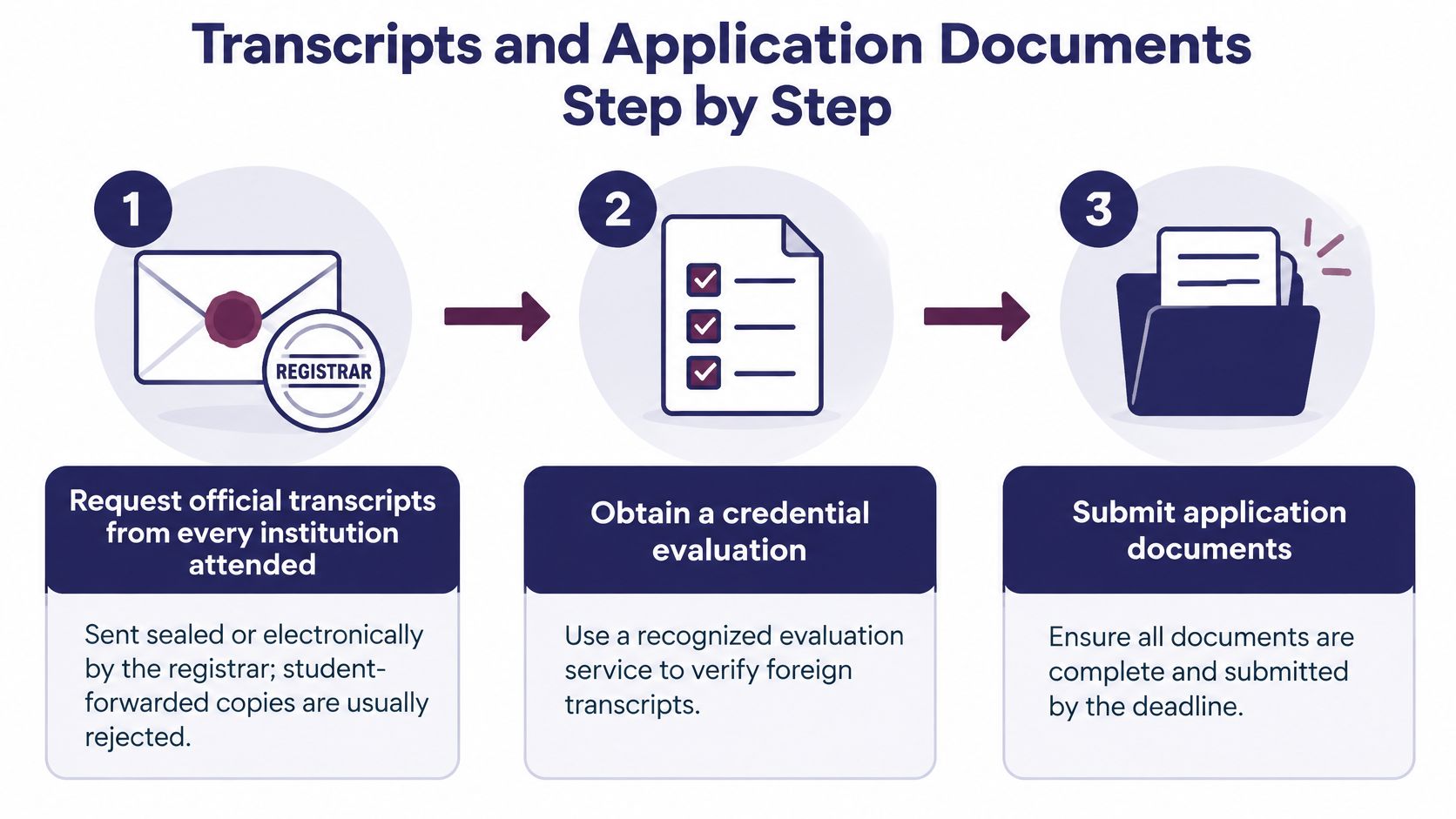
- Official transcripts from every institution. That means every college, community college and summer school, even a single course taken for transfer credit. Ask the registrar to send them sealed or electronically. A copy you forward yourself is usually rejected.
- A credential evaluation or certified translation. Needed when a transcript isn't issued in English, so staff can read grades in a standard format. Use a recognised evaluation service rather than a translation from a notary who has never seen a transcript.
- The personal statement. Usually about one page. Answer two questions: why medicine, and why this school. Name the rotation structure or the curriculum detail that drew you, because a statement that would fit any campus reads as one.
- Two or three academic letters. Add a physician or clinical supervisor if the school asks for one. Give each referee a deadline two weeks before the actual one, plus your CV and your statement.
- The CV. Clinical exposure, research, volunteering and leadership, each with dates and hours. "Shadowing, 2024" tells a reader nothing. "Shadowed a family physician, 40 hours, June to August 2024" tells them plenty.
- Health and immunization records, plus any background check. Expired immunisations stall more files than missing essays do, and a titres test can take weeks to come back.
- A passport scan valid through the program's expected end date. Not through enrolment. Students arriving with eight months left on a passport end up renewing it from an island consulate.
- The application form and fee. Last, not first, because a form submitted with three documents outstanding still waits on the three documents.
Letters uploaded to the wrong portal are the most frequent slip at this stage. Check the recipient before you send the link to a referee.
Keep one tracking list: document, sender, date requested, date confirmed received. Review it a week before the deadline, not the morning of.
ECFMG Eligibility and the Four-Year Credit Rule
A school's directory listing works like a passport. It has to stay valid for the whole trip, including the morning of a board exam you sit two years from now.
For US residency, a Caribbean degree is judged by future ECFMG eligibility. Admission answers whether a school will take you. Eligibility answers whether the degree it gives you will still count when you apply for residency. The Educational Commission for Foreign Medical Graduates sets three conditions, and they arrive in a fixed order.
First, the school must appear in the World Directory of Medical Schools with an ECFMG eligibility note covering your graduation year. Second, you must receive credit for at least four academic years of medical education. Third, you must pass USMLE Step 1 and Step 2 Clinical Knowledge. All three are set out in the ECFMG credentials requirements, which also confirm that certification is what international medical graduates need to enter a residency accredited by the Accreditation Council for Graduate Medical Education (ACGME).
The four-year credit rule catches applicants who assume any completed MD counts. What counts is credit for four academic years of medical education, which is why transfer credits, advanced standing and shortened pathways all need checking against the school's own credit documentation.
What the policy history adds
ECFMG's eligibility requirements have changed over time, which is why the current guidance sends applicants back to the individual school's World Directory listing and its graduation-year note. A school's status can shift while you are enrolled, so the version that matters is the one in force when you graduate.
The sequence of exams, and what each one enables, is set out in the guide to USMLE for international medical graduates.
The practical consequence: eligibility is a condition that has to hold through your expected graduation period, and the person responsible for checking that it still holds is you.
Requirements therefore extend past the admissions letter. Before you accept an offer, confirm that the institution stays eligible across the years you'll be enrolled, and that the degree you'll hold will support the later USMLE and ECFMG steps without a workaround.
Accreditation and Clinical Rotations to Check
Accreditation is the requirement applicants check most and understand least. "Accredited" isn't a single status. It's a bundle of separate claims, and each one has to hold independently for the degree to keep a US licensing path open through ECFMG.
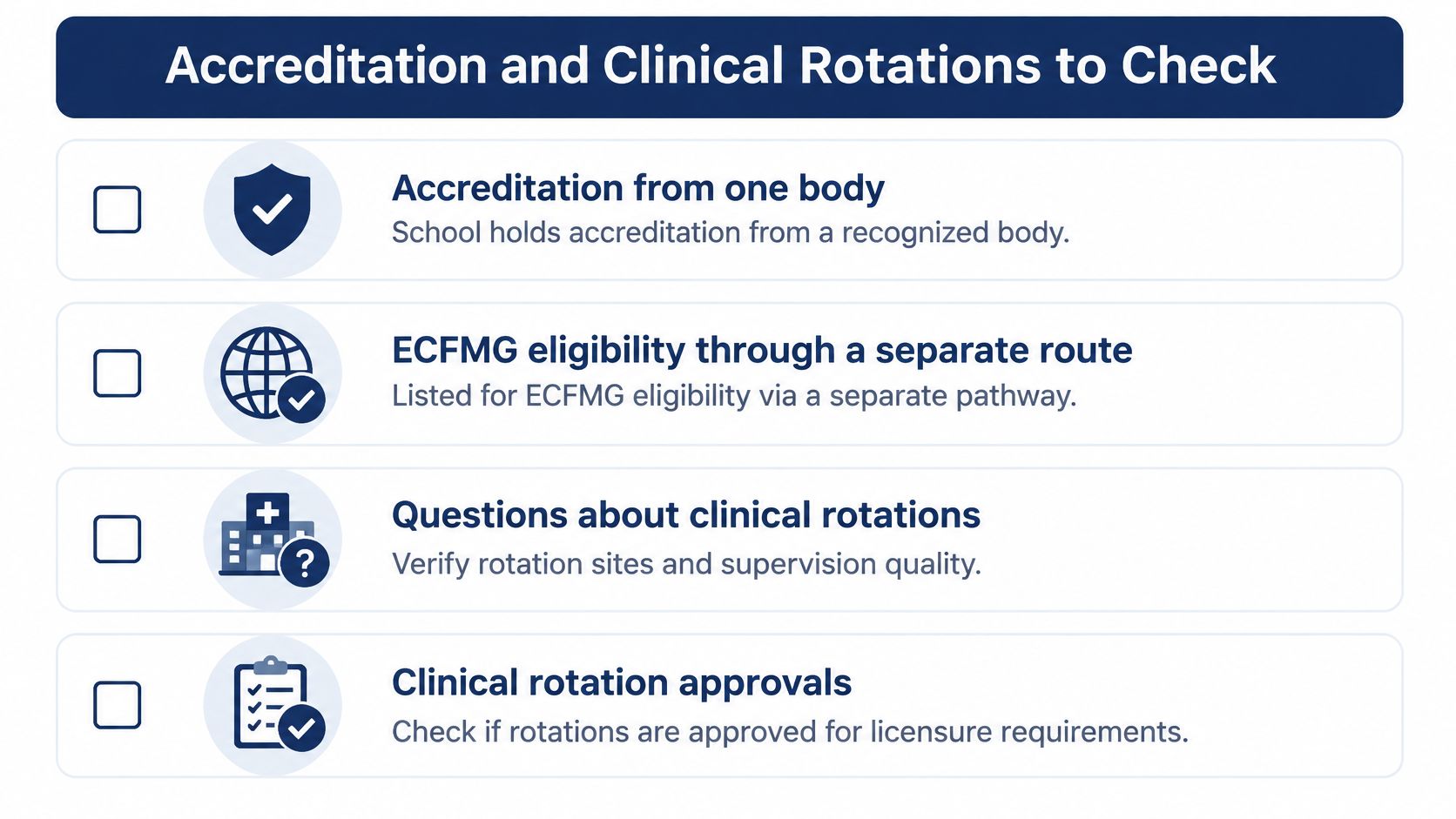
The Caribbean Accreditation Authority for Education in Medicine and Other Health Professions (CAAM-HP) is authorized under CARICOM to prescribe standards and accredit programs on the basis of institutional structure, function and performance, as the USMLE Bulletin of Information records. That authority has also warned that some schools have made misleading claims about accreditation and about face-to-face teaching, which is why you check the specific program and its conditions rather than the institution's reputation.
Here's the assumption worth challenging: that a school holding accreditation from one body has settled every question a US-bound applicant should ask. It hasn't. Accreditation works like a building inspection. It confirms one inspector found the structure sound on a given date. ECFMG eligibility is a separate listing with its own graduation-year conditions, and the two can point in different directions. Rules vary by island.
The four items to request in writing
Before you pay anything, ask the admissions office for these, in a document you keep:
- The written clinical rotation policy, covering how placements are assigned and what happens if a site closes.
- Rotation locations and hospital affiliations, named, with the city and the teaching arrangement at each.
- Required clerkship weeks by specialty, so you can compare the core year against another school's.
- The list of US rotation sites used in the last few years, which is a better predictor than the list of sites a school hopes to use.
Weak or unverifiable institutional status can block USMLE access or ECFMG certification outright. Unstable clinical affiliations do quieter damage: they shrink the supervised US clinical experience that residency programs weigh when they read an application, and no exam score replaces it.
Our directory of Caribbean medical schools lists tuition, program length and licensing notes taken from official sources, which gives you a starting point before you request the rotation documents above.
Residency Competitiveness Beyond Admission
Admission is a screening decision. It says a school believes you can pass its curriculum. It says nothing about whether a residency program will rank you.
Residency outcomes rest on a portfolio, not on a single number: USMLE Step 2 Clinical Knowledge performance, the number of contiguous ranks you hold in a specialty, your specialty choice, research output, clinical work and volunteer experience. The NRMP's Charting Outcomes framework evaluates exactly these measures for non-U.S.-citizen international medical graduates, which is why an offer letter is the first screening decision and not evidence of a predictable US pathway.
That matters when you compare schools. Two programs can both be eligible, both accredited, and still produce very different match results, because one prepares students for Step 2 CK with structured support while the other leaves it to individual discipline.
Ask for evidence that matches your goal
The right questions depend on where you intend to end up. A student targeting family medicine in the US and a student planning to practise in Canada or the Gulf need different proof before they enrol, and a single "match rate" figure serves neither.
| Career endpoint | Evidence to request | Why it matters |
|---|---|---|
| Competitive US specialty | Recent Step 2 CK results, graduate match data, US rotation sites | Specialty matches depend on scores, ranks and clinical experience |
| Primary care in the US | Step 1 and Step 2 CK results, US clinical rotation list, ECFMG eligibility note | Programs still screen for exam scores and certification |
| Practice outside the US | Licensing board rules for the target country, school's recognition records | Licensing bodies set their own requirements and may not recognise the degree |
Ask for first-time pass rates rather than all-attempt figures, match lists with the specialty and the hospital named, and the US rotation sites students attended last year. Compare those against your endpoint, not against the school's marketing average. How those filters work on the other side of the table is covered in our guide to the residency match for international medical graduates.
The video below is worth watching before you shortlist.
Decide the backup plan while the decision is still cheap. If Step 1 has to be repeated, or a rank list comes back unmatched, what's the plan and what does it cost in months and tuition? Write the answer down before you pay a deposit, not after a disappointing March.
Confirm Eligibility Before You Pay a Deposit
The deposit is the point of no return. Once it's paid, you have very little negotiating power if the listing doesn't cover your expected graduation year, and switching schools late usually means losing a cycle rather than a fee.
Work through this in order, and keep the written replies:
- Find the exact school and campus in the World Directory of Medical Schools. Not the country entry, not the brand name, not a parent university's listing.
- Confirm the ECFMG eligibility note covers your expected graduation year. Not the year you apply. The year you'll finish.
- Request written confirmation of the listing and the accrediting body from the admissions office, and save the email with its date.
- Ask for the written clinical rotation policy and the documentation that shows graduates can evidence the credited academic years ECFMG requires.
- Recheck the listing before registering for Step 1 and Step 2 CK, and again on the examination date. The ECFMG 2025 information booklet is explicit that the graduation years on the listing must remain current at the point of application and on the day you sit the exam.
A phrase like "internationally recognised" is not an active ECFMG eligibility designation. Neither is a logo on a brochure. Only the written listing, the dated note and the accreditation record should decide whether the deposit gets paid.
One nuance is worth holding onto. Requirements in this area aren't a single yes-or-no test: accreditation rules vary by island, and ECFMG's Recognized Accreditation Policy, implemented in 2024, turns on whether the school's accrediting agency is itself recognised by an approved quality-assurance body. Graduates of a school that doesn't satisfy that policy may still pursue certification through the World Directory sponsor note, which is exactly why the graduation-year coverage matters more than the label. The published analysis of Caribbean accreditation and ECFMG eligibility makes the same point in more detail.
Treat "accredited" as four separate questions rather than one status: accreditation, ECFMG sponsor eligibility, recognised accreditation, and the exam consequences of each. Program data on this site comes from schools' official websites and authoritative bodies such as the World Directory of Medical Schools, ECFMG, NRMP and national accreditation agencies, and program facts are checked against each school's official pages, dated, and updated when a school changes its fees or requirements.
If you want that checklist in one place, our admissions guide covers eligibility, transcripts, MCAT, English tests, visas, funding and the schools that accept international students.
Medical School Programs lists 24 English-taught medical programs in Europe and the Caribbean, including four-year, US-style MD programs on island campuses with clinical rotations at affiliated hospitals mostly in the United States. Every Caribbean entry shows tuition, program length and licensing notes taken from official sources, so you can run the verification steps above against real programs instead of marketing pages. Visit Medical School Programs to compare Caribbean medical school requirements side by side before you commit a deposit.