
The most common advice about Caribbean medical schools is to pick the one with the biggest name and the longest list of affiliated hospitals. That gets the order backwards. A hospital list tells you nothing until you know whether the school's accreditation makes you eligible for ECFMG Certification, because eligibility is the gate every later step sits behind.
Accreditation here is a rule, not a badge. The 2021 peer-reviewed analysis of Caribbean medical education lays out both halves of the problem: the Educational Commission for Foreign Medical Graduates announced in 2010 that, from 2023, applicants would need to graduate from a school accredited through a process using standards comparable to U.S. medical education, and the analysis counted 82 medical schools operating in the Caribbean, of which only 11 held CAAM-HP accreditation.
So the sequence of questions is fixed. Which body accredits the school. Where the basic sciences happen. Where the clinical years happen. Who sponsors your visa. What the total cost is beyond tuition.
The seven schools below are compared on exactly those points, not on rankings or brand recognition. Each one asks something different of you, and each one has a detail worth confirming directly before you pay a deposit.
Table of Contents
- 1. St. George's University School of Medicine (SGU)
- 2. Ross University School of Medicine
- 3. American University of the Caribbean School of Medicine (AUC)
- 4. Saba University School of Medicine
- 5. American University of Antigua College of Medicine (AUA)
- 6. Trinity School of Medicine
- 7. Medical University of the Americas (MUA)
- How the seven Caribbean schools differ on island base, accreditation, clinical training and fit
- Choosing Among Caribbean Medical Schools and Verifying Before You Commit
1. St. George's University School of Medicine (SGU)
St. George's University in Grenada is one of the best-known schools in the region, and its structure explains why applicants look at it first. The four-year MD lets some students spend year one at Northumbria University in England, then finish basic sciences in Grenada. Clinical training runs through affiliated hospitals in the U.S., UK, Canada and Grenada. Longer entry tracks exist for applicants missing prerequisites, and graduate programs in public health and biomedical research sit alongside the MD.
The accreditation line carries the most weight here
SGU names the Grenada Medical and Dental Council as its accreditor, while the CAAM-HP listing records the program as voluntarily withdrawn in 2021. Two sources, two different answers, and only one of them decides whether your cohort qualifies for ECFMG Certification. Confirm the current designation in the World Directory of Medical Schools, and get the answer for your entering class in writing before you commit.
Ask this first: Which body will accredit the program I actually enroll in, and do graduates of my cohort meet ECFMG's eligibility rule?
Scale is not the same thing as a match. SGU's own statistics page reports that international medical graduates made up approximately 23% of the active U.S. physician workforce in 2024, according to St. George's University's published statistics. That figure tells you the offshore pathway is mainstream.
It says nothing about your individual odds.
- Multiple entry tracks: a four-year MD plus longer routes for applicants missing prerequisites. More options usually mean more tuition to price.
- Choice of starting country: Northumbria for year one suits students who want a European start before moving to Grenada.
- Cost discipline: run the full four years before comparing anything else. This breakdown of medical school costs gives you the line items that schools leave out of the headline figure.
Official site: St. George's University School of Medicine.
2. Ross University School of Medicine
Ross schedules your clinical rotations for you. That is the feature to weigh. Basic sciences run five semesters in Barbados, roughly 20 months, then 80 weeks of core clerkships and electives at affiliated U.S. teaching hospitals, with limited return-home clerkship slots for eligible students. A school that leaves you to source your own rotation sites hands you a second admissions process mid-degree. Judge Ross on its affiliated network, its accreditor and where the training leads, not on the brand.
The pipeline you'd be joining is crowded
A longitudinal study in Academic Medicine counted 61 medical schools operating in the Caribbean between 2000 and 2009, while Caribbean-educated ECFMG registrants rose from 1,510 in 2000 to 4,000, per the Academic Medicine study of Caribbean medical education. In 2009 alone, 2,639 of the 10,406 physicians ECFMG certified, or 25.4%, were Caribbean graduates. Those graduates compete for the same residency seats you want.
Ross publishes a residency-attainment figure for recent graduates, and the headline percentage looks strong. The catch lies in the definition: school-reported rates typically count only graduates who were active applicants, which excludes everyone who left, sat out or never applied. Before you weigh the number, ask admissions how many students entered the class, how many stayed eligible through clinical training, how many applied to the Match, and which specialties the matched group entered.
A placement rate with no denominator is advertising. A placement rate with a denominator is a planning tool.
- Structured clinical network: affiliated U.S. teaching hospitals with published rotation information, so your clinical years are pre-arranged rather than self-sourced.
- Published costs: tuition, administrative charges, insurance and living costs are itemized; total all four years before comparing against anything else.
- Accreditation caveat: CAAM-HP lists the program as "Accredited with Conditions until the next site visit." Ask what the conditions cover and when the visit is scheduled.
- Before you commit: weigh the trade-offs of studying medicine abroad against what Ross's pipeline offers you.
Official site: Ross University School of Medicine.
3. American University of the Caribbean School of Medicine (AUC)

Judge AUC by its split: the island basic-science phase in Sint Maarten, then clinical rotations in the U.S. or UK. That route matters more than the brand name. The accreditation path runs through ACCM, so check the current ACCM listing for the term and any conditions rather than relying on a date in a brochure. Scholarships exist, and some awards are considered automatically for accepted students. Ask for the exact award names, amounts and renewal rules.
Benchmark the school against the national pool
In the 2025 Main Residency Match, the match rate was 67.8% for U.S.-citizen international medical graduates and 58.0% for non-U.S.-citizen international medical graduates, per the NRMP data summarized in AUC's Caribbean medical school guide. Those are applicant-level figures across all international schools. Use them as the floor your target outcome should clear for your citizenship group and specialty.
The factors tied to a match are Step 2 CK performance, clinical evaluations, research experience and recommendation letters. Tuition does not decide them.
- Cohort denominators: how many entered, how many applied, how many matched.
- First-attempt exam performance: Step 1 and Step 2 CK reported separately.
- Attrition and rotation completion: the two numbers schools rarely volunteer.
- Clinical placement for your year: which U.S. or UK sites are open to your cohort and how placement is assigned.
- Scholarship fine print: automatic consideration, academic-standing requirements and what happens if you repeat a term.
Request in writing: outcomes by specialty and citizenship group, with the graduating class named.
Official site: American University of the Caribbean School of Medicine.
4. Saba University School of Medicine

Saba runs ten semesters: five of basic sciences on the island, then five clinical semesters at affiliated U.S. hospitals, with select electives in Canada. Accreditation comes from NVAO, the Dutch and Flemish body, and the National Committee on Foreign Medical Education and Accreditation has found its standards comparable to those used for U.S. medical schools. That makes Saba the outlier in this list. Where the other schools route through CAAM-HP or ACCM, Saba answers to a European agency, and that changes which offices you verify with.
A European accreditor, the same licensing route
The accreditor changes; the arithmetic does not. Whatever body stamps the program, you sit the same USMLE sequence and enter the same residency system as every other international graduate. The practical difference sits upstream. U.S. federal loan eligibility turns on NCFMEA comparability, which Saba carries, while Canadian provincial funding varies by province. Two applicants can face different financing on identical merit, so confirm your eligibility before you compare tuition.
Accreditation decides whether you can sit the exams. A state board, a lender or a program director makes its own call after that.
Cost paperwork needs the same attention. Saba publishes a 2026-27 cost-of-attendance document, and some elective clinical sites add weekly fees that sit outside the headline figure. Ask for the full schedule before you budget.
- Quiet campus: small-island life suits focused students and frustrates others within a semester.
- Logistics: travel and housing options are narrower than in a city, and you pay for both through the clinical years.
- The question to ask: does NVAO status satisfy the licensing body in the country where you intend to practice?
Official site: Saba University School of Medicine.
5. American University of Antigua College of Medicine (AUA)
AUA runs a U.S.-style MD: preclinical study in Antigua, then clinical rotations in affiliated settings, including a partnership with Florida International University's Herbert Wertheim College of Medicine, subject to program requirements. Applicants short of prerequisites can enter through a pre-medical pathway in its College of Arts and Sciences, which adds time before the MD begins. CAAM-HP lists the medical program as "Accreditation with Conditions for 4 years, 2024 to 2028."
Conditional status changes what you check
Conditions mean the accreditor found items the school must resolve, so read the label as a prompt for questions. Record the current status, the review date and the clinical locations attached to your cohort, then confirm the same details on CAAM-HP's own listing and on ECFMG's pages, since certification eligibility depends on a recognized accrediting body. Words like "approved" and "recognized" get used loosely on admissions pages. The status that counts is the one on the official register.
AUA promotes pricing incentives and housing support for incoming students. Read the terms, then build a budget that survives without them.
- Pre-medical route: an extra year buys admission, and it also buys another year of tuition and living costs.
- Clinical partnership: confirm which students rotate through the FIU affiliate and under what conditions.
- Placement figures: ask for the definitions and denominators behind any residency number before you compare it to another school's.
- Promotions: grants and freezes carry conditions and rarely cover the whole cost of attendance.
Official site: American University of Antigua College of Medicine.
6. Trinity School of Medicine
Trinity splits the route into basic sciences in St. Vincent and the Grenadines and clerkships in the U.S. The draw is administrative: a clerkship administrator schedules placements, and the published sequence is built around core rotations plus electives, with most core work kept in one primary clinical region. That matters because third year is where Caribbean plans usually get expensive or chaotic. A defined region cuts down on moves, housing churn and gaps between rotations.
Ask how the placement rate was built
Trinity advertises a strong five-year residency-placement record. Treat it as a cohort question. Match results for international graduates differ by citizenship, visa needs, exam timing and specialty choice, and national pool data includes every overseas school, so it cannot tell you how one Trinity class did.
Selection effects explain a lot of high placement rates. Students who leave, delay application or never qualify for the Match disappear from the numerator and the denominator both.
- Rotation map in writing: named hospitals, required travel, and how often students are moved outside the primary region.
- Cohort attrition: matriculation to graduation, class by class.
- Active applicant count: how many graduates entered each Match, and where they landed by specialty.
- Accreditation timing: CAAM-HP lists "Accreditation with Conditions for 2 years, 2024 to 2026," so get the renewal status that will apply to your graduation date.
Official site: Trinity School of Medicine.
7. Medical University of the Americas (MUA)
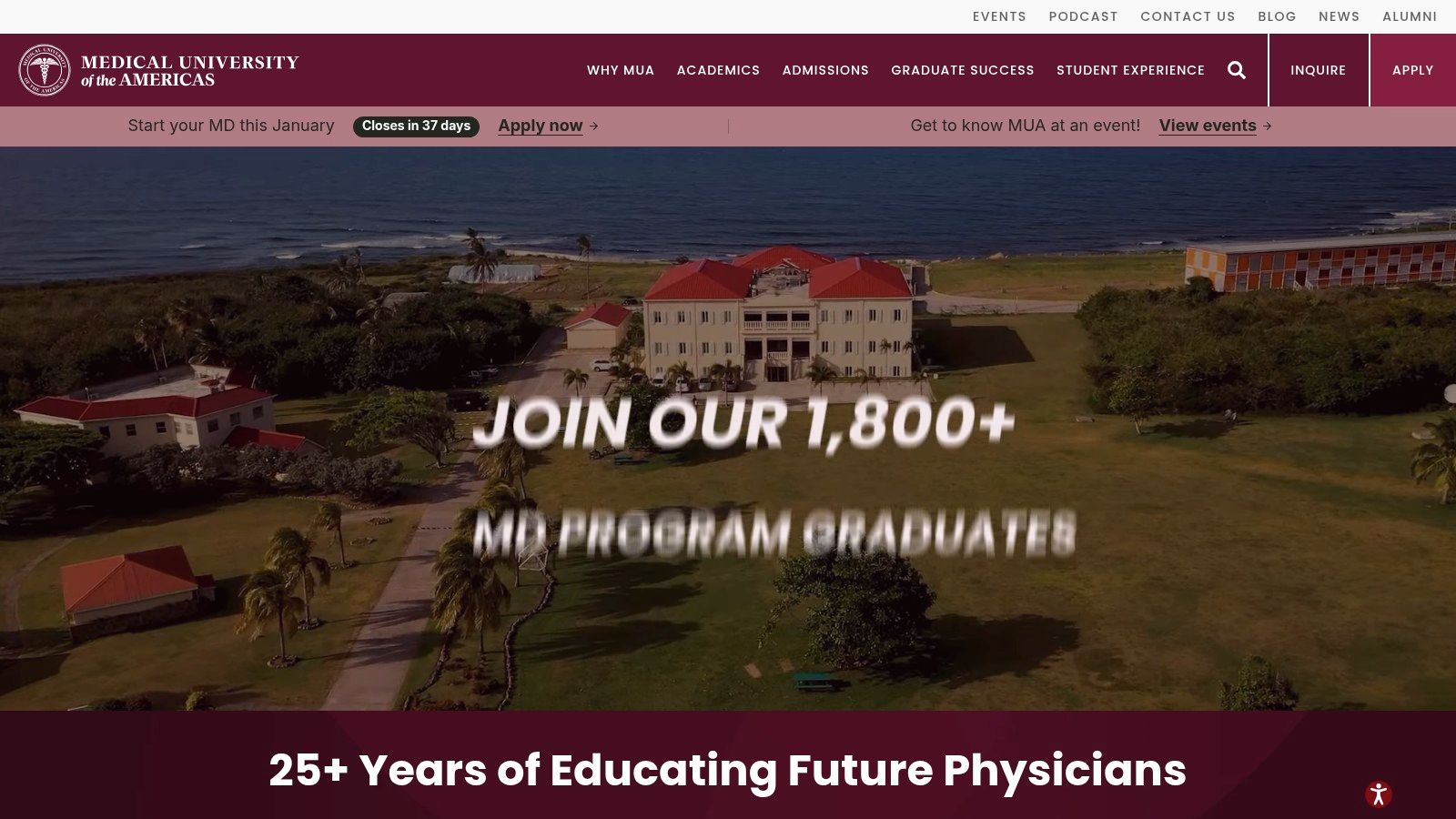
MUA runs an English-language MD program on Nevis: preclinical study on the island, then clinical rotations at affiliated hospitals, mostly in the United States. ACCM lists a current accreditation term, so confirm the expiry date and any conditions directly with the school before you commit. It has the smallest public profile of the seven schools here, and that changes your workload. Less independent data exists, so more of it has to come from the school in writing.
Visa and specialty decide more than campus does
Non-U.S.-citizen international medical graduates fill a substantial share of PGY-1 positions each year, while U.S. citizens who trained abroad take a smaller share. Non-U.S. IMGs commonly rely on J-1 or H-1B sponsorship, which adds a layer of risk that most admissions pages skip entirely.
Primary care absorbs most of that demand. Family medicine has drawn growing numbers of non-U.S. IMG matches in recent years. Dermatology, orthopedic surgery and plastic surgery remain selective for everyone, and demand for IMGs in hard-to-staff fields doesn't transfer to them.
- Request cohort data: completion, first-time exam performance and match results by specialty.
- Confirm clinical sites and fees: availability and charges change, and the school is the only current source.
- Check the licensing jurisdiction: ACCM accreditation does not guarantee licensure in any state.
- Compare more options: see medical schools that accept international students before you settle on one island.
Official site: Medical University of the Americas.
How the seven Caribbean schools differ on island base, accreditation, clinical training and fit
| Item | Island base | Accreditation (as listed) | Clinical training | Best for |
|---|---|---|---|---|
| St. George's University School of Medicine (SGU) | Grenada | SGU identifies the Grenada Medical and Dental Council; CAAM-HP lists voluntary withdrawal in 2021 | Affiliated hospitals in the U.S., UK, Canada and Grenada | Applicants seeking multiple entry tracks and study-location options |
| Ross University School of Medicine | Barbados | CAAM-HP: Accredited with Conditions until the next site visit | 80 weeks, primarily at affiliated U.S. teaching hospitals | Applicants seeking a structured U.S. clinical-training network |
| American University of the Caribbean School of Medicine (AUC) | Sint Maarten | ACCM accreditation listed through December 31, 2027 | 80 weeks of rotations in the U.S. or UK | Applicants seeking a clearly sequenced MD program with U.S. or UK rotations |
| Saba University School of Medicine | Saba | NVAO accreditation | U.S. hospitals and select Canadian electives | Applicants seeking a small-island setting and a European accreditation route |
| American University of Antigua College of Medicine (AUA) | Antigua | CAAM-HP: Accreditation with Conditions for 4 years, 2024–2028 | Clinical rotations in affiliated settings; partnership with Florida International University, subject to requirements | Applicants seeking a pre-medical pathway or Antigua-based preclinical study |
| Trinity School of Medicine | St. Vincent and the Grenadines | CAAM-HP: Accreditation with Conditions for 2 years, 2024–2026 | U.S. rotations, including 48 weeks of core rotations and 27 weeks of electives | Applicants seeking coordinated clerkship scheduling and a smaller campus |
| Medical University of the Americas (MUA) | Nevis | ACCM accreditation listed through June 30, 2032 | Clinical training follows preclinical study; confirm sites and placement details | Applicants seeking a smaller island campus and an additional school to compare |
Choosing Among Caribbean Medical Schools and Verifying Before You Commit
Shortlist two or three schools whose accreditation status and clinical-placement model fit the country where you intend to practice. Then ask each one the same four questions in writing: which body accredits the program and when that status next comes up for review, which clinical sites are confirmed for your entering class, what total cost of attendance looks like beyond tuition, and whether graduates of the last three cohorts were eligible for ECFMG Certification.
Handle the money second. Median yearly tuition across the Caribbean programs listed on Medical School Programs is $61.2k, and that figure covers tuition only. Housing, travel between clinical sites, exam fees and the months you spend not earning sit outside it.
If a school won't put an accreditation status, a cohort denominator or a rotation list in an email, that silence is your answer.
Caribbean programs are four-year, U.S.-style MDs taught on island campuses, with clinical rotations at affiliated hospitals mostly in the United States. That structure is why the accreditation question comes first: the degree travels only as far as the certification behind it.
Two practical checks separate a real shortlist from a brochure collection. Ask for first-attempt USMLE Step 1 and Step 2 CK pass rates for the last three graduating classes, split by campus and entry track. Then ask who schedules rotations and what happens if a site closes mid-year, because that answer tells you how much of your clinical education depends on an administrator you'll never meet.
Compare sources side by side rather than one admissions page at a time. Medical School Programs lists 24 English-taught medical programs with tuition, program length and licensing notes taken from official sources, which gives you a baseline for judging each Caribbean school's claims.
Confirm every detail with the school itself after that. Conditional accreditation gets renewed or withdrawn, clinical sites move between cohorts, and requirements in your target jurisdiction can change while you're enrolled. A shortlist of three verified in writing beats a list of ten you've only browsed.
Medical School Programs has been an independent guide to medical school programs since 2009, and its directory lists 24 English-taught medical programs across 16 countries with tuition, program length and licensing notes taken from official sources. If you're weighing a Caribbean MD against a European six-year degree, the side-by-side cost and licensing comparison shows the cost of each route before you commit. Visit Medical School Programs to compare the listings before you contact any admissions office.