
For students finishing in 2026, the median four-year cost of attendance is $297,745 at U.S. public medical schools and $408,150 at U.S. private schools. Listed English-taught European programs often run $11,500 to $18,100 a year, and that lower sticker only holds if you also price six years of living costs.
Tuition is the line on the brochure, and it is often the smaller part of the bill. A private U.S. school can list first-year tuition and fees near the mid-$70,000s while the full first-year budget, once housing, food, insurance, and required fees are in, clears $100,000. Families who multiply the tuition line by four will under-budget.
How much does medical school cost also depends on the route you pick. A six-year European degree entered from high school is not the same product as a four-year Caribbean MD with clinical rotations in the United States, and neither matches a U.S. school whose official budget already folds in living costs. Currency moves, visa cash held in a bank, and one repeated year can erase a tuition bargain. The comparison that matters is the full completion total in the currency that pays the bills.
Table of Contents
- Medical School Tuition by Region and School Type
- Four-Year Cost of Attendance at U.S. Schools
- Build Your Own Four-Year Budget
- International Students and Foreign-Student Pricing
- European and Caribbean Routes Compared on Total Cost
- Choose the Program With the Lowest Four-Year Total
Medical School Tuition by Region and School Type
Annual tuition is the figure applicants look up first, and it splits by school type, country, and program length.
| School or region | Program length | Annual tuition (USD) |
|---|---|---|
| U.S. public medical schools, median first-year tuition and fees | 4 years | $43,648 |
| U.S. private medical schools, median first-year tuition and fees | 4 years | $74,661 |
| Vanderbilt University, Doctor of Medicine, 2025-26 | 4 years | $70,900 |
| Yale School of Medicine, MD, 2025-26 | 4 years | $74,460 |
| Listed English-taught European programs, median | 6 years | $17.1k |
| Listed Caribbean MD programs, median | 4 years | $61.2k |
The U.S. rows are medians for first-year tuition and fees, not one campus price. Two private programs sit in that private band for 2025–26. Vanderbilt University listed annual Doctor of Medicine tuition at $70,900. Yale's listed MD tuition is in the same range. That tuition line is not the student budget.
How to read length and currency
The European programs in our listings are six-year medical degrees at public universities, taught in English and usually entered straight from high school. The median yearly tuition across those listed European programs is $17.1k. The Caribbean programs are four-year, US-style MD programs on island campuses, with clinical rotations at affiliated hospitals mostly in the United States. The median yearly tuition across those listed Caribbean programs is $61.2k.
A low annual price on a longer degree can still add up. A high annual price on a shorter degree can overtake it. Tuition is shown in the school's own currency where available, with an approximate US dollar figure for comparison. Convert at the rate you will transfer before you rank two schools.
Practical rule: Find the row closest to your situation and multiply annual tuition by program length. That product is a tuition-only total, and it is only the starting point for the budget that follows.
Four-Year Cost of Attendance at U.S. Schools
Cost of attendance (COA) is the number to budget against. It combines tuition, mandatory fees, insurance, housing, food, transportation, books, and other education-related living costs.
For the 2025–2026 academic year, an Association of American Medical Colleges compilation put median first-year tuition and fees at $43,648 at public medical schools and $74,661 at private schools. When living expenses, books, transportation, health insurance, and other required costs are included, median first-year cost of attendance rose to $75,654 for public schools and $106,787 for private schools. The figures were compiled from 94 public and 66 private U.S. medical schools.
The same compilation shows where that money sits inside a four-year view.
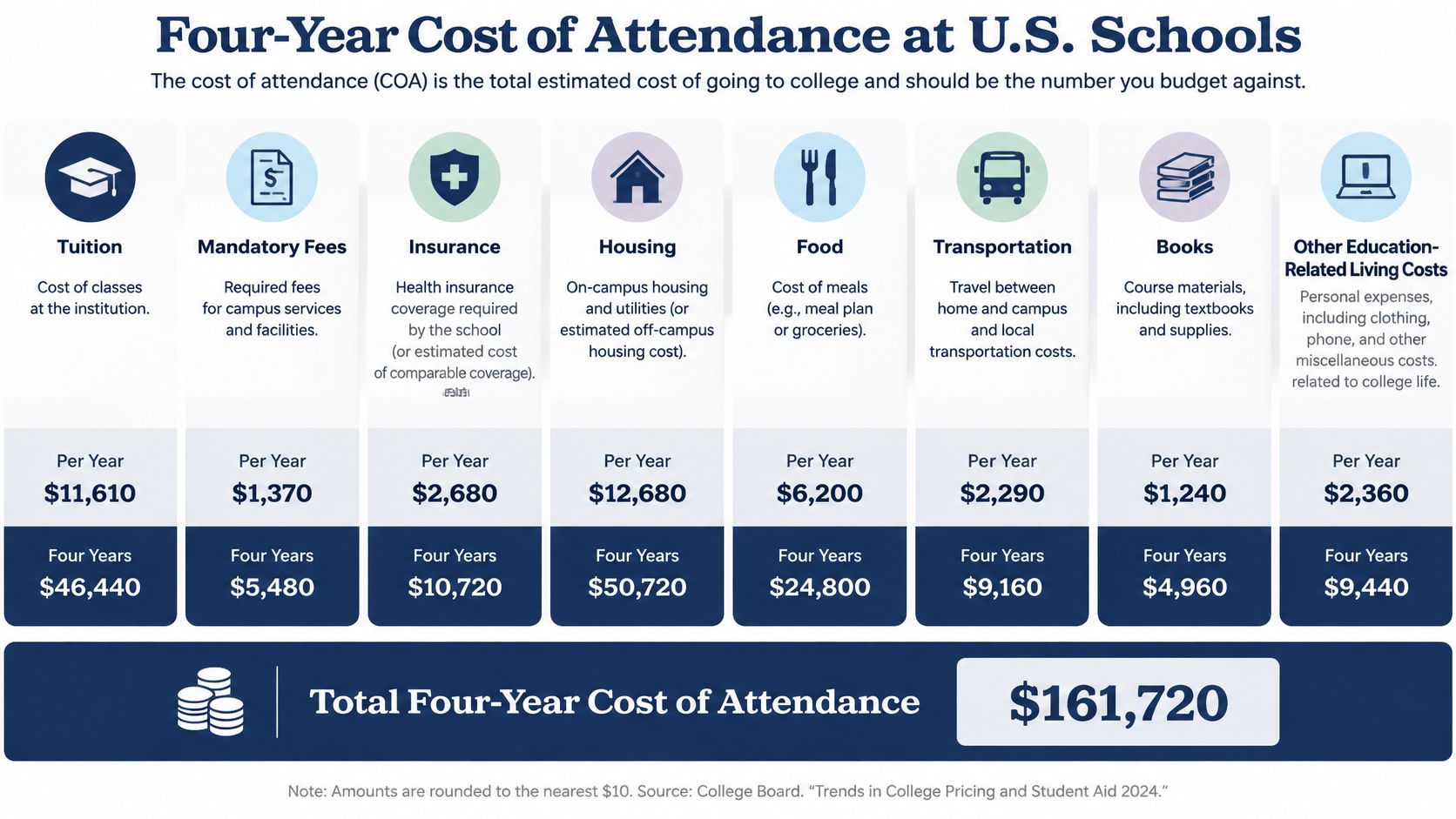
| School type | First-year cost of attendance | Four-year cost of attendance |
|---|---|---|
| Public medical schools | $75,654 | $297,745 |
| Private medical schools | $106,787 | $408,150 |
| Difference, private minus public | $31,133 | $110,405 |
What drives the private premium
Over four years, the median estimated cost of attendance for students graduating in 2026 was $297,745 at public schools and $408,150 at private institutions. Private minus public is $110,405 across the degree, about $27,601 a year, before local living costs are adjusted school by school. Published tuition alone understates the family budget because those four-year totals include both direct educational charges and the costs of living while enrolled. The private median can approach or exceed $400,000 before interest on loans, undergraduate debt, application expenses, or residency relocation costs are added.
A campus with lower tuition can still cost more if it sits in an expensive city or requires a large insurance and housing allowance. National medians are a yardstick, not your invoice. Replace them with the target school's official annual COA, multiply by four, and set that total beside the public and private rows. If your school-specific total sits well above the public median, housing and required fees are the usual reason, not a hidden tuition surcharge.
Build Your Own Four-Year Budget
A personal budget starts from the school's official annual budget for each year, not from the tuition page alone. For the 2025–26 academic year, Yale School of Medicine listed annual MD tuition of $74,460 and total annual budgets ranging from $115,691 for first-year students to $124,170 for third-year students. Tuition is about three-fifths of the first-year budget. The rest is the living and required-cost block you can sometimes trim, and the school can still require.
Price each line the tuition page skips
Separate tuition from everything else so you can see which part is fixed by the bursar and which part you estimate.
| Cost item | Included in published tuition? | How to estimate |
|---|---|---|
| Mandatory institutional fees | Usually no | Use the school's official fee schedule |
| Required health insurance | No | Use the school's student health plan price |
| Housing, food and transport | No | Use the school's living allowance or local rent |
| Books and equipment | No | Use the booklist and any clinical kit requirement |
| Application and test costs | No | Add application fees, test fees and score reports |
| Licensing exam fees | No | Check the exam body's current published fee |
| Visa and proof of funds | No | Check the visa fee and bank statement rules |
| Travel to clinical placements | No | Estimate return flights and housing near rotation hospitals |
| Loan interest and a repeated year | No | Model interest during study and one extra year |
Work through the sheet in this order.
- Copy each year's official budget. Yale's third-year figure is higher than the first-year figure, so a flat "year one times four" already misses a real step-up. Use the year-by-year sheet when the school publishes one.
- Split tuition from living costs. On the Yale 2025–26 numbers, first-year non-tuition costs are the gap between $74,460 and $115,691. That gap is what a high-rent city or a required health plan inflates.
- Fill the nine lines in the table from primary documents. Fee schedules, the student health plan price, the visa bank-statement rule, and the exam body's current fee beat a blog average. If a line has no published price, use the school's living allowance and label it as an allowance, not a receipt.
- Add costs the COA often leaves out. Application fees, licensing exams, proof-of-funds charges, and flights to rotation hospitals are easy to omit because they are not term bills.
Run three stress tests, then subtract funding
Next, rerun the four-year sum under three shocks. Raise living costs by 10%. Move the exchange rate 15% against the currency you earn or borrow in. Add one extra year of tuition plus living costs for a failed or delayed year. Keep the base case and the three shocked totals on the same sheet.
Sum all years in the base case, then subtract only funding you have in writing, such as savings, a named scholarship, or an approved loan. If your total is far from the school's annual budget multiplied by four, a line is missing or double-counted. On a Yale-style budget, four years near the first-year figure already imply a completion cost well above tuition times four, and the third-year step-up pushes it higher before interest.
If the shocked total only works when every scholarship arrives and no year is repeated, you don't have a plan yet. You have a best case.
International Students and Foreign-Student Pricing
International pricing is not one global average. Split domestic tuition, international tuition, and living costs, then convert the sum into the currency that funds you.
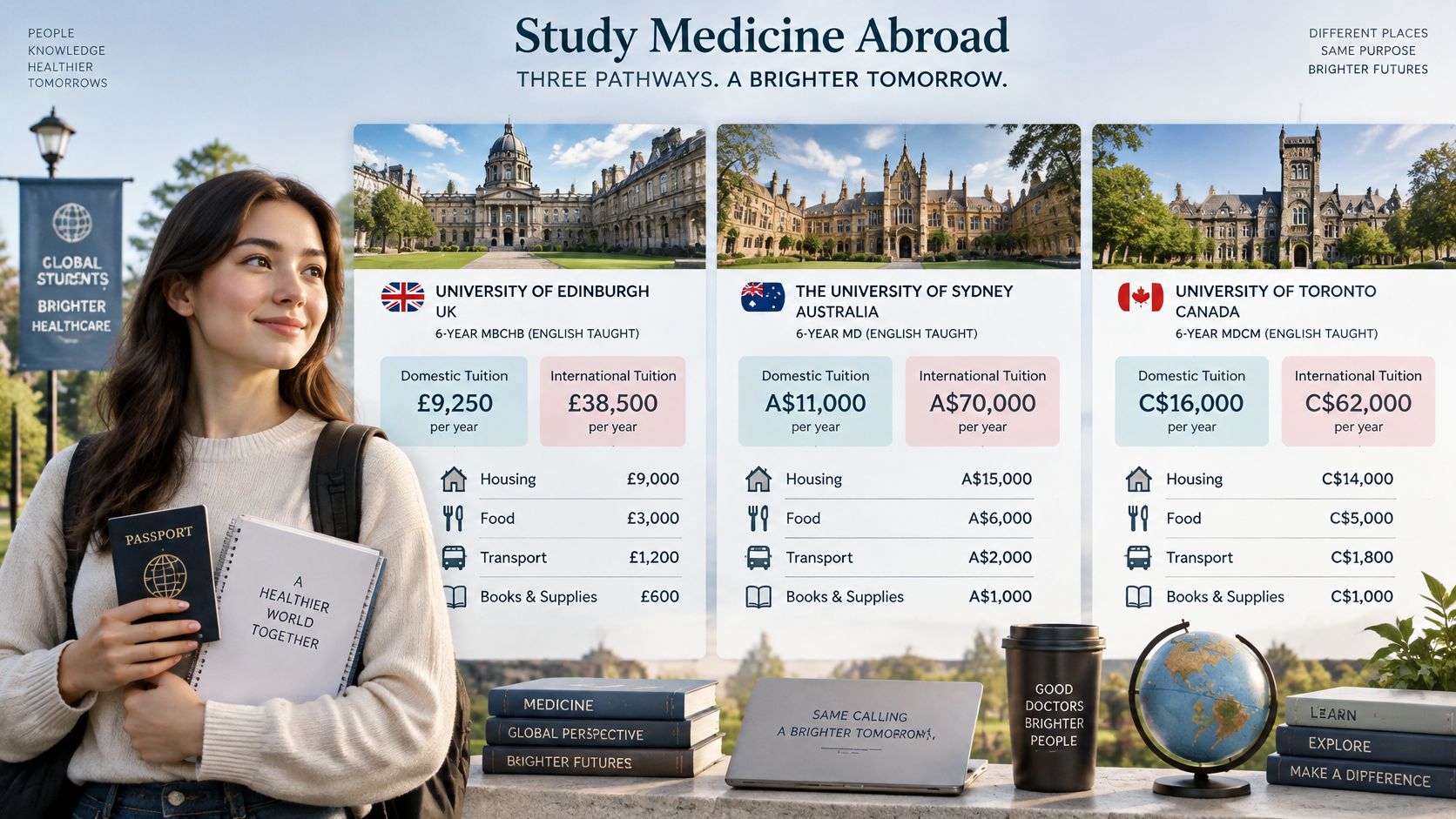
Three English-taught public-university programs show the European tuition band in dollars. The Medical University of Sofia in Bulgaria lists $11,500 a year for a 6-year MD. Riga Stradiņš University in Latvia lists $15,500 a year for a 6-year MD. Masaryk University, Faculty of Medicine in Brno, lists $18,100 a year for a 6-year MUDr. (MD). Those figures are tuition only. A six-year degree also adds two extra years of housing and food compared with a four-year MD, even when the annual tuition looks modest.
Why the international price can reverse the bargain
An OECD analysis of medical education in Ireland reported average tuition paid by international medical students of approximately USD 56,000, and Irish medical-school representatives noted that international tuition helped subsidize domestic students. Public funding is aimed at the domestic cohort, so universities set a higher fee for non-EU or other international students. Education at a Glance 2025 finds that foreign students typically pay higher tuition than national students in about two-thirds of OECD countries and economies.
Headline tuition misses four costs that hit international applicants harder.
- Currency: A fee that is unchanged in euros costs more in your home currency if that currency weakens. A 15% move against you raises every remaining year.
- Proof of funds: Visa rules can require a bank balance you cannot spend, on top of the visa fee itself.
- Aid access: Subsidized loans and domestic-style grants often stop at the border. Our guide on financial aid for international medical students sets out which routes still exist.
- A repeated year: Failing to progress means another year of international tuition plus living costs, not a small resit fee.
Borrowing is not the same thing as the sticker. The AAMC financial aid guidance reports median education debt for the class of 2025 of $215,000, below a full private cost of attendance, because students also use savings, family resources, scholarships, and institutional aid. International applicants who cannot tap those same tools should not assume they will land near that debt figure.
Apply the same three shocks used on a U.S. budget: living costs up 10%, a 15% currency move, and one extra year. The metric to keep is total completion cost in the currency of the funding source, with the Sofia, Riga, and Brno figures labelled as tuition only.
A short walk-through of how families line up those totals against aid is here.
European and Caribbean Routes Compared on Total Cost
Compare routes on tuition across the whole degree, not on the yearly headline. Using the median yearly figures for the listed programs, a six-year European program comes to about $102,600 in tuition alone. A four-year Caribbean program comes to about $244,800. Both are approximate products of medians, not quotes from a single bursar.
What each total leaves out
The routes are not like for like, so those two products are not final prices.
European degrees run six years at public universities, in English, and students usually enter from high school. You pay two extra years of rent, food, and local transport. You may also pay for a visa renewal and for language support once clinical work leaves the English classroom. Our English-taught medical schools in Europe list length and entry route beside each program so you are not comparing a six-year public degree with a four-year graduate-entry MD by accident.
Caribbean degrees run four years on island campuses, with clinical rotations at affiliated hospitals mostly in the United States. The island years and the U.S. clinical years do not share a rent market. Budget return flights and short-term housing near rotation hospitals, or the tuition-only total will look calmer than the years you live.
Set both beside a U.S. public and a U.S. private completion budget that already includes living costs. The Caribbean tuition-only median sits in a much higher band than the European tuition-only median, and U.S. clinical housing can push it further. The European tuition-only median stays far lower, then rises once you add six years of living costs and any repeated year.
Compare each program's full completion total, including living costs, travel to placements, and licensing exams. A cheaper year is not a cheaper degree.
Choose the Program With the Lowest Four-Year Total
Rank finished completion totals, not annual tuition. Set a ceiling that still works after living costs rise 10%, the exchange rate moves 15% against you, and graduation slips by one year. If a school only fits under the ceiling in the base case, it doesn't fit.
Different lengths belong on one comparison only after both are fully costed. A six-year European degree and a four-year Caribbean degree can show similar yearly living costs and very different completion bills once placement travel and the extra two years are in. The debt side of that choice matters as much as the tuition side, because interest during a long program changes which route is cheaper.
Three questions before you apply
Confirm every figure with the school for the year you would start. Fees, exam prices, and visa rules change. We don't publish figures we can't verify, and you shouldn't budget from an undated screenshot either. Record the date you checked each line.
- What does the official budget page say for your start year? Ask for tuition, mandatory fees, insurance, and the living allowance as separate lines.
- How is the living allowance built? A national average or a city rent survey will not match a hospital neighborhood in a clinical year.
- Can an international student receive institutional aid or a subsidized loan? A "scholarships exist" page that is limited to domestic students does not reduce your total.
Build a four-row sheet with one row per shortlisted school and columns for tuition, living cost, fees, and the scenario total. The program directory shows tuition, program length, and licensing notes taken from official sources, which is a useful first fill for those columns. Then email the three questions to each admissions or aid office before you pay an application fee. The school that answers with a year-specific budget, a clear living allowance, and a direct yes or no on international aid is the one you can rank. The school that answers with a slogan is still an unknown price.
Medical School Programs has published independent guides to medical degrees since 2009, including tuition, living costs, and program length for English-taught routes in Europe and the Caribbean. If you are pricing a full degree rather than a headline fee, start with the directory and the cost notes checked against each school's own pages. Visit Medical School Programs and line up your shortlist before you apply.