
Most new physicians finish medical school owing money on their education, and the balance is large enough to influence the years that follow.
The useful question is how that debt behaves before specialty income arrives. Loans taken for a bachelor's degree can join medical school borrowing, interest keeps accruing while earnings are low, and residency pay can limit monthly flexibility even when federal repayment tools are available.
Med school debt is a financing problem across an entire training pathway. Read the graduate balance as the starting line, then judge each program by the cost of reaching the first attending paycheck.
Table of Contents
- What Recent Graduates Actually Owe
- Debt That Starts Before Medical School
- Costs That Turn Tuition Into a Large Balance
- How Repayment Behaves Through Residency
- Three Borrowers and Three Different Bills
- Run the Affordability Test on Two Programs
What Recent Graduates Actually Owe
The AAMC 2024 Graduation Questionnaire reports that 71% of graduates finished with education debt, with a mean of $212,341 and a median of $205,000 among those reporting debt. The table collects the questionnaire figures for total education debt, including premedical borrowing.
Education debt reported by 2024 U.S. medical graduates
| Measure | Figure | Who it describes |
|---|---|---|
| Finished with education debt | 71% | All graduates |
| Mean total education debt | $212,341 | Graduates who reported debt |
| Median total education debt | $205,000 | Graduates who reported debt |
| Public medical school mean | $203,606 | Public-school graduates with the reported mean |
| Private medical school mean | $227,839 | Private-school graduates with the reported mean |
| Owed at least $200,000 | 56% | All graduates |
| Owed at least $300,000 | 23% | All graduates |
| Total education debt of $100,000 or more | 84% | All graduates |
Read the midpoint before the average
The median is the midpoint among indebted graduates: half owed more than that amount and half owed less. It's often the more useful starting point when you're trying to understand a typical borrower rather than the total borrowing spread across a group.
The mean, or average, adds everyone's reported debt and divides it by the number of borrowers. Larger balances can pull that average upward. Neither measure predicts your own bill, because your aid package, previous borrowing and living arrangements won't necessarily resemble another graduate's.
Public and private school averages offer another comparison, but they aren't price quotes. A private school with substantial grant aid could require less borrowing from a particular applicant than a public school offering little assistance.
Practical rule: Compare the amount you would need to borrow after grants and available savings, not the school's category or advertised tuition.
Understand what the balance includes
Total education debt isn't the same as medical-school tuition debt. These balances include educational borrowing accumulated before medical school, as well as borrowing associated with medical training.
That distinction matters when you compare your projected loans with a graduation statistic. If you add your undergraduate balance to a benchmark that already includes premedical debt, you may accidentally count the same category twice.
The balance also isn't a complete household financial statement. It doesn't tell you whether a graduate has credit-card payments, dependents, savings or someone else contributing to rent.
For a typical indebted graduate in this dataset, the median provides a sensible starting balance for an affordability discussion. Your enrollment decision, however, should begin with the complete cost of attendance and your likely borrowing, not brochure tuition or the assumption that you'll land near the average.
Debt That Starts Before Medical School
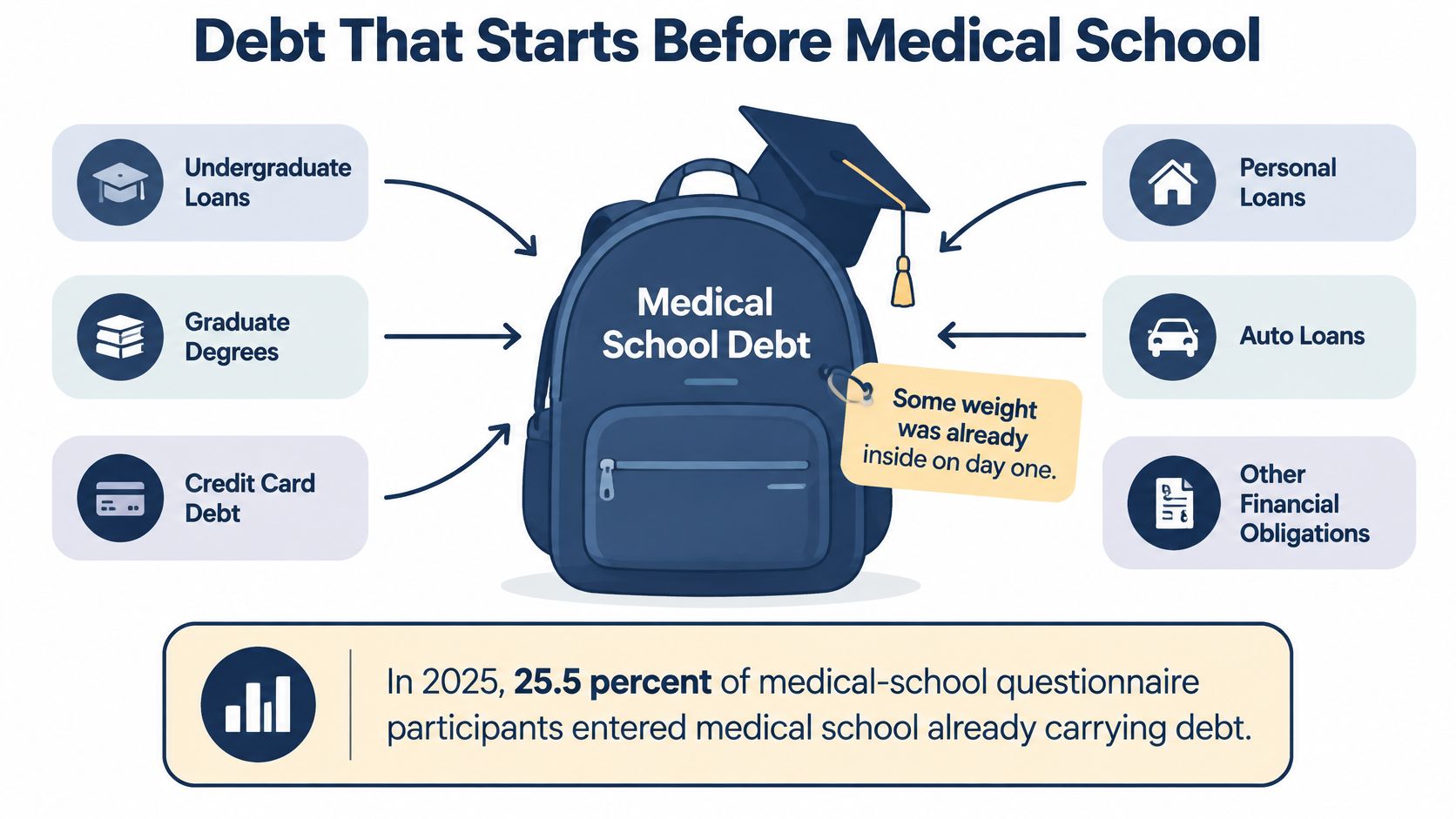
Think of graduation debt as a full backpack. Some of its weight was already inside on the first day of medical school.
The AAMC's 2025 questionnaire report states that 25.5% of participants entered medical school with educational debt, with a median of $25,000 among those who already owed; it also reports graduate medians of $215,000 in education debt and $6,000 in credit-card debt. These are different measures from a different questionnaire year, not interchangeable figures or, by themselves, proof of a trend.
The distinction between debt categories is easier to see as a packed bag.
Separate existing obligations from new borrowing
Say you and a classmate receive the same admission offer and identical financial-aid packages. Your classmate has no previous loans, while you still owe undergraduate debt and make credit-card payments.
You'll need the same new funding for school, but you won't have the same financial flexibility. Your existing accounts may require payments, accrue interest or affect the resources available for emergencies.
Keep these categories separate:
- Premedical education loans: Record the balance, lender, interest rate and repayment status for each undergraduate or other education loan.
- Noneducation obligations: List credit cards, vehicle loans and other required payments separately from student borrowing.
- New medical-school borrowing: Estimate what you'll need for tuition and living costs after grants, scholarships and usable savings.
Don't add separate medians together and call the result a typical borrower's total. The people represented by each median aren't necessarily the same borrowers.
Decide what would improve your starting position
Delaying enrollment can make sense if you have a credible opportunity to reduce expensive debt or build savings. It isn't automatically the cheaper choice, because postponing training also changes when you can begin your medical career.
A lower-cost admission offer or additional grant aid may improve your position without requiring a delay. Compare actual alternatives rather than treating existing debt as an automatic reason to abandon medicine.
Applicants considering English-taught European or Caribbean programs need an additional eligibility check. Loan availability, visa conditions and repayment across currencies can differ, and an international applicant shouldn't assume access to the federal aid or income-driven options available to an eligible U.S. borrower.
Complete this inventory before accepting an offer:
- Existing education loans: Balance, rate, lender and current repayment requirements.
- Other consumer debt: Balance, minimum payment and any upcoming rate changes.
- Expected annual cost of attendance: School charges plus a realistic personal living budget.
- Loans you can obtain: Confirmed borrower eligibility, school eligibility and lender terms.
Costs That Turn Tuition Into a Large Balance
A tuition quote describes a school charge. Your borrowing requirement comes from several layers of spending and financing, minus the money you can contribute without borrowing.
Build those layers for a named program, using its current fee schedule and your own living arrangements. A comparison based on national averages won't tell you what rent, travel or required clinical placements will cost you.
Build the cost stack
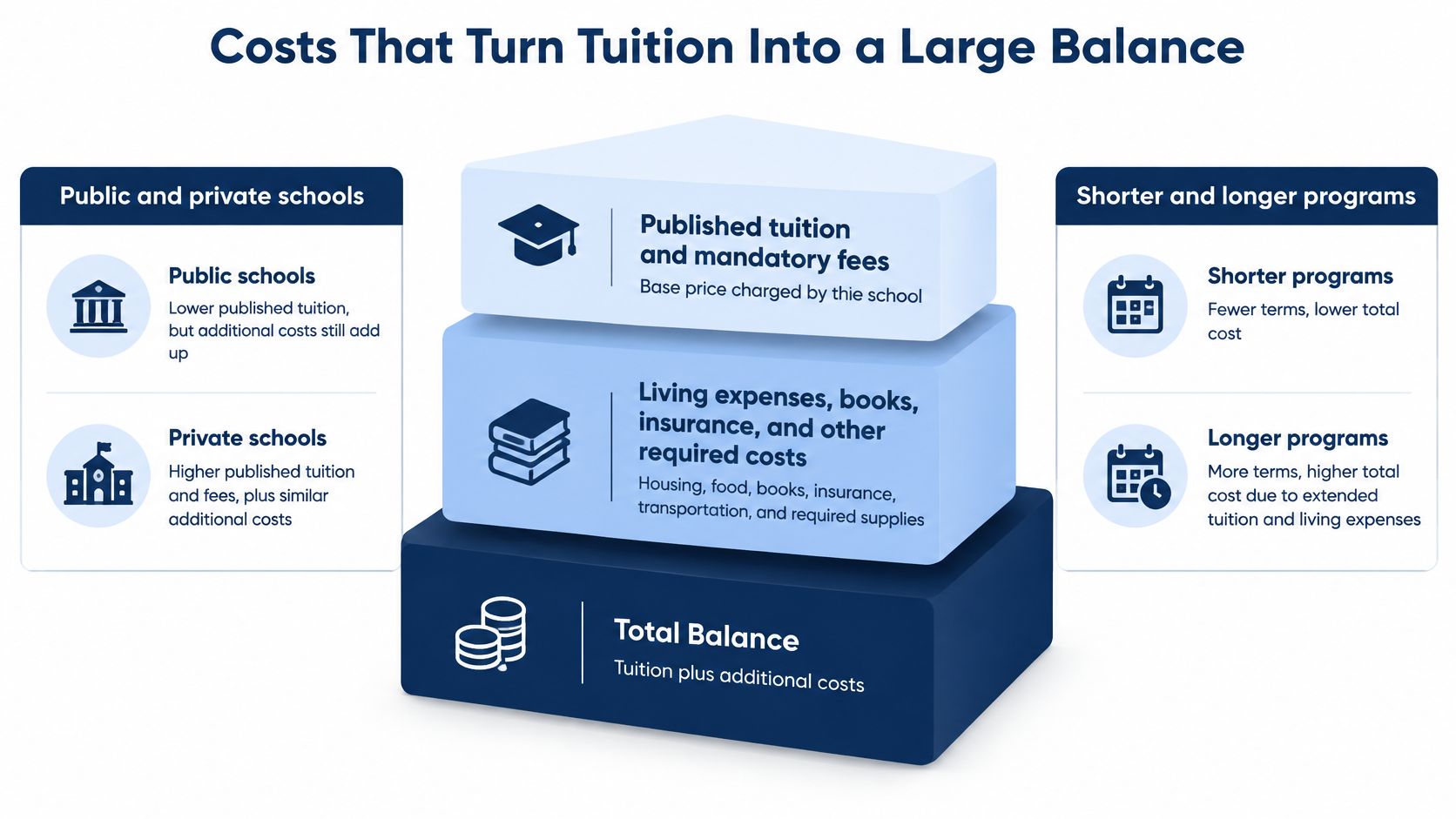
Published tuition and mandatory fees come first. Record the charges for each stage of the degree, including any differences between classroom and clinical training. Don't assume the opening-year price applies unchanged throughout the program.
Living and training expenses come next. Include housing, food, transport, books, insurance, required equipment and examination costs. If you'll need to relocate for placements, include the move and possible overlap between accommodation commitments.
The diagram separates the headline school price from the expenses that surround it.
Financing costs form another layer. Check when interest begins on each loan and whether unpaid interest can be added to principal under its terms. Keep original borrowing and accrued interest in separate spreadsheet columns so you can see why the projected balance changes.
Funding gaps and currency exposure complete the stack. If scholarships, savings and available education loans don't cover expenses, identify the proposed replacement funding before enrolling. For overseas study, record the currency of tuition, living expenses, loans and expected repayment income.
Compare the whole program
Lower annual tuition doesn't necessarily mean lower total borrowing. A longer course requires living support for longer, while an apparently shorter pathway may have expensive placements or relocation requirements.
Use a spreadsheet with a row for each academic period and columns for charges, living costs, confirmed aid, available cash and new borrowing. Keep uncertain scholarship awards out of the confirmed-aid column.
Our guide to financial-aid options for students attending an international medical school can help you identify funding categories to investigate. A possible funding route isn't an approved loan, so don't use it to close a budget gap until eligibility and terms are confirmed.
A school is financially comparable only after you've priced the full route through graduation, not just its opening tuition invoice.
Put rankings aside until that calculation is written down. You need to know what you're purchasing, how long you'll need support and which expenses you'll finance.
How Repayment Behaves Through Residency
A future physician salary doesn't make every loan balance manageable. You have to reach that income while meeting the obligations that apply during training.
The AAMC's 2025 repayment illustration uses $215,000 in federal Direct Loans, shows the repayment totals below, lists the stated federal rates and reports the post-residency payoff finding. These are illustrations and historical loan-period rates, not a personalized quote or a guarantee of currently available repayment terms.
Repayment outcomes and federal rates for a $215,000 example
| Item | Figure | What it applies to |
|---|---|---|
| Higher illustrated total repayment | About $480,000 | One scenario on $215,000 of federal Direct Loans |
| Income-based illustrated total | About $390,000 before a later balance treatment | Income-based scenario on the same balance |
| Direct Unsubsidized Loan rate | 7.94% | July 2025 through June 2026 |
| Direct PLUS Loan rate | 8.94% | July 2025 through June 2026 |
| Repaid within 10 years or less after residency | 85% | Physicians who borrowed for medical school |
Distinguish the payment from the total cost
A smaller required monthly payment doesn't necessarily mean a smaller lifetime bill. It may reflect a longer repayment period, income-based calculations or another treatment of the remaining balance.
The income-based illustration also includes a later balance treatment. Don't interpret its displayed repayment total as a universal payoff amount, and don't assume that every borrower qualifies for the mechanism behind it.
The post-residency payoff finding is encouraging, but it doesn't describe how outcomes differ by specialty, geography, family obligations or international-graduate status. Nor does a clock starting after residency capture the full period since borrowing began.
Check interest against your training-year payment
For a rough monthly interest check, multiply the outstanding balance by the annual rate and divide by the months in a year. Using the illustration's balance and Direct Unsubsidized rate gives approximately $1,423 in monthly interest, calculated as $215,000 × 0.0794 ÷ 12.
That's an approximation, not a loan servicer's exact accrual calculation. If your payment is below accrued interest, unpaid interest can accumulate unless the applicable plan provides an interest benefit; whether it capitalizes depends on the loan and repayment rules.
- Check the required payment: Use your expected resident income and household circumstances, not your hoped-for attending income.
- Check unpaid-interest treatment: Ask whether the plan waives, pays, retains or capitalizes interest you don't cover.
- Check eligibility: Confirm that your specific loans and borrower status qualify for the repayment option being modeled.
Use a residency medicine salary guide to understand the income stage you're budgeting for, then replace general estimates with the relevant employment offer when available.
A delayed match requires its own budget, including how you'll support yourself and meet loan obligations without the expected residency job. Overseas-program graduates shouldn't assume that pursuing U.S. residency automatically provides access to federal repayment tools.
Model the low-pay years first. Specialty income matters later, but it can't pay a bill that comes due before you earn it.
Three Borrowers and Three Different Bills
Borrowers can attend similarly priced schools and still face very different risks. The following scenarios illustrate how loan access, household obligations and the route into residency change the decision.
The people reviewing a loan plan need more than the graduation balance in front of them.

A public-school graduate with a confirmed residency
Consider a U.S. public-school graduate who borrowed through eligible federal Direct Loans and has matched into residency. The borrower chooses a repayment route using the actual resident employment terms and confirms the treatment of unpaid interest.
This plan is manageable when required payments fit alongside rent, essential spending and a modest emergency reserve. Its weak point is a budget that leaves no room for relocation, family needs or a change in household income.
A repayment system helps, but it doesn't replace a workable monthly budget. The borrower should know which expenses could be reduced before relying on extra credit.
A private-school graduate with older obligations
Another graduate finishes a private program while still carrying undergraduate loans and credit-card debt. The education-loan payment looks affordable on its own, but the household budget also includes obligations outside that calculation.
This borrower needs an account-by-account payment calendar. A student-loan option that adjusts to income won't automatically adjust the credit-card bill or make an existing vehicle payment disappear.
The plan becomes more resilient when the borrower controls expensive consumer debt and avoids adding new fixed commitments during training. It becomes fragile if every unexpected expense goes back onto a card.
A separate repayment discussion can help prompt questions, but your own loan documents determine the answer.
An overseas-program applicant using private financing
An international applicant compares an overseas tuition quote with a U.S. alternative and finds the annual price attractive. The proposed financing, however, comes from a private or home-country lender, while the hoped-for repayment income depends on entering U.S. residency.
This applicant needs written answers about payment start dates, hardship options, currency conversion and what happens without the expected match. The school's location alone doesn't establish either borrower eligibility or lender flexibility.
The plan is stronger when the applicant has an affordable repayment route outside the preferred residency outcome. It breaks if repayment requires a job the graduate hasn't yet secured and the lender won't accommodate the delay.
Choose the scenario closest to your actual financing and career route, not the school with the most familiar name.
Run the Affordability Test on Two Programs
Compare named programs using the same assumptions. Don't give a preferred school optimistic living costs while assigning the alternative a cautious budget.
For a concrete starting comparison, our Medical School Programs directory lists 24 English-taught programs in Europe and the Caribbean; median yearly tuition is $17.1k across the listed European programs and $61.2k across the listed Caribbean programs. For the worksheet, Program A is the Medical University of Sofia, with $11,500 annual tuition for a six-year MD, and Program B is Riga Stradiņš University, with $15,500 annual tuition for a six-year MD.
Those are tuition inputs, not complete financing proposals. Without applicant-specific expenses and approved funding, neither program has demonstrated affordability.
Complete the checks before committing
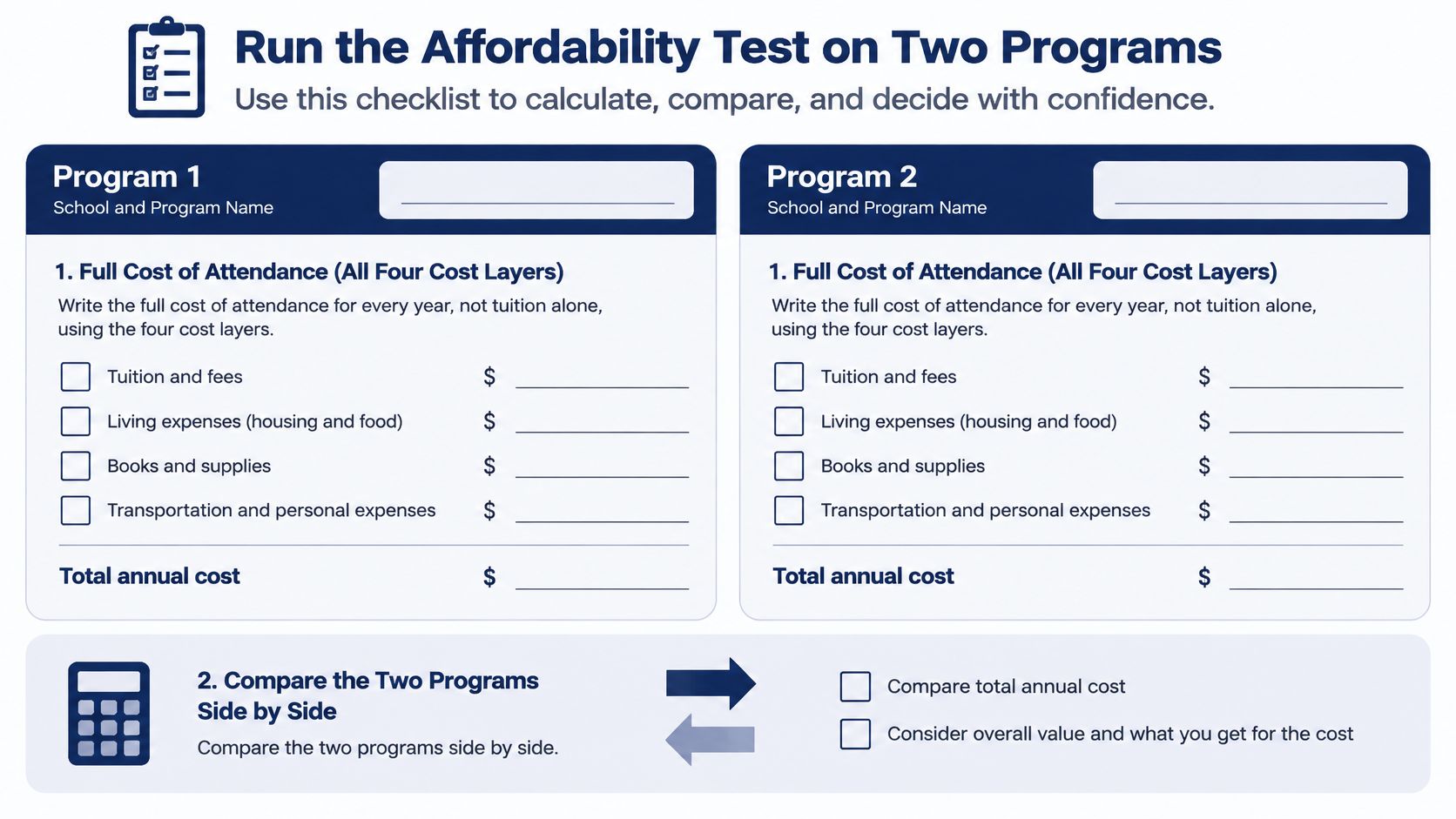
Write the full cost of attendance for every year. Use the fee schedule and a personal budget, including required travel and clinical-placement expenses. Leave a visible question for any charge you can't establish.
Add debt already owed. Enter actual account balances, not questionnaire medians. Keep consumer payments separate so they don't disappear inside a student-loan total.
List only obtainable loans. Record borrower eligibility, available funding, rate type and repayment start date. An advertised loan product isn't evidence that you qualify.
Estimate the residency-period payment. Use the lender's applicable terms and realistic training income. Record whether unpaid interest accumulates and how the balance changes.
Test a disrupted career timeline. Build a budget for delayed matching and a lower-income specialty outcome. Identify the money that would cover essential spending and required payments.
Check cross-border restrictions. Record relevant visa conditions, borrowing and repayment currencies, and whether federal repayment options are unavailable. Don't substitute an assumption for a lender's written answer.
Compare and save the results. Date the worksheet and update it when school fees, funding offers or your circumstances change. Mark a program as passing only when a documented repayment route works during the low-pay years.
Use the checklist to keep missing information visible rather than treating it as a zero-cost item.
Record a decision rather than a preference
Affordability worksheet for two programs
| Check | Program A | Program B |
|---|---|---|
| 1. Full cost of attendance per year | Sofia tuition identified; obtain mandatory fees and price personal living costs | Riga tuition identified; obtain mandatory fees and price personal living costs |
| 2. Debt already owed | Enter current education and consumer account balances | Use the same current account balances |
| 3. Loans actually obtainable and rate type | Obtain written eligibility and lending terms for Sofia | Obtain written eligibility and lending terms for Riga |
| 4. Estimated residency-period payment and interest growth | Calculate from approved loan terms and expected training income | Calculate from approved loan terms and expected training income |
| 5. Result if the match is delayed or pay is lower | Identify funding for the delay and required payments | Identify funding for the delay and required payments |
| 6. Visa, currency and federal repayment limits | Confirm Bulgarian study requirements and borrower-specific restrictions | Confirm Latvian study requirements and borrower-specific restrictions |
| 7. Repayment path works in low-pay years (pass or fail) | Fail for now: total costs and financing remain unconfirmed | Fail for now: total costs and financing remain unconfirmed |
These verdicts don't mean either school is unaffordable. They mean tuition alone is insufficient evidence to approve borrowing.
If you're deciding whether studying medicine abroad is worth it, make the financial verdict specific to your intended licensing and employment pathway. A degree can fit your academic goals while its proposed financing still fails your household budget.
Borrow only after the unanswered cells become documented costs, confirmed funding and a workable repayment route. A low sticker price isn't a pass, and neither is confidence that you'll eventually earn more.
Visit Medical School Programs to compare English-taught medical degrees in Europe and the Caribbean alongside guidance on admissions, costs and career pathways. Choose the programs you're seriously considering, record their tuition and duration, and build an affordability worksheet before committing to loans.