
The average first-year resident stipend in the United States comes to roughly $68,000 a year. That figure is a training stipend set by year and institution, and it stays the same whether you plan to practice surgery or pediatrics.
Published residency medicine salary numbers describe the gross line on a training contract. Usable income is what remains after inflation, local housing costs, and any benefits you would otherwise pay for yourself. For many international graduates, visa rules can also block the extra shifts that colleagues pick up. So read the offer as an apprenticeship wage for supervised years, and treat attending income as a separate question for later.
Table of Contents
- What Residency Medicine Salary Means
- Resident Stipends by Training Year
- How Region Changes the Same Training Year
- Why Specialty Barely Changes Residency Pay
- A Monthly Budget Built From One Stipend
- What International Graduates Can Actually Use
- How to Judge an Offer Before You Rank
What Residency Medicine Salary Means
Say you match at a large teaching hospital as a first-year resident. The graduate medical education office sends a contract with one annual figure. That number is a gross training stipend paid by the employing hospital, not a market wage negotiated from the field you will eventually practice.
Think of it as an apprenticeship. The hospital pays you to learn under supervision while you staff the service. A surgery resident and a pediatrics resident in the same program and the same year usually share one scale. The contract is paying for the training year, not for the specialty label on your badge.
Three ideas get mixed up in salary threads, and they should stay separate.
- National mean: A published average across many programs. It is a benchmark, not your paycheck.
- Individual offer: The postgraduate-year line in one hospital's contract, plus whatever that hospital adds in benefits.
- Later attending income: What physicians earn after training ends. It belongs to a different labor market and does not arrive on match day.
A nominal raise can still leave you with less purchasing power. Prices for rent, food, and transport move on their own, so the headline increase is not the same thing as a gain in what the stipend buys. Geography, the institution's own scale, benefits, and local housing decide the rest.
Practical rule: Read the stipend as a contract figure for one training year. Do not read it as a forecast of what you will earn as an attending.
Your own contract's year line is the offer. City costs, benefits paid in kind, and any visa limits on extra work sit outside that line and change what you can spend.
Resident Stipends by Training Year
The American Medical Association's summary of AAMC stipend data reported an unweighted average first-year resident or fellow stipend of $68,166 as of July 1, 2025. That was $1,453 more than the 2024 average, a 2.2% rise, and the slowest first-year growth since 2021. Pay steps up by postgraduate year, not by specialty.
| Training year | Average annual stipend |
|---|---|
| PGY-1 | $68,166 |
| PGY-2 | $70,499 |
| PGY-3 | $73,301 |
| PGY-4 | $77,593 |
| PGY-5 | $81,807 |
| PGY-6 | $84,744 |
| PGY-7 | $89,187 |
| PGY-8 | $94,215 |
Divided across twelve months, the first-year average is about $5,681 before taxes. That monthly figure is gross. Federal tax, state tax where it applies, Social Security, and Medicare all come out before rent.
The steps are uneven
The ladder does not climb in equal bites.
- PGY-1 to PGY-2: $2,333
- PGY-2 to PGY-3: $2,802
- PGY-3 to PGY-4: $4,292
- PGY-4 to PGY-5: $4,214
- PGY-5 to PGY-6: $2,937
- PGY-6 to PGY-7: $4,443
- PGY-7 to PGY-8: $5,028
Raises alternate between roughly $2,300 to $2,900 and $4,200 to $5,000. A resident who expected a straight line will feel some years as a small bump and others as a clearer jump. From the first-year average to the eighth-year average the full climb is $26,049, about 38%. Many programs end well before year eight. A three-year residency uses the early rungs. A five-year surgical program reaches the middle of the table. Year eight is a benchmark for long training, not a salary most readers will collect.
Nominal up, prices up faster
The same AAMC figures, after adjustment for the U.S. Consumer Price Index, show resident and fellow pay down 0.48% from 2024 to 2025. The check grew. What it bought did not.
A national mean is a yardstick. The PGY line in your contract is the offer.
Use the table to see whether an offer sits near the unweighted average for that year. Then read the contract, because institutions set their own scales around that benchmark.
How Region Changes the Same Training Year
Hold the training year still and the stipend still moves. Weighted first-year averages run from $65,076 in the Southern United States to $77,649 in the West, a gap of $12,573 a year. That works out to about $1,048 a month before taxes for the same stage of training.
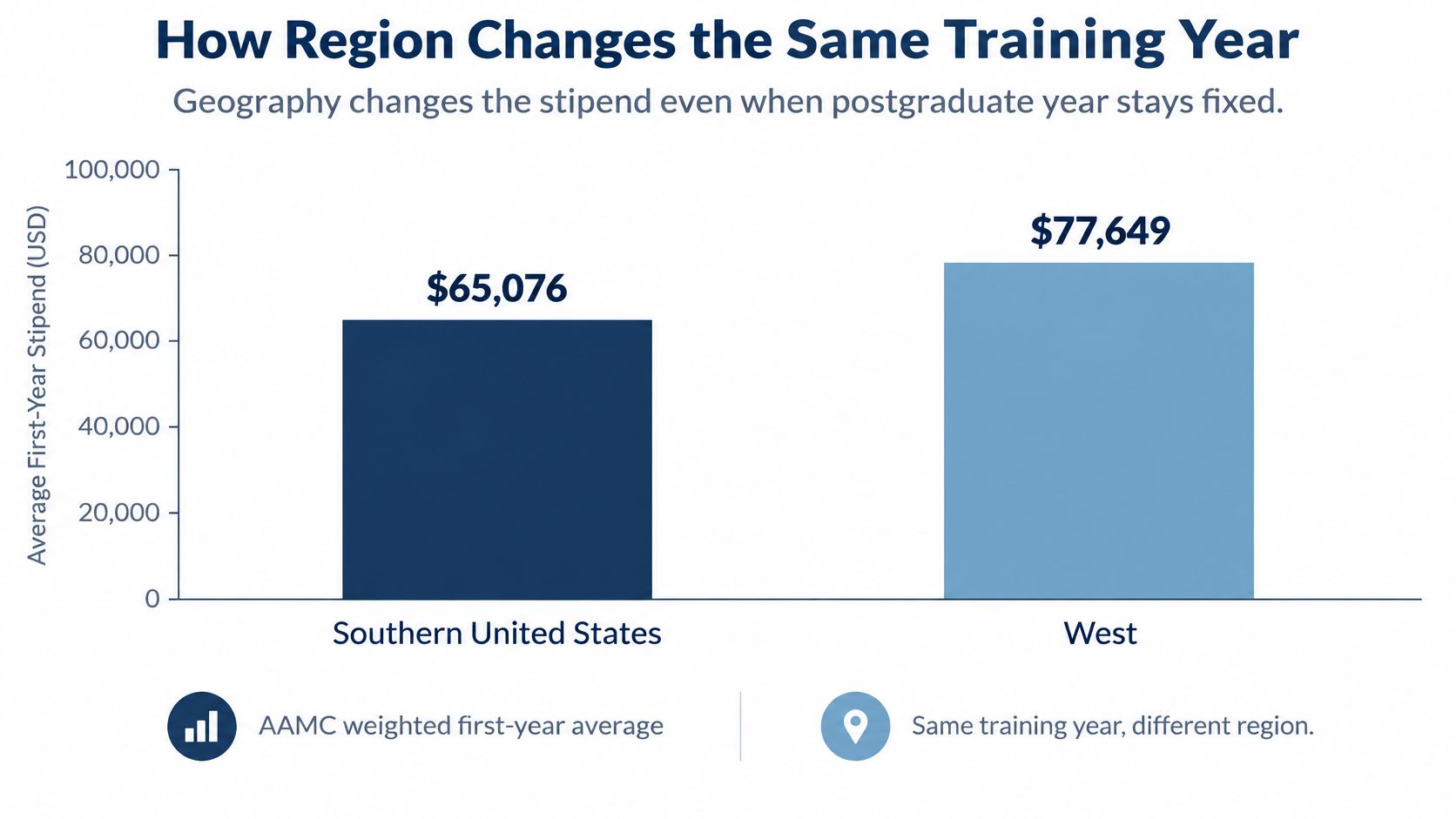
At year eight the spread widens. The South averages $86,768 and the West $107,587, a gap of $20,819. A longer program in a higher-paying region compounds that difference across every year of training. The rule stays the same: year and institution set the scale, and region decides where on the map that scale sits.
| Region | PGY-1 weighted average | PGY-8 weighted average |
|---|---|---|
| Southern United States | $65,076 | $86,768 |
| Western United States | $77,649 | $107,587 |
Weighted bands, not the national mean
These regional figures are weighted averages. A national unweighted mean counts each program once, while a weighted cut lets some programs count for more than others. The two answer different questions, so do not subtract $65,076 from $68,166 and call the difference a mistake.
Housing can erase the higher gross
A Western stipend can shrink fast once rent enters the picture. A lower Southern stipend can go further if housing takes a smaller share of the check. Two PGY-1 contracts with the same gross are not equal offers once you price a one-bedroom near the hospital, a parking permit, and groceries.
Hospitals within a region still set their own pay scales, so the regional figure marks a band rather than the number on your contract. Compare offers at the same postgraduate year in the cities where you would live. Then ask what the program includes on top of the stipend: housing support, meals, parking, and call pay. None of that shows up in a regional average, and it can change the usable monthly amount by more than the gap between two gross figures.
Why Specialty Barely Changes Residency Pay
Applicants hear that attending pay differs by field and expect the residency check to split the same way. The AAMC's discussion of resident stipends states that resident salaries are generally set by the employing institution and correlate with training year rather than specialty.
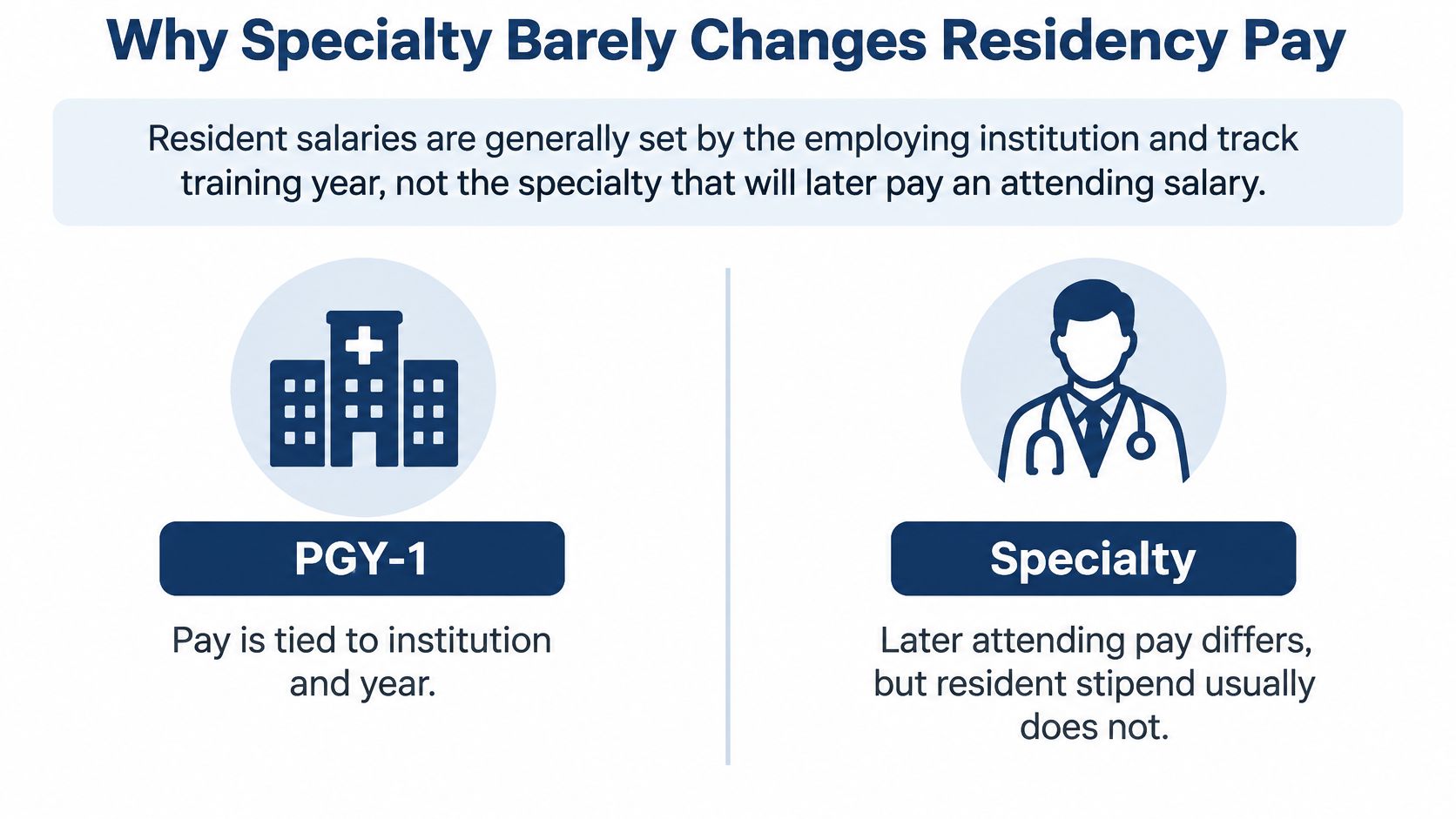
A PGY-1 in internal medicine, pediatrics, or surgery at one hospital is usually on one scale. Choosing a field with higher attending earnings does not shorten the toll in training years, and choosing a lower-earning field does not reduce it. Residency is the span you cross. Attending pay is the far bank.
A different labor market
Published physician and surgeon medians sit far above residency stipends because they describe attending practice after training. They are not contract figures for residents, and they are not a promise for any one specialty. A three to seven year training path is paid on the stipend schedule in front of you, year by year.
Later-year pay rises because the postgraduate year rises. A chief year, research track, or extra call can add a small differential, and those add-ons stay institutional rather than forming a national specialty scale. If a program advertises one, read it as a local extra on top of the year line.
The stipend is still a gross contract figure. What remains usable depends on taxes, local prices, benefits you would otherwise buy, and visa limits on outside work.
Don't fund medical school on an attending median you will not earn while you are still a resident.
Choose the specialty for the work you want after training. Use the stipend only to plan the years you will live on it.
A Monthly Budget Built From One Stipend
Take a PGY-3 at the national unweighted mean of $73,301. Divided by twelve, that is about $6,108 a month before taxes. Build the month in order, and don't invent a single take-home. Filing status and state tax make one national net figure false.
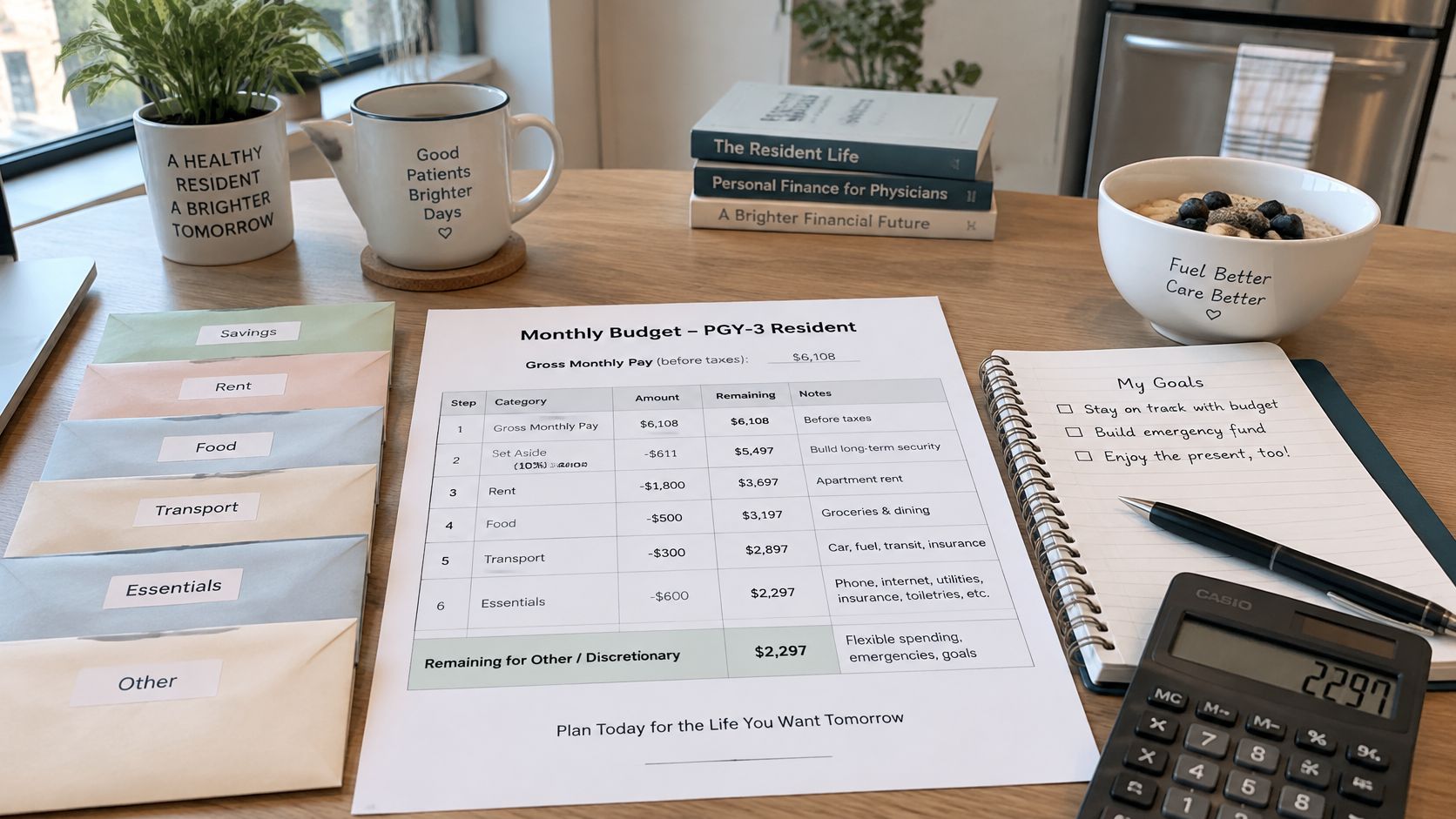
- Start from gross monthly pay. Write $6,108 at the top. That is the ceiling, not the spending money.
- Set aside taxes without pretending you know the exact net. Plan for federal income tax, state tax where the hospital sits, Social Security, and Medicare. Two residents with the same gross can land in different nets if one files single in a state with an income tax and the other files jointly where there is none.
- Subtract rent as the swing item. A West Coast match can absorb more of the check than a Southern match even when the gross stipend is higher. Price an actual unit near that hospital, not a national rent average.
- Count non-cash benefits as pay you don't have to buy. Health insurance, disability coverage, meals on call, parking, and a retirement match replace cash you would otherwise spend. A free meal on a long call night is not glamorous, and it is still money that stays in the account.
- Leave moonlighting out of this base budget. Extra shifts are not guaranteed income. Build the month so it works on the stipend alone.
A small raise against a rent hike
On a $68,166 first-year stipend, a 2.2% nominal raise is the $1,453 already on the books. That extra does not automatically cover a rent increase in the same city. If the landlord raises the lease by more than the after-tax slice of that raise, the resident is behind even though the contract went up.
The same habit you'd use to build a small-business cash flow forecast applies to a training year: list what comes in, list what must go out, and don't count money you can't yet earn. Readers still comparing schools should also look at the cost of attending an international medical school before they assume a residency stipend will service those bills.
Run three lines on any offer. Gross by postgraduate year. Benefits that replace cash spending. Housing in that city.
What International Graduates Can Actually Use
Two residents in the same program and the same postgraduate year draw the same base stipend, whatever passports they hold. What each one can use is a different question. The published figure is a gross contract number set by year and institution, and for an international graduate several deductions never appear in the table at all.
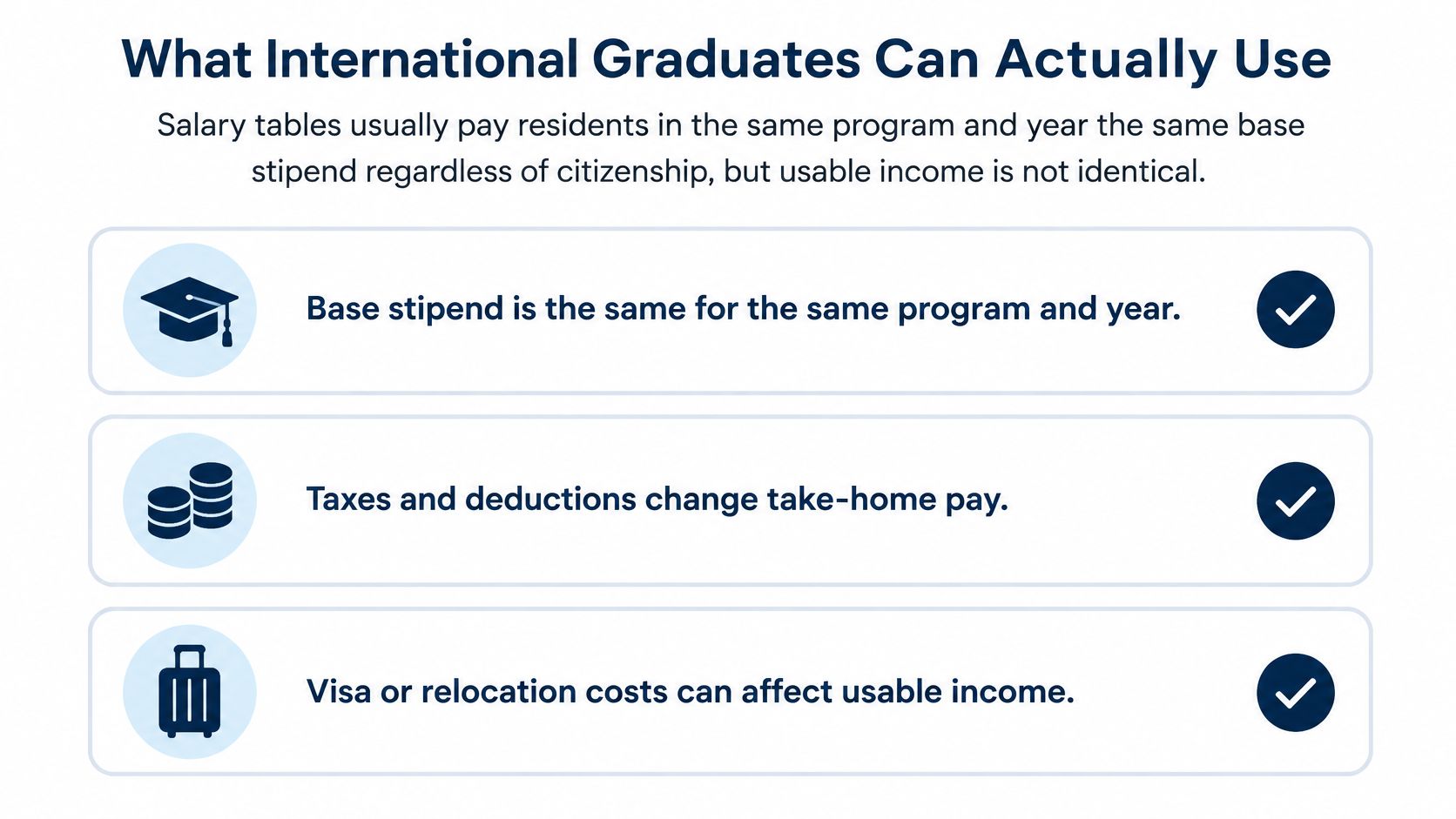
International medical graduates form a significant share of U.S. residents, and the label covers two distinct groups: graduates of foreign schools and U.S. citizens who earned their degrees abroad. "IMG" and "international applicant" describe different sets of people. A pay discussion that treats them as one person misleads both, because the restrictions that change usable income attach to the visa rather than the diploma.
Visa status changes the plan, not the base line
A common J-1 training visa carries immigration conditions that can narrow post-residency options. An H-1B can involve different salary-documentation rules. Visa specifics belong with an immigration professional. The budget point is narrower: the base stipend can match a classmate's exactly while the paperwork around the job, and the path that follows it, does not.
Base stipend is not moonlighting
Extra shifts are often presented as the way to raise residency medicine salary. For an international graduate, the permission question comes first. Visa status, program approval, licensing, and malpractice coverage can block that work even when the resident on the next rotation is cleared to take it. If the visa or the program closes that door, the extra income never enters the plan, and the stipend has to carry the month on its own.
Costs that sit outside the advertisement
Relocation, licensing fees, and the weeks before the first paycheck never appear in the stipend table. A graduate who arrives early, sits exams, and puts a deposit on an apartment is spending money the contract has not started paying yet. The residency match for international medical graduates turns that timing into a real expense, because a match without a usable first month is a thinner offer than the annual number suggests.
Ask what remains usable for this applicant after visa rules, relocation, licensing, and limits on outside work. That figure is the one to plan around.
How to Judge an Offer Before You Rank
Compare programs with the contract in front of you, including applicants who trained or may train outside the United States.
- Match the offer to the correct postgraduate year on the national scale. Ignore specialty folklore. A higher year pays more because it is a higher year.
- Use the South and West bands only as context, then price housing in that city with the three-line check: gross, benefits, rent.
- List benefits that replace spending, such as health insurance, meals on call, parking, and a retirement match. Add their value in the currency of bills you no longer pay.
- If a visa is involved, confirm permitted extra work and the post-residency plan before you count any supplemental income. Classmates on the same stipend may not have the same permission.
- Keep the $275,930 physician median out of the residency budget. It describes a later occupation, not this contract.
The figures cited here don't show stipend differences based on where the medical degree was earned. Match access, screening filters, and licensing decide whether you reach a stipend at all. Our careers guide covers residency match rates, screening filters, salaries, alternative pathways, and how to judge a school for international medical graduates, which is the right next read if you are still choosing where to study. Graduates comparing outcomes can start with how successful graduates of an international medical school are in finding employment.
This is an independent editorial guide. Program facts change, and the stipend on a contract has to be confirmed with that program.
Medical School Programs publishes independent guides to English-taught medical degrees, admissions, costs, and what training pays once you match. If you are weighing a European or Caribbean path against the years you will live on a resident stipend, visit Medical School Programs and compare programs, licensing notes, and career pathways before you commit.