
A published Caribbean medical-school example puts full-program basic tuition and fees above $360,000, before housing, transportation, health insurance, examination fees, or loan interest, according to an analysis published in Frontiers in Education. That reframes the question. The useful measure of Caribbean medical school cost isn't the advertised tuition rate. It's the total amount you must fund, when you must pay it, and whether your available borrowing can cover the path.
A lower tuition figure can still leave you with an unmanageable funding gap. Compare each school's complete budget with your actual financing capacity, then test what happens if graduation or residency takes longer than planned.
Table of Contents
- Caribbean Medical School Costs for 2026
- Why Headline Tuition Understates the Total Bill
- How the Clinical Years Change What You Pay
- How to Build a Total Cost Budget
- Federal Loans and the Funding Gap
- Residency Risk and the Cost of a Longer Path
- Confirm the Figures Before You Pay a Deposit
Caribbean Medical School Costs for 2026
Published Caribbean medical school costs by school and phase
| School and phase | Published figure | What it covers | Period |
|---|---|---|---|
| Medical University of the Americas, full program | $200,250 | Total tuition and administrative fees, according to MUA's tuition schedule | Students starting September 2026 |
| American University of Antigua, pre-clinical sciences | $20,335 per trimester | Tuition only; administrative fees listed separately at $4,000 in AUA's cost-of-attendance schedule | Fall 2026 |
| American University of Antigua, clinical sciences | $22,850 per trimester | Tuition only; administrative fees listed separately at $3,425 in the same schedule | Fall 2026 |
| Caribbean Medical University, basic sciences | $6,900 per trimester | Full-time MD tuition in CMU's fee schedule | 2026 |
| Caribbean Medical University, clinical sciences | $10,900 per trimester | Full-time MD tuition in the same schedule | 2026 |
| Ross University, Foundations of Medicine | $25,811 per semester | Semester tuition in Ross University's published schedule | 2026–2027 academic year |
| Ross University, clinical clerkships, semesters 6–10 | $30,500 per semester | Semester tuition in the same schedule | 2026–2027 academic year |
| Trinity School of Medicine, full MD | $168,500 tuition; $195,950 with fees | Tuition alone and tuition plus fees | Published overview for the MD program |
| Caribbean Medical University, full estimate | $147,160 total | $99,900 tuition, plus fees, housing with meals, and clinical housing | Published cost-of-attendance estimate |
These figures use different accounting bases. MUA's full-program total includes administrative fees, while CMU's broader estimate also includes housing with meals and clinical housing. AUA, CMU, and Ross list prices by phase or term, so those amounts cannot be compared directly with a degree total.
Read the unit before judging the price
A trimester charge, semester charge, academic-year figure, and full-program total measure different things. Before converting a term price into an annual or degree estimate, establish how many terms are billed and whether charges continue through phase transitions or scheduling gaps.
The median yearly tuition across the Caribbean programs listed by Medical School Programs is $61.2k. Use it as a reference point for tuition comparisons, not as an all-in cost or a prediction of your borrowing needs.
The table helps identify what needs aligning before comparing schools: period, program phase, included charges, and cohort. A tuition-and-fees total cannot be ranked fairly against an estimate that also includes living costs.
Comparison rule: Match the period, entering class, included charges, and program phase before comparing prices.
For each school, record whether the published amount covers tuition alone, mandatory institutional charges, or a broader attendance estimate. The resulting figures provide a clearer basis for assessing how much of the full path must be financed.
Why Headline Tuition Understates the Total Bill
Mandatory fees alone add $27,450, approximately 16.3%, to Trinity School of Medicine's published MD tuition, taking its total from $168,500 to $195,950, according to Trinity's fees and funding overview. That difference exists before you build a personal budget for accommodation, meals, travel, and other expenses outside the tuition-and-fees total.
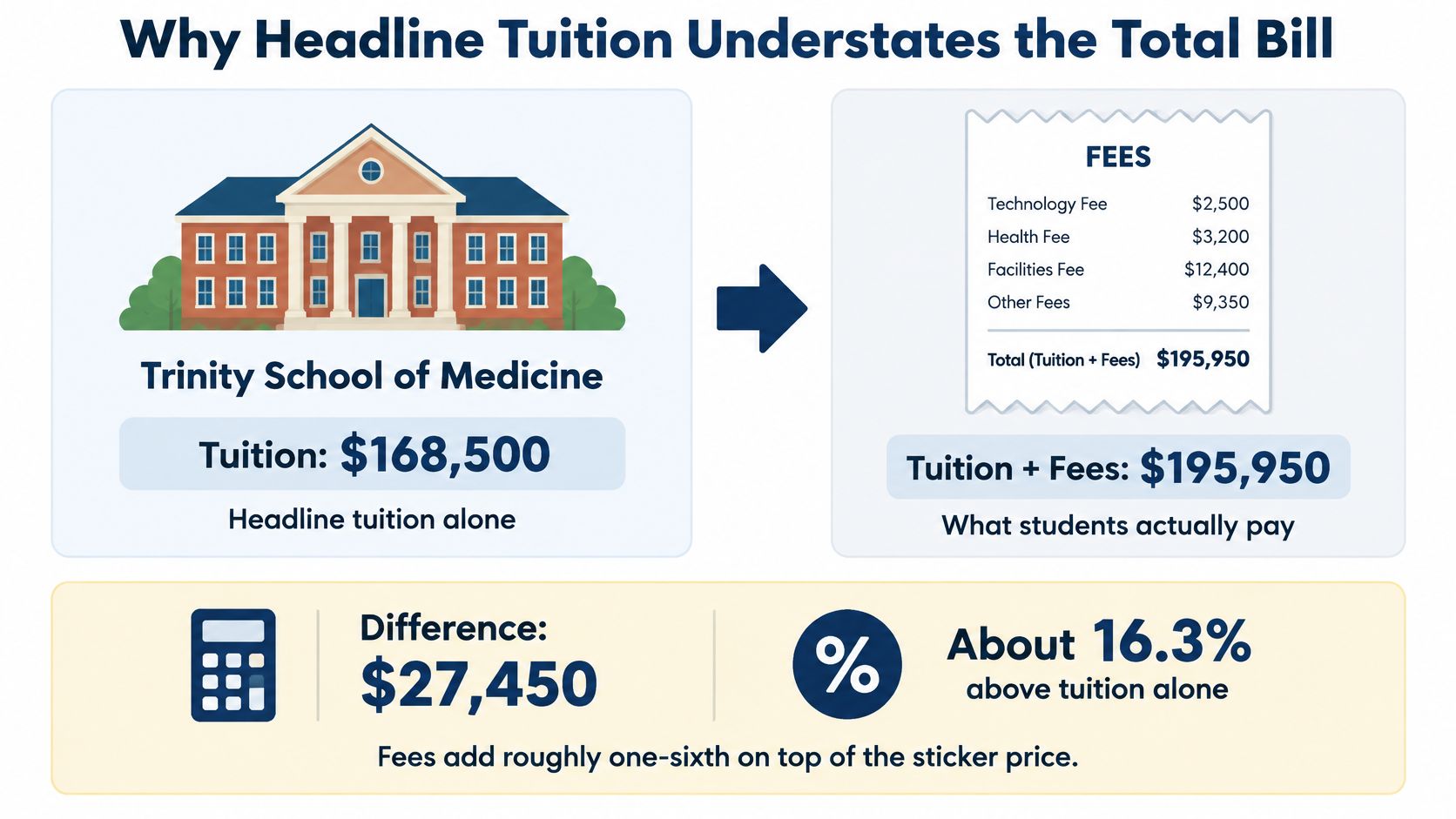
The distinction matters because tuition plus fees still doesn't necessarily mean total cost of attendance. A mandatory administrative charge belongs in the institutional bill. Rent belongs in your attendance budget, even when you pay a landlord rather than the school.
Separate the layers of cost
Build distinct categories instead of placing every expense under “school fees.”
- Mandatory institutional charges: Include administration, required technology, and other compulsory charges identified by the institution.
- Health coverage: Record the premium, billing frequency, waiver conditions, and coverage requirements for each location.
- Accommodation and food: Separate school-billed accommodation from estimated off-campus spending so you don't count either twice.
- Transportation and relocation: Distinguish everyday commuting from flights, moving expenses, and travel between clinical locations.
- Examinations and financing: Keep examination expenses, borrowing charges, and interest outside the tuition subtotal.
These categories answer different questions. The institutional bill tells you what the school requires you to pay. The attendance budget estimates what you need to remain enrolled and support yourself. The financed cost adds the consequences of borrowing to meet those expenses.
Read the exclusions as carefully as the total
Ask the financial-aid office to identify every mandatory item omitted from its advertised price. Then ask which living-cost figures are allowances rather than guaranteed prices, and whether those allowances reflect your actual accommodation and transportation arrangements.
Don't interpret a school's living allowance as a promise that suitable housing will be available at that amount. Conversely, don't add a separate housing budget if the published estimate already includes the same accommodation.
A dated schedule matters because an old fee page can be accurate for its original cohort and wrong for yours. Keep the effective academic year and entering class beside each figure.
Compare tuition with tuition, institutional charges with institutional charges, and complete budgets with complete budgets. A price difference is meaningful only after you've established that both figures buy and include the same things.
How the Clinical Years Change What You Pay
The Caribbean programs in our listings are four-year, US-style MD pathways, with island-based study and clinical rotations at affiliated hospitals, mostly in the United States. For budgeting, that means treating the degree as a multi-location commitment rather than a single-campus purchase.
Caribbean Medical University's cost-of-attendance estimate combines basic-science study in Curaçao with clinical-science education in the United States, estimating $147,160 overall against $99,900 in tuition, including fees, housing with meals, and off-campus housing during clinical rotations. That leaves $47,260, about 32.1% of the total, for the non-tuition components included under its assumptions.
Build a location-specific spending plan
During island-based study, price the accommodation you can obtain, groceries, utilities, and transport to campus. Don't assume an island location automatically means inexpensive living, or that another student's budget will fit your housing needs.
For clinical education, replace those assumptions with the expected rotation locations. Check lease flexibility, commuting requirements, moving arrangements, and whether you'll need to retain accommodation while traveling elsewhere.
A short rotation can create a practical mismatch between a hospital placement and a conventional lease. Ask the clinical office how students arrange accommodation and whether its allowance accounts for temporary housing.
Request a budget for each phase
Ask for the following in writing:
- Tuition and mandatory charges: The billable terms and the charges attached to each phase.
- Insurance requirements: Premiums, coverage periods, and any change when entering clinical training.
- Housing assumptions: Included accommodation, off-campus allowances, and the locations those allowances represent.
- Rotation transportation: Expected commuting, relocation, and travel between assigned sites.
- Examination and travel expenses: Costs that fall between phases rather than within an ordinary teaching term.
The financial issue isn't whether clinical tuition is higher. It's whether tuition, location, and payment timing change together.
Budget clinical education as a separate block with its own contingency. Don't carry the island living budget forward unchanged.
How to Build a Total Cost Budget
Use a spreadsheet with a row for each billable term and separate columns for school charges, personal expenses, and funding. Add a payment-date column: a budget can balance over the whole degree while leaving you unable to pay an early invoice.
Assemble the cost model
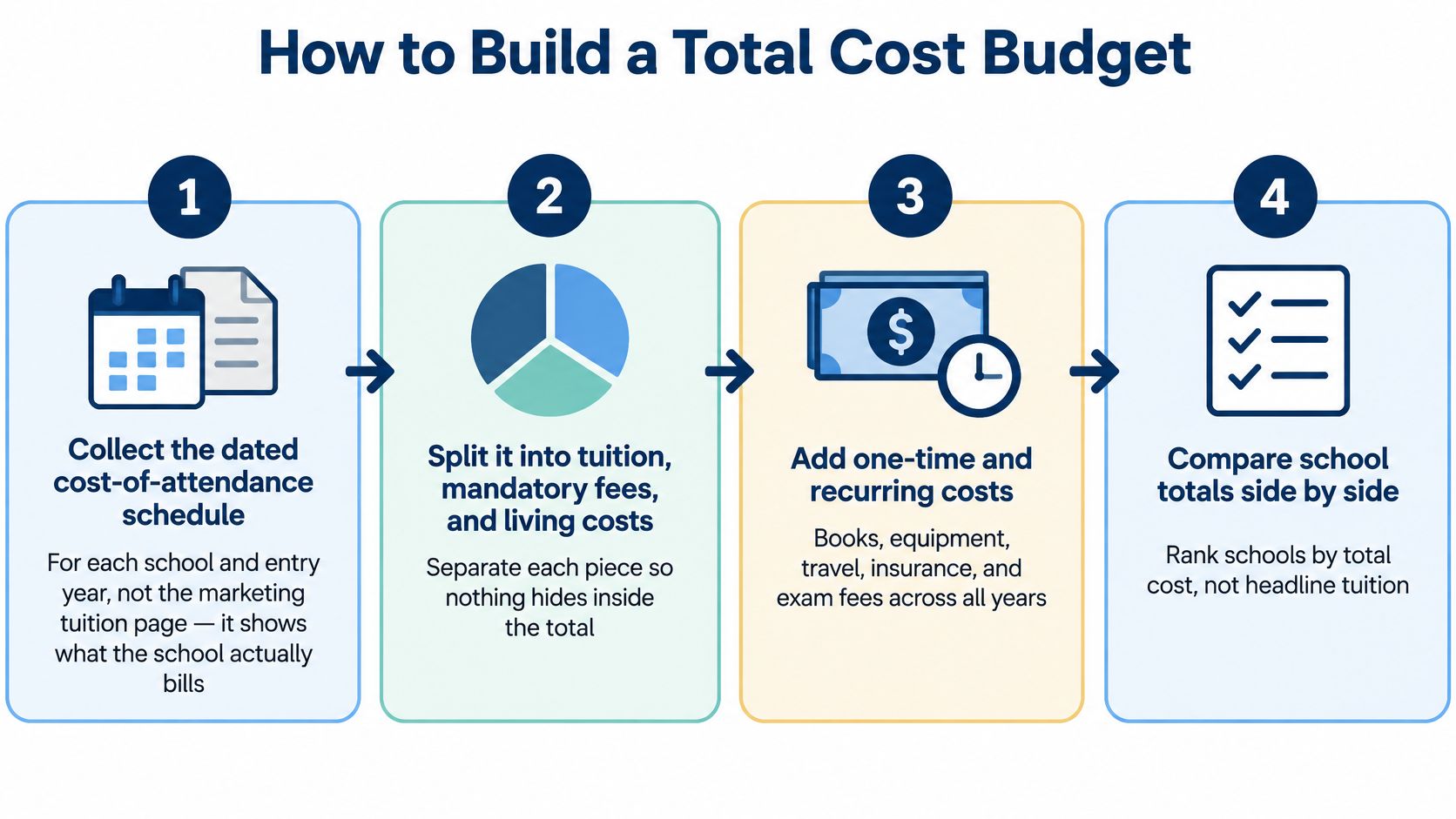
Collect the dated attendance schedule. Save the document for your entering class, not just the marketing tuition page. Identify which items the school bills directly and which are estimated allowances.
Separate the expense categories. Create columns for tuition, mandatory fees, insurance, housing, food, and transport. Mark each item as school-billed, externally paid, or already included elsewhere.
Create a distinct clinical block. Enter the expected locations, tuition periods, accommodation, relocation, and travel. Don't copy the pre-clinical monthly budget into this block without checking each assumption.
Add examination and progression expenses. Include the examinations and licensing-related steps applicable to your intended pathway, using current official prices when you obtain them. Ask the school for its repeat-term, leave, and re-enrollment charging rules rather than assuming ordinary tuition covers every delay.
Price an extra-term scenario. As a planning stress test, add an extra term of applicable tuition, housing, and insurance. This isn't a prediction of delay; it tests whether your finances could withstand one.
Assign a funding source to every period. Enter confirmed federal eligibility, approved private financing, accessible savings, and committed family support separately. Keep pending scholarships and unapproved credit out of the fully funded column.
Record the source and verification date. Save the official page or written estimate beside each input, then recheck before committing another payment. We check program facts against official school pages, date them, and update them when schools change fees or requirements, but your cohort-specific written estimate remains essential.
Reconcile spending with borrowing
Keep cash required for attendance separate from projected debt at repayment. Loan charges and interest can affect the latter even when they don't appear on a tuition invoice. Our medical school debt guide can help you consider that distinction while building your financing plan.
Check billing units before multiplying. A per-trimester insurance premium should follow the school's actual charging schedule, not an assumed academic calendar. Housing already included in an attendance estimate shouldn't reappear as an additional expense unless you're deliberately replacing the allowance.
Finally, produce a single baseline total labeled with its start and end period, plus a separately identified delay scenario. Beside each, show available funding and any unresolved balance.
An unexplained funding source is a gap, not a budget assumption.
Federal Loans and the Funding Gap
A federal loan ceiling matters only if the student, school, and program qualify. It also does not establish that federal borrowing will cover a Caribbean program's total financed cost, including tuition, fees, living expenses, and borrowing costs.
The Federal Student Aid overview of international students explains that eligibility depends on the applicable federal rules. The new professional-student limits it describes begin July 1, 2026, and Grad PLUS is unavailable to new borrowers under those rules. Treat any borrowing ceiling as a maximum, not as an award or a guarantee that funds will cover the full program.
Compare the right totals
If a program's published tuition and administrative fees exceed the aggregate federal borrowing available to you, the shortfall begins before living expenses are added. Even when tuition falls below the ceiling, annual borrowing limits can leave a gap in a particular year if that year's tuition and other costs exceed the available funds.
Eligibility requires more than a school's participation in a federal loan program. Check whether your specific program and borrower circumstances qualify, then get a school-specific estimate of your available borrowing before relying on it in a budget.
Run a funding stress test
- What federal borrowing is available to you? Ask the school to estimate your eligibility and remaining borrowing capacity under the rules that apply to your enrollment.
- What other funding is committed? Count accessible savings, family contributions you can rely on, awarded aid, and approved private credit.
- Can funding cover an extended path? Recalculate the budget for added expenses and the funds available if your studies take longer than planned.
The medical-school scholarship guide can help you look for additional aid. Subtract a scholarship from your funding gap only after it has been awarded, and account for its renewal conditions and disbursement timing.
Students who cannot use US federal loans need to establish another financing route before treating a federal borrowing ceiling as part of their plan.
Funding test: Total attendance budget minus confirmed eligible federal borrowing equals the amount you must cover through other sources.
Private credit closes the gap only if you qualify on terms you can accept. Do not make enrollment depend on financing that has not been approved.
Residency Risk and the Cost of a Longer Path
Model on-time graduation with a residency match, delayed graduation, graduation without a US residency, and withdrawal after substantial borrowing as distinct financial outcomes. They don't produce the same expenses, timing, or ability to repay.
A Caribbean budgeting comparison published by Ross University lists roughly $226,000 to more than $340,000 in tuition at major schools before living expenses and fees. At that scale, evaluating only the advertised completion timeline leaves a consequential part of the decision unexamined.
Price the outcome, not just the degree
| Outcome | What to include in the financial scenario |
|---|---|
| On-time graduation and residency match | Planned attendance spending, borrowing costs, and the transition to residency |
| Delayed graduation | Repeat coursework where charged, extended housing and insurance, examination expenses, travel, and later earnings |
| Graduation without a US residency | Remaining debt, application-related spending, continued living expenses, and a realistic alternative income plan |
| Withdrawal after borrowing | Debt already incurred, applicable refund terms, and the cost of changing educational or career direction |
For delay, distinguish additional cash spending from opportunity cost. Extra rent requires funding now; delayed earnings affect your later financial position. Both matter, but combining them without labels makes the borrowing requirement harder to understand.
Withdrawal deserves its own scenario because the debt can remain even when the expected professional outcome doesn't materialize. Review the school's written refund and withdrawal rules before assuming unfinished study means recoverable tuition.
Interrogate outcome denominators
School-reported matches and placements aren't automatically comparable. Ask whether the denominator includes all entering students, graduates, eligible applicants, or only those who entered the Match.
Request completion, attrition, examination-pass, and residency information for clearly defined cohorts. A placement figure that excludes students who left the program cannot answer an entering applicant's full progression question.
Our guide to residency matching for international medical graduates helps applicants assess that career-planning dimension.
The cheapest advertised program isn't necessarily the lowest-risk financial choice. A tuition saving may be outweighed by a delay or an outcome that doesn't support the repayment plan. Without comparable progression data, you can't confidently calculate which school offers the lower risk-adjusted cost.
If the downside scenario exceeds what you can fund, resolve that problem before enrollment rather than relying on the best outcome.
Confirm the Figures Before You Pay a Deposit
Treat the deposit decision as a document check, not a final reaction to the tuition price. The US Department of Education's international-school guidance explains that participating institutions must meet reporting and eligibility requirements, and that a medical program may be ineligible even when its institution participates.
Complete the enrollment checks
Verify the exact institution and medical program. Check the Department of Education's current participating-school information and request confirmation for your campus and pathway. Don't substitute a general statement about international financial aid for program-specific eligibility.
Obtain a written annual estimate. Request tuition, mandatory charges, living-cost allowances, loan origination charges, and expected borrowing capacity. Ask the school to identify exclusions and the period covered by each allowance.
Confirm your individual eligibility. Establish how citizenship or eligible-permanent-resident status, applicable foreign-medical-school requirements, and entry-year borrowing rules affect you. A classmate's financial-aid package doesn't establish your entitlement.
Identify events that require reassessment. Ask what happens if you change campus, enter clinical education in another country, or take a leave. Get the financial consequences and any required eligibility review in writing.
Reconcile the offer with your funding model. Replace provisional estimates with verified amounts and compare payment dates with expected disbursements. Leave unresolved expenses visible rather than absorbing them into an optimistic contingency.
Keep independent guidance in its proper role
Our cost guide covers tuition by region, living expenses, hidden fees, US comparisons, and ways to pay, from savings to loans. We date and check program facts, but a comparison guide can't confirm your personal award, private-credit approval, or cohort-specific invoice.
Save the written estimates and eligibility responses with your budget. If the school changes an assumption, update both the cost total and the funding schedule before making another commitment.
Pay the deposit only when the verified total is fully funded, with a workable answer for the downside scenario.
Medical School Programs offers independently sourced program comparisons and practical guides to tuition, living costs, financing, and residency planning. Visit Medical School Programs to compare your shortlisted pathways, build a complete attendance budget, and identify the funding questions to resolve before you enroll.