
Apply for every scholarship you can find. That's the standard advice, and it's the wrong starting point. A scholarship isn't the same as a free medical degree, because a headline award can cover tuition and still leave housing, insurance, exam fees and travel unfunded. Some awards also decide where you'll work, which specialty you can choose, or whether funding continues after a difficult term.
Recent U.S. figures show why the terms matter more than the label. The American Medical Association summary of Association of American Medical Colleges data reported that 65% of graduating medical students surveyed in 2024 received some form of non-loan financial assistance, including grants, stipends or scholarships. Yet 70% of graduating students had educational debt, and the same summary reported that 59% owed at least $200,000 in medical-school loans.
This list of Scholarships Medical schools offer sorts ten programs by condition, not size. Some are automatic, some are competitive, some cover tuition only, and some exchange broad funding for a defined service commitment. Read each entry for three things. What does it pay, what remains unpaid, and what do you give in return?
Table of Contents
- 1. National Health Service Corps (NHSC) Scholarship Program
- 2. Armed Forces Health Professions Scholarship Program (HPSP)
- 3. NYU Grossman School of Medicine Full-Tuition Scholarship
- 4. Albert Einstein College of Medicine Gottesman Scholarship Fund
- 5. Yale School of Medicine Scholarships and Need-Based Aid
- 6. Duke University School of Medicine Scholarships and Grants
- 7. St. George's University (SGU) School of Medicine Scholarships
- 8. Saba University School of Medicine Pre-Med Club Scholarship
- 9. American University of the Caribbean (AUC) Scholarships and Grants
- 10. Trinity School of Medicine Scholarships
- How the 10 Medical School Scholarships Differ by Award Type, Eligibility and Conditions
- Read the Terms Before You Count the Money
1. National Health Service Corps (NHSC) Scholarship Program
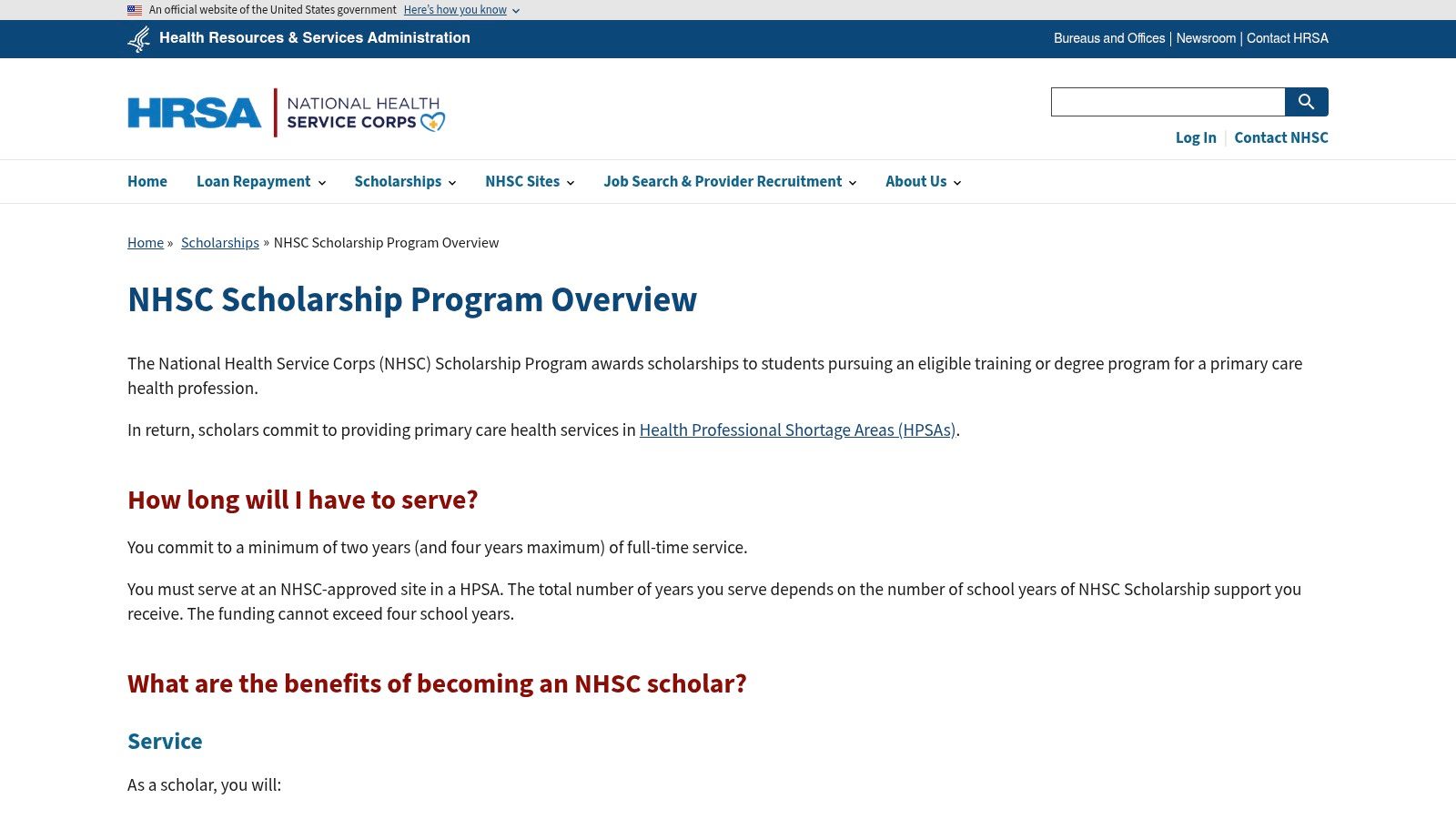
The NHSC Scholarship Program overview describes a service-linked route for eligible medical students preparing for primary-care work in underserved U.S. communities. It can support up to four school years, cover tuition and eligible fees, contribute to other educational costs, and provide a monthly living stipend. That breadth makes it different from a tuition-only discount.
The return obligation is specific. Recipients serve at an NHSC-approved site in a Health Professional Shortage Area, with service of at least two years and up to four years, based on the scholarship support received. You're therefore trading early-career location and practice choice for substantially reduced borrowing.
Who It Fits
- Strong fit: Students already committed to primary care in a shortage community.
- Weak fit: Students who want unrestricted specialty or location choice after training.
- Financial limit: It doesn't provide support during postgraduate training.
Service awards are a distinct segment, not the whole market. In the AAMC Medical School Questionnaire, scholarships with a service commitment accounted for 3.7% of respondents in 2025. Before applying, compare the expected borrowing avoided with your likely medical school debt if you choose an unrestricted but smaller award.
2. Armed Forces Health Professions Scholarship Program (HPSP)
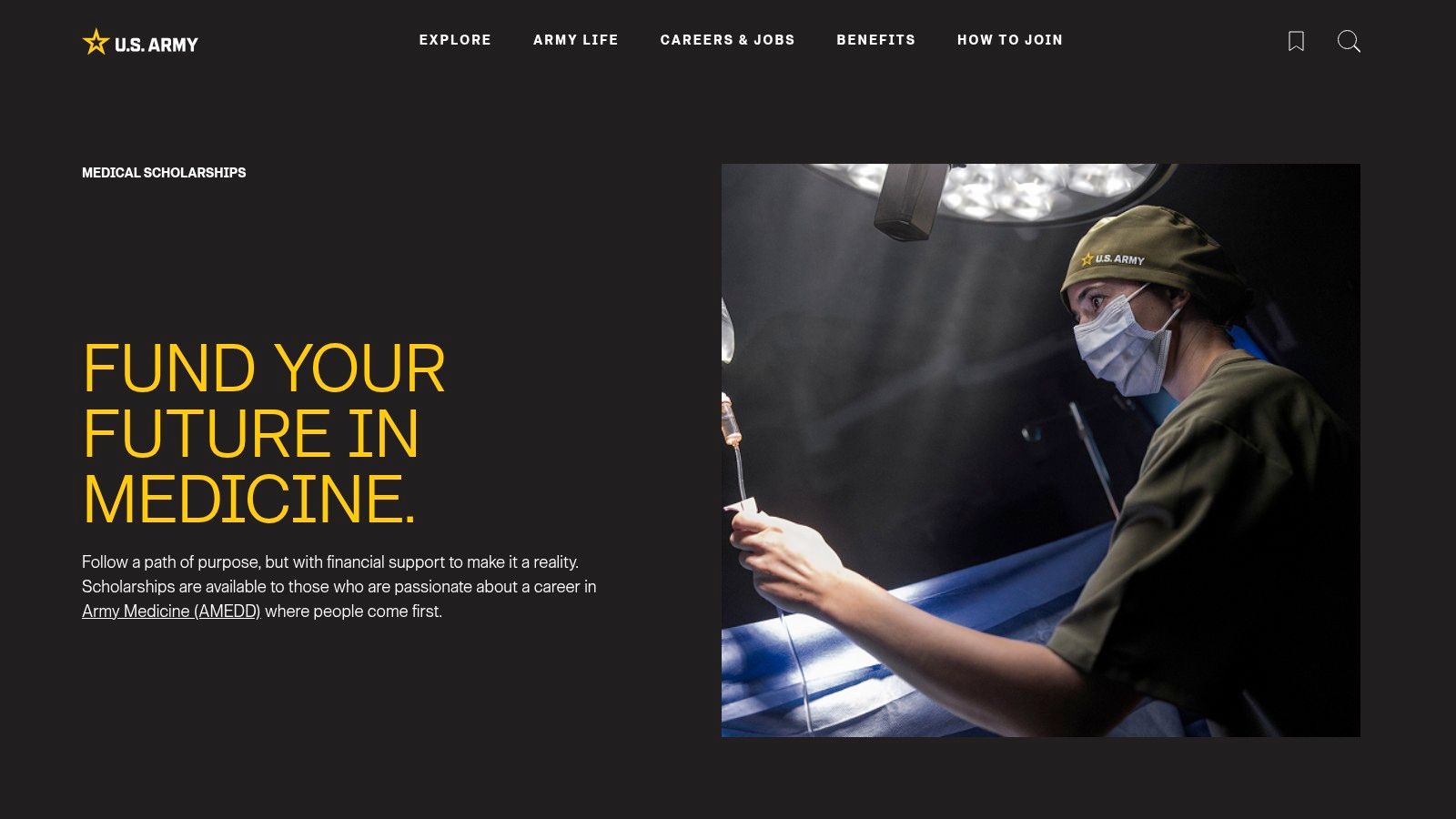
HPSP lets eligible students attend a civilian medical school while building a career as a military physician. The U.S. Army AMEDD scholarship page is one branch route, and programs are also available through the Navy and Air Force. HPSP can pay medical-school tuition and provide a monthly stipend and other education-related support.
Don't treat the branches as interchangeable. Benefits, training expectations and service terms vary by branch and individual contract. Military needs may also affect specialty timing, assignment location and career sequencing in ways a civilian employer wouldn't.
Contract test: Ask what happens to your obligation if you change specialty plans, delay training, or can't meet a military requirement. Get the answer from the contract, not a recruiting conversation.
The advantage is a structured route that can offset a major share of school expenses while giving you defined military experience. The cost is a significant service commitment and reduced control over early career decisions. It's most rational when you'd actively choose military medicine even without the scholarship. If you're accepting the obligation only to solve a tuition problem, the financial saving may not compensate for years of constrained choices.
3. NYU Grossman School of Medicine Full-Tuition Scholarship
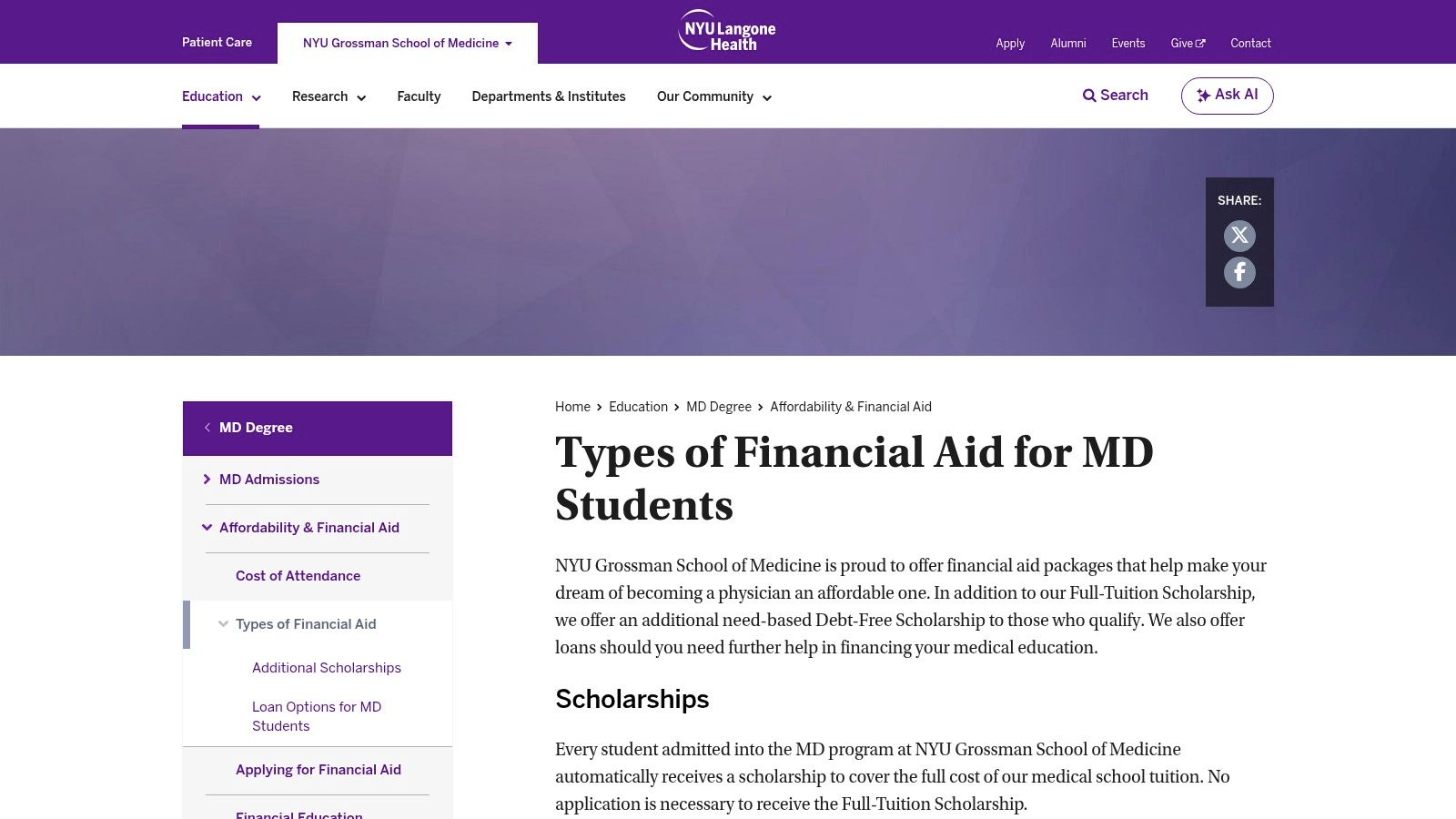
NYU Grossman reverses the usual uncertainty. According to the NYU Grossman financial aid information, every student admitted to its MD program receives a full-tuition scholarship, regardless of merit or financial need. You don't submit a separate application for that tuition award.
Full tuition still doesn't mean full cost. Students may apply for additional need-based Debt-Free Scholarship support for costs beyond tuition, but that help depends on financial review and eligibility. Rent, food, insurance and other living expenses aren't automatically covered by the tuition scholarship.
The Real Trade-Off
- Guaranteed after admission: The full-tuition component.
- Competitive before admission: Entry to NYU Grossman itself.
- Separate and need-based: Additional support for non-tuition costs.
That structure makes the award unusually predictable once you're admitted, but it shouldn't anchor your whole application strategy. A less selective school with partial aid and lower living costs could still require less total borrowing. NYU also offers a three-year MD pathway for eligible students, which may shorten living-cost exposure, although pathway fit and specialty planning matter as much as speed.
4. Albert Einstein College of Medicine Gottesman Scholarship Fund
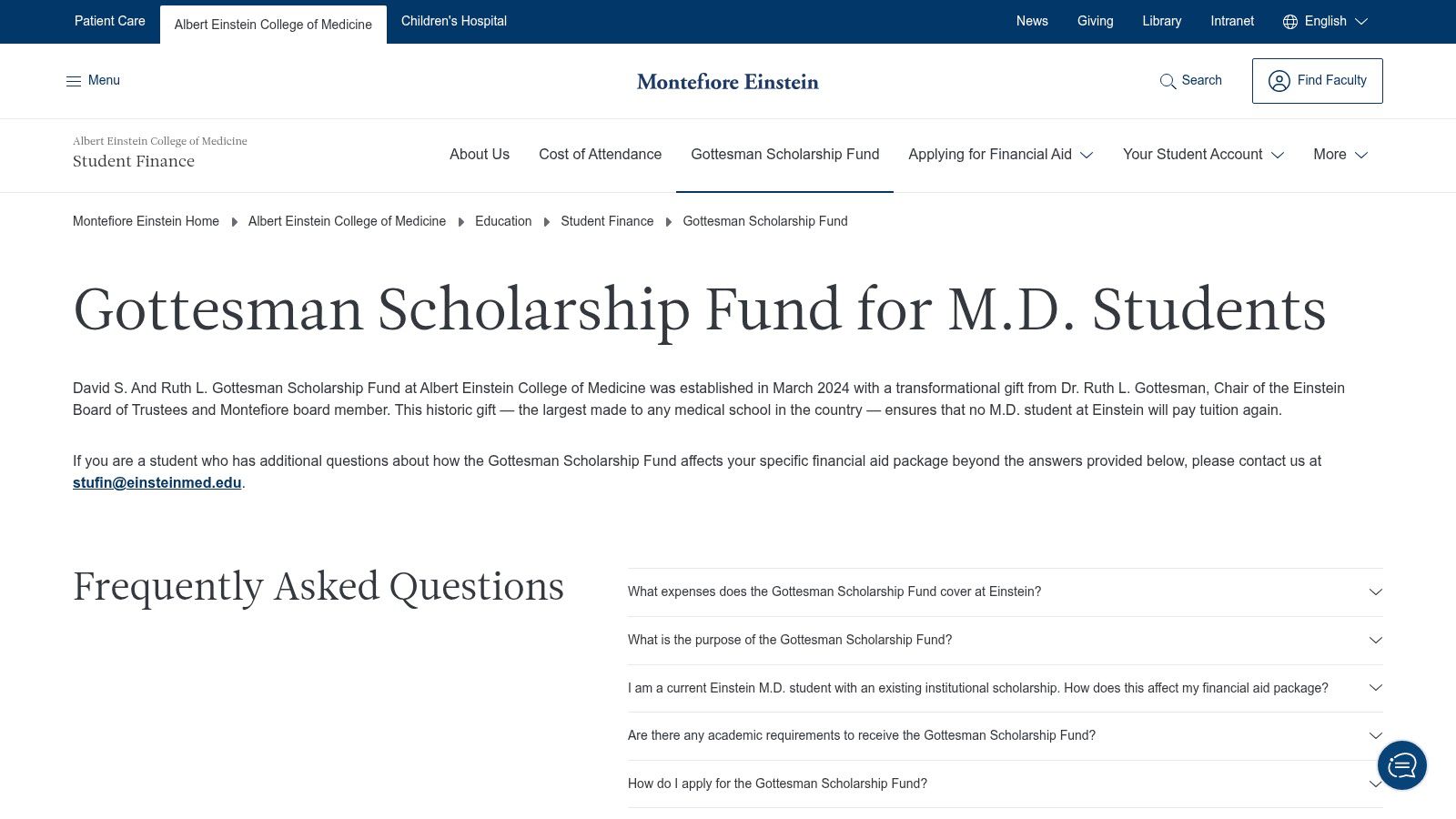
Einstein's model is also automatic, but its covered charges are defined more narrowly. The Einstein Gottesman Scholarship Fund page says accepted MD students receive the award automatically, without a separate scholarship application. It covers tuition and educational and technology fees.
It doesn't cover living expenses, room and board, or every other cost of attendance. Recipients must also remain in good academic standing. That's an ordinary condition, but it's still a condition, so ask how academic remediation, a leave of absence or a repeated term affects eligibility.
For applicants, the value lies in certainty. You aren't competing against classmates for a limited number of tuition awards, and you can model the remaining budget around living costs from the start. The limitation is institutional. The scholarship benefits only students admitted to Einstein's MD program and doesn't travel with you.
Complete the school's financial-aid steps even though the scholarship is automatic. You'll still need a plan for housing, insurance, transport and exam-related expenses. Automatic should describe the award process, not your assumption that every remaining bill has been handled.
5. Yale School of Medicine Scholarships and Need-Based Aid
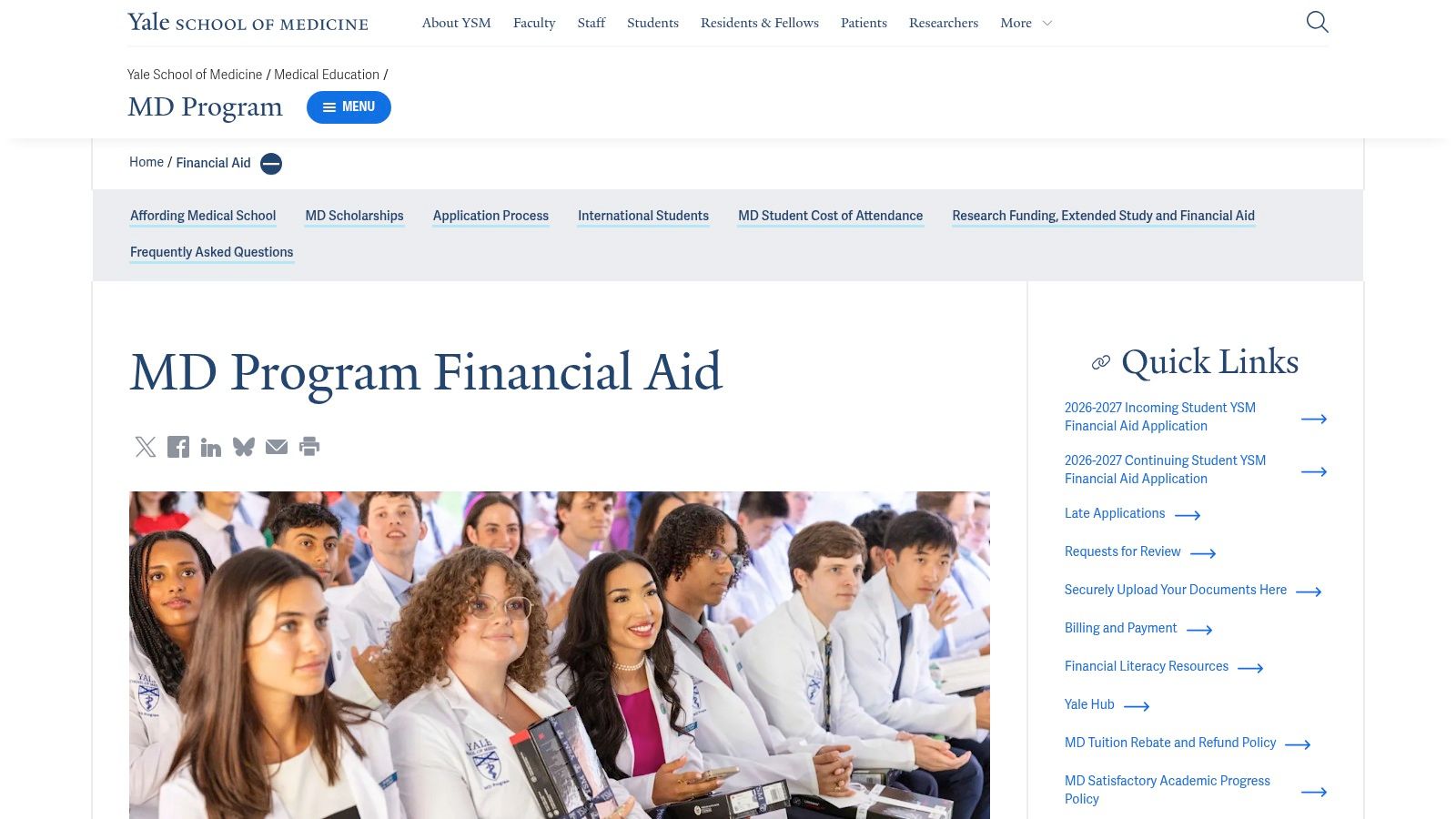
Yale combines competitive merit money with document-heavy need-based aid. The Yale School of Medicine financial aid office states that incoming students who receive a merit scholarship get full tuition coverage for four years. Merit consideration happens during admissions, and no separate merit application is required.
The phrase to watch is who receive. Full-tuition merit funding isn't guaranteed to every admitted student. By contrast, need-based aid depends on financial documents, including the CSS Profile. International students can also be considered for Yale scholarship funds through that process, which isn't universal among U.S. schools.
What to Separate
- Merit route: Full tuition for selected incoming students.
- Need route: Determined from submitted financial information.
- Residual costs: A tuition award may still leave living expenses unfunded.
Build two budgets before you apply, one with a merit award and one without it. Then compare both against how much medical school costs once housing and fees are included. Yale also lists an emergency aid fund for unexpected financial situations, but emergency help shouldn't substitute for a four-year funding plan.
6. Duke University School of Medicine Scholarships and Grants
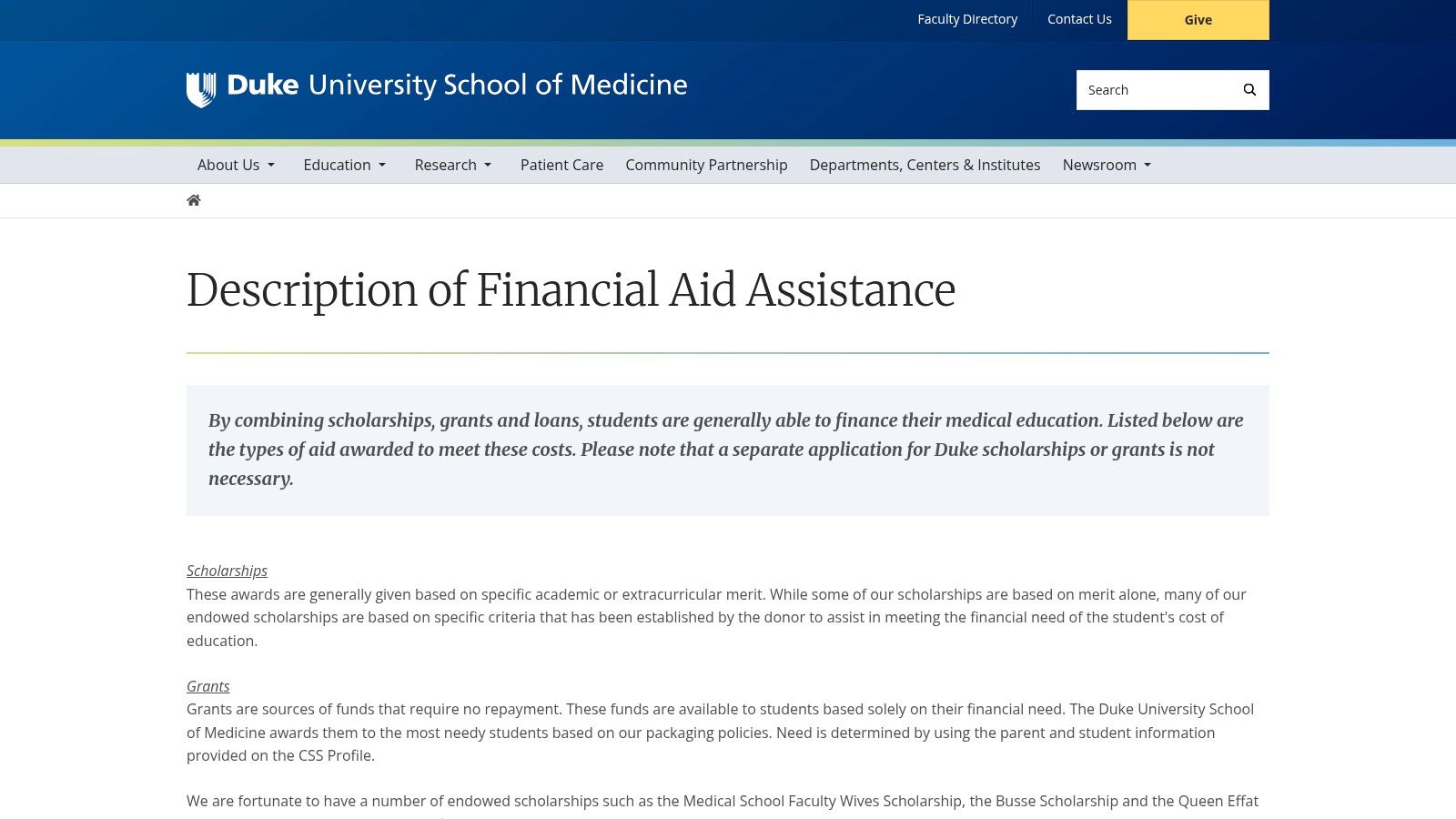
Duke spreads support across several categories rather than making one universal promise. The Duke School of Medicine description of financial aid assistance covers merit-based scholarships, endowed scholarships with donor-set criteria, and need-based grants that don't need to be repaid. You don't file a separate application for Duke scholarships or grants, although need-based aid requires financial information.
Some scholarships may be renewable, which matters more than a large first-year label. Ask whether renewal is automatic, whether it requires satisfactory progress, and whether the amount changes if tuition rises or your enrollment pattern changes.
Duke says international students may qualify for scholarship funds depending on available funding and the applicant pool. That's a real route, but it isn't a predictable entitlement. International applicants should therefore identify supplementary funding before accepting an offer.
The practical risk is incomplete coverage. Duke aid isn't guaranteed to meet the full cost of attendance, and the application requires detailed student and family information. Treat an award letter as a partial budget until you've checked the renewal period, donor restrictions and the difference between billed tuition and total living costs.
7. St. George's University (SGU) School of Medicine Scholarships
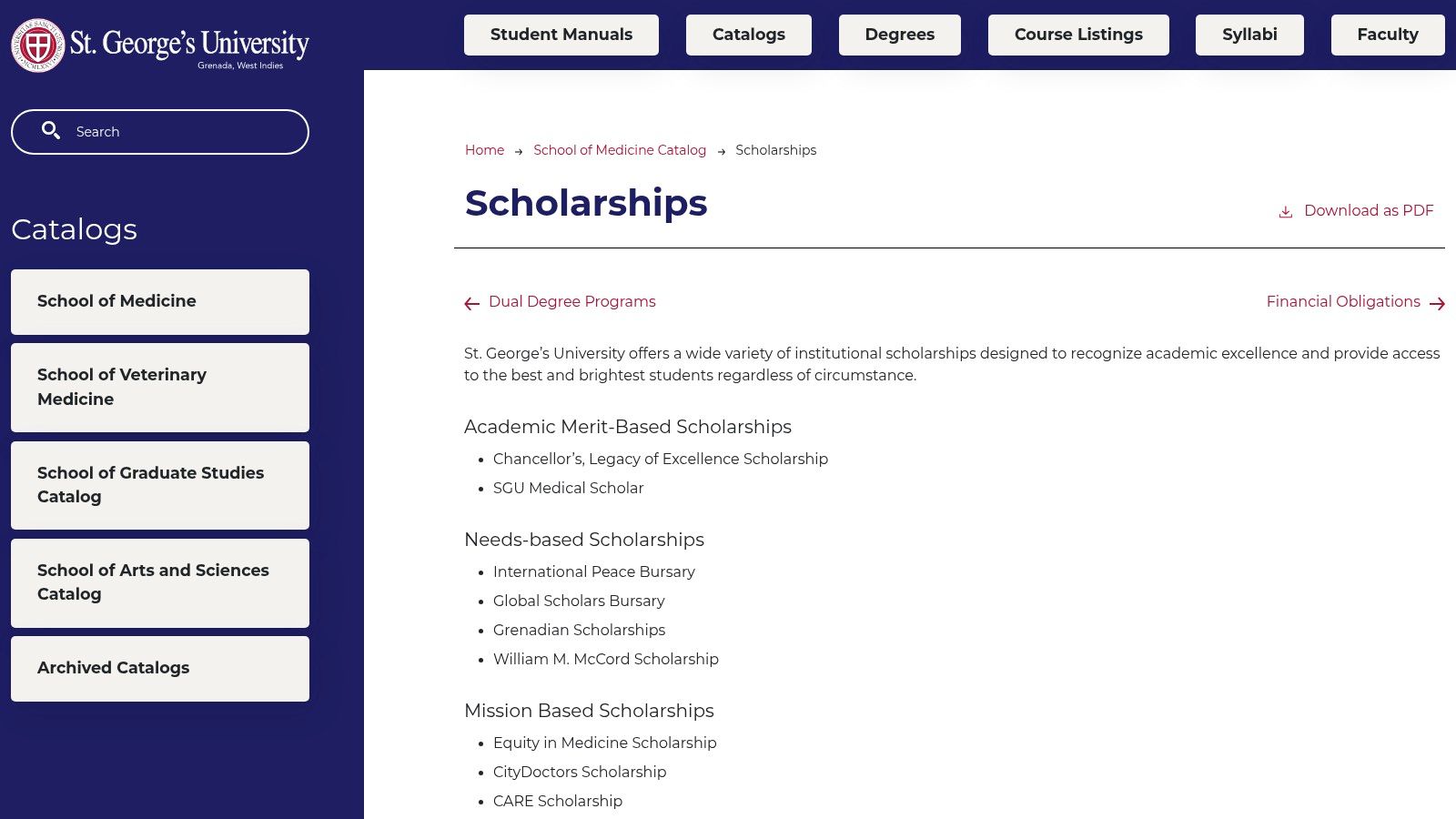
At SGU, the first task is choosing the right category, because there isn't one general award covering every applicant. The SGU School of Medicine catalog scholarships page lists merit-based awards, need-based bursaries, mission-based scholarships and discretionary awards. Named options include the SGU Medical Scholar, International Peace Bursary, Global Scholars Bursary, Equity in Medicine Scholarship and CityDoctors Scholarship.
That range gives applicants more than one possible route. Your academic record might fit one award, your financial circumstances another, and a mission or background-based award a third. Confirm current amounts and eligibility directly with SGU because criteria can vary by scholarship and intake.
A scholarship offer doesn't establish the total cost of a Caribbean MD. Price tuition, housing, travel, insurance, clinical placement expenses and licensing steps before calculating the award's real coverage.
Students evaluating eligibility from outside the United States should also examine financial aid for international medical students. SGU's awards can reduce a bill, but they don't answer separate questions about residency access, licensing in your intended country, or the cost of repeating coursework. Those questions determine whether a discounted program remains affordable.
8. Saba University School of Medicine Pre-Med Club Scholarship
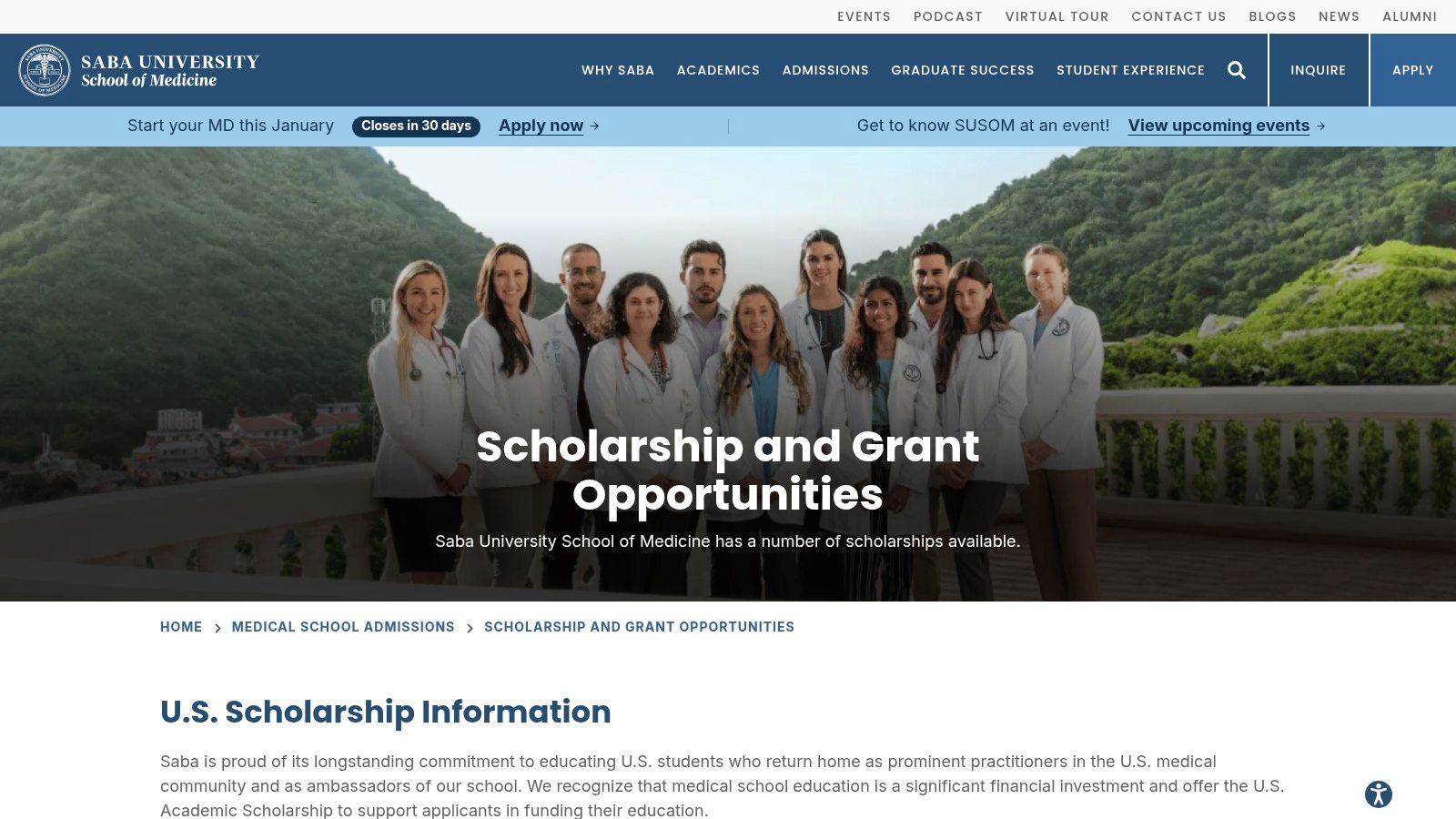
Saba's Pre-Med Club award is small, specific and unusually easy to value. The Saba scholarships page states a $5,000 tuition credit for eligible accepted U.S. MD students. To qualify, a student must participate in a Saba presentation to their university pre-med club, complete a brief inquiry form and meet the stated conditions.
A virtual admissions session may serve as an alternative for club members who miss the presentation. The award applies to new students matriculating during or after May 2026, according to the same Saba scholarship terms. Because the credit is applied directly against tuition, you don't need to guess its disbursement mechanism.
Its limits are clearer than many larger awards. Eligibility is tied to a U.S. pre-med club connection, so it isn't available to all applicants. A fixed credit also covers only a small share of overall medical-school costs.
Ask whether the credit can be combined with other Saba aid and when it appears on your account. The useful comparison isn't whether the amount sounds worthwhile in isolation. It's whether participation gives you both a modest tuition reduction and better information before you commit to a Caribbean program.
9. American University of the Caribbean (AUC) Scholarships and Grants
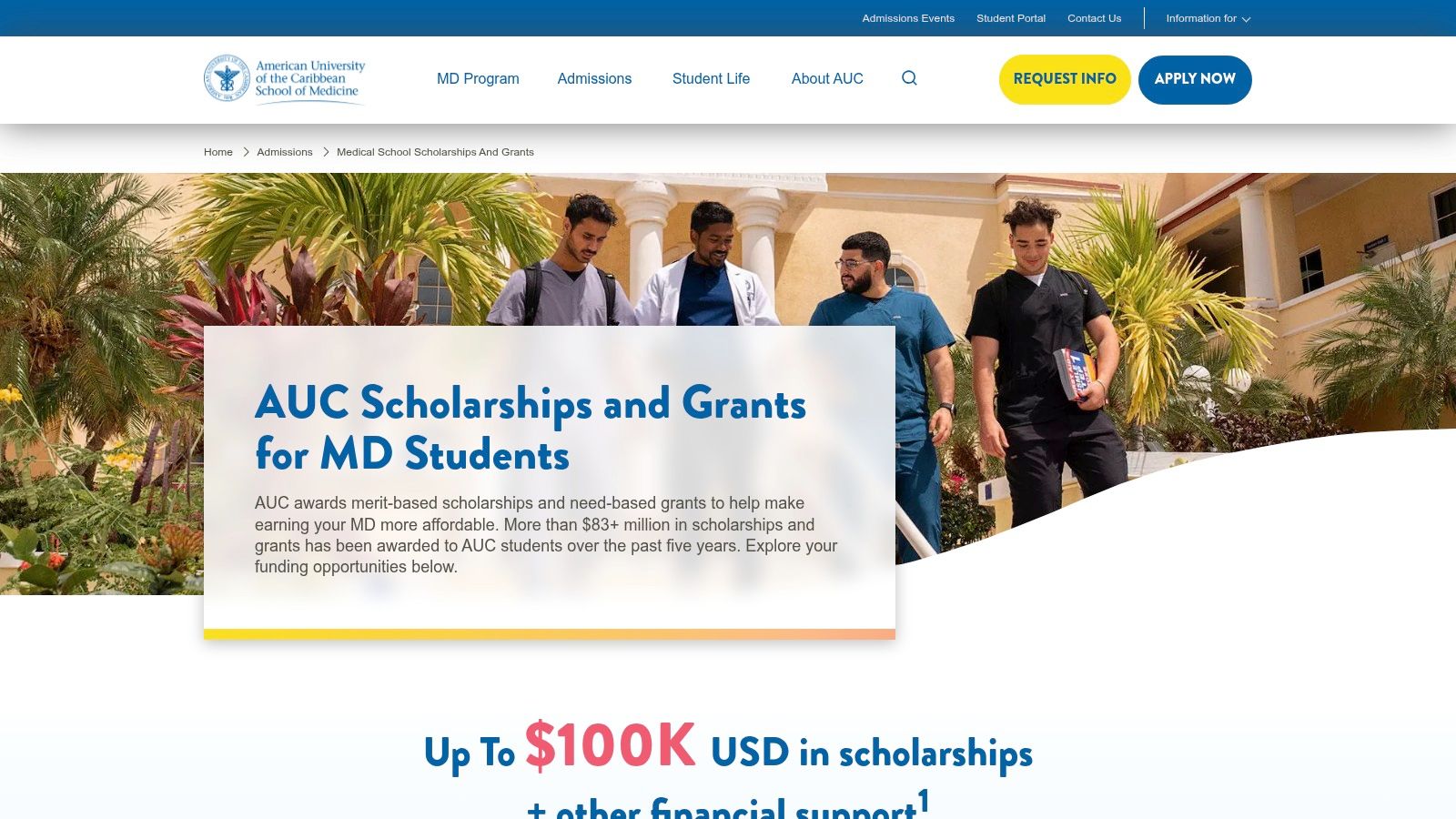
AUC publishes a stepped award whose final value depends on performance. The AUC scholarships page says its Summit Award starts at a minimum of $48,000 over ten semesters and can reach up to $100,000 when students meet specified academic milestones. Additional funding is tied to academic progress and exam performance.
That conditional structure creates an incentive, but it also creates financial risk. Model your budget using the minimum award, not the maximum. Then treat any additional milestone funding as upside rather than money you've already secured.
Questions Before You Count It
- Disbursement: How much is credited in each semester?
- Milestones: Which grades, exams and timing rules allow more funding?
- Setbacks: What happens if you repeat a semester or miss a milestone?
AUC says some applicants are automatically considered after acceptance and describes a scholarship committee that reviews applications weekly. Rolling review can provide earlier information, which helps when you compare offers. Still, the relevant figure is the award's guaranteed portion divided by the full program cost. A large maximum has limited planning value if later payments depend on results you haven't yet achieved.
10. Trinity School of Medicine Scholarships
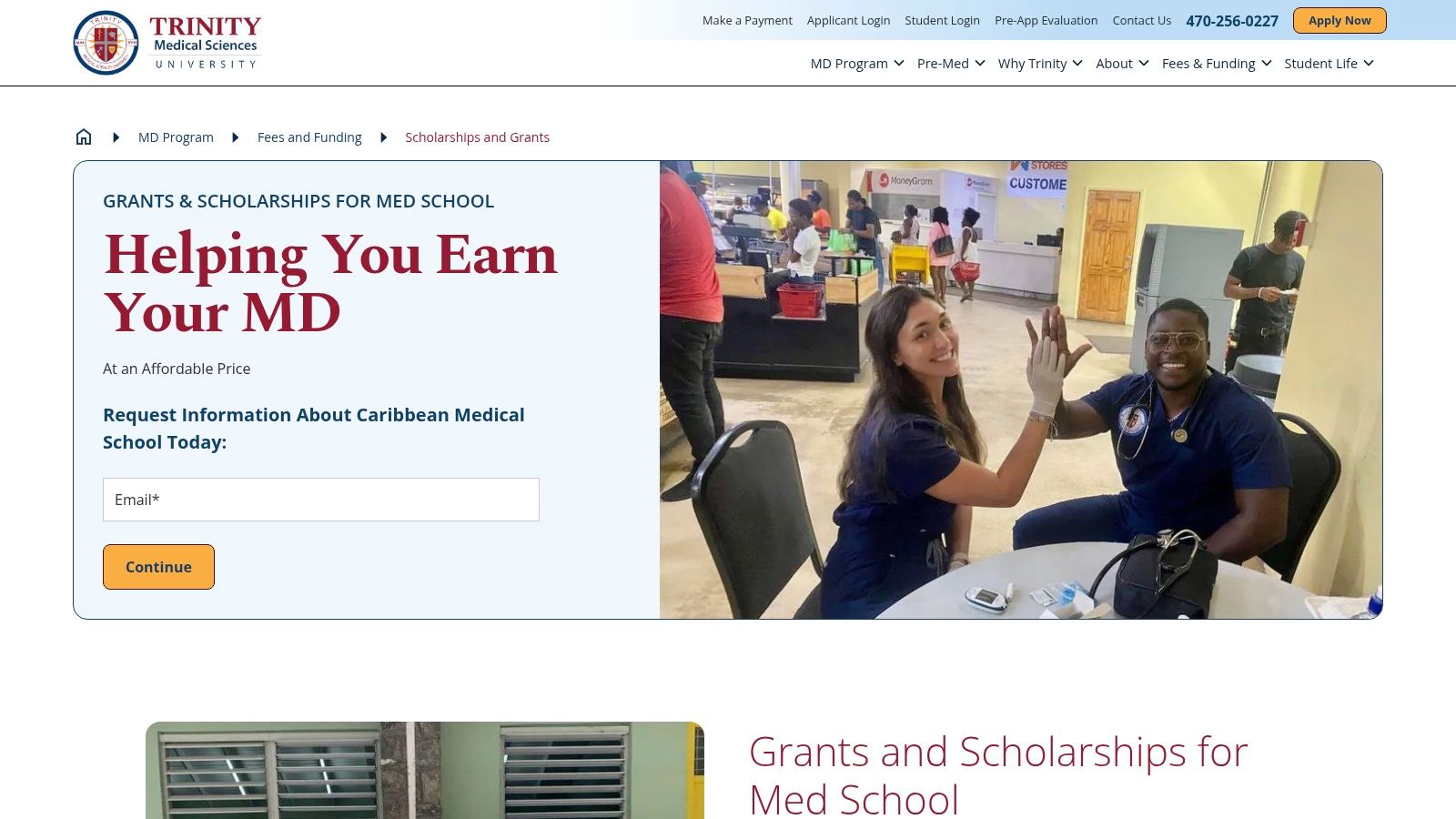
Trinity publishes several smaller awards with term-based payments and continuation rules. The Trinity scholarships and grants page lists a $12,000 Excellence in Action Scholarship for eligible new students starting May 2026 or later, paid as $1,200 per term for up to ten terms. It also lists a $20,000 Physician's Scholarship and a $25,000 Dean's Scholarship on the same page.
Term-based disbursement spreads the benefit across the program, which can help with recurring tuition bills. It also means you don't receive the full headline amount upfront. Awards can carry GPA or satisfactory-progress requirements, and some can't be combined with particular other awards.
Some Trinity scholarships are open regardless of citizenship, which widens the applicant pool you'd normally expect for institutional aid. Read the stacking restrictions before adding two published amounts together. A combined total is only real if the school permits that combination for your entry term.
Trinity's funding can reduce tuition, but it won't necessarily cover the full cost of attendance. Calculate what's left for housing, travel, insurance and clinical training, and ask how a failed term or delayed progression changes the remaining payments.
How the 10 Medical School Scholarships Differ by Award Type, Eligibility and Conditions
| Item | Award Type | Who Qualifies | Key Condition | Application Step |
|---|---|---|---|---|
| National Health Service Corps (NHSC) Scholarship Program | Tuition, eligible fees, education-cost support, and monthly stipend | Eligible medical students preparing for primary-care work | Serve at an NHSC-approved site in a shortage area for at least two years | Apply to the NHSC Scholarship Program |
| Armed Forces Health Professions Scholarship Program (HPSP) | Tuition support, monthly stipend, and other education-related support | Eligible students attending civilian medical school | Complete military training and the service obligation set by the branch and contract | Confirm eligibility and terms with a military branch |
| NYU Grossman School of Medicine Full-Tuition Scholarship | Automatic full-tuition scholarship; additional need-based aid may be available | All students admitted to the MD program | Additional support for non-tuition costs depends on financial review | No separate application for full tuition; submit financial-aid documents for additional aid |
| Albert Einstein College of Medicine Gottesman Scholarship Fund | Tuition and educational and technology fees | Accepted Einstein MD students | Maintain good academic standing; living expenses are not covered | No separate scholarship application; complete financial-aid steps for other expenses |
| Yale School of Medicine Scholarships and Need-Based Aid | Merit scholarships and need-based aid | MD applicants; international students may be considered for scholarship funds | Merit awards are not guaranteed; need-based aid requires financial documentation | Merit consideration occurs during admissions; submit financial documents, including the CSS Profile, for need-based aid |
| Duke University School of Medicine Scholarships and Grants | Merit scholarships and need-based grants | Duke MD students; international students may qualify | Need-based support requires financial information and is not guaranteed to cover full costs | No separate scholarship application; provide financial information for need-based aid |
| St. George's University (SGU) School of Medicine Scholarships | Merit, need-based, mission-based, and discretionary awards | Students considering SGU's Caribbean MD pathway | Amounts and eligibility vary by scholarship and intake | Confirm current award details and eligibility with SGU |
| Saba University School of Medicine Pre-Med Club Scholarship | $5,000 tuition credit | Eligible accepted U.S. MD students connected to a university pre-med club | Participate in a Saba presentation or qualifying alternative and meet award terms | Complete the inquiry form and participate in the required presentation or session |
| American University of the Caribbean (AUC) Scholarships and Grants | Scholarships and grants, including the Summit Award | Accepted MD students; some are automatically considered | Additional Summit Award funding depends on academic progress and exam milestones | Some applicants are considered automatically after acceptance; confirm award requirements |
| Trinity School of Medicine Scholarships | Merit awards, including published awards of $12,000, $20,000, and $25,000 | Eligible MD students, depending on award criteria | Continued funding may require satisfactory academic progress; some awards cannot be combined | Review award eligibility and application requirements with Trinity |
Read the Terms Before You Count the Money
Start by separating guaranteed money from possible money. NYU Grossman and Einstein remove the scholarship competition for admitted MD students, but both leave living costs to solve. Yale and Duke can provide substantial support, yet merit selection, donor criteria or documented need determines who receives it. AUC and Trinity publish meaningful amounts, but milestones, progress rules and term-based payments decide how much you collect.
Then price the exchange. NHSC and HPSP can cover far more than tuition, which makes them financially powerful, but neither is free money in any practical sense. You're committing early career time, location and sometimes specialty flexibility. That trade can be excellent if the service matches work you'd choose anyway. It can be expensive if you're borrowing against future preferences you haven't formed yet.
Applicant-level evidence shows why partial awards shouldn't be mistaken for complete funding. In a dataset reported in the PMC applicant scholarship and debt table, 61% of 8,170 medical-school applicants reported receiving a medical-school scholarship, with a median total scholarship amount of $25,000. The same table reported median total educational debt of $197,000, which shows that a scholarship can reduce risk without eliminating borrowing.
Institutional averages can also hide wide variation. Brown University states in its Warren Alpert Medical School financial aid summary that in fiscal year 2024, 49% of students received school-funded scholarship aid. That's useful context, but it doesn't tell an individual applicant their award, renewal terms or remaining cost. Your offer letter and the school's current cost of attendance do.
Use a simple coverage ratio for every offer. Add only the scholarship amount that is guaranteed or realistically renewable, then divide it by four years of tuition, fees, housing, food, insurance, transport, exam costs and visa expenses where relevant. Run a second version that assumes you lose a performance-based payment or repeat a term. That stress test exposes awards that look strong only under perfect progression.
Ask each school the same questions in writing. Is the award automatic or competitive? Is it renewable, and under what academic standard? Can it be stacked with institutional aid? Which charges can it pay? What repayment or service penalty applies if you withdraw, change specialty, or fail to meet an obligation? Confirm current figures directly, because published awards and intake rules change.
Our cost guides help you build that full budget alongside tuition, fees, living expenses and loan options. Compare the award against the whole degree, not the first semester, and choose the combination of funding and flexibility you can sustain. The best scholarship isn't always the largest one. It's the one whose conditions you understand and can meet without compromising the career you're funding.
Use Medical School Programs to compare medical programs by tuition, duration, admissions requirements and licensing notes, then test each scholarship against the full cost of attendance. Browse the program directory and student finance guides before you apply, so your shortlist reflects both the award you might receive and the amount you'd still need to fund.