
What if the college isn't the first decision at all? Most students search for good colleges for doctors as if there's one ranked list, but you're really choosing between three structurally different routes. The U.S. route means a bachelor's degree first, then a four-year MD. Direct-entry European degrees take you from secondary school into a six-year medical degree. Caribbean MD programs usually follow a U.S. style curriculum offshore, with clinical rotations elsewhere.
Those routes differ in timeline, total cost, entrance tests, language demands, and licensing risk, not just prestige. A famous name doesn't help if the degree doesn't lead cleanly to residency where you want to practice. The seven options below let you compare the path first, then the institution. Details change by intake, so verify every fee, deadline, and recognition rule directly with the school before you apply.
Table of Contents
- 1. Medical School Programs A-Z
- 2. UMass Amherst
- 3. Yale School of Medicine
- 4. University of Bologna
- 5. University of Pavia - Harvey Medicine and Surgery Course
- 6. Iuliu Hațieganu University of Medicine and Pharmacy Cluj-Napoca
- 7. St. George's University School of Medicine
- 7 Colleges and Pathways for Future Doctors at a Glance
- Choosing Your Route Next Steps Before You Apply
1. Medical School Programs A-Z
Start with comparison, not application. Medical School Programs A-Z brings together 24 English-taught medical programs across Europe and the Caribbean, so you can compare tuition and program length side by side before you fall for a single campus or country. Region filters help you narrow the search quickly, whether you're weighing a six-year public university degree in Europe or a four-year Caribbean MD.
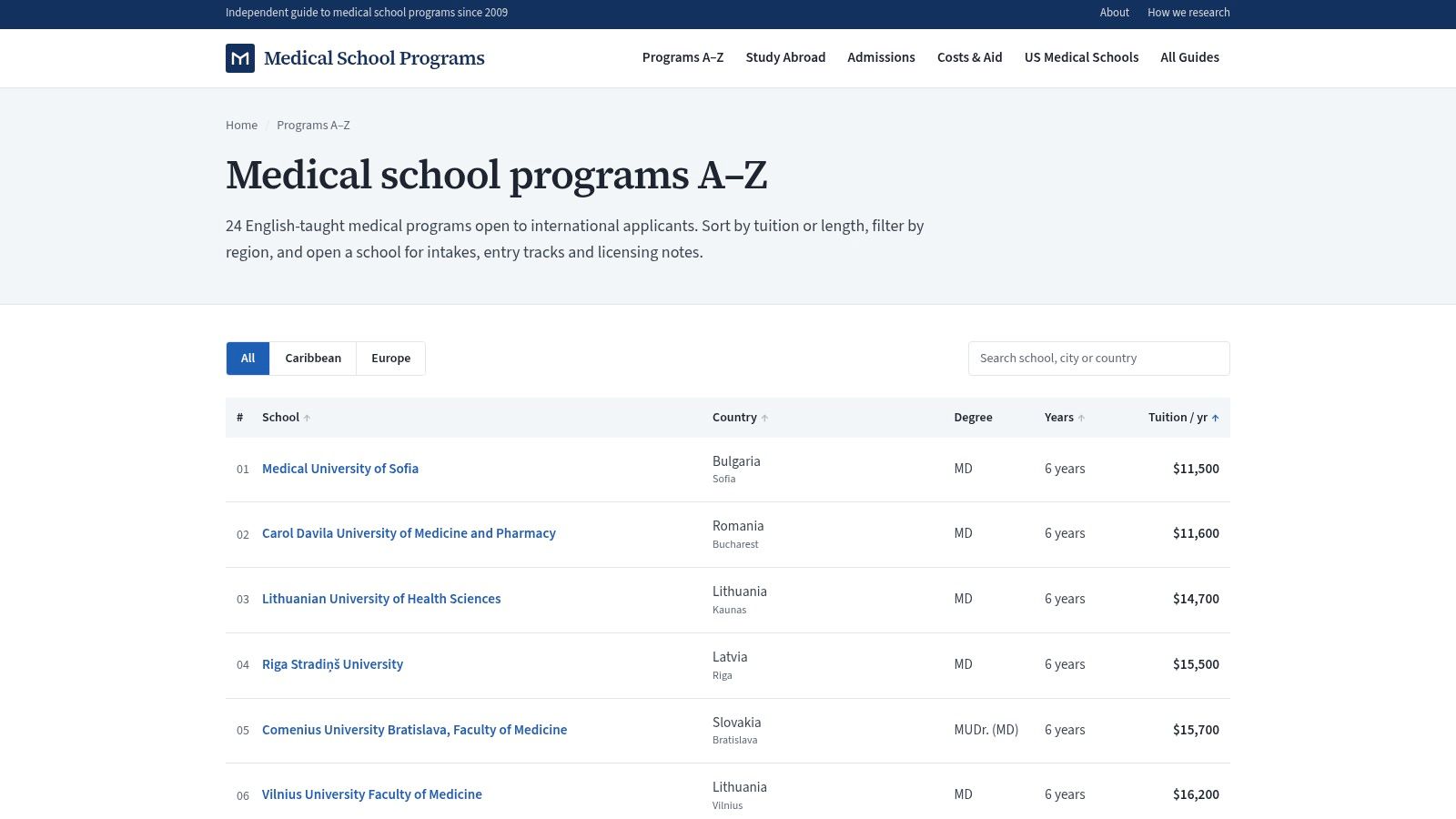
How to Use It Well
Build a shortlist by route, annual tuition, duration, and language of clinical training, then check each school's own residency and licensing information. Don't stop at a headline match claim. The National Resident Matching Program 2025 Main Residency Match data report is the benchmark for validating match claims, because it reports position fill rates, specialty results, and placement outcomes in context. Ask schools for recent match lists and separate U.S. MD seniors from international graduates, since those groups face different competitiveness.
We run this as an independent editorial resource, not a school or recruitment agency. That's a strength for early research, and also the limit. A directory can't confirm that a degree will be recognized in your target country, and it can't replace checking current admissions rules with each institution.
- Pros: 24 English-taught programs in one place, with tuition, length, and region filters for faster comparison.
- Pros: Covers both Europe and the Caribbean, so you can compare routes instead of only rankings.
- Cons: The scope is limited to the regions and programs listed, and fees, admissions, and licensing details still need direct verification.
Practical rule: Shortlist by licensing destination first. Tuition only matters if the degree leads where you intend to practice.
I recommend this as your first pass, not your final answer.
2. UMass Amherst
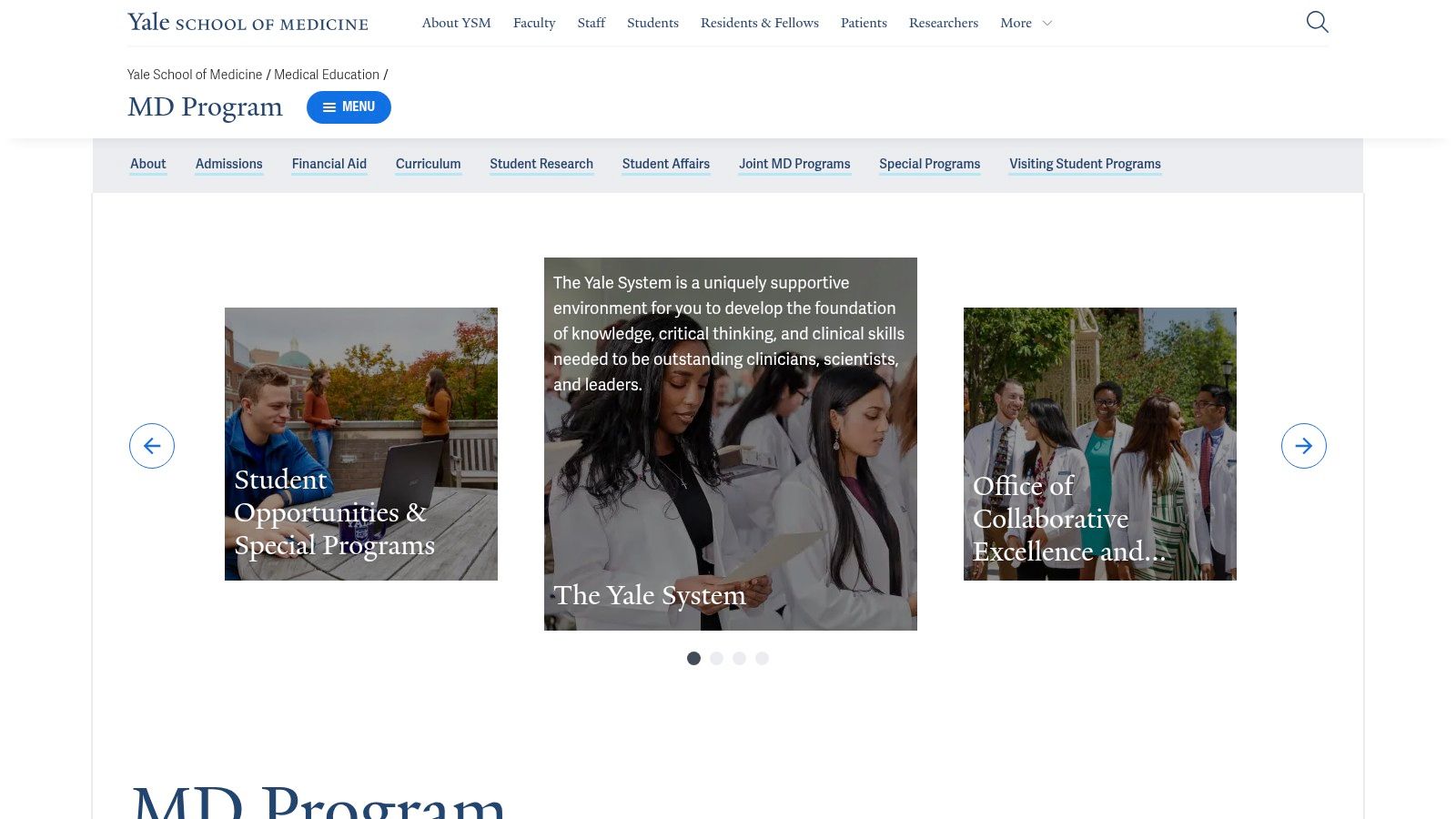
UMass Amherst suits students who want the U.S. bachelor's first route and aren't ready to commit to medicine at eighteen. You're not locked into a named pre-med major. You choose a major, complete medical school prerequisites, and use UMass Amherst pre-health advising for coursework planning, experience, MCAT preparation, recommendations, applications, and interviews.
That flexibility has value. You can study biology, psychology, public health, or something less obvious, then test your commitment through clinical exposure before you apply. PreHealth Peer Advisors give early guidance, and professional advisers add support as the application gets serious. If you want broader context on the U.S. pathway, our guide to U.S. medical schools explains how undergraduate choices connect to later MD applications.
The Trade-Off
This route is longer and less certain. UMass isn't a medical school and doesn't guarantee admission to one. The Association of American Medical Colleges 2025 enrollment news reports a mean MCAT of 512.1 for matriculants and a mean GPA of 3.81 for matriculants in the 2025 to 2026 cycle. You'll need grades, prerequisites, relevant experience, and a strong application, then you'll still face medical school tuition later.
- Best fit: Students who want major flexibility and time to build a competitive U.S. application.
- Weak fit: Students who want direct entry into medicine straight after secondary school.
3. Yale School of Medicine
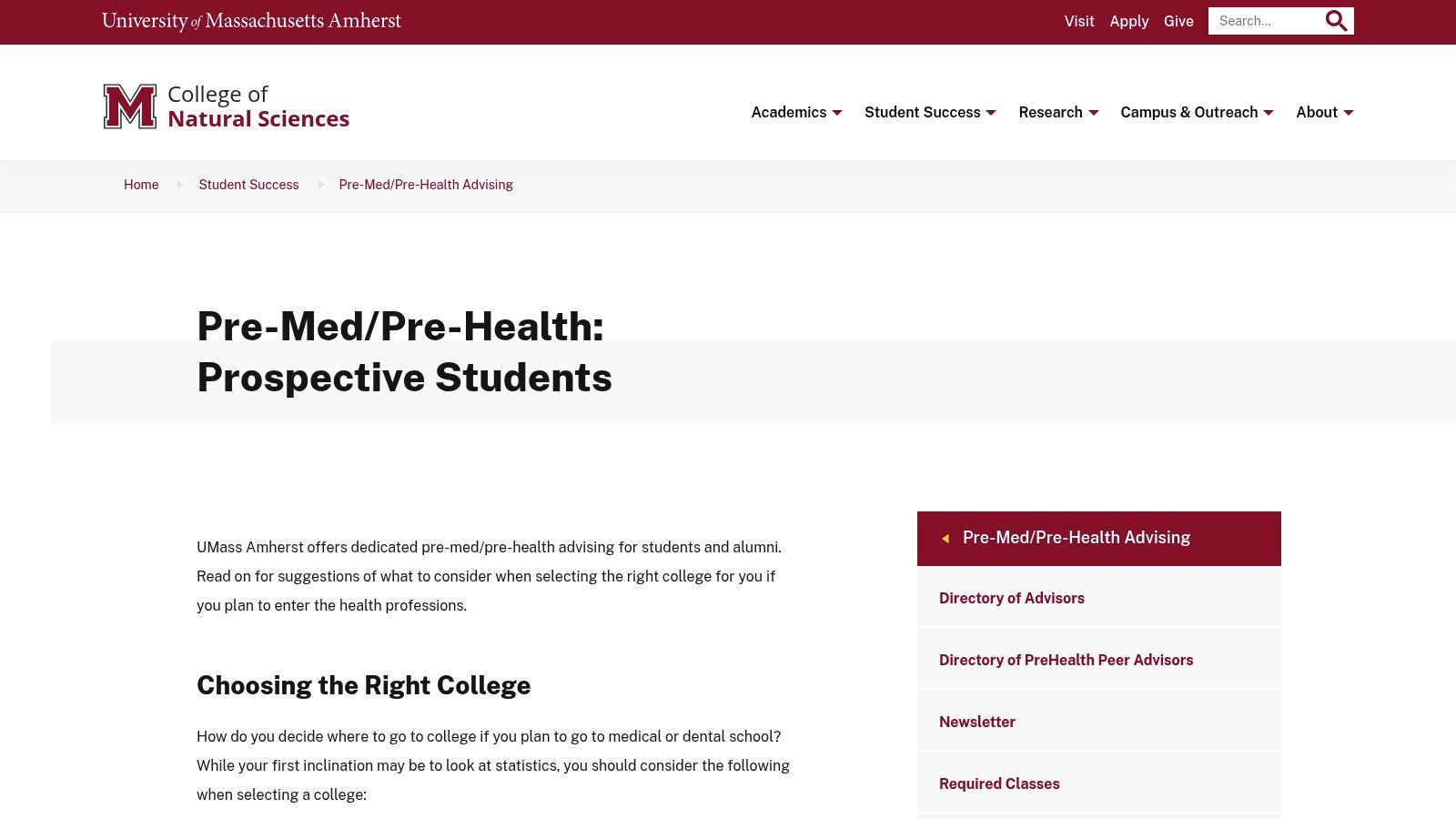
Yale sits at the opposite end of the U.S. route from a pre-med college. It's a graduate MD program for applicants who've already completed substantial university study, built around student initiative, faculty mentoring, clinical skills, research, and a required thesis. Start with the Yale School of Medicine MD Program to confirm current entry requirements and curriculum structure.
The draw is depth. LCME accreditation matters because Yale states the program meets educational requirements for licensure in all fifty states and Washington, D.C. Research intensity is also concrete. Yale School of Medicine reports its researchers received $571,450,883 in National Institutes of Health awards during federal fiscal year 2023. That doesn't guarantee you a lab place, but it signals serious research infrastructure if you actively seek mentors.
Cost and selectivity are the hard limits. Yale is expensive before housing, fees, and other expenses, so confirm current tuition and financial aid eligibility on the official program page, especially if you're international. Our explainer on how medical school rankings work helps you separate research prestige from fit, debt, and residency goals.
- Pros: U.S. accredited MD, strong mentoring, required thesis, and integrated clinical training.
- Cons: Highly selective, expensive, and unavailable as a direct-entry route after high school.
I wouldn't choose Yale for the name alone. Choose it if you want research led training and can finance it without distorting your specialty choice later.
4. University of Bologna
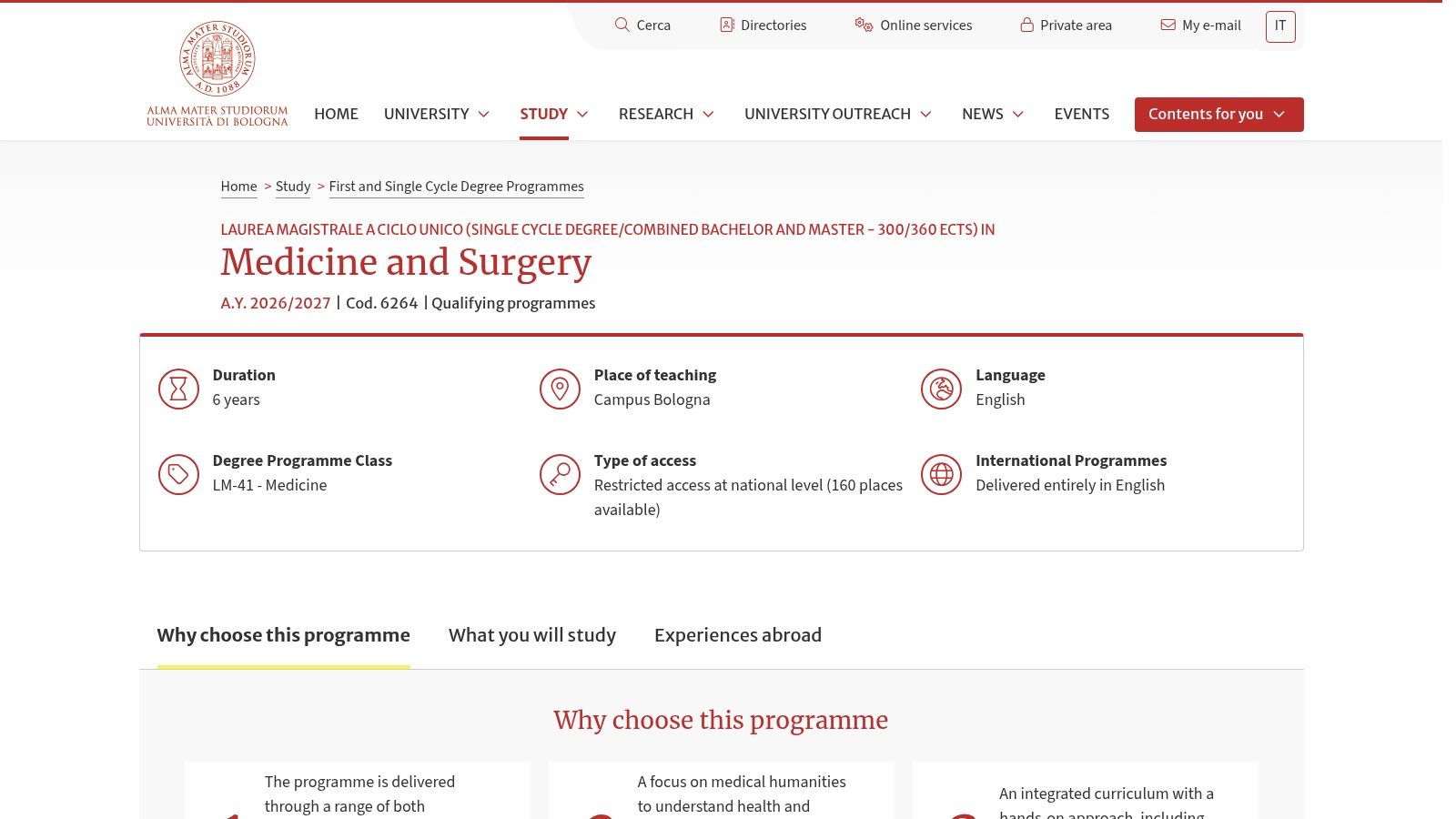
Bologna represents the cleanest direct-entry contrast to the U.S. system. Its six-year, English-taught Medicine and Surgery degree takes students from secondary school into medicine without a separate bachelor's degree. The University of Bologna Medicine and Surgery programme page describes the 2026 to 2027 listing as nationally restricted with 160 places.
Early clinical contact changes the experience. Clerkships begin in Year 1 according to the program description, alongside problem solving, medical humanities, and multidisciplinary learning. You'll know sooner whether patient facing work suits you. International exchange and internship opportunities add breadth, but they don't remove language reality. Lectures in English don't mean every patient, nurse, or ward conversation will be in English, so plan to learn Italian seriously.
Licensing Comes First
Admission is restricted and requires an entrance test, and procedures can change by academic year. If your end goal is U.S. residency, treat that as a separate project from admission. The American Medical Association report on the 2025 Match states that 67.8% of U.S. citizen international medical graduates matched into first-year positions, compared with 58.0% of non-U.S. citizen international graduates. Eligible to apply isn't the same as matched.
- Pros: Direct entry, English instruction, and clinical exposure from the first year.
- Cons: Entrance test required, Italian needed for placements, and extra recognition steps if you practice elsewhere.
5. University of Pavia - Harvey Medicine and Surgery Course
Pavia's Harvey Course is another six-year, English-taught single-cycle degree in Italy, combining undergraduate and master's level study in one medical program. It isn't a pre-med bachelor's with a medical label. You enter medicine directly, so your school grades, entrance preparation, and tolerance for early commitment matter from day one. Review the University of Pavia Harvey Medicine and Surgery Course page for applicant categories and current instructions.
Clinical training links are the practical selling point. The university highlights opportunities with healthcare facilities in the area, including San Matteo, Maugeri, and Mondino. Ask specific questions before you apply. Which years involve hospital placements, what Italian level is expected, how feedback is given, and how career advising works for students targeting another country after graduation?

Student experience should be benchmarked, not marketed. The University of Mississippi Medical Center summary of the 2025 AAMC Graduation Questionnaire notes 92% of graduating U.S. medical students agreed or strongly agreed they were satisfied with the overall quality of their medical education nationally. Use that mindset anywhere. Ask Pavia for evidence on clinical teaching, feedback timing, and student support, not only curriculum claims.
- Pros: Direct-entry English-taught degree with hospital-linked clinical training in northern Italy.
- Cons: Entrance rules and deadlines need checking each cycle, and recognition depends on where you'll practice.
Don't buy English-taught as English-only. Your clinical competence will depend on the language patients actually speak.
6. Iuliu Hațieganu University of Medicine and Pharmacy Cluj-Napoca
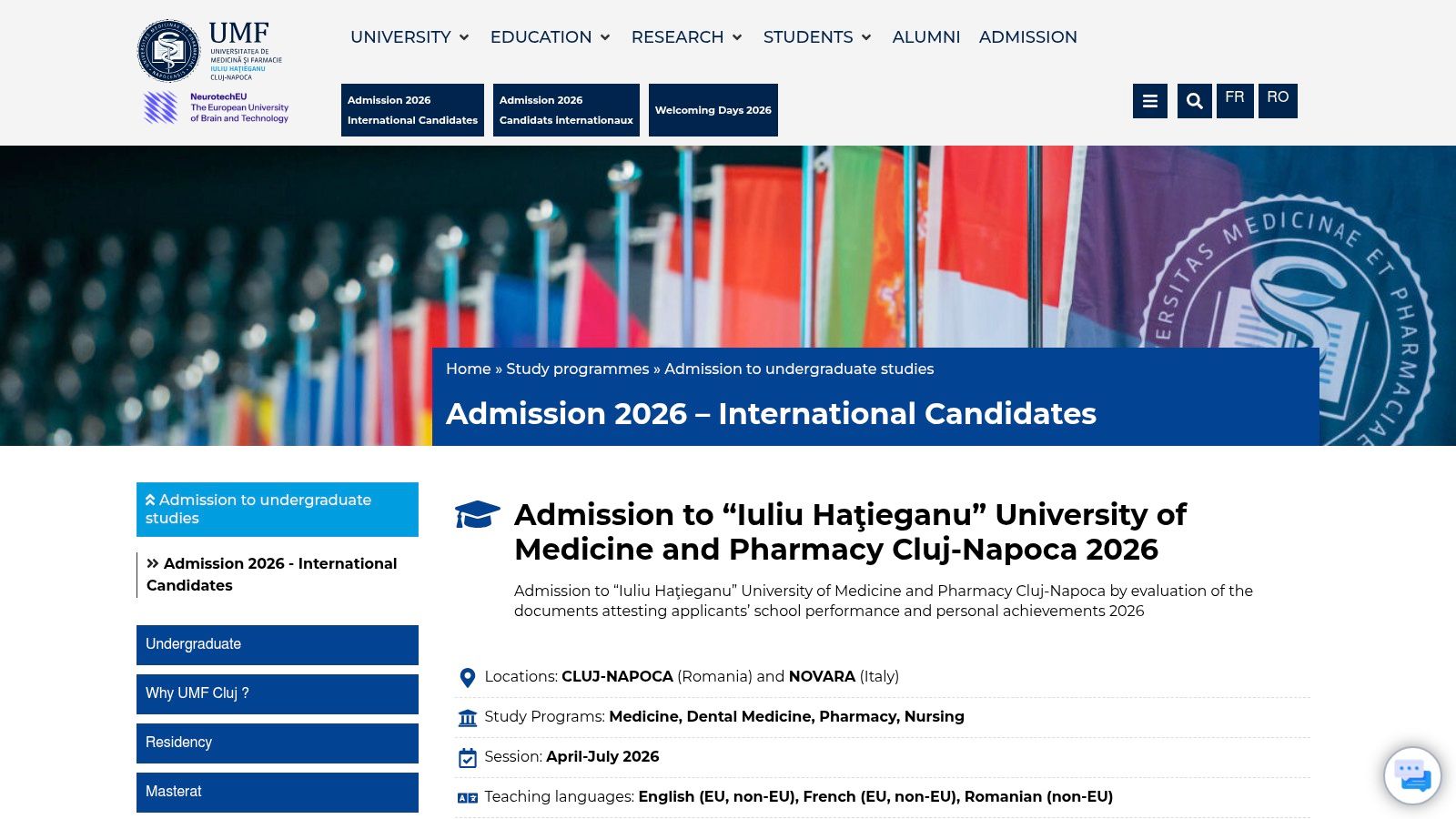
Cluj-Napoca offers a six-year Medicine degree in English and French for EU and non-EU applicants, with a different admissions filter from Italy. For international candidates, the university describes selection based on academic performance and personal achievements rather than an entrance exam. Its international admissions page for Iuliu Hațieganu University lists 200 places in English at Cluj for 2026 admissions.
That document based review can suit students with strong school records who test less well under one-day exam pressure. It doesn't make admission easy or guaranteed. The program totals 360 ECTS credits, and the university reports international students from more than 56 countries, according to its program materials. For country level context on visas, costs, and student life, use our guide to studying medicine in Romania alongside the university's own rules.
Cash flow is a real constraint for non-EU students. The university states they must pay the full first-year tuition fee to obtain a Type D student visa. Build that timing into your family budget before you celebrate an offer. Also verify how clinical Romanian language expectations develop across the degree, since classroom language and ward language often diverge.
- Pros: No entrance exam for international file review, English and French options, and direct entry after secondary school.
- Cons: Competitive document review, upfront visa-linked tuition payment, and licensing checks still required for your target country.
7. St. George's University School of Medicine
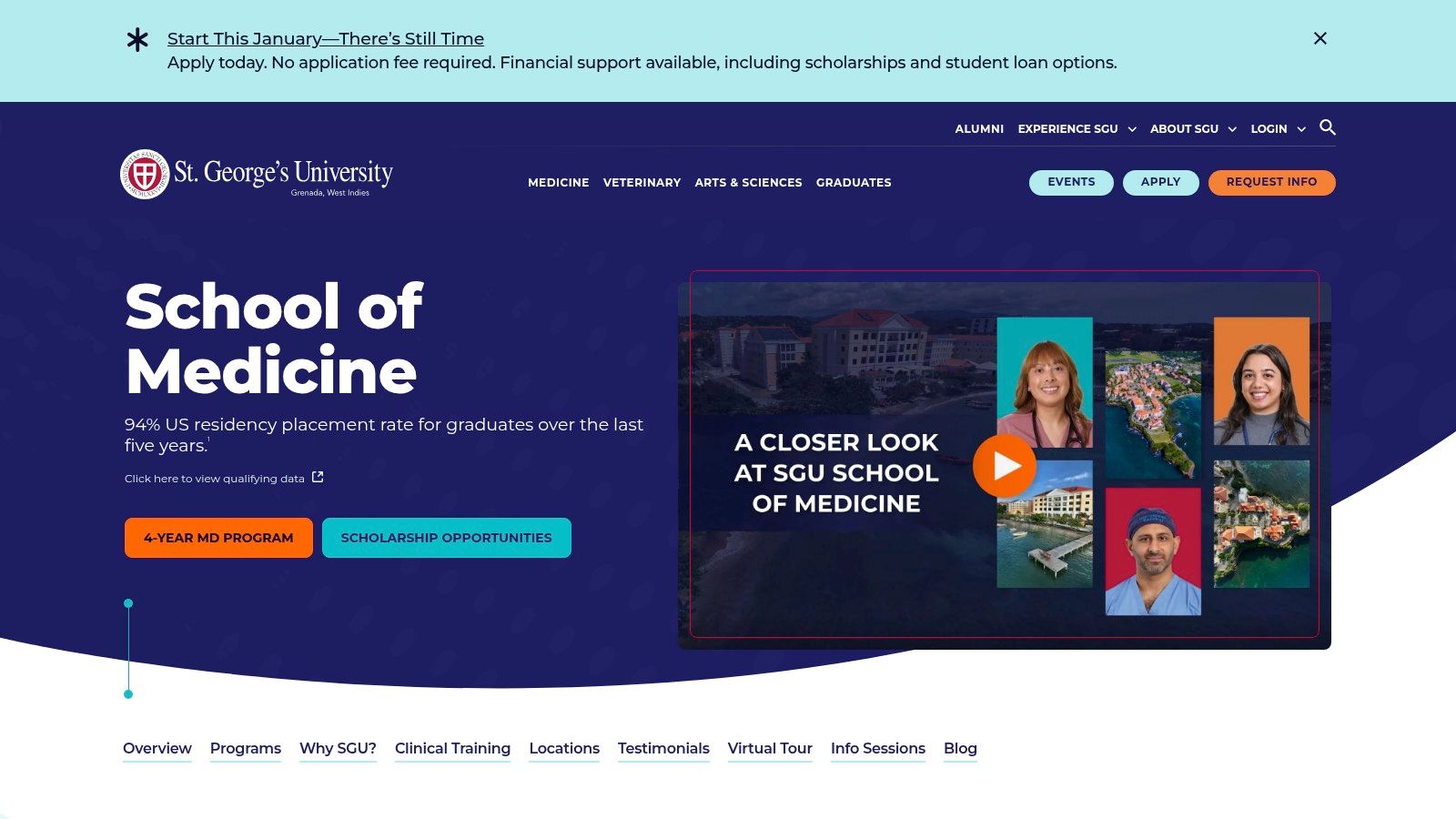
St. George's University in Grenada is the clearest Caribbean comparator. It offers an MD pathway based in Grenada with clinical training options that include the United States, plus school-provided career guidance and residency support. Start with St. George's University School of Medicine and read how the school defines its own residency placement figures before you compare them with U.S. MD or DO programs.
Transparency helps, but it doesn't soften the price. The school publishes tuition and fee schedules, including repeat-course charges and cost-of-attendance information, with four-year MD tuition and administrative fees totaling $389,987 before living and other expenses. At that level, debt can steer your specialty and location choices for years. Compare loan eligibility, rotation locations, attrition support, USMLE preparation, and what happens financially if you need to repeat a term.
Residency scarcity is the wider risk you can't ignore. A Manatt briefing note on medical education in 2025 reports 47,208 active applicants competed for 40,041 first-year residency positions in 2025. A school-reported placement rate doesn't guarantee your outcome in that market. Ask for outcomes by citizenship, specialty, and first attempt status.
- Pros: U.S. clinical training options, published fees, and publicly described residency advising.
- Cons: Very high total cost, school-reported outcomes, and a harder residency path than a U.S. MD for many applicants.
I see SGU as a calculated second route, not a shortcut.
7 Colleges and Pathways for Future Doctors at a Glance
Seven options, three structures. Compare where each route starts, how long it runs, where it teaches, and who it suits.
| Pathway | Entry Point | Program Length | Language / Location | Best For |
|---|---|---|---|---|
| Medical school programs A–Z | Direct entry after secondary school or graduate entry, by program | Six years for European degrees; four years for Caribbean MD programs | English-taught programs in Europe and the Caribbean | Comparing medical programs, tuition, and length |
| UMass Amherst | Undergraduate study before applying to medical school | Bachelor's degree, then a four-year MD | English / Massachusetts, USA | Students seeking pre-health advising and a flexible major |
| Yale School of Medicine | After at least three academic years of college | Four-year graduate-entry MD | English / Connecticut, USA | Research-focused applicants seeking a U.S. MD |
| University of Bologna | Direct entry after secondary school | Six years | English / Italy | Students seeking a direct-entry medical degree in Europe |
| University of Pavia, Harvey Medicine and Surgery Course | Direct entry after secondary school | Six years | English / Italy | Students seeking English-taught medicine with clinical training |
| Iuliu Hațieganu University of Medicine and Pharmacy Cluj-Napoca | International applicants; selection by application review | Six years | English or French / Romania | International students seeking document-based admission |
| St. George's University School of Medicine | Graduate entry after prior university study | Four years | English / Grenada, with U.S. clinical training options | Applicants considering an international MD pathway with U.S. clinical options |
Choosing Your Route Next Steps Before You Apply
Decide the structure before you chase names. If you want time to explore, keep U.S. options open, and build maturity before committing, the bachelor's then MD route fits, though it takes longer and admission is never assured. If you're certain about medicine now and can handle early clinical work abroad, a direct-entry six-year degree skips the separate undergraduate stage. If you choose the Caribbean, go in with eyes open on debt, rotations, licensing exams, and residency competitiveness.
Your Three-Step Check
- Step 1: Pick your route, U.S. bachelor's then MD, a direct-entry six-year European degree, or a four-year Caribbean MD, based on where you want to train and practice.
- Step 2: Shortlist two or three programs and confirm current tuition, admission rules, language expectations, and licensing steps directly with each school.
- Step 3: For international routes, confirm recognition, internship eligibility, residency access, and visa rules in the country where you plan to practice, not only where you'll study.
Cost needs the same discipline as admissions. Compare total borrowing against realistic specialty and location goals, because expensive prestige can narrow your choices later. I'd rank recognition and residency access above tuition savings or brand name every time. A program with strong primary care or regional placement may serve your actual career better than a famous school aimed at highly competitive specialties.
Fit beats mythology. That is the true measure of good colleges for doctors.
Medical School Programs has been an independent guide to medical school programs since 2009 and lists 24 English-taught programs in Europe and the Caribbean, including 4 in Poland, the most of any European country listed, alongside guides on admissions, funding, and licensing. We check program data against official school sources and authoritative bodies such as the World Directory of Medical Schools, ECFMG, and NRMP, then date it, so confirm current details with each institution before you pay an application or tuition deposit.
Compare routes, tuition, program length, and licensing considerations across English-taught medical programs in Europe and the Caribbean before you apply. Visit Medical School Programs to build a realistic shortlist, check country and admissions guides, and then confirm the final details directly with your chosen schools.