
Most guides treat Caribbean medical schools with no MCAT as a simple shortcut around standardized testing. That framing misleads thousands of applicants every cycle. Roughly 85,000 students take the MCAT each year, according to a 2025 CaribbeanMedicalSchool.com admissions overview, and plenty of them look south hoping to skip the exam altogether.
In reality, the MCAT waiver rarely belongs to the school. It belongs to your citizenship, residency status, and entry track. The Medical University of the Americas U.S. admissions page explicitly requires U.S. applicants to submit MCAT scores, and comparative reporting confirms the same requirement across major regional campuses including St. George's, Ross, AUC, Saba, and Trinity. One applicant can walk in without a test score while a classmate holding a U.S. passport or green card gets rejected without one.
Cost figures require the same skepticism. A published tuition schedule rarely equals your final bill once you add island housing, travel to U.S. clinical sites, exam fees, and potential extended terms. Admissions policies also shift between cycles, so use the seven profiles below to separate published rules from estimates you must confirm directly before paying an application fee.
Table of Contents
- 1. St. George's University School of Medicine (SGU)
- 2. Ross University School of Medicine (Ross Med)
- 3. American University of the Caribbean School of Medicine (AUC)
- 4. Saba University School of Medicine
- 5. American University of Antigua College of Medicine (AUA)
- 6. University of Medicine and Health Sciences (UMHS)
- 7. Caribbean Medical University (CMU)
- How the 7 Caribbean Schools Compare on the MCAT and Published Costs
- Turning a 'No MCAT' Listing Into a Shortlist You Can Verify
1. St. George's University School of Medicine (SGU)
A "no MCAT" line next to St. George's University describes the applicant, not the campus. SGU operates in Grenada with a standard four-year MD track and longer entry pathways for students who have not completed a bachelor's degree. The St. George's University MD admissions page publishes that citizenship split in plain rules.
Here is a look at the student environment at SGU's Caribbean medical campus.

Applicants from outside North America do not need to submit an MCAT score. Canadian applicants sit in a conditional middle ground: SGU generally exempts them unless they have already taken or scheduled the exam, in which case they must report it. U.S. citizens and permanent residents have no waiver and must submit valid MCAT scores to be considered. One published policy, three different gates.
Who Skips the Exam and What It Costs
SGU tuition is not one fixed total you can copy into a budget. It varies by entry track, so the number that matters is the figure on SGU's official cost sheet for that track. Housing, meals, flights, health insurance, and licensing exam fees sit outside tuition and administrative fees. Five-year and six-year pathways add extra terms of tuition and island living costs. Before treating any schedule as a final bill, set it beside a breakdown of total Caribbean medical school costs that covers living expenses and financing overhead.
- Published strengths: Multiple MD entry tracks, multiple annual start dates, and citizenship-based MCAT rules stated on the admissions page make the first screen concrete.
- Key limitations: U.S. citizens and permanent residents cannot bypass the MCAT, and an exemption for international candidates never guarantees a seat.
- What to confirm: Request an itemized cost-of-attendance sheet for your exact entry track. Treat any outside total as an estimate until that sheet matches your start date and pathway length.
2. Ross University School of Medicine (Ross Med)
Ross Med's MCAT requirement turns on applicant status, so a “no MCAT” label alone is not enough to decide whether its Barbados program belongs on your shortlist. Under the Ross University admissions requirements page, international applicants can apply without an MCAT score, while U.S. citizens, nationals, and permanent residents must submit one before an admissions interview can be scheduled.
That interview requirement matters for planning. If you fall into a required-testing category, submitting the rest of your application does not remove the MCAT checkpoint.
Admissions reality: Eligibility to apply without an MCAT score does not establish how competitive an application will be. Ask Ross how it assesses applicants using your academic record and application route.
What Replaces the Score for International Applicants
International applicants still need to meet degree expectations, complete prerequisite science coursework, provide official transcripts, and submit letters of recommendation. Review the Caribbean medical school entry requirements alongside Ross Med's requirements to identify missing coursework or documents before applying.
Make the questions specific: which prerequisites remain outstanding, whether your degree meets entry expectations, and what supporting materials are required without an MCAT score. This separates permission to apply from readiness for review.
Budgeting requires a separate assessment. An exam exemption says nothing about tuition, living expenses in Barbados, or relocation for clinical training. Request the current term-by-term tuition schedule and an itemized account of living and clinical travel expenses. Keep published charges separate from estimates, and ask which costs depend on your clinical placements before comparing Ross with another school.
3. American University of the Caribbean School of Medicine (AUC)
Many roundups blur a critical distinction highlighted in Confetto's analysis of Caribbean medical school requirements: the gap between "MCAT not required to submit an application" and "MCAT not required for admission." American University of the Caribbean School of Medicine in St. Maarten sits right on that boundary.
AUC requires MCAT scores from all U.S. citizens, nationals, and permanent residents. Non-U.S. applicants aren't required to submit an MCAT score, according to the AUC application portal, yet the university encourages those candidates to sit for a recognized medical admissions exam offered in their own country.
How Individual Exam Waivers Work at AUC
Rather than handing out automatic exemptions to every overseas student, AUC's admissions committee evaluates exam waivers on an individual basis. You still have to present strong university transcripts and satisfy prerequisite science courses, meaning your academic record carries heavier scrutiny if you apply without a test score.
- Published policy: Clear online separation between U.S. applicants (MCAT mandatory) and non-U.S. applicants (MCAT not required, alternative national exams encouraged).
- Review friction: Because waivers happen case by case, submitting an application without an exam doesn't guarantee the committee won't ask for additional testing or coursework proof.
- Verification step: Email admissions before submitting transcripts to confirm which home-country medical exams they accept and what minimum science GPA typically qualifies for an individual waiver.
4. Saba University School of Medicine
Start with the sticker price. For September 2026 entrants, Saba University School of Medicine publishes total four-year MD tuition and administrative fees of $298,750, laid out term by term rather than hidden behind a single vague average. That level of upfront pricing on the Saba University MD program overview gives prospective students a firmer baseline than most island campuses offer.
Medical students at Saba complete their basic sciences on the island of Saba before transitioning into clinical rotations.
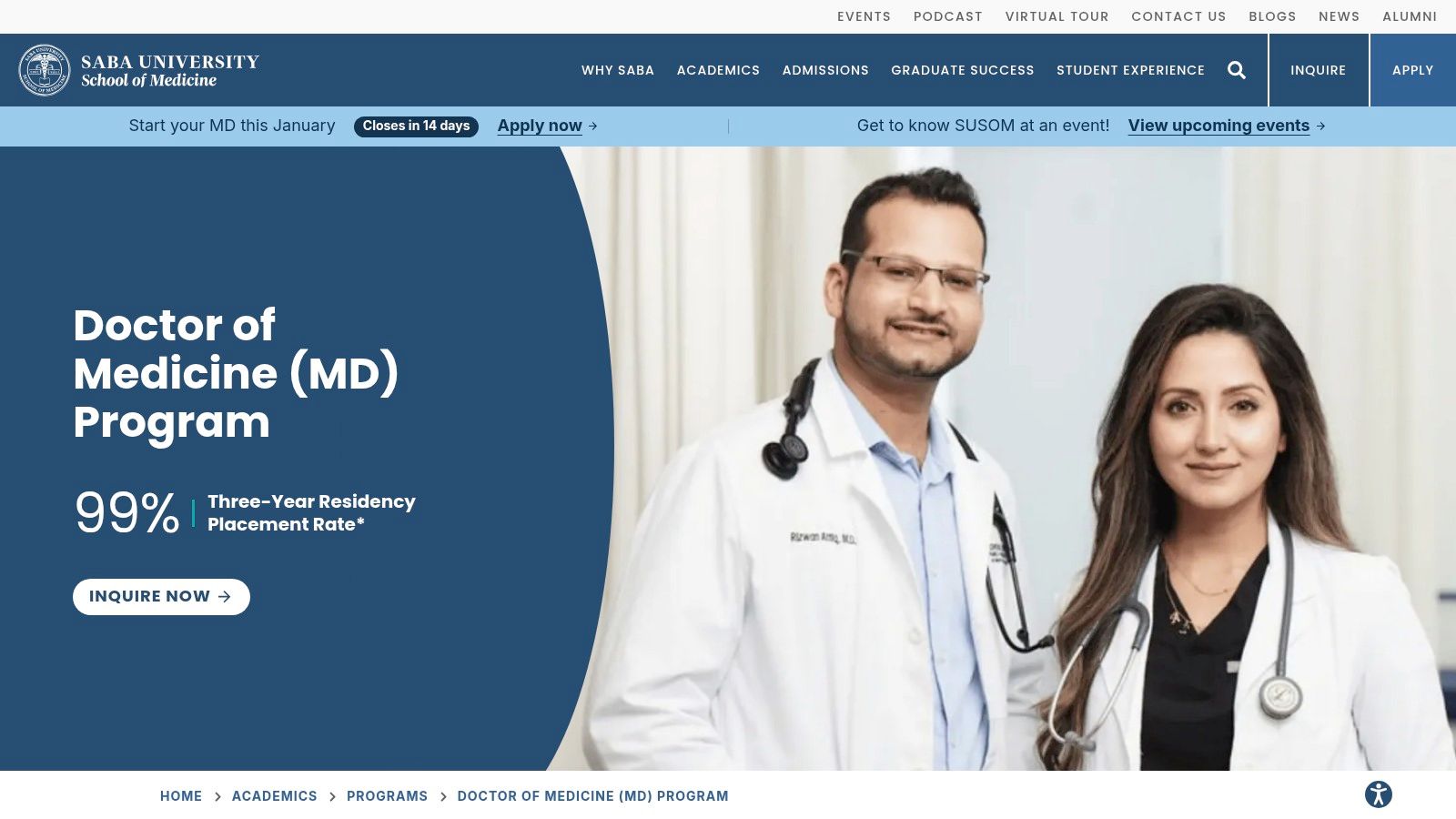
On testing, Saba draws the same citizenship boundary seen across the larger four-year Caribbean programs. U.S. citizens, nationals, and permanent residents must submit MCAT scores. Applicants outside those categories face different testing rules, though Saba's published guidance requires each non-U.S. applicant to confirm exact expectations for their specific citizenship and application track.
Published Fees Versus Final Attendance Costs
That $298,750 figure isn't your all-in cost of attendance. Published tuition and administrative fees leave out island rent, groceries, inter-island travel, health coverage, licensing exam fees, and potential clinical elective surcharges during your third and fourth years. Weighing those extras against domestic options is essential if you're still deciding whether studying medicine abroad is worth it for your career goals.
Treat any published four-year fee schedule as your floor, never your ceiling. One repeated basic-science semester or out-of-network clinical elective can push your real spending tens of thousands of dollars higher.
Before applying to Saba, get written confirmation on two items: whether your nationality qualifies for an MCAT exemption in your intended term, and which clinical rotation sites carry extra institutional surcharges.
5. American University of Antigua College of Medicine (AUA)
Dual citizens often get tripped up by Caribbean testing rules, and American University of Antigua College of Medicine spells out why. According to the AUA admissions requirements and FAQ, U.S. citizens, nationals, and permanent residents must take the MCAT and submit their scores. Canadian and other international applicants only skip the MCAT if they don't also fall into one of those U.S. categories.
Students entering AUA study on the island of Antigua across either the direct MD track or a preparatory pre-medical pathway.
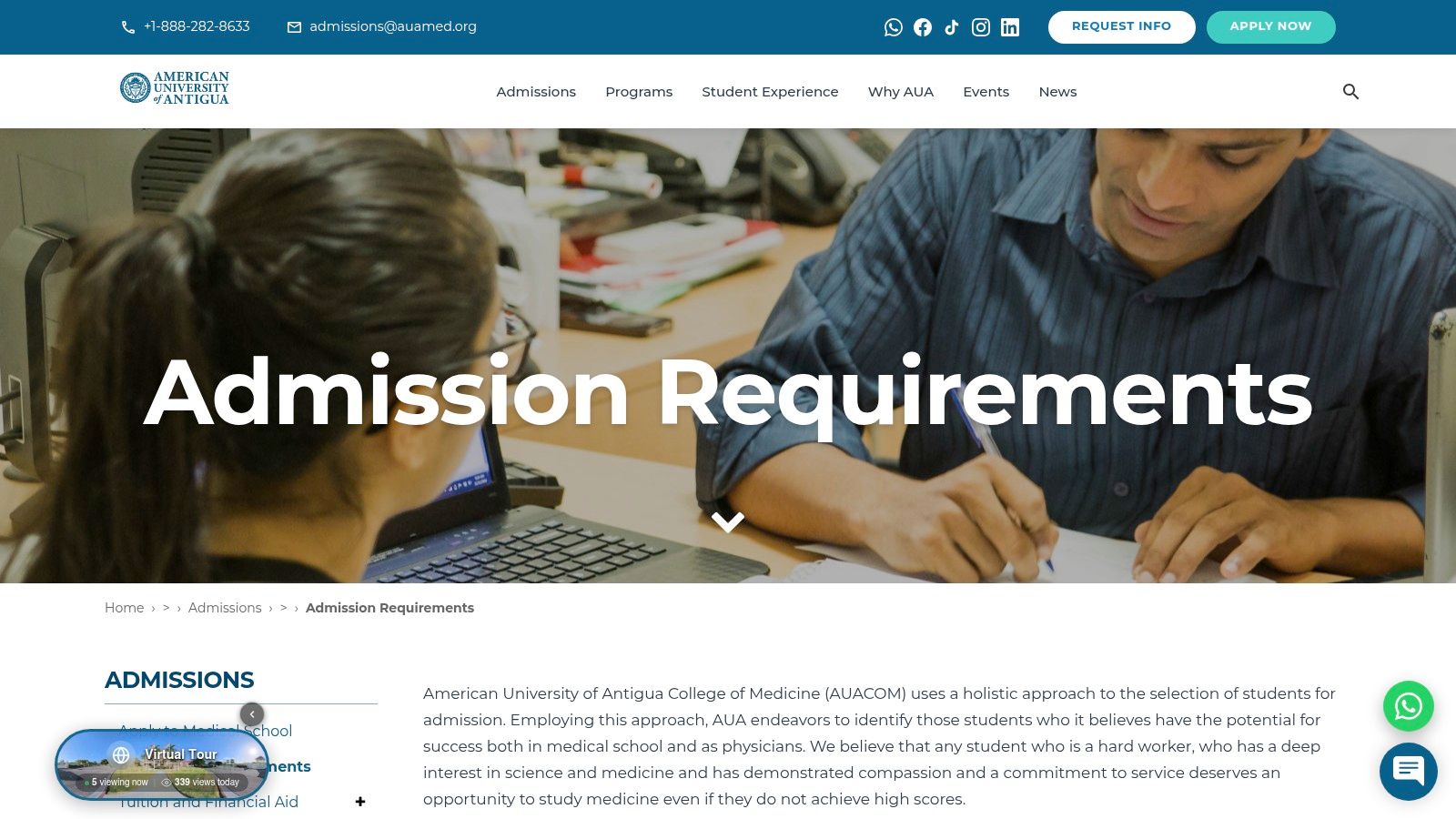
If you hold both Canadian and U.S. citizenship, AUA treats you as a U.S. applicant for MCAT purposes. Even eligible international candidates who avoid the exam still have to clear prerequisite coursework, English-language proficiency checks where applicable, and standard admissions interviews.
Pre-Medical Pathway and Variable Clinical Charges
AUA's pre-medical route appeals to students who need foundational science preparation before starting basic sciences, though adding preparatory semesters changes both your timeline and your budget.
- Published cost data: AUA shares tuition and cost-of-attendance figures online so families can start building a working budget.
- Clinical variability: Charges during the clinical phase can shift depending on your rotation schedule and sequencing, making a static four-year estimate unreliable on its own.
- Actionable next step: Ask AUA's financial aid office for a personalized cost projection tied to your exact entry route (direct MD versus pre-medical) and expected clinical timeline.
6. University of Medicine and Health Sciences (UMHS)
Not every applicant looking into Caribbean medical schools without an MCAT has finished a four-year university degree. University of Medicine and Health Sciences in St. Kitts stands out on its academic entry structure: a completed bachelor's degree isn't required, provided you bring at least 90 semester credits along with the school's specified science prerequisites.
UMHS offers both standard and extended basic-science tracks on its St. Kitts campus before students move into clinical rotations.
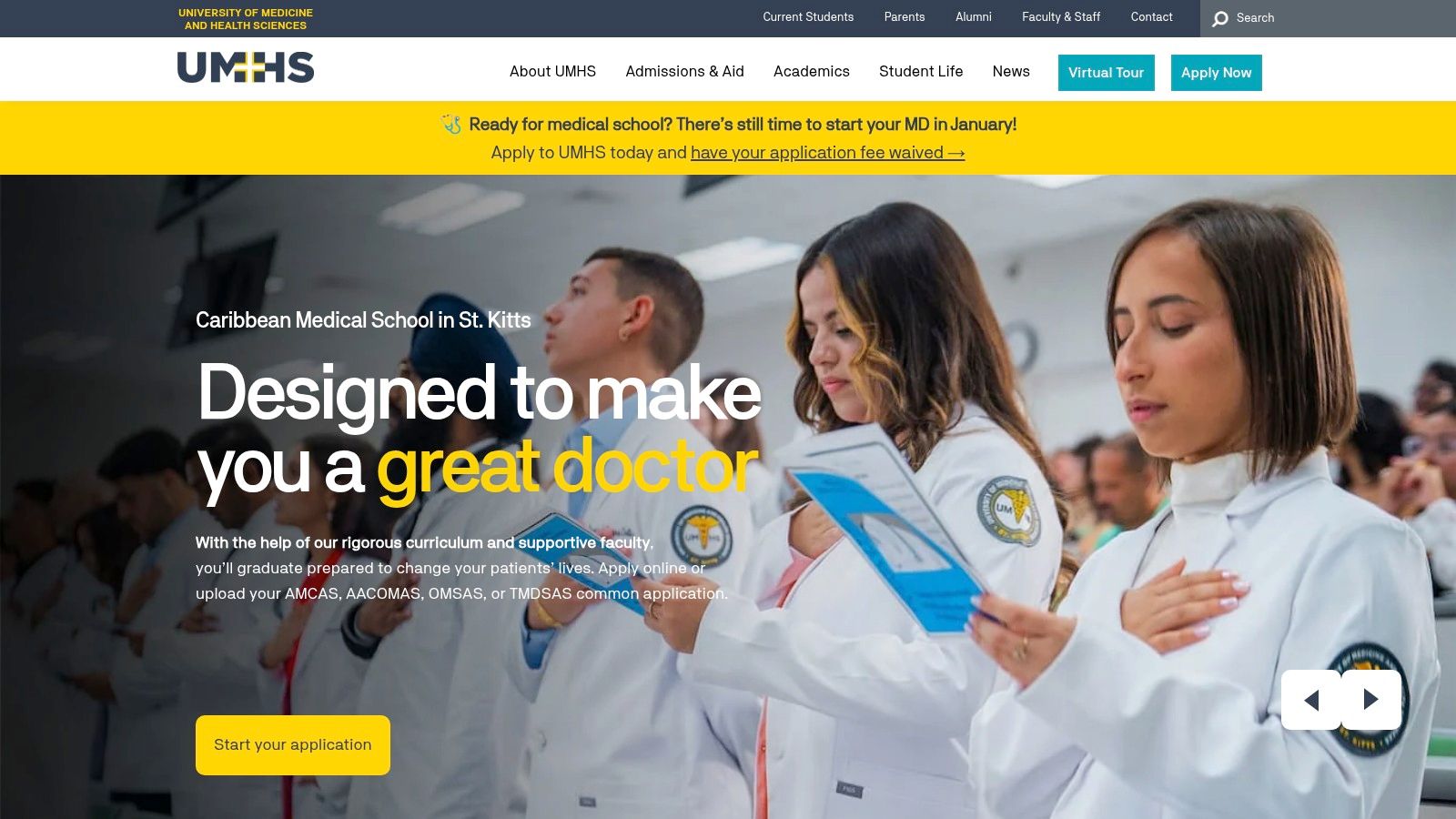
Its testing policy follows the familiar North American split. On the UMHS official website, U.S. citizens and permanent residents are required to submit MCAT scores. For Canadian citizens and other international applicants, UMHS recommends the MCAT rather than mandating it, meaning you can apply without a score while recognizing that admissions officers still value it as a readiness indicator.
Decoding the Per-Semester Tuition Structure
Effective May 2026, UMHS publishes basic-science tuition at $17,550 per semester. Don't multiply that number by eight and assume you've found the total degree cost. UMHS charges different rates for extended basic-science terms and clinical semesters, and semester tuition alone excludes island housing, meals, insurance, books, and exam fees.
Budgeting note: An extended basic-science track can protect your GPA and USMLE readiness if you need a slower pace, yet every added semester increases both direct tuition and living costs.
Ask UMHS admissions for the current clinical-semester tuition rate alongside the basic-science figure so you can calculate a realistic four-year or extended-track total before depositing.
7. Caribbean Medical University (CMU)
Caribbean Medical University in Curaçao breaks the pattern running through the first six schools on this list. Elsewhere, MCAT flexibility is a function of who you are: exempt if you apply as a Canadian or international candidate, required if you hold a U.S. passport. The CMU admissions requirements page lists the MCAT as optional in its published requirements without tying that exemption to citizenship, so the waiver here is a school-level policy rather than an applicant-category carve-out. Applicants are evaluated primarily through coursework, transcripts, and interviews.
CMU structures its MD degree with basic-science terms in Curaçao followed by clinical science rotations in the United States, with multiple start terms each year.
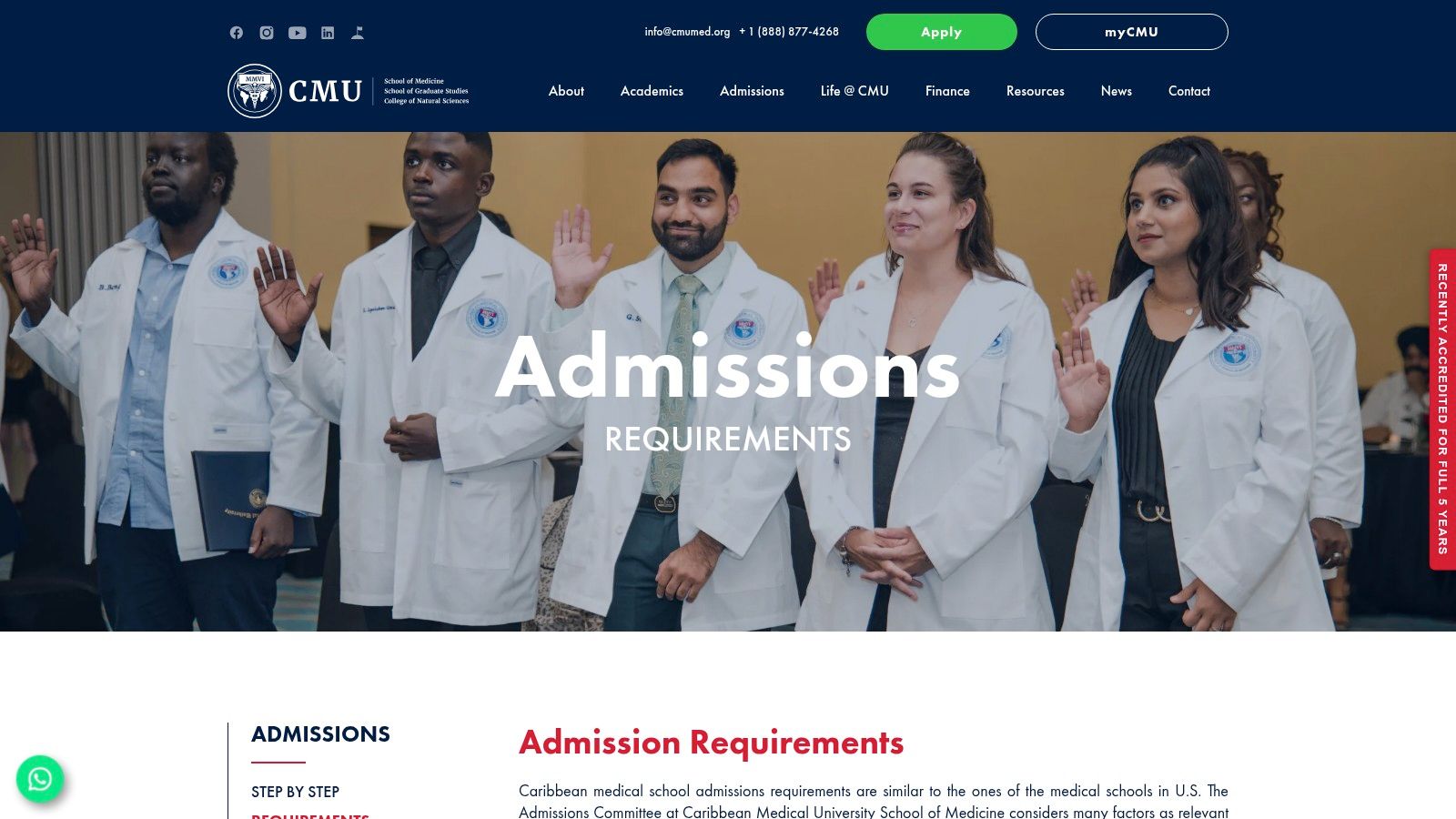
An optional MCAT at the admissions gate changes nothing about what waits after graduation. Caribbean graduates enter U.S. graduate medical education as international medical graduates (IMGs), and in the 2025 Main Residency Match, 9,761 IMGs obtained first-year U.S. positions overall, as outlined in Match A Resident's guide to Caribbean medical schools. Clearing the entry hurdle says nothing about whether a program prepares you for ECFMG certification, USMLE exams, or placement at competitive U.S. clinical sites.
What the Published Cost Estimate Covers and What You Must Verify
CMU publishes a full-program cost estimate with term-by-term breakdowns that incorporate tuition, fees, and specified housing and living estimates. That transparency helps with initial comparison. Treat the total as a planning figure rather than a guaranteed final bill, because several line items move with choices you control.
- Variable expenses: Actual spending shifts with your Curaçao housing choices, travel between U.S. clinical rotation sites, and personal living costs.
- Admissions nuance: Even though the MCAT is optional, ask admissions whether submitting a score improves scholarship eligibility or strengthens a borderline prerequisite GPA.
- Licensing due diligence: Confirm CMU's current accreditation status, World Directory of Medical Schools listing, ECFMG eligibility, and state licensing acceptance for the exact U.S. states or countries where you plan to practice.
That last point carries more weight at a smaller island school than at the larger programs above. Where a big established school publishes years of match data you can inspect, a smaller program's record is thinner, so the verification work falls on you. Request the term-by-term cost sheet and the school's residency placement outcomes in writing before you commit a deposit.
How the 7 Caribbean Schools Compare on the MCAT and Published Costs
Read across the rows and a pattern emerges that most school-by-school profiles obscure. The MCAT requirement tracks the applicant's passport, not the campus. Every one of the seven schools requires the exam from U.S. citizens, and most extend that requirement to U.S. nationals and permanent residents, while applicants outside those categories are routinely exempted, encouraged rather than required, or routed to a local admissions exam instead.
| Item | MCAT for Non-U.S. Applicants | MCAT for U.S. Applicants | Published Cost Figure |
|---|---|---|---|
| St. George's University School of Medicine (SGU) | Not required for applicants outside North America; Canadian applicants generally do not need to submit a score unless taken or scheduled | Required | About $389,987 for 2026–27 four-year MD tuition and administrative fees |
| Ross University School of Medicine (Ross Med) | Not required for international applicants; strongly encouraged | Required for U.S. citizens, nationals, and permanent residents | No application fee; no consolidated program total published |
| American University of the Caribbean School of Medicine (AUC) | Not required; applicants may be encouraged to take a local admissions exam | Required for U.S. citizens, nationals, and permanent residents | No consolidated program total published |
| Saba University School of Medicine | Not required for most applicants outside the United States; the exemption depends on citizenship category | Required for U.S. citizens, nationals, and permanent residents | $298,750 in tuition and administrative fees for September 2026 entrants |
| American University of Antigua College of Medicine (AUA) | Not required for eligible Canadian and other international applicants | Required for U.S. citizens, nationals, and permanent residents | Publishes cost information without a single consolidated program total |
| University of Medicine and Health Sciences (UMHS) | Recommended but not required for eligible Canadian and other international applicants | Required for U.S. citizens and permanent residents | Basic-science tuition is $17,550 per semester, effective May 2026 |
| Caribbean Medical University (CMU) | Optional | Optional | Estimated full-program cost of $147,160, including tuition, fees, and specified housing and living estimates |
The cost column demands more careful reading than the MCAT column. Only SGU and Saba publish a consolidated tuition-and-fees total, and those two figures cover tuition and administrative fees alone. CMU's $147,160 is a different kind of number: an estimate that folds housing and living costs into tuition and fees, so it cannot be compared line for line with the SGU or Saba totals. UMHS publishes per-semester tuition instead, which means applicants must multiply across terms and add clinical-phase costs before any comparison is possible.
Three schools publish no consolidated total at all. For Ross Med, AUC, and AUA, the honest answer to "what does it cost" has to be assembled from per-term tuition, fees, and living expenses rather than read off a single page. That absence is itself useful information when ranking schools by transparency.
One benchmark helps calibrate all of these figures: the median yearly tuition across the listed Caribbean programs is $61,200. A four-year total well above or below four times that median deserves a closer look at what the figure includes, which terms it covers, and whether it is a published rate or an estimate.
Turning a 'No MCAT' Listing Into a Shortlist You Can Verify
Treat MCAT flexibility as an early filter, never as your main decision criterion. The bottleneck arrives four years later when you apply for postgraduate training. In the 2025 U.S. Main Residency Match, 3,108 of 4,587 U.S.-citizen international medical graduates matched to PGY-1 positions (67.8%), while 6,653 of 11,465 non-U.S.-citizen IMGs matched (58.0%), according to the NRMP 2025 Match results announcement.
Those national percentages combine graduates from medical schools worldwide rather than isolating individual Caribbean campuses. Still, they set a clear risk benchmark: any school that waives an entrance exam should back up its curriculum with recent, audited cohort outcomes for USMLE Step 1 and Step 2 CK pass rates, four-year graduation rates, and residency placements broken down by citizenship.
Four Verification Checks Before You Submit
Before sending transcripts or deposits to any program on your shortlist, run every candidate through four checks:
- Confirm your exact citizenship rule in writing: Ask admissions whether your passport, permanent residency, or dual citizenship qualifies for an exemption in your specific start term, and clarify whether "optional" still favors applicants who submit scores.
- Separate published tuition from total attendance cost: Across the four-year, US-style Caribbean MD programs we track at Medical School Programs, median yearly tuition sits at $61.2k, yet final four-year bills climb substantially once you factor in housing, airfare, clinical surcharges, and extra terms.
- Audit accreditation and licensing pathways: Check the World Directory of Medical Schools, ECFMG eligibility, and your target country or state medical board directly rather than relying on marketing brochures.
- Demand school-specific outcome data: Ask how many students from your citizenship group graduate on time, pass licensing exams on the first attempt, and secure residency positions in your intended country.
Since 2009, we've built Medical School Programs as an independent reference that cross-checks program figures against official university pages, the World Directory of Medical Schools, ECFMG, NRMP, and national accreditors, without letting schools pay to alter their listings. Use those benchmarks to challenge every headline claim, then verify your final numbers directly with each admissions office before you enroll.
Comparing Caribbean medical schools side by side takes verified data on citizenship rules, true attendance costs, and international licensing pathways. Explore our sourced directory of 24 English-taught medical programs across the Caribbean and Europe, along with plain-language guides on admissions, student finance, and IMG residency outcomes, at Medical School Programs.