
You're looking at medical school requirements after work, wondering whether your science courses still count and how you'd manage training alongside a mortgage, children, or an established career. The question isn't just whether you're too old. It's whether you can make a convincing application and build a life that gives you room to succeed once you're admitted.
For a non traditional medical student, the strongest strategy is to replace broad worries about age with specific evidence: current academic readiness, an informed reason for becoming a physician, and a workable support plan. Your earlier career can strengthen that evidence, but it won't substitute for it.
Table of Contents
- Who Counts as a Non-Traditional Medical Student
- How Common Non-Traditional Paths Really Are
- What Admissions Committees Look For in Career Changers
- Academic Risks and How to Offset Them
- Pathways Beyond the Traditional MD Route
- How to Build a Strong Non-Traditional Application
- Confirm Your Fit and Decide on a Route
Who Counts as a Non-Traditional Medical Student
Consider a hypothetical former pharmacy technician who completed a chemistry degree through evening classes, then worked in a hospital laboratory before applying to medical school. Her application reflects several departures from the direct college-to-medical-school sequence: employment, time away from college, and a professional transition. Her age alone tells an admissions committee much less than that combination.
Nontraditional doesn't have a single formal definition. Schools and applicants use it to describe different routes into medicine, including delayed education, caregiving, military service, and careers outside healthcare.
The transition can involve both a change of workplace and a return to academic life.

Signals that make an applicant nontraditional
These are descriptive examples, not admissions thresholds.
| Signal | Typical Example | Why It Matters |
|---|---|---|
| Age at entry | An applicant older than classmates entering directly from college | Life experience may add perspective, while existing obligations can constrain study time |
| Time since college | Returning after an extended period away | The application needs to explain the interval and demonstrate current readiness |
| Prior employment | Former nurse, engineer, or teacher | Employment can provide evidence of teamwork, communication, and responsibility |
| Family responsibilities | Parent of dependent children | Caregiving shapes study hours, childcare needs, and financial planning |
| Previous career | Changing fields after sustained employment | The applicant needs a clear, honest explanation of why medicine now |
A single signal doesn't describe your whole situation. A recent graduate caring for a dependent relative may face greater scheduling constraints than an older applicant without caregiving responsibilities. Likewise, working in a hospital doesn't automatically mean someone understands a physician's responsibilities.
An established pathway, not a new exception
Older entrants have a long history in medical education: the Association of American Medical Colleges' discussion of older medical students reports that 16% of first-year U.S. medical students were age 28 or older in 1991, while describing prior life and professional experience as an asset.
They remain a minority under a narrower age definition: the AAMC's entering-class announcement reports that 2.8% of U.S. MD-granting medical-school matriculants in 2024–25 were older than 30.
Neither figure supplies an age cutoff for your application. Your useful self-check is to identify which signals apply, then ask what each requires you to explain or arrange.
Practical rule: Treat nontraditional as a description of your preparation needs, not a prediction of your admission chances.
How Common Non-Traditional Paths Really Are
Working before medical school and discovering medicine after another career aren't the same experience. Someone may have planned to become a doctor throughout college but delayed applying to earn money. Another applicant may have built a satisfying career before clinical volunteering prompted a genuine change of direction.
The following visual highlights employment and delayed entry, but the distinction between those experiences matters.
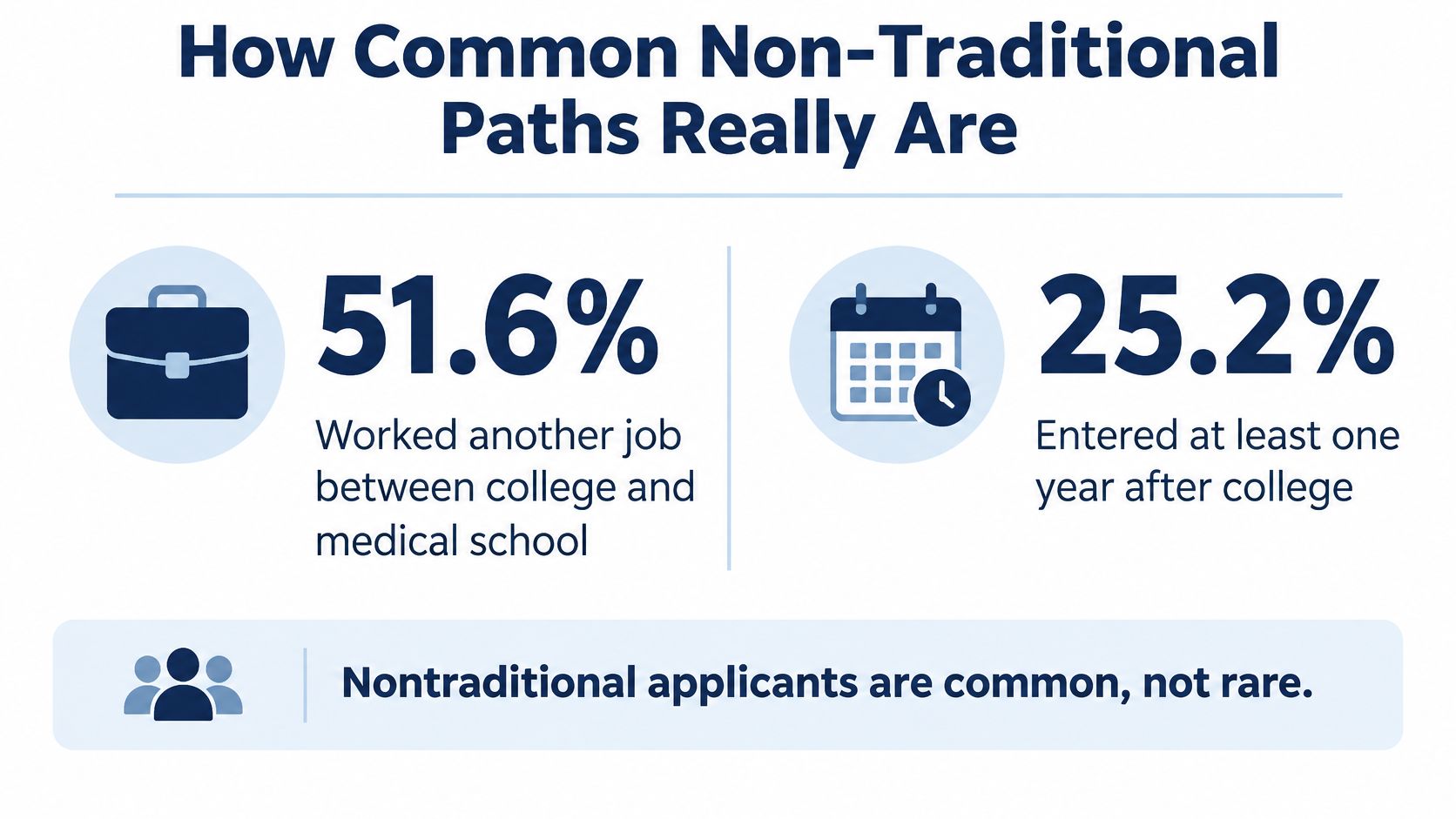
Entry timing and work history among matriculants
The figures below come from the 2023 AAMC survey, as reported by the University of Colorado Anschutz Department of Medicine.
| Measure | Share of Students | What It Signals |
|---|---|---|
| Worked another job between college and medical school | 51.6% | Employment before enrollment was more common than not |
| Entered medical school at least three years after college | 25.2% | An extended interval before enrollment was common |
| Decided on medicine only after a bachelor's degree | 8.4% | Discovering medicine after college was a recognized pathway |
| First-year students aged 26 to 28 | 11.6% | Entrants in this age band formed a measurable group |
| First-year students older than 28 | 5.6% | Older entrants remained a minority |
Use the table's delayed-entry definition: at least three years after college, not merely time off after graduation. These categories can overlap, so don't add the percentages together or interpret them as separate groups.
At Medical School Programs, we don't publish figures we can't verify. That includes keeping the distinction between work experience, entry timing, and a later decision to pursue medicine intact.
Find the comparison that fits your situation
If you always intended to study medicine but worked first, explain what you did during that interval and how you stayed prepared. If medicine became your goal later, explain how you tested that decision rather than presenting dissatisfaction with your old job as sufficient motivation.
For an additional perspective on the transition, this video offers a starting point for reflection.
Place your own graduation date, employment history, and decision to pursue medicine alongside the table. The purpose isn't to find a category that guarantees acceptance. It's to identify which part of your story needs the clearest explanation.
What Admissions Committees Look For in Career Changers
At schools using holistic review, academic metrics sit alongside interviews, references, experiences, and written explanations. That doesn't mean a compelling career story cancels out weak preparation. It means committees can evaluate evidence that a transcript alone doesn't capture.
The central trade-off is straightforward: your earlier career may demonstrate judgment and interpersonal skill, while leaving uncertainty about your readiness for intensive science learning. A strong application answers both questions.
Can maturity offset lower metrics?
The Japanese retrospective study and its discussion of international evidence describe a mixed picture: earlier McGill findings associated older applicants with lower GPAs and MCAT scores but stronger interview and reference-letter ratings; admitted older students had lower basic-science scores without significantly different clinical scores. The same discussion describes broadly comparable examination pass and graduation outcomes in New Zealand, while the Japanese study found differences in selected academic outcomes rather than consistently poorer clinical competence.
That supports a careful conclusion: professional maturity can strengthen an application, but it isn't an academic exemption. Nor does comparable clinical performance mean every older applicant will thrive.
Should you prioritize conventional metrics or emphasize communication, adaptability, and experience? Do both, but use different evidence for each claim:
- Academic readiness: Recent graded science work and deliberate MCAT preparation address whether you can handle the curriculum.
- Professional readiness: Specific examples of responsibility, feedback, conflict resolution, and teamwork show how you behave.
- Career understanding: Patient-facing experience helps explain why you want the physician's role rather than merely a different job.
Translate experience without overstating it
Say a former teacher has learned to explain difficult material, notice confusion, and adjust an explanation without embarrassing the learner. Those skills can support a thoughtful account of an interest in patient communication. The applicant shouldn't imply that classroom experience already qualifies them to explain diagnoses clinically.
A former engineer might describe systematic problem-solving, then use sustained patient-facing volunteering to show that the move toward medicine involved more than an interest in technical problems. The persuasive connection is between analytical work and a tested commitment to caring for people.
Your previous career is evidence of what you've learned. Your clinical exposure explains why you want to use those abilities in medicine.
Prepare a concise transition timeline and request letters from people who can describe your conduct through specific observations. A supervisor who watched you handle a difficult conversation can provide stronger evidence than a senior executive who barely knows you.
Also check each school's rules for MCAT score validity. An earlier score may not satisfy the institution's current policy, and confidence in past performance isn't a substitute for checking eligibility.
Academic Risks and How to Offset Them
Older applicants deserve an honest account of academic risk, not blanket reassurance. In a six-cohort observational study of 358 students at the Kirk Kerkorian School of Medicine at UNLV, students entering at age 30 or older scored lower across institutional and licensing assessments; mean USMLE Step 1 performance was 220.8 versus 231.4 among younger students, a statistically significant difference (P=0.005), and Step 2 CK performance also showed a significant disadvantage.
That is an association, not a verdict about an individual applicant. The study came from a single institution and didn't establish that age caused lower performance. It doesn't justify an admissions cutoff or prove that older students can't learn medicine.
Look for the mechanism you can change
Age may stand in for competing demands: paid work, caregiving, financial pressure, or less uninterrupted study time. Those are plausible explanations to investigate, not causes established by this study.
The practical response is to examine where your own preparation could break down.
| Challenge | Why It Matters | Practical Plan |
|---|---|---|
| Competing work and family demands | Interruptions reduce protected study time | Put dedicated study periods and childcare coverage on a shared calendar before starting |
| Rusty science recall | Familiar concepts may no longer be readily accessible | Use diagnostic questions, then audit or retake a prerequisite that exposes a genuine gap |
| Financial strain | Lost earnings can create pressure to keep working | Model debt capacity, household expenses, and scholarship options before committing |
| Slower recall under exam pressure | Knowing material doesn't always mean retrieving it efficiently | Add timed practice blocks and review why each error occurred |
| Limited academic support | Delayed help can allow small gaps to grow | Arrange tutoring or faculty coaching when formative assessments first reveal difficulty |
For prerequisite planning, use our guide to medical school prerequisites and the MCAT to organize the questions you need to resolve.
Rehearse the workload before enrollment
Don't assess your available time from an unusually quiet week. Try a realistic study routine while maintaining your ordinary household obligations, and record what interrupts it. If your plan depends on studying after every exhausting shift, revise it before tuition becomes a commitment.
For science review, combine retrieval practice with an error log. Answer questions without notes, classify mistakes as knowledge gaps or reasoning errors, then return to the underlying material. Rereading alone won't tell you whether you can retrieve and apply what you've learned.
Schools also have responsibilities. Ask how they use diagnostic examinations, formative results, structured remediation, and faculty coaching, and whether assistance is available before a student fails a major assessment.
Before accepting an offer, confirm protected study time, dependent-care arrangements, debt capacity, and actual access to support. A service listed on a website helps only if you can use it when you need it.
Pathways Beyond the Traditional MD Route
The best route isn't necessarily the one with the easiest entry requirements. It's the route that matches your existing education, household constraints, intended licensing destination, and need for supervised clinical experience.
Compare the complete journey, including preparation before entry. A program with a shorter published duration may still require additional coursework, while a longer program may repeat material you've already studied.
Compare the structure, not just the credential
| Route | Entry and preparation | Main trade-off to examine |
|---|---|---|
| Domestic MD or DO | May require individual prerequisites, a post-baccalaureate program, or further undergraduate study | Preparation time, total cost, and compatibility with your intended practice location |
| Graduate-entry or accelerated programs | Designed around prior education, with eligibility set by the institution | Whether your degree qualifies and whether the pace suits your circumstances |
| International programs | Entry points and recognition requirements differ by country and institution | Relocation, clinical placements, language expectations, and the route back to your intended licensing jurisdiction |
A useful starting point is a structured assessment of whether studying medicine abroad is worth it. Don't assume an overseas credential creates an automatic path to residency or licensure elsewhere.
Test the educational environment
A University of North Dakota comparison of rural and traditional urban clinical tracks found no significant differences in MCAT, NBME subject examination, or USMLE Step 1 and Step 2 results, while rural-track students received significantly higher internal-medicine preceptor assessments.
This was evidence about a clinical track at a U.S. institution, not proof that international schools or alternative credentials are equivalent. Its useful lesson is to examine assessment quality and supervised clinical learning, not to trust the label nontraditional.
Ask who supervises students, how often clinicians directly observe them, how feedback is standardized, and whether patient exposure and board-review resources are adequate. Request documented outcomes and clarify who is included in them.
A different pathway deserves careful evaluation, not automatic dismissal or automatic trust.
How to Build a Strong Non-Traditional Application
Build the application as a set of connected pieces of evidence. Your timeline should agree with your activities, your references should support your account of your strengths, and your academic preparation should address the weaknesses you've identified.
This visual summarizes the relationship between your history, explanation, and readiness.
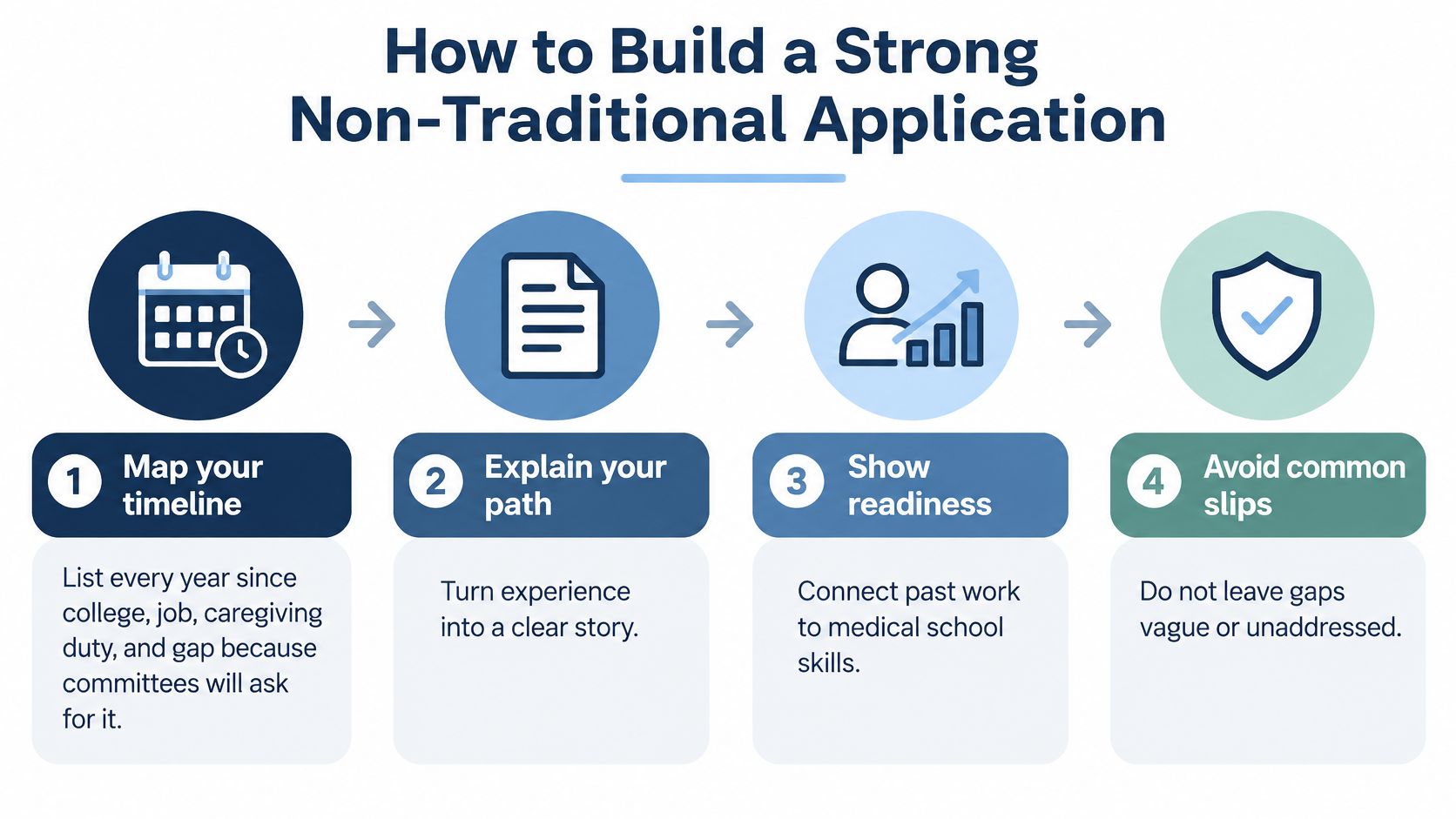
Prepare the evidence in a workable order
Map your timeline. Create a dated record of education, employment, caregiving, volunteering, and periods away from formal work or study so you can complete applications consistently. The common slip is omitting an interval because it feels unimportant or difficult to explain.
Audit prerequisites and recency rules. Match your transcript against each target school's official requirements, recording course content, laboratory components, and any stated recency restrictions. Don't assume a course qualifies because its title resembles a required subject, or that older coursework is automatically disqualified.
Plan the MCAT around your schedule. Take a diagnostic before choosing a test date, then build a study calendar around the content gaps and protected time you have. Booking first and discovering your baseline afterward can leave you preparing against an unrealistic deadline.
Choose sustained patient-facing involvement. Find a setting where your responsibilities and contact with patients are clear, then keep reflective notes without recording identifying patient details. Avoid collecting disconnected visits that leave you unable to explain what you learned about care or the physician's role.
Recruit references strategically. Consider a former supervisor who knows your reliability and a recent academic or clinical referee who can discuss current readiness, while following each school's required letter categories. A prestigious name won't compensate for a generic letter, and workplace references may not replace required faculty recommendations.
Write a focused transition narrative. Draft a concise explanation of why you changed direction, then show what your earlier work contributes and what clinical experience confirmed. Don't apologize for your path or spend so much space defending it that your reasons for medicine disappear.
Build the support plan alongside the application. Budget for tuition, living expenses, lost earnings, relocation, and household care across the full course of study. The common slip is funding entry while leaving later clinical placements or changes in family circumstances unaddressed.
Create a policy-based shortlist. Look for explicit review language, then verify academic requirements, international eligibility, and any published age-related policy on official pages. Don't treat a welcoming mission statement as confirmation that you meet the admissions rules.
Check the file before you submit
Keep a requirements tracker with columns for the official policy, your evidence, the unresolved question, and the next action. Our guide to applying to medical school can help you organize the broader process.
Your readiness check is practical: a complete timeline, a school-specific prerequisite audit, and referees who have agreed to write appropriate letters. If those pieces aren't ready, identify what's missing before paying application fees.
Confirm Your Fit and Decide on a Route
Your first move is to make a household-and-study feasibility sheet, not another aspirational school list. Put your available time, financial resources, care arrangements, and academic preparation on the same page so you can see whether they work together.
Use these decision criteria:
- Time: Can your ordinary weekly schedule accommodate study, attendance, travel, and essential paid work without relying on constant sleep loss?
- Money: Can you explain how you'll fund the full program, including living costs and interruptions to earnings?
- Support: Are household responsibilities and dependent care assigned to willing people, with backup arrangements?
- Academic recovery: Do you have a credible way to demonstrate readiness where your record leaves uncertainty?
Turn uncertainty into a short planning cycle
During your opening planning week, record the unresolved questions rather than guessing. In the following weeks, obtain written answers from admissions offices, test your study schedule, and discuss the financial and care commitments with everyone affected.
At the end of that planning cycle, decide whether to apply, strengthen your preparation, or choose a different route. You can investigate schools while a problem remains unresolved, but don't mistake a promising shortlist for permission to ignore a critical funding or caregiving gap.
We check program facts against schools' official pages, date them, and update them when fees or requirements change. Still, confirm the policy that applies to your intended intake before committing.
A nontraditional path is workable when the practical conditions support the ambition. When a condition is missing, changing the plan is responsible preparation, not evidence that you don't belong in medicine.
Our admissions guide covers eligibility, transcripts, the MCAT, English tests, visas, funding, and schools that accept international students, while our program directory brings together tuition, program length, and licensing notes from official sources. Visit Medical School Programs to compare routes against your existing qualifications, household commitments, and intended place of practice before building your shortlist.