
Romania produced 28 medical graduates per 100,000 population in 2023, the third-highest rate in the European Union and nearly twice the EU average, according to the OECD Country Health Profile 2025 for Romania. Roughly one-third of medical-school places in recent years were taught in foreign languages, mainly English, and in the 2021-22 academic year, 52% of foreign students in Romania studied medicine or health sciences. That scale makes medical schools in Romania a serious option for international applicants who want a six-year European degree straight out of high school.
Across the seven public universities compared below, published 2026-27 annual tuition for English-taught Medicine runs from €7,000 to €10,000 per year. Those headline numbers tell only half the story. What separates these schools are your applicant category (EU/EEA versus non-EU), upfront processing fees, non-refundable deposits, entrance requirements, and how clinical training works in each city. Treat the list below as a verification checklist rather than a ranking, and confirm every line item before wiring a deposit.
Table of Contents
- 1. Iuliu Hațieganu University of Medicine and Pharmacy, Cluj-Napoca
- 2. Carol Davila University of Medicine and Pharmacy, Bucharest
- 3. Grigore T. Popa University of Medicine and Pharmacy, Iași
- 4. Victor Babeș University of Medicine and Pharmacy, Timișoara
- 5. George Emil Palade University of Medicine, Pharmacy, Science and Technology, Târgu Mureș
- 6. Ovidius University of Constanța, Constanța
- 7. Lucian Blaga University of Sibiu, Faculty of Medicine
- English Medicine Tuition, Location and Language Options at a Glance
- Verify the Fee, the Category and the Deadline Before You Apply
1. Iuliu Hațieganu University of Medicine and Pharmacy, Cluj-Napoca
Romania expanded capacity in foreign-language medical tracks by 75% between the 2011-12 and 2018-19 academic years, according to the 2019 OECD report on international migration of doctors, nurses and medical students. Cluj-Napoca is one option for applicants comparing English, French, and Romanian Medicine tracks within the same university.
Start with the international admissions requirements at Iuliu Hațieganu University of Medicine and Pharmacy, including the document rules for your applicant category. Language choice deserves attention before you apply: candidates who speak French can compare that track with English rather than choosing on location alone.
Cluj-Napoca is a major university hub. Consider whether its student setting and housing options suit you, alongside the clinical training arrangements. Ask how teaching is organised across the course and which clinical settings you would attend. A city preference should not replace checking the programme itself.
What to Verify Before Paying the Deposit
Use these questions to compare Cluj with the other schools on your shortlist:
- English tuition: Confirm the annual fee for your entry year and applicant category. Build your budget around the applicable amount, not a fee quoted for another intake.
- Non-EU seat allocation: Check which admissions category applies to your citizenship and school qualifications, then review the places available within that category.
- Upfront charges: Separate any processing fee from the payment required to confirm a place. Check the payment deadline and which amounts are non-refundable.
- Language flexibility: Compare the English and French tracks' admissions requirements before committing to either.
Get the refund terms before transferring funds, particularly if your student visa is delayed or refused. For country-level guidance on visas, living arrangements, and entry tracks, use our guide to studying medicine in Romania.
2. Carol Davila University of Medicine and Pharmacy, Bucharest
The English-taught Medicine track at Carol Davila University of Medicine and Pharmacy is a six-year, 360-ECTS degree. Based in Romania's capital, the university also trains students in Dentistry and Pharmacy across multiple language tracks.
Bucharest's appeal is practical: a large urban hospital network and a major international airport. Weigh those advantages against accommodation and daily living costs when comparing the capital with regional university towns. Hospital access deserves a closer look than the campus address alone.
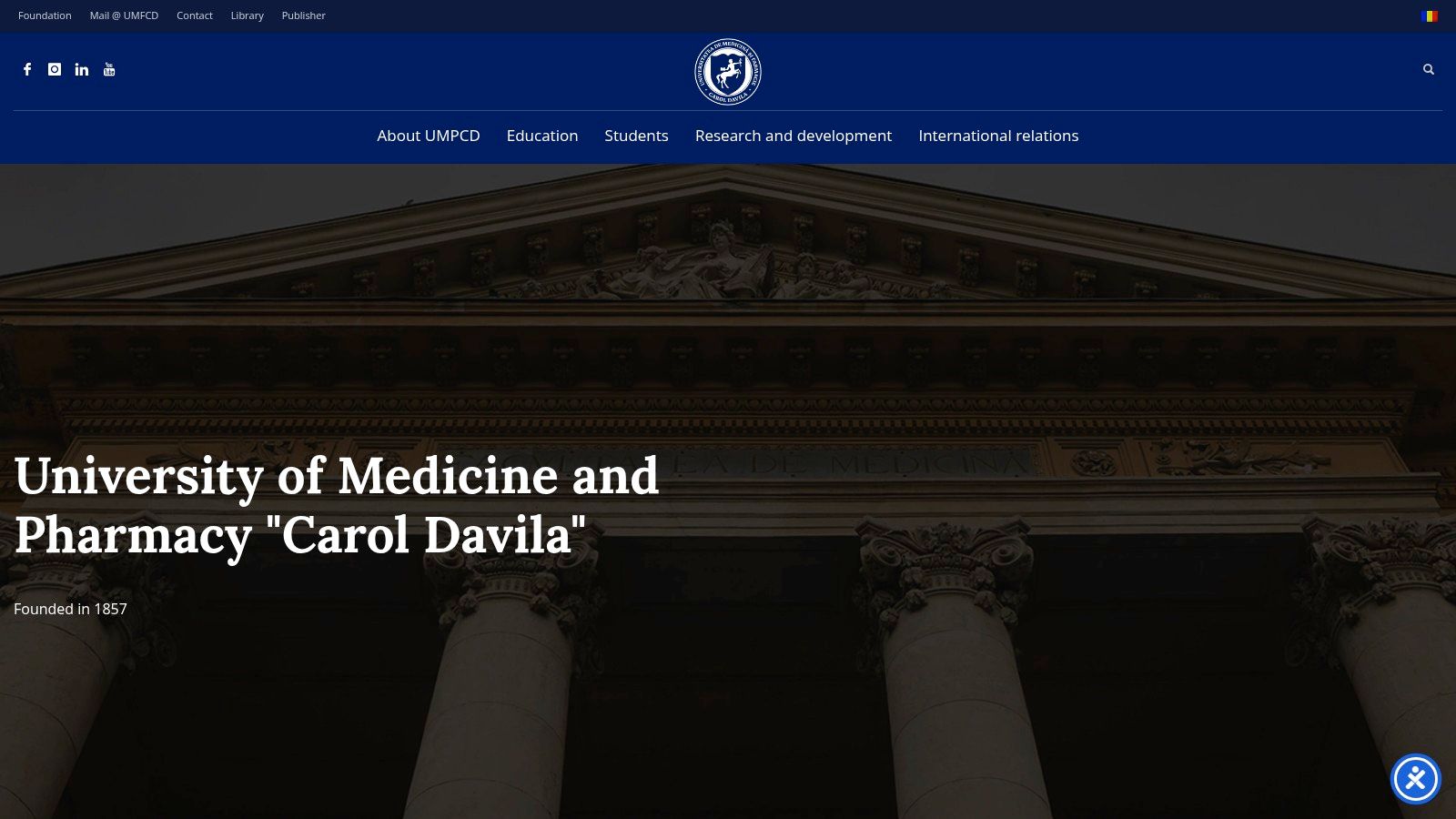
Before applying, establish which international or fee-paying category covers your passport and high-school diploma. Then request the annual English-track tuition, any language-test charge, and the payment schedule for that category. Ask whether a deposit applies and how it counts toward tuition.
Build the budget beyond tuition. Accommodation, health insurance, exam fees and flights all need room in your comparison. Treat these questions as an application checklist, rather than assuming every international applicant faces identical charges.
Clinical Rotations and Hospital Access
A questionnaire study of 798 final-three-year students at Romania's largest medical university found more than 70% reported general dissatisfaction with clinical medical education, while 39.9% said practical training needed improvement and 58.0% said both practical and theoretical training needed improvement, according to the Balkan Medical Journal.
Use that finding to ask specific questions about the English track. How many students share each bedside group? How are patient encounters logged? Which teaching hospitals host rotations? Ask admissions staff and current upper-year students the same questions to compare the published structure with students' accounts of clinical teaching.
3. Grigore T. Popa University of Medicine and Pharmacy, Iași
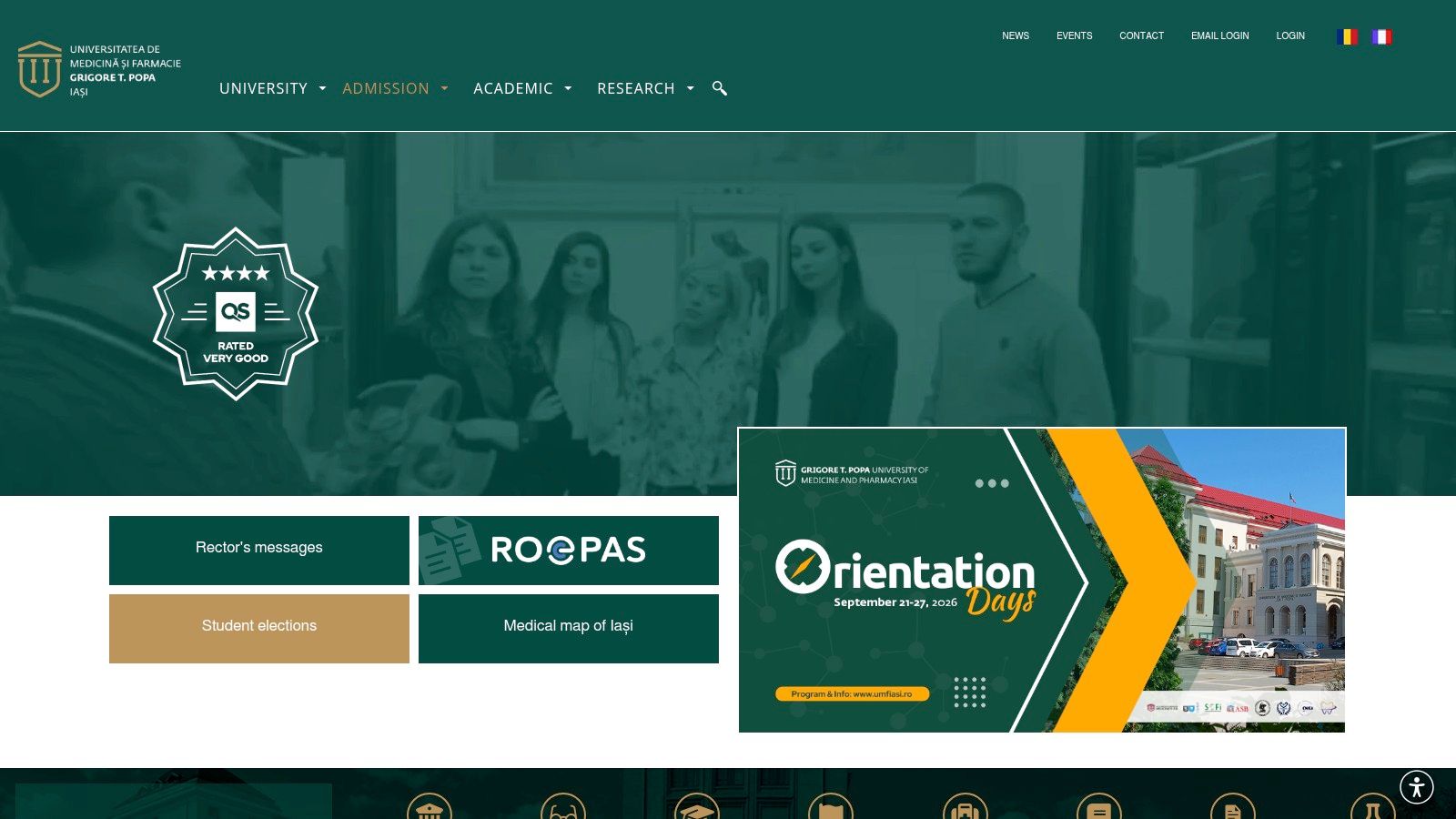
Non-EU applicants lose weeks every summer to apostilled diplomas, certified translations, and medical clearance paperwork, so a school that posts its requirements early is easier to plan around. Grigore T. Popa University of Medicine and Pharmacy in Iași publishes English-language curriculum documents for 2026-27 and a step-by-step international admissions checklist directly on its portal.
Demand for Romanian medical seats keeps growing well beyond Bucharest. A higher-education analysis on Wiley Online Library reports that undergraduate medical places across Romania rose roughly 14%, from 5,636 in 2017-18 to 6,426 in 2023-24, while an estimated 55,000 foreign students graduated from Romanian medical universities between 2019 and 2024, led by cohorts from Moldova, Israel, France, Germany, and Italy. If you're weighing Iași against programs in Poland, Bulgaria, or the Czech Republic, our overview of English-taught medical schools in Europe puts the regional options side by side.
Applicant Categories and Program Options
Iași offers a university-city setting away from the capital's congestion, and the campus groups several health-science degrees under one roof. Three checks belong on your list before you apply.
- Match your applicant category first. The university splits its fee schedule by applicant category tied to citizenship status, so identify the line that covers your passport before you budget or compare Iași against other Romanian schools.
- Compare the related degrees. Alongside six-year English Medicine, the university runs Dentistry and Pharmacy programs, useful if you're still deciding between clinical paths.
- Start document authentication early. Legalizing secondary-school diplomas and transcripts often takes longer than completing the application portal itself.
4. Victor Babeș University of Medicine and Pharmacy, Timișoara
At €9,000 per year on its 2026-27 international fee schedule, Victor Babeș University of Medicine and Pharmacy in Timișoara sits €1,000 below the €10,000 annual rate published by Cluj-Napoca, Bucharest, and Târgu Mureș. Over a six-year degree, that difference adds up to a meaningful reduction in base tuition, assuming annual rates remain steady.
Timișoara offers Medicine in English, French, and Romanian, plus an English-language Dentistry option. You can access the university's admissions notices directly from its English homepage.
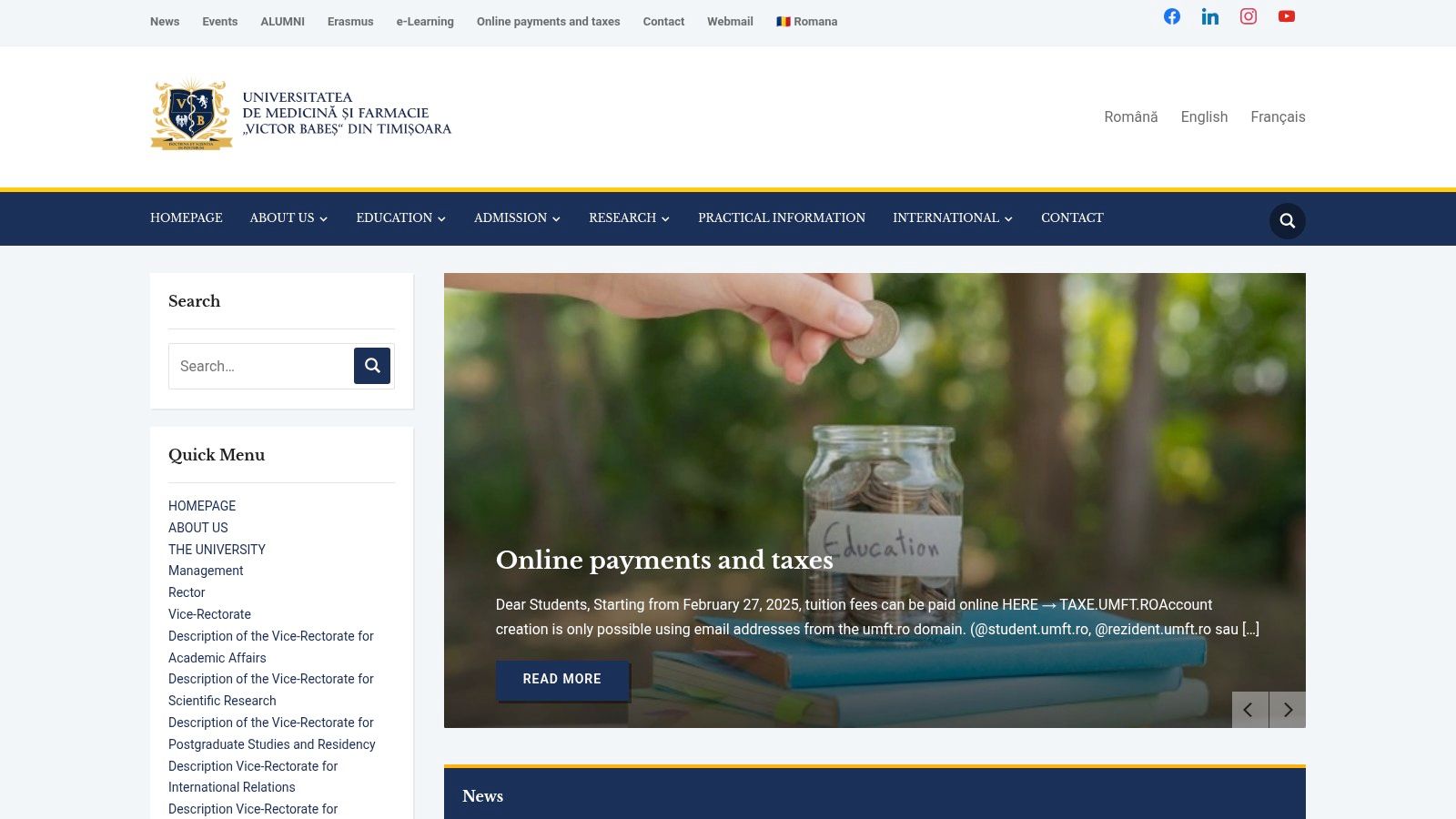
Application watchout: Victor Babeș organizes international admissions strictly by applicant type based on your citizenship and educational background. Filing under the wrong category can stall your evaluation or invalidate your file during a tight summer window.
Matching Your Citizenship to the Right Track
Before paying any application charge, read the exact eligibility definitions for EU/EEA/Swiss citizens versus non-EU nationals on the university's international portal. Dual citizens in particular need to pick one passport and follow that track consistently for both admissions and residency paperwork.
Once your applicant category is confirmed, ask the admissions office in writing for the full list of additional charges beyond the €9,000 tuition, including enrollment deposits, file-evaluation fees, and whether first-year tuition must be paid in a single lump sum or installments. Timișoara's western location near the Hungarian and Serbian borders makes regional travel straightforward, which appeals to European students who plan to fly or drive home between semesters.
5. George Emil Palade University of Medicine, Pharmacy, Science and Technology, Târgu Mureș
Not every Romanian school relies purely on paper transcripts and GPA formulas. George Emil Palade University of Medicine, Pharmacy, Science and Technology (UMFST) in Târgu Mureș runs its six-year English Medicine program through a dedicated Faculty of International Medical Studies, evaluating candidates through both file review and an online interview.
That direct conversation gives candidates with non-traditional backgrounds a chance to explain their preparation, rather than leaving admission solely to grade-conversion tables. UMFST also offers a French-language Medicine track on its Târgu Mureș campus.
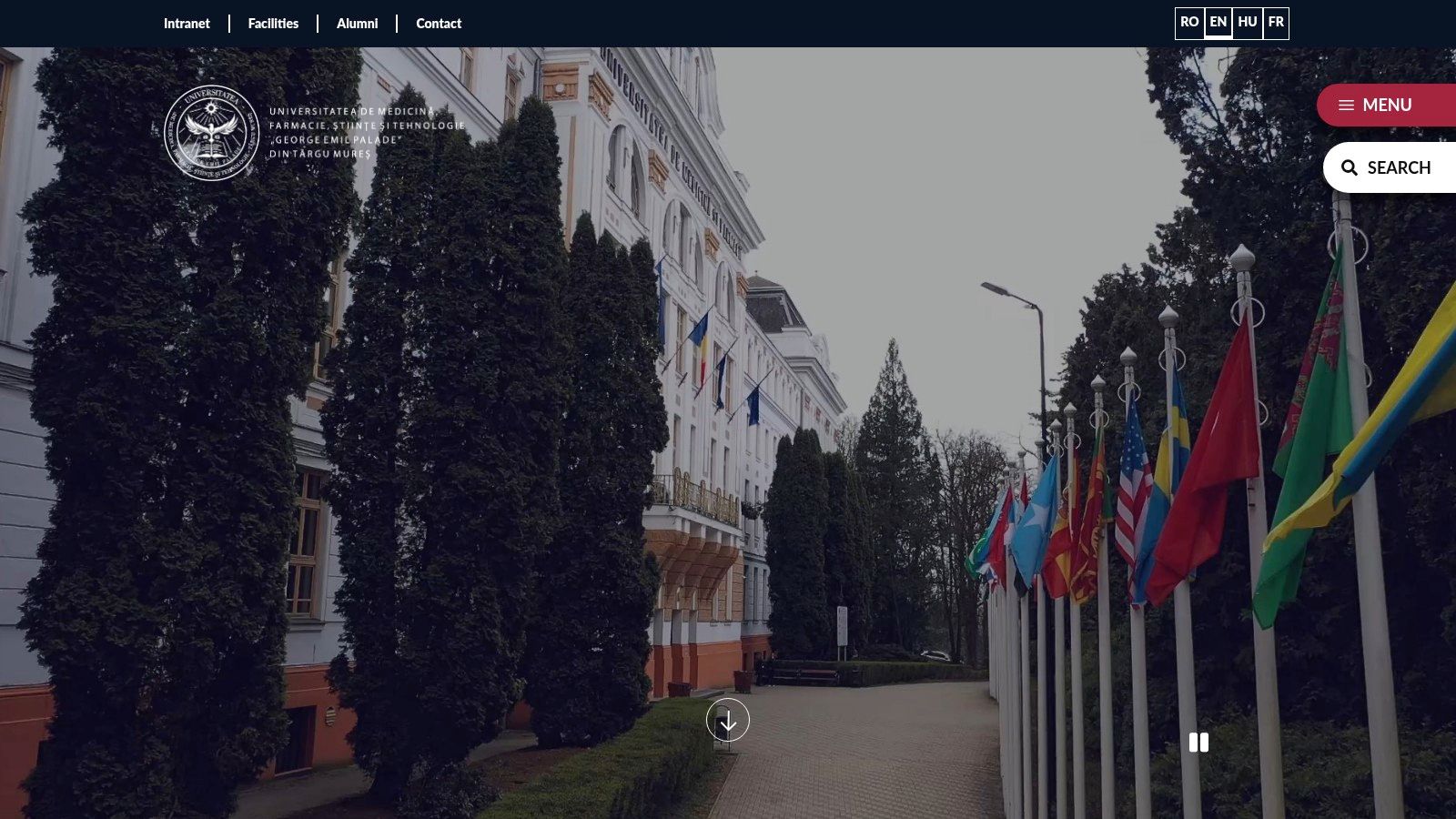
For 2026-27, published tuition is €10,000 per year. Admitted students must pay a €5,000 deposit, which is credited toward first-year tuition but explicitly marked non-refundable. Only commit to that transfer once you're certain UMFST is your top choice and your financing is locked in.
English Classrooms vs. Romanian Wards
One reality applies to UMFST and every other English-track program in the country: "English-taught" describes your lectures and exams, not the native language of hospital patients. For context on how Romanian public programs structure these degrees, the University of Medicine and Pharmacy of Craiova 2026 international admissions page lists a standard six-year, 360-credit English Medicine track with 90 places for 2026-27, yet clinical years across Romania still require interacting with Romanian-speaking patients and ward staff.
During your online interview at UMFST, ask how Romanian medical-language classes are scheduled in Years 1 through 3, whether language proficiency is tested before clinical rotations start, and what documentation graduates receive when applying for licensing exams in the US, UK, Canada, or the Gulf states.
6. Ovidius University of Constanța, Constanța
Positioned on Romania's Black Sea coast, Ovidius University of Constanța lists €8,000 per year for its six-year English-language Medicine program on its 2026-27 fee schedule. That places Constanța among the lower-cost options in this seven-school comparison, sitting well below its €10,000 peers.
The Faculty of Medicine publishes current curriculum information online, and applicants weighing dental school can compare English-language Dentistry at the same institution. Because Constanța is a coastal port city rather than an inland academic hub, daily life has a distinct rhythm, with quieter winters and busy summer tourist months that can affect short-term rental pricing.
- Verify admission criteria early: Confirm whether your applicant category is evaluated purely by high-school file review or requires supplemental tests and interviews.
- Audit clinical teaching depth: Compare hospital affiliations, simulation labs, and rotation group sizes directly against larger centers like Bucharest and Cluj-Napoca.
- Check student-support services: Ask how the international office handles residence permits, academic advising, and verification paperwork for foreign medical boards.
Budget reality: Lower annual tuition is meaningless if weak clinical documentation or poor exam preparation delays your postgraduate licensing by a year.
Evaluate Constanța on the full six-year package, not the €8,000 line alone. Speak with enrolled third- through sixth-year students about clinical supervision and exam grading before choosing it over higher-priced peers.
7. Lucian Blaga University of Sibiu, Faculty of Medicine
Lucian Blaga University of Sibiu posts the lowest published annual tuition in this comparison for non-EU students: €7,000 per year for 2026-27, paired with an €800 processing fee. Unlike file-only admissions at several competitors, the English Medicine program's admissions guidance describes a biology-and-chemistry entrance exam, so applicants need dedicated science study time ahead of the test date.
Sibiu is noticeably smaller and quieter than Bucharest, Cluj-Napoca, or Timișoara, which many students prefer for focused studying during the preclinical years.
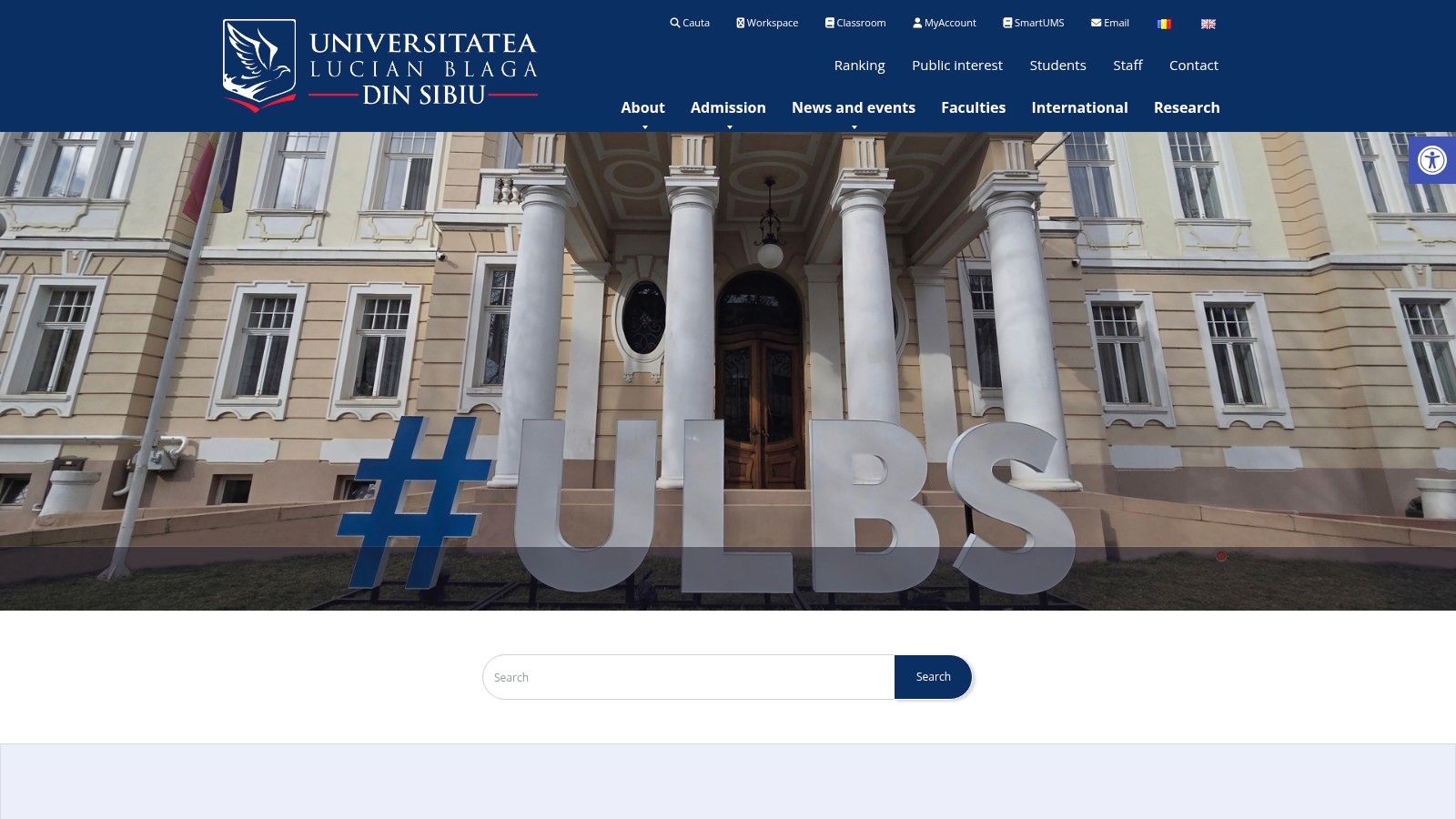
Two constraints demand close attention before you apply. First, the English program lists a limited number of places for 2026, meaning competition per seat can tighten quickly. Second, the €7,000 figure is published specifically for non-EU applicants; EU and EEA candidates must check their separate fee schedule directly with the faculty.
Smaller-City Trade-Offs and Total Cost Context
A compact city lowers daily distractions and commute times, though a smaller regional hospital network naturally handles fewer ultra-specialized tertiary cases than a capital-city medical center. Weigh that clinical trade-off carefully if you plan to pursue competitive surgical or subspecialty residencies abroad.
Even with the €800 processing fee factored in, Sibiu's tuition sits far below most Western alternatives. Across the 24 English-taught programs we list at Medical School Programs, median yearly tuition is $17.1k in Europe and $61.2k in the Caribbean. Lower tuition reduces debt dramatically, yet it only pays off if your degree clears your target country's licensing hurdles. For a clear look at residency match barriers and long-term return on investment, read our breakdown of whether studying medicine abroad is worth it.
English Medicine Tuition, Location and Language Options at a Glance
| Item | English Medicine Tuition (Per Year) | City | Language Options |
|---|---|---|---|
| Iuliu Hațieganu University of Medicine and Pharmacy | €10,000 (2026–27) | Cluj-Napoca | English, French, Romanian |
| Carol Davila University of Medicine and Pharmacy | €10,000 (2026–27) | Bucharest | English, Romanian |
| Grigore T. Popa University of Medicine and Pharmacy | €9,000 (2026–27) | Iași | English |
| Victor Babeș University of Medicine and Pharmacy | €9,000 (2026–27) | Timișoara | English, French, Romanian |
| George Emil Palade University of Medicine, Pharmacy, Science and Technology | €10,000 (2026–27) | Târgu Mureș | English, French |
| Ovidius University of Constanța | €8,000 (2026–27) | Constanța | English |
| Lucian Blaga University of Sibiu, Faculty of Medicine | €7,000 for non-EU applicants (2026–27) | Sibiu | English |
Use this table as a shortlist check, not a ranking. Each row answers the same practical questions: annual English tuition, city, and available language options. I would treat the tuition column as the starting point, then check your applicant category before budgeting, because a published rate may apply to one group and not another.
Location changes the day-to-day choice. Bucharest and Cluj-Napoca suit applicants who want larger urban settings, while Iași, Timișoara, Târgu Mureș, Constanța, and Sibiu offer lower daily distractions and different clinical exposure. Language options also matter: English is common to all seven entries, while French or Romanian appears only at selected schools. Confirm those options, the applicable fee category, and any extra charges directly before committing.
Verify the Fee, the Category and the Deadline Before You Apply
Comparing annual tuition on paper is only step one. Across Romania's wider market, Med Romania's 2026 guide shows published 2026-27 English Medicine fees spanning from €8,500 per year at the University of Medicine and Pharmacy of Craiova up to €16,500 per year at private Titu Maiorescu University, and notes that some institutions use non-flat fee schedules rather than locking your first-year rate for all six years. Once you add compulsory deposits, processing charges, health insurance, student housing, utilities, and travel home, the six-year cost gap between schools narrows considerably.
Before submitting a single application or wiring a non-refundable deposit, run every shortlisted university through four final checks:
- Confirm six-year fee stability: Ask in writing whether the published 2026-27 rate is locked for your cohort or subject to annual senate adjustments, and verify separate rates for EU/EEA/Swiss versus non-EU passports.
- Get deposit refund terms in writing: Clarify whether confirmation deposits (such as €5,000 or 50% of first-year tuition) are credited toward tuition and exactly what happens if your student visa is denied.
- Verify your licensing pathway first: EU recognition doesn't guarantee automatic residency entry everywhere; check current rules with your home country's medical council, ECFMG, or national exam board before enrolling.
- Track document deadlines backward: Apostilles, certified translations, and equivalency letters from the Romanian Ministry of Education routinely take weeks, so start assembling files well ahead of portal cutoffs.
Because tuition schedules, seat quotas, and entrance methodologies shift from one intake to the next, always verify final numbers directly on each university's admissions pages. We check program facts against official school pages, date every entry, and never publish figures we can't verify, and schools can't pay to alter their listings. That gives you an independent baseline before you commit years of study and tens of thousands of euros to a degree.
Ready to compare Romanian universities side by side with other English-taught options across Europe and the Caribbean? Visit Medical School Programs to explore our sourced directory of 24 English-taught medical programs, read country-by-country admissions and visa guides, and map out total degree costs and licensing pathways before you apply.