
Your phone buzzes in the middle of a lecture, and the preview line contains the sentence you've been refreshing your inbox for since June: interview invitation. Then you open it, and the second paragraph says something like "your interview will consist of a six-station circuit" or "a recorded video assessment." Confidence drops a notch. You know how to talk to people. You're less sure what this format is scoring.
The invitation is a real milestone, and it's also a narrower door than most applicants expect. In the United States, AAMC data show that 53,030 people applied to MD-granting medical schools for the class entering in fall 2020, 23,105 were accepted and 22,239 enrolled, according to the AAMC class profile. The same profile reports an average total undergraduate GPA of 3.73 for enrolled students.
So the interview pool is not a group of weak applicants getting a second chance. It's a strong academic field compressed into a stage where a structured, scored assessment decides who gets an offer. What follows is what committees rate, how to answer in each format, and how to prepare when money, time or a disability makes the standard advice hard to follow.
Table of Contents
- Interview Formats and Timing You Will Face
- Common Questions and How to Answer Them
- How to Work Through an MMI Station
- How to Request Interview Accommodations Early
- Practice Plans That Cost Little or Nothing
Interview Formats and Timing You Will Face
Four formats cover nearly every invitation you'll receive, and they don't reward the same habits.
| Format | What It Assesses | How It Runs | Typical Timing |
|---|---|---|---|
| Traditional one-on-one | Fit, communication, motivation | Conversation with one or more interviewers | Invitations late summer to winter, school-specific |
| Multiple mini-interview (MMI) | Communication, ethics, teamwork, empathy, judgment | Rotating short stations, each scored separately | August to February, with dates set by each school |
| Virtual video interview | The same competencies as the format it replaces | Live or recorded video from home or a shared room | Autumn months at some schools |
| Recorded screening interview | Early fit and communication | Pre-recorded answers to fixed prompts | Early in the cycle, before full interviews |
A conversation with one physician, a circuit of six scored stations and a recorded answer to a fixed prompt are three different tests.
Prepare for the format you've been invited to, not the one your friend sat last year.
The season runs longer than applicants tend to plan for. Invitations commonly begin in late summer or early fall, and interviews are most often offered from August through February, with some schools continuing invitations into winter or the following spring, according to the AAMC's admission requirements reports. Plan for a season measured in months, not a single day in spring.
What the format shift means for you
Medical schools have moved past the single one-on-one conversation toward structured designs such as the multiple mini-interview, which samples communication, ethical reasoning, teamwork and other nonacademic attributes across several short stations. The same AAMC resources carry school-level detail on invitation start dates, regional options, video availability and the shape of the interview day. There is no national schedule to memorise.
Virtual formats sit inside that same window, and some schools run virtual interviews in the autumn months. Each format also changes what preparation costs you. A video interview removes travel but demands a quiet room, a stable connection and a camera you have already tested. A recorded format removes scheduling pressure but gives you no interviewer to read. If you will need an adjustment such as extra time or screen-reading support, the format decides who you ask and how early, so raise it when the invitation arrives rather than the week before. Build conversation skills, station performance and on-camera composure in the same run-up.
Before you rehearse a single answer: open each school's own admissions page and write down its format, its invitation window and whether video interviews are offered. Two schools on your list can run completely different processes in the same month.
Program details change and summary pages lag behind them. The program data on this site is drawn from schools' official websites and authoritative bodies such as the World Directory of Medical Schools, ECFMG, NRMP and national accreditation agencies, and official sources are the standard worth applying to your own shortlist. If you're still working out everything that comes before the invitation, our guide to applying to medical school covers eligibility, transcripts, MCAT, English tests, visas, funding and the schools that accept international students.
Common Questions and How to Answer Them
Committees don't ask questions to test trivia. Each question is a probe for a specific competency, and the competency carries more weight than the story you wrap around it. The wording shifts from school to school. The questions below map to the competencies committees score.

What each question type is really testing
| Question Type | What It Tests | Example Question | Strong Answer Includes |
|---|---|---|---|
| Motivation | Whether medicine is a considered choice | Why medicine, and why now? | One specific experience and what it taught you about the work |
| Teamwork | Your personal contribution, not the team's | Describe a time a team you joined struggled | Your own action, your reasoning and the result |
| Ethical dilemma | Process over conclusion | A patient refuses a treatment you recommend. What do you do? | Stakeholders, a framework, one action and a follow-up step |
| Failure or adversity | Self-reflection and learning | Tell me about a setback you handled poorly | What you would do differently and why |
| Health-system issue | Awareness and balanced judgment | Which health-system problem would you address first? | A clear position, the evidence for it and one counterargument |
The method that survives scoring is behavioral and slightly boring on purpose. For each competency, give the situation, the specific action you took, the reasoning or trade-off behind it, and the observed result, then finish with what you would do differently. A scorer marks your working the way a maths examiner marks the steps of a solution: the right conclusion without visible reasoning earns little.
Structure matters because format shapes what gets measured. This review of medical school interview outcomes reports that unstructured interviews have lower validity and are vulnerable to bias related to age, gender and prior academic achievement, while structured interviews use standardised questions and explicit scoring rules to improve reliability. The same review found interview effects depend heavily on format: structured interviews were associated with stronger clinical performance and social competence, though one reported comparison showed lower performance on academic examinations, and across unstructured and semi-structured formats, admitted and non-admitted cohorts often showed little meaningful difference in academic or clinical outcomes.
You can't control which format you meet. You can control whether your answer contains evidence or adjectives. Read that as a warning about fluency: the candidate who sounds impressive isn't automatically the candidate who scores higher.
Four habits that sink otherwise good answers
- A conclusion without a process. In an ethical scenario, "I'd respect the patient's autonomy" is a verdict, not an answer. Name the stakeholders, the framework, one action and how you'd check it worked.
- Teamwork without your contribution. "We built the rota" tells an interviewer nothing. Say what you decided, what you changed and what happened next.
- Rehearsal that sounds like rehearsal. Over-practised answers turn inflexible the moment a follow-up question arrives. Practise the structure, not the script.
- Guessing what the interviewer wants. Speculating about a physician's preferred viewpoint reads as insincerity and costs you the reasoning they were scoring.
Watch a live answer get built before you record your own. The pace matters as much as the content, and a phone camera plus a friend willing to ask follow-ups costs nothing.
Write one answer per row of that table, check each against the elements listed, and say it aloud before your next practice run. Applicants who arrive by a considered path rather than a straight one usually carry richer material, and our guide to the non-traditional medical student route explains how to frame that path without apologising for it.
How to Work Through an MMI Station
An MMI circuit looks chaotic from the corridor and is tightly controlled from the scorer's side. Each station is scored separately, on a preset rubric, by an assessor trained to rate the same competency across every candidate. That design is why one weak station can't be rescued by charm in the next room, and why preparation should be procedural rather than conversational.
The reliability numbers back the structure. In a five-school California study of 4,993 applicants and 7,516 interviews, MMI reliability between institutions reached an adjusted intraclass correlation of 0.47 (95% CI 0.41 to 0.54), compared with 0.27 (95% CI 0.20 to 0.35) for traditional interviews, and within-school Cronbach's alpha was 0.68 and 0.60 against 0.40 to 0.61 across three traditional formats (study of MMI reliability). Translation: your average across stations is the signal, not any single impression.
Here's the sequence that keeps that average high.
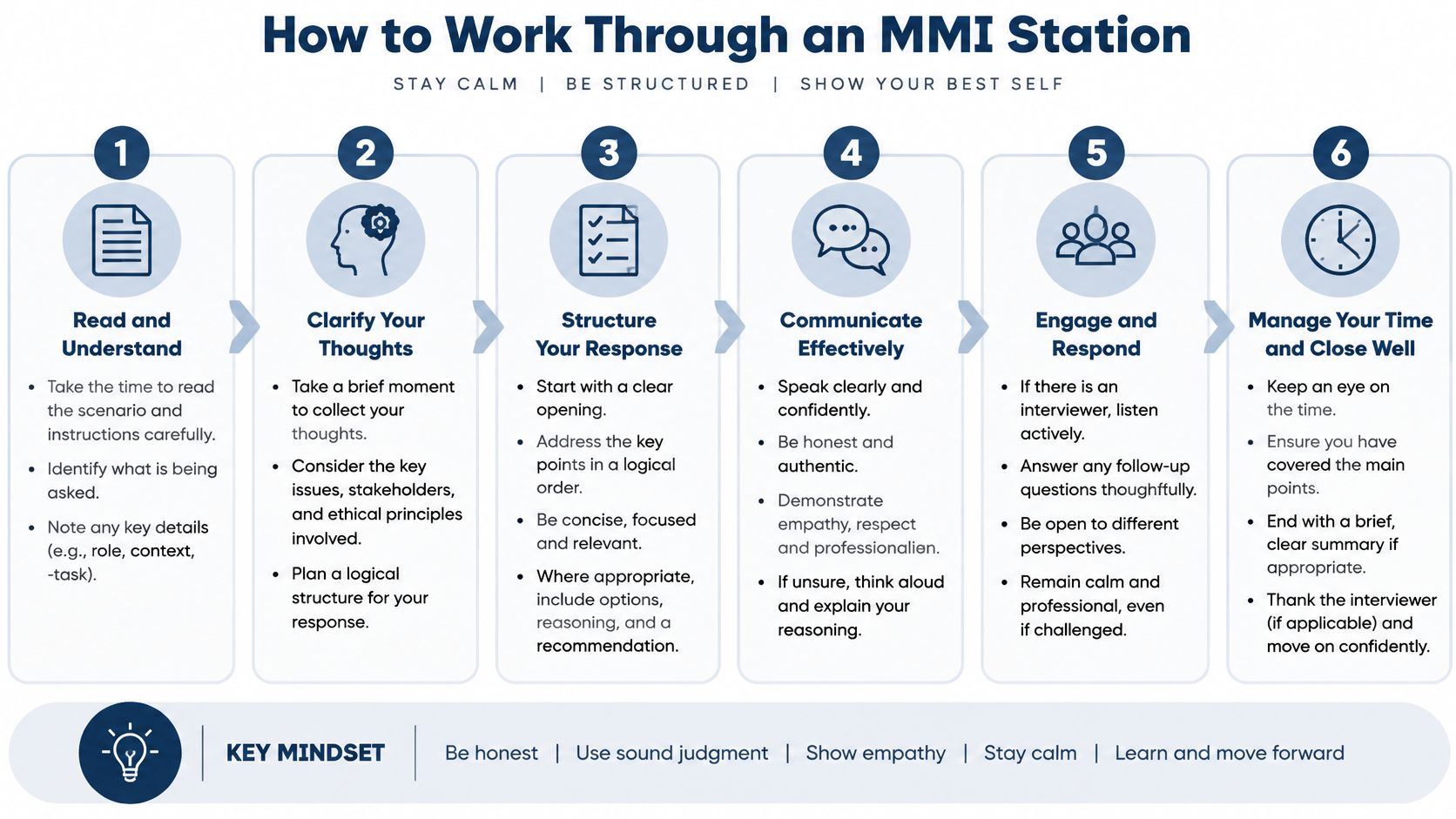
Six steps that fit almost any station
- Name the competency. Decide whether the prompt is testing ethics, teamwork, communication or judgment, then lean your answer into that one thing. The common slip is answering all four at once and scoring well on none.
- State your framework in one sentence. Something like "I'd separate the clinical question from the communication question" gives the assessor something concrete to mark. A framework you use but never name rarely earns credit.
- Rank the stakeholders. List who is affected and what each one needs, then say which need carries most weight and why. A flat list with no priorities scores poorly on judgment, even when every name is correct.
- Choose one action and own the trade-off. Commit to a specific step, then say what it costs and who absorbs that cost. Three options with no decision reads as indecision, which is the opposite of what the station measures.
- Explain how you'd check it worked. A follow-up appointment, a review point, a colleague you'd ask. This is the step applicants skip most often, and skipping it leaves an ethics answer with no accountability.
- Stop at the bell. Extra words after a complete answer dilute it. Finish the sentence, breathe, walk.
Model answer, opened well: "This one is testing ethical reasoning. I'd start by separating capacity from consent, because the patient's decision only counts if they can make it. The stakeholders are the patient, the treating clinician and the family, and the patient's stated wish carries most weight. My action is a capacity assessment plus a documented conversation about what happens next. I'd check it by reviewing that decision at the next ward round, and I'd ask the patient whether they felt heard."
Notice what that answer avoids: no verdict before the process, no listing of stakeholders without ranking them, and one action with a monitoring step attached. Practise that shape on unfamiliar prompts, because the station content changes and the structure doesn't.
How to Request Interview Accommodations Early
Most interview advice skips the part where you're managing a chronic illness, a disability or an anxiety-related need at the same time as a high-stakes assessment. The information gap is real. A 2025 peer-reviewed study of medical-school applicants found inadequate communication about interview-accommodation procedures and recommended that schools route requests through disability-resource professionals to reduce bias and clarify the process, according to this study of interview accommodation practices.
The uncertainty usually isn't whether you need an adjustment. It's about whom to ask, when to ask and whether asking will mark you down. Treat it as an administrative process with a known sequence, because that's what it is.
The request, in order
- Find the named office. Open the school's interview or accommodations policy and identify the disability-resource or accessibility office it names. If the policy is silent, call admissions and ask which office handles interview adjustments.
- Contact them the week the invitation arrives. Earlier requests give the school time to book a room, a captioner or an extra slot, and give you time to escalate if the answer is vague.
- Describe the need and the format together. "Captioning for a live video station" or "a short break between MMI stations on campus" tells the office exactly what to arrange. Vague requests get vague answers.
- Share only what supports the request. You don't owe an interviewer a diagnosis. Documentation should answer one question: what adjustment is needed, and why.
- Ask for written confirmation. An email listing every agreed adjustment is what you show on the day if a station runs differently from the plan.
- Confirm again the day before. A short message asking who to contact on arrival costs nothing and catches a cancelled booking.
Common adjustments include screen readers for written prompts, captioning, extra preparation time, breaks between stations, accessible venues and adjustments for chronic illness or anxiety. The line to hold in your head is the one between reasonable accommodation, which changes how you're assessed, and preferential treatment, which changes what you're assessed on. Extra time to read a prompt and a scored advantage on the prompt's content aren't the same thing, and schools that publish their policy wording make that distinction easier to test.
Unclear accommodation systems create an assessment disadvantage before the first question is asked. Asking early isn't a special favour; it's using a process the school already runs.
Practice Plans That Cost Little or Nothing
Interview preparation has a price tag that advice rarely mentions. A 2025 applicant-experience report found that 53.9% of surveyed medical-school applicants received a screening-interview invitation, while 41.2% of pre-med respondents reported at least one virtual interview, so recorded and video formats sit at the front of the funnel for many people (2025 applicant-experience report).
You can't opt out of those formats by being strong in person.
Money changes how preparation looks, not whether it works. Coaching, mock-interview packages and travel to practice days buy convenience, so applicants on smaller budgets need substitutes for the same practice. The practice itself is cheap once you know what each paid resource does.
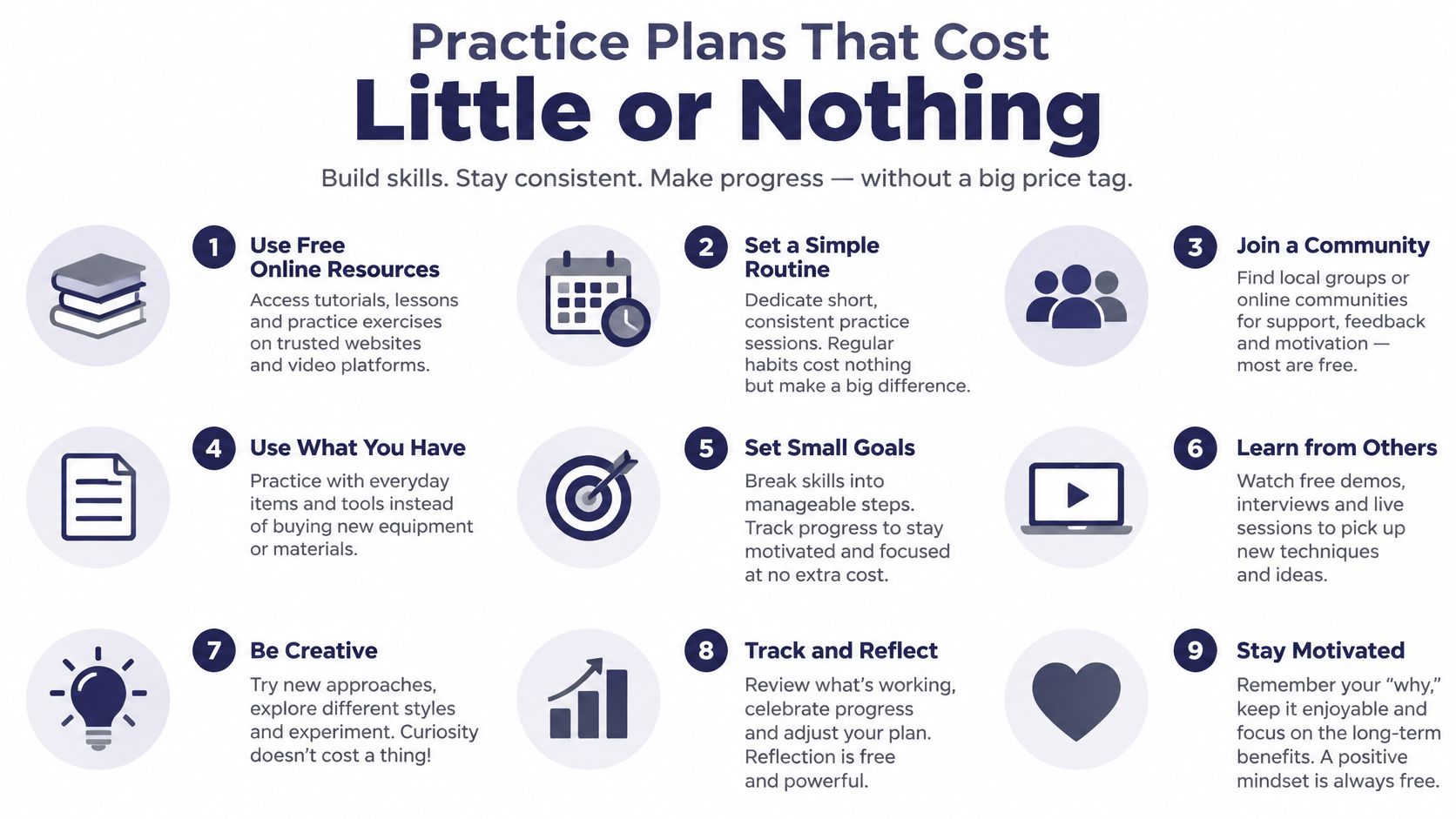
Five substitutes that cost nothing
- A phone camera and a scoring sheet. Record a two-minute answer, watch it once without pausing, then score clarity, evidence and structure. The recording catches the filler words and rushed endings you can't hear from inside the answer.
- A practice partner from your class or a pre-med society. Swap ethical prompts and score each other against the same rubric. Free, and more useful than a coach who has never seen your material.
- A library booth or a bookable study room. Timed station practice needs a door, a chair and a surface for notes. Campuses usually let you reserve rooms like this at no cost.
- Your accessibility or careers office. Ask whether a quiet room with stable broadband can be booked for a virtual interview day, and test the connection there before it counts.
- A self-review sheet. Three lines per answer: the competency, the action you chose, the follow-up step. Fill it in right after each practice run rather than from memory at the end of the week, and one document replaces a lot of paid feedback.
What you're replacing
| Paid Resource | Low-Cost Substitute | Use It For |
|---|---|---|
| Paid mock interview | Phone recording reviewed against the rubric | Checking clarity and structure |
| Paid coaching | Free practice partner from a pre-med society or class | Practising ethical prompts aloud |
| Travel to a paid practice site | School library booth or quiet room | Timed station practice |
| Paid technology setup | Accessibility office check on room and connection | Virtual interview readiness |
A plan you can start this week
- Put every target school's format and invitation dates on one page, taken from its own site.
- Decide whether you need an accommodation and contact the accessibility office in the same week.
- Write one answer per question type, then cut each to ninety seconds.
- Practise two timed MMI stations on ethics prompts each week, out loud, standing up.
- Record one virtual answer weekly and mark it against your sheet.
- Test the whole setup: private space, stable broadband, working camera, charged device, backup room.
An eight-week outline
Weeks one and two are research and writing. Formats confirmed, answers drafted, first recordings made and watched back with the sound on. Weeks three and four turn drafts into speech, with two station sessions and one recorded answer each week until you can score yourself without flinching.
Weeks five and six add pressure. Book a partner session where you answer unfamiliar prompts cold, and run a virtual mock on the exact equipment you'll use. Weeks seven and eight are full mock interview days: one traditional conversation, one station circuit, one recorded set, each reviewed the same evening with two specific changes to make.
A plan built for a one-on-one conversation won't survive a station circuit, which is why step one keeps every school's format on a single page you recheck before each mock. If your list crosses borders, the filters change, and our guide to how hard it is to get into med school as an international student sets out what to check before you commit to a country.
Interview readiness comes down to three things you control: knowing which format is waiting for you, knowing what each question is scored against, and knowing where to practise without paying for it. Medical School Programs has been an independent guide to medical school programs since 2009 and lists 24 English-taught medical programs in Europe and the Caribbean, so the school research and the interview research sit in one place. Visit Medical School Programs to compare programs and check requirements before your next invitation lands.