
AMCAS Early Decision is due August 1, and UK medicine applications through UCAS close at 18:00 UK time on 15 October, while regular AMCAS deadlines are set by each school. These are closing dates, not necessarily safe dates to submit.
The distinction matters because submitting your application doesn't mean a medical school can immediately review it. Transcript delivery, application verification, references, test results, and supplemental forms can all affect when your file becomes usable. Your calendar needs both a hard deadline and an earlier target submission date.
Table of Contents
- Key Application Deadlines at a Glance
- What Deadlines Apply Right Now
- How AMCAS Deadlines Work for US MD Applicants
- How Verification Time Shapes Your Submission Date
- UK Medicine Deadlines and Oxford and Cambridge
- Deadlines for Early Decision, Late and International Applicants
- Related Deadlines and Mistakes That Cost a Date
- Confirm Each School Deadline and Build Your Calendar
Key Application Deadlines at a Glance
Application deadlines by route
| Application route | Deadline | What counts as on time |
|---|---|---|
| AMCAS Early Decision, US MD | August 1, or the next business day if it isn't a working day | Application submitted and all official transcripts received |
| Regular AMCAS, US MD schools | School-set dates, commonly August to December | Application submitted by 11:59 p.m. Eastern Time; required transcripts generally received within 14 calendar days afterward, with applicable business-day adjustments |
| UCAS medicine, UK | 15 October, 18:00 UK time, in the year before entry | Completed application received by the applicable equal-consideration deadline |
| Oxford and Cambridge undergraduate, UK | 15 October, 18:00 UK time | Completed application received by the same October cutoff |
| Dentistry and veterinary courses, UK | Generally 15 October, 18:00 UK time | Completed application received by the applicable October cutoff |
| Listed English-taught European programs | Current intake deadline set by each school | Confirm the closing date, time zone, and required documents on the school's official page |
| Caribbean US-style MD programs | Current intake deadline set by each school | Confirm the intake-specific application and document deadlines on the school's official page |
Read this as a route selector, not a calendar you can copy without checking. The US rules are detailed in the AMCAS sections below; the UK closing-time rule is addressed in the UK section.
For the entry-year distinction, the UCAS application-cycle report identifies 15 October 2026 as the medicine deadline for 2027 entry. The same report records 25,770 medicine applicants in the 2026 cycle, illustrating the scale of the applicant pool, not the number of available places.
Read the year before you read the day
An application submitted during one calendar year may be for a course that begins in the following year. Search results, saved screenshots, and university pages can therefore look current while describing the wrong intake.
Before adding a deadline to Google Calendar, Outlook, or a spreadsheet, record:
- Entry year: When you intend to begin studying.
- Application route: AMCAS, UCAS, or a direct school application.
- Deadline event: Submission, document receipt, or completion of a supplemental application.
- Time zone: The school's stated zone and its equivalent where you'll submit.
Don't replace an unknown European or Caribbean deadline with a date from another institution. Even programs that appear similar can use different intake calendars and document requirements.
Your immediate task is simple: find your route, open the official application page, and record the exact closing date, time, and time zone. Only then should you decide when to submit.
What Deadlines Apply Right Now
If you're planning in late November, first establish whether you're looking at an open application window or preparing for a future intake. A university page remaining online doesn't mean applications remain open.
For UK medicine applicants considering the autumn entry covered by the October deadline, that ordinary application window has already closed. Don't assume the later general undergraduate deadline offers another opportunity to submit a medicine application.
US applicants need a school-by-school answer. Some regular AMCAS deadlines may still be ahead, while others have passed, and an open primary application window doesn't establish that every supporting requirement remains achievable.
Check your position before spending money
Use this sequence before ordering documents or paying application fees:
- Name your intended intake. Write the entry year beside each program, rather than keeping a single undated school list.
- Check the current official application page. Look for whether the school is accepting applications for that intake and whether supporting materials have separate cutoffs.
- Choose an available route. If the deadline has passed, prepare for the following cycle unless admissions explicitly confirms an eligible alternative.
When contacting admissions, ask a precise question: “Is the application route for my intended intake still open, and can my supporting documents arrive within your required timetable?” Include your applicant category if international or graduate-entry eligibility may affect the answer.
An application portal that lets you create an account isn't proof that your intended program is still accepting applications.
Don't roll an old deadline forward yourself
A recurring seasonal pattern can help you prepare, but it isn't confirmation of the next cycle's date. Keep an unconfirmed future deadline marked awaiting official publication, rather than copying last year's date.
Time-zone conversion also matters near closing time. London and New York don't share a clock, and daylight-saving changes make a remembered offset unreliable. Use a calendar's time-zone setting for the actual deadline date, then save the original school wording alongside it.
If your window has closed, use the additional preparation time deliberately. Resolve eligibility questions, arrange your academic records, and identify test requirements before the next application opens.
How AMCAS Deadlines Work for US MD Applicants
AMCAS centralizes the primary application for participating US MD schools. It doesn't replace each school's authority over its admissions timetable or supplemental materials.
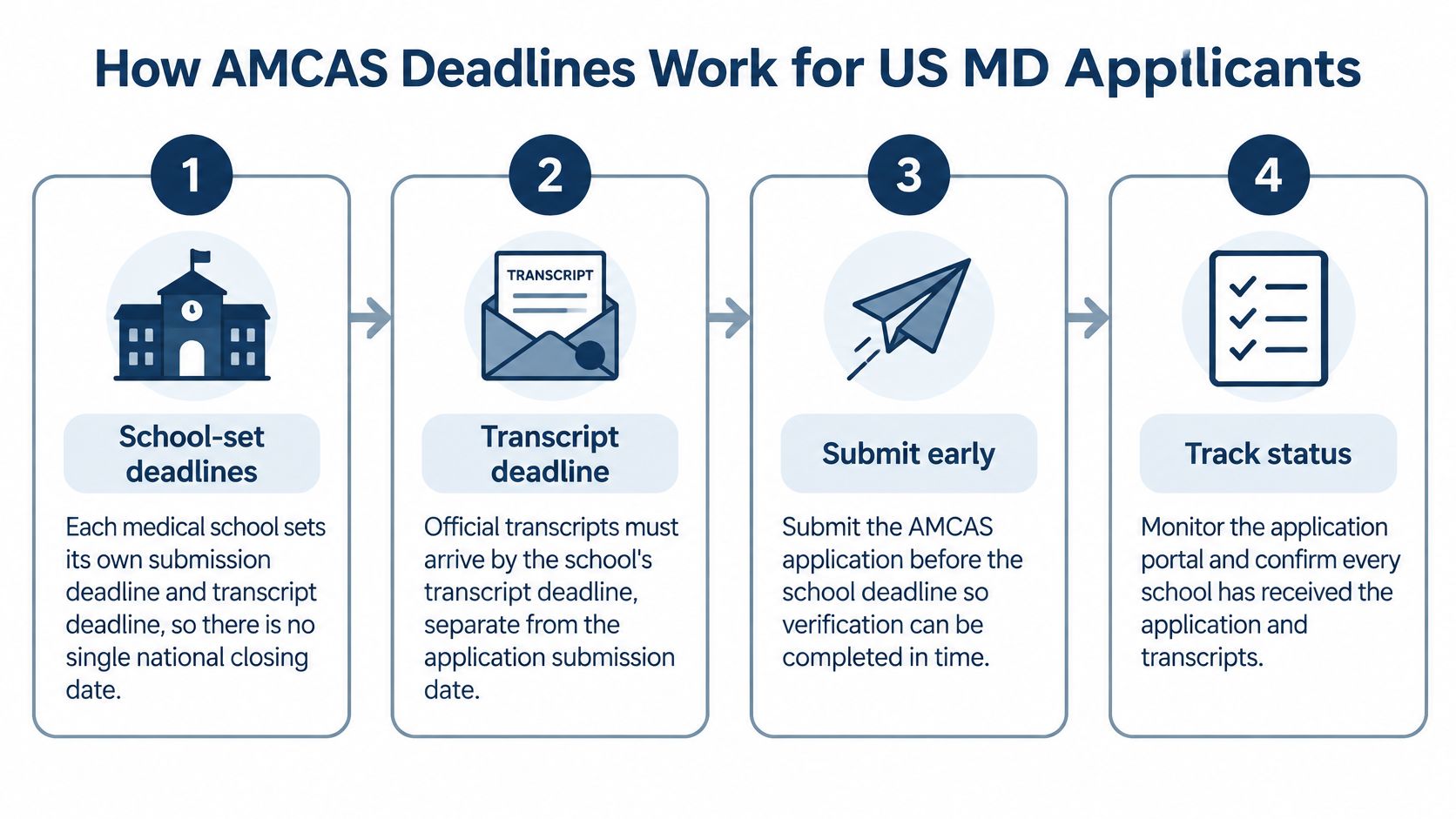
The AAMC's participating schools and deadlines guidance establishes the main rules: schools set their own deadlines; regular applications must be submitted by 11:59 p.m. Eastern Time; official transcripts generally must arrive within 14 calendar days after the application deadline, with applicable next-business-day adjustments; and Early Decision requires the application and all official transcripts by August 1, or the next business day when necessary.
The rules behind a valid submission
Each medical school controls its deadline.
Build a separate record for every school. A date you've confirmed for one institution doesn't authorize you to use the same date elsewhere, even though you're using the same application service.Submitted means submitted, not saved.
Completing your coursework entries and saving your essay leaves you with a draft until you finish submission. A draft still open at closing time doesn't count as a timely application.Transcript receipt is a separate event.
Ordering a transcript isn't the same as AMCAS receiving it. Check the application status to confirm receipt and matching, and investigate missing records rather than relying only on the registrar's dispatch confirmation.Early Decision has its own timetable.
Treat this route as a separate planning commitment, including document readiness. If you're considering regular applications afterward, confirm the restrictions and release rules before scheduling those submissions.
The process graphic provides a useful checklist for managing the application and document stages.
Why a shared application still needs separate school records
Think of AMCAS as the central application channel, not a universal completion certificate. A school may still need recommendation letters, a secondary application, test results, or other institution-specific materials before reviewing your file.
For example, you might successfully submit your primary application while a school's supplemental form remains unfinished. The primary submission confirmation doesn't establish that you've met that school's separate completion requirements.
Use the AMCAS medical school requirements guide to organize the application components, then match each component to the current instructions for your target institution. Keep separate status fields for submitted, received, and complete.
Before submitting, open each school's own deadline page again. If its wording conflicts with what you've recorded, ask admissions to clarify the applicable rule rather than choosing the more convenient interpretation.
How Verification Time Shapes Your Submission Date
The posted deadline is a hard cutoff, not a safe submission date. It tells you when submission closes, not how quickly your verified application will reach a school.
According to the AAMC's AMCAS submission and deadlines guidance, verification begins after the application and required official transcripts are received and can take approximately six weeks, after which verified applications are transmitted to schools on a rolling basis.
AMCAS timing stages and their effect on your target date
| Stage | Typical timing | Effect on your target date |
|---|---|---|
| Application submission | By the school's published Eastern Time cutoff | Treat this as the last permissible submission point |
| Official transcripts to AMCAS | Within the permitted transcript-receipt window | Missing or unmatched records postpone readiness for verification |
| AMCAS verification | After the application and required transcripts are received | Reserve processing time before your intended school-receipt date |
| Transmission to schools | Rolling, after verification | A late-ready application reaches schools later |
| Secondary application turnaround | School-set deadline or response period | Confirm the school's instructions and reserve writing time |
Work backward from school readiness
Say a hypothetical school closes primary submissions in early November. If you submit in late October and processing uses the full verification allowance, the school might not receive the verified application until mid-December.
That's an illustration of the processing sequence, not a prediction for a particular school or application. Missing transcripts could move readiness later, while actual processing conditions could produce a different result.
The important point is that a technically timely primary submission can still produce a late-arriving file. At schools using rolling admissions, you should ask how application completion timing affects review rather than assuming all submissions receive identical treatment.
Practical rule: Plan around when your application can become review-ready, not just when you can click submit.
A useful reverse-planning formula
Set your target using this sequence:
- Choose the intended school-receipt point. Consider the school's published guidance and admissions process.
- Allow for verification. Use current AMCAS processing information, not an old applicant's experience.
- Move document requests earlier. Allow time for registrar processing, delivery, and transcript matching.
- Reserve a contingency buffer. Account for corrections, supplemental writing, and documents outside your control.
Subtracting processing time from the final deadline is a starting exercise, not a guarantee of a competitive submission date. If your result leaves no room for a missing transcript or a demanding secondary, move your target earlier.
UK Medicine Deadlines and Oxford and Cambridge
For UK applicants, the central question is whether the completed UCAS application arrives on time. Preparing the form, arranging a reference, and submitting it are distinct tasks.
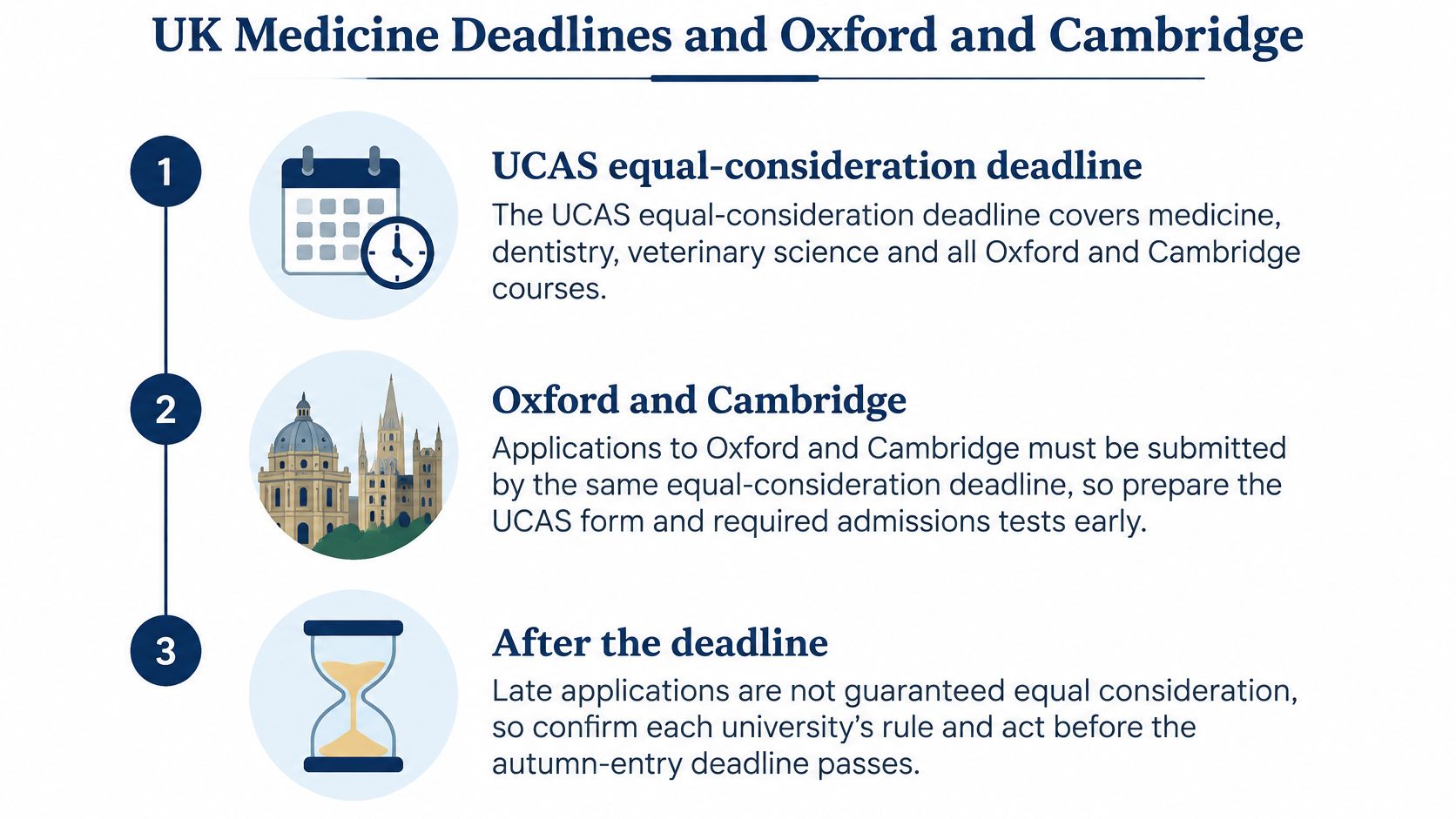
The UCAS event page for 2027 entry sets the deadline for most medicine courses and all Oxford and Cambridge undergraduate courses at 18:00 UK time on 15 October 2026. The same course-category deadline generally covers dentistry, veterinary medicine, and veterinary science.
The timeline graphic helps distinguish the shared application cutoff from the preparation that must happen beforehand.
Understand what the common cutoff covers
- Medicine belongs to the early-deadline group. Don't use the general deadline for another undergraduate subject as your medicine submission target.
- Oxford and Cambridge share the early cutoff. The rule isn't limited to medicine applications at those universities.
- The entry cycle determines the applicable date. Confirm the intake on the current UCAS page and convert the stated closing time into your local time zone.
For medicine, don't treat “equal consideration” as an invitation to submit late. Plan on the published cutoff being final and seek explicit official guidance if you believe an exceptional route applies.
The centralized deadline helps universities organize a large applicant pool within their selection timetable. It doesn't tell you your individual admission chances, and applicant totals shouldn't be read as acceptance rates.
Prepare the parts you can't finish instantly
The application form is only one part of readiness. Check these dependencies while you still have time to resolve a problem:
- Application writing: Complete the personal statement or equivalent components required for your cycle.
- Reference: Give your referee the correct instructions and confirm how the reference enters the submission process.
- Admissions tests: Check required tests, registration, booking, and acceptable testing periods.
- Eligibility: Verify qualifications, subject requirements, and any applicant-category restrictions.
- International preparation: Check English-language evidence, financial planning, and visa research separately.
If your school or adviser handles submission, ask about its internal deadline. An internal handover date may be earlier than the public cutoff because staff need time to check and send the application.
For additional application context, the following video can supplement, but not replace, current UCAS and university instructions.
Unlike AMCAS's school-by-school primary deadlines, UCAS gives these course categories a prominent common cutoff. Universities still determine their own eligibility and selection requirements, so a shared application date doesn't eliminate the need to read individual course pages.
Deadlines for Early Decision, Late and International Applicants
Your applicant category can change what needs to be ready first. Choose the case that matches your situation, then identify the earliest action you can't postpone.
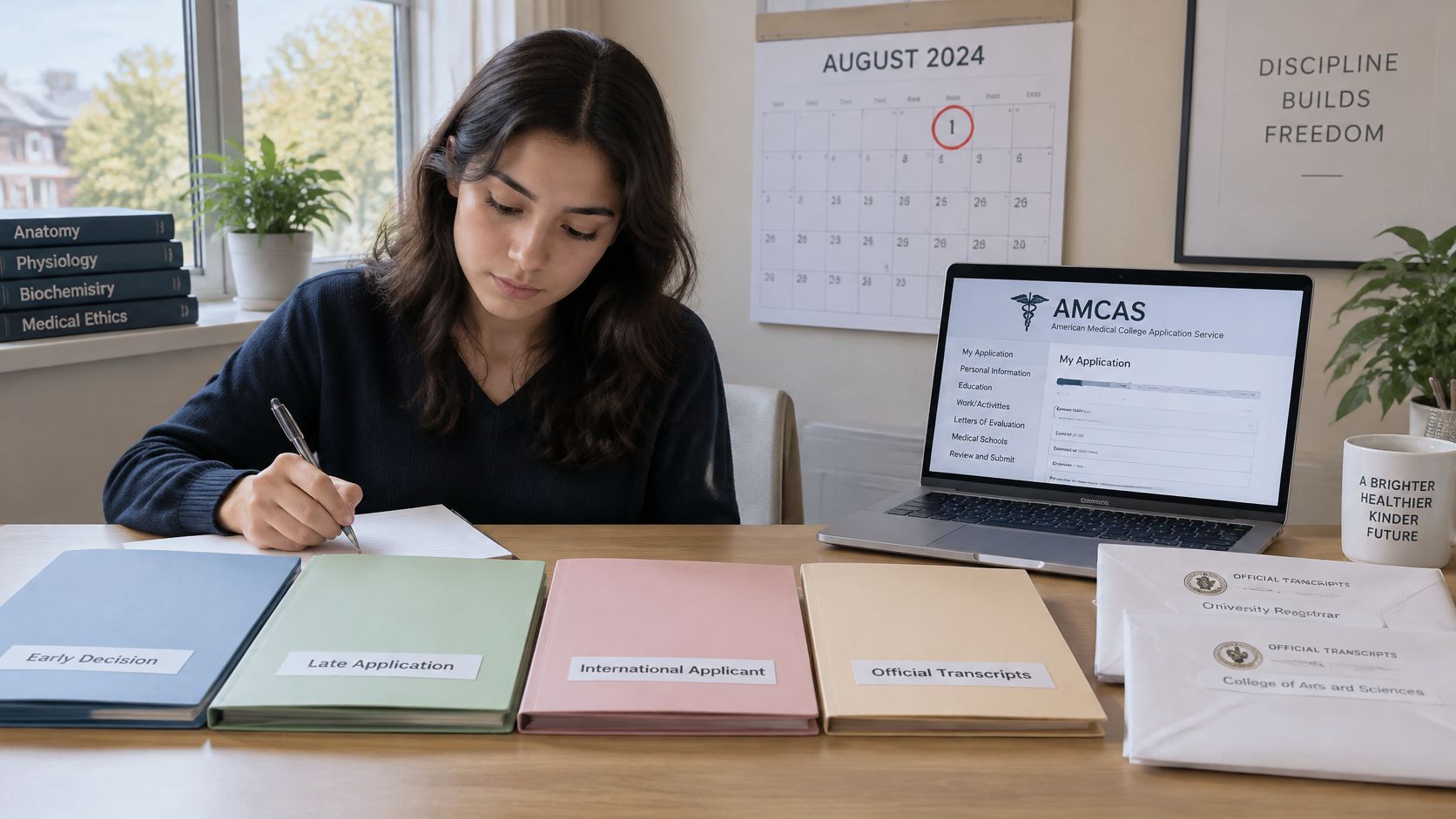
Organizing supporting documents by route makes those differences easier to manage.
Early Decision and late-cycle choices
Early Decision applicants need document readiness, not just a finished essay. Request academic records early enough to resolve missing institutions, delivery problems, or mismatched details. Prepare a conditional regular-application plan, but don't act on it until the applicable Early Decision rules permit you to do so.
Late-cycle applicants need a feasibility check before paying. Ask whether the school is still accepting applications for your intake, whether it uses rolling admissions, and what must arrive before review. An open submission button doesn't answer those questions.
A useful admissions email identifies your intended program, intake, application status, and outstanding documents. Ask whether completing those items within the remaining timetable would meet the school's requirements; don't ask staff to guarantee an admission outcome.
International and direct-application routes
For international applicants, the earliest bottleneck may sit outside the application portal. Academic records, translations, English-language evidence, and visa preparation can require separate arrangements.
- Map document ownership: Identify which registrar, examination body, translator, or testing service must send each item.
- Separate admissions from immigration: A visa appointment doesn't extend an application cutoff, and application submission doesn't establish visa eligibility.
- Check applicant eligibility first: Use the guide to medical schools that accept international students to frame your questions, then confirm your category with the school.
For English-taught European programs and Caribbean US-style MD routes, use the specific program and intake, not the region, as your planning unit. Confirm whether applications are direct, whether entrance assessments have separate booking deadlines, and whether supporting documents can follow the initial form.
Don't assume another applicant's timetable applies because you share a nationality or qualification. Your school history, document requirements, and intended intake may differ.
Finish by writing down the earliest required action for your case: a transcript request, test booking, eligibility inquiry, or application submission. Give that action a calendar entry and name the person or organization responsible for completing it.
Related Deadlines and Mistakes That Cost a Date
A medical school application deadline is easy to notice. The dependencies that stop you meeting it are easier to overlook.
The AAMC application guidance notes that verification can take about six weeks after an application is marked Ready to Review and that schools set their own deadlines, which may change during the cycle. That makes current status tracking more useful than a checklist that only says “application started.”
Track the items that can block completion
Official transcripts require receipt confirmation. Keep the request confirmation, but also check whether AMCAS has received and matched the record. If something is missing, contact the sending institution and follow the application's instructions for resolving the issue.
Recommendation letters have their own completion rules. Don't assume letters are a prerequisite for AMCAS verification; distinguish primary processing from the materials a school needs for review. Give referees the actual submission instructions and monitor receipt without waiting until the school's final cutoff.
Test scores need a review-compatible schedule. Check which test sittings the school accepts and when results must be available. The last test you can book isn't automatically the last test a school will accept for your intake.
Secondary applications need individual tracking. Read each school's invitation and instructions rather than assuming every secondary follows the same screening process or response window. Record the deadline immediately and identify any essays or documents that need additional work.
Replace common assumptions with evidence
| Risky assumption | Better check |
|---|---|
| The primary deadline is my ideal submission date | Compare the cutoff with processing and school-completion requirements |
| Every US MD school uses the same timetable | Keep a separate deadline record for each institution |
| The date alone is enough | Save the closing time and original time zone |
| Ordering a transcript completes the task | Confirm receipt and matching |
| A recommendation request means the letter is ready | Check the receiving system's status |
| Last cycle's instructions still apply | Verify the current intake on the official page |
| A submitted primary means my whole file is complete | Check the school's supplemental requirements |
Save the confirmation, then check the status. A successful action in one system doesn't establish completion in another.
For UK applicants, test registration and reference preparation deserve their own calendar entries. Don't assume every required assessment can be arranged shortly before application submission, or that the public UCAS deadline is your school's internal handover deadline.
When a status is unclear, ask a focused question and retain the answer. “My registrar confirms dispatch, but my transcript isn't showing as received” gives staff a concrete problem to investigate.
Confirm Each School Deadline and Build Your Calendar
A useful calendar records what must happen, who controls it, and what proves completion. A list of closing dates alone won't tell you whether you're on track.
Build a record you can verify
List every school and exact program. Include the intended intake and application route. Keep similarly named undergraduate, graduate-entry, and direct-entry programs separate.
Open the official deadline page. Record the submission cutoff, document-receipt requirements, supplemental deadlines, and time zone. If a date isn't published, mark it unconfirmed and ask admissions rather than filling the gap with an estimate.
Add both deadlines and target dates. Keep the hard cutoff visible, then create an earlier submission target based on document delivery and processing. Add reminders before the target, not only before the final deadline.
Assign dependencies. Record transcripts, references, tests, English-language results, and secondary applications as separate tasks. Give each a status such as requested, sent, received, or accepted.
Recheck before submission. Save a dated copy of the official instructions and record when you last confirmed them. Reconcile any changes before relying on your calendar.
Keep guidance separate from confirmation
Use our guide to applying to medical school to organize the broader preparation process. For the final deadline decision, rely on the school's current application instructions and the relevant application service.
Our program data comes from official school websites and authoritative bodies such as the World Directory of Medical Schools, ECFMG, NRMP, and national accreditation agencies. We check program facts against each school's official pages, date those checks, and update facts when a school changes its fees or requirements.
Those checks support comparison, but they don't replace intake-specific confirmation. If a school hasn't published a closing time, ask for it explicitly and retain the response with your application records.
Before closing your planning session, make sure every target program has either a confirmed deadline or a named follow-up task. The school's official page remains the final authority for its program-specific requirements.
Medical School Programs offers admissions guidance and a sourced program directory to help you compare eligibility, supporting documents, and study routes. Visit Medical School Programs to organize your shortlist, then confirm each school's current deadline before building your submission calendar.