
Your interview invitation is open beside your clinical schedule, and you're trying to decide what needs attention first: answers, travel, the camera setup, or the program itself. It's easy to spend the evening polishing your specialty story and leave the harder question untouched: would you want to train there?
Medical residency interviews require both kinds of preparation. You need to demonstrate judgment, reliability, and commitment without sounding rehearsed. You also need to investigate supervision, workload, and resident support before a friendly conversation becomes the main reason you rank a program highly.
Table of Contents
- Interview Formats and What Each One Tests
- How to Prepare for Each Interview Step by Step
- Common Residency Interview Questions and How to Answer Them
- Interview-Day Conduct That Affects Your Rank
- Verifying Program Culture When Interviews Go Virtual
- Who Still Pays When Interviews Are Virtual
- Budgeting for the Interview Season
- Score Programs and Build Your Rank List
Interview Formats and What Each One Tests
Prepare for the format in the invitation, not the one your classmates expect. A 2025 census of residency interview formats identified formats for 4,014 programs across 23 specialties, with 74.5% virtual, 17.4% in person, and 8.1% hybrid, as summarized below.
Residency interview formats in the 2025 census
| Format | Share of programs | What it gives you | What it costs you |
|---|---|---|---|
| Virtual | 74.5% | Lower travel and lodging costs, less time off | Harder to judge culture, facilities, and resident interaction |
| In-person | 17.4% | Tours, resident lunches, and social events for firsthand culture assessment | Travel, lodging, and missed clinical or academic days |
| Hybrid | 8.1% | A mix of formats depending on the program | Two sets of preparation and logistics in the same season |
Virtual interviews let you meet faculty without organizing a trip around every invitation. They're particularly useful when programs are geographically dispersed, but a polished presentation tells you little about how residents interact during a difficult service.
In-person interviews give you more opportunities to observe informal behavior. Notice whether residents can speak freely, whether faculty listen to them, and whether the tour includes actual working spaces rather than only attractive facilities.
What convenience doesn't replace
The time burden of travel is substantial: a Journal of Graduate Medical Education article reports the AAMC finding that more than 70% of surveyed plastic surgery applicants missed at least seven days of medical school for in-person interviews. The same article reports that, among respondents to a national internal medicine resident survey associated with the 2022 American College of Physicians In-Training Examination, 80.1% were somewhat or very satisfied with information from in-person interview days, compared with 76.6% for virtual interviews, a statistically significant difference.
That gap doesn't make travel automatically worthwhile. It means applicants interviewing remotely should deliberately replace missing observations with specific questions and independent checks.
For a hybrid season, maintain separate logistics checklists for travel and remote attendance. Confirm whether “hybrid” means applicant choice, separate interview dates, or an interview followed by an optional visit. Read the invitation closely before booking anything.
How to Prepare for Each Interview Step by Step
Preparation works best when you build reusable evidence, not a script for every possible question. Keep your application, program notes, and practice recordings together so you can check consistency rather than relying on memory.
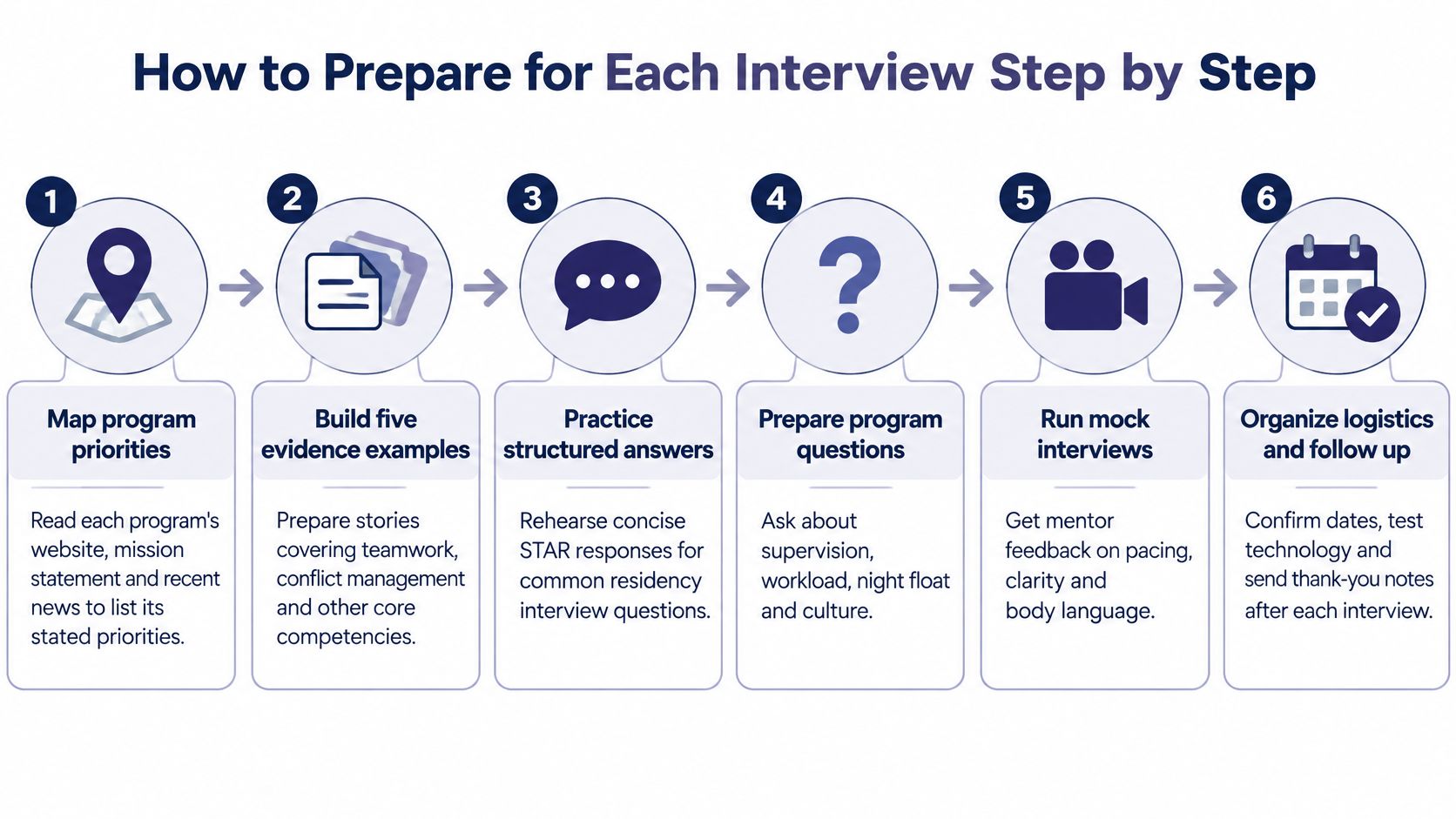
Map the program's priorities. Read its website, mission statement, curriculum, and recent institutional news. Translate broad language into something testable: a commitment to underserved care should connect to identifiable clinical experiences and support.
Build five evidence examples. Prepare material covering teamwork, conflict management, ethical judgment, clinical learning, and specialty commitment. Choose experiences you can discuss accurately, including what was difficult and what you would change.
Structure each example. Use situation, action, result, and reflection, keeping your personal contribution distinct from the team's work. If the outcome wasn't measured, describe what you observed instead of manufacturing an improvement.
Rehearse aloud and record a practice session. Ask a mentor to interrupt with follow-up questions rather than letting you deliver uninterrupted speeches. Listen for buried answers, unexplained jargon, and endings that never arrive.
Prepare program-specific questions. Focus on supervision, feedback, duty-hour implementation, resident progression, and graduate outcomes. Ask about the mechanism behind a claim, such as how residents obtain help overnight, rather than whether the program is supportive.
Create your comparison sheet before interviewing. Choose criteria that matter to your training and life, then define what strong evidence would look like. Leave space for unanswered questions and contradictions, not just scores.
Use this visual checklist to organize the preparation work.
Why structure matters
A literature review of residency selection interviews examined 104 studies; among 34 studies testing whether interview scores predicted later residency performance, 17 found no predictive relationship. The practical lesson isn't that interviews are pointless, but that a convincing conversation isn't proof of future clinical competence or a healthy training environment.
Practical rule: Prepare evidence you can defend, not a personality you have to maintain.
Programs also assess your academic record, specialty letters, examination performance, and demonstrated commitment. Review your residency letter of recommendation preparation alongside your interview work so the examples you discuss fit the broader application.
Common Residency Interview Questions and How to Answer Them
Build answers around the questions that expose your reasoning, not just your enthusiasm:
- Specialty motivation: Why this specialty, and which experiences made the choice convincing?
- Program interest: Which training features match your goals?
- Teamwork and conflict: What did you do when colleagues disagreed?
- Ethical judgment: How did you recognize competing responsibilities and seek appropriate help?
- Mistakes: What happened, whom did you notify, and what changed afterward?
- Weaknesses: What are you actively improving?
- Feedback: How did criticism alter your behavior?
For your specialty narrative, connect a clinical experience to the work you keep wanting to do. Explain the clinical problems, relationships, or responsibilities that attract you, rather than claiming you've always known your destination.
A behavioral answer that stays concrete
Say you're describing a handoff during a busy night shift. Explain that you were a student working under supervision, a patient had an unresolved issue, and the receiving clinician needed a clear account of what remained pending.
Then describe your actions: you checked the outstanding task with your supervising resident, included the concern in the handoff, and confirmed who would follow it up. State the outcome only as far as you know it, such as confirmation that the receiving team understood the pending work.
Finish with reflection: you now identify unresolved tasks before summarizing the rest of the patient's course. Don't claim you prevented harm unless you can substantiate that conclusion.
Answer the question first. Context should clarify your decision, not delay it.
That discipline matters when discussing errors. Name your responsibility without claiming independent authority you didn't have, and protect patient confidentiality. If you have a genuine measured result, use it; otherwise, a precise description is stronger than an invented number.
Applicants familiar with medical school interviews should shift the emphasis toward clinical responsibility, escalation, and learning within a team. A residency answer needs more than motivation to become a doctor.
Close your own questioning with criteria you can use:
- Supervision: How does an intern obtain immediate senior help overnight?
- Feedback: What happens when a resident isn't progressing as expected?
- Career preparation: How does the program support residents pursuing my intended practice setting?
These questions give you material for a decision, not merely another pleasant exchange.
Interview-Day Conduct That Affects Your Rank
Interrupting to deliver a prepared answer is an avoidable mistake. You can know the material and still communicate that you're not listening. Evasive answers, dismissiveness toward staff, and disparaging comments about previous institutions create similar problems.
A dependable interview-day protocol
- Before starting: Arrive early. For virtual interviews, test the camera, microphone, platform, and internet beforehand, with lighting on your face and notifications disabled.
- At introductions: Confirm names and roles without turning the opening into an interrogation. Keep your application and a short question list accessible.
- During discussion: Listen through the question, answer directly, and allow follow-up. If you lose the thread, pause and return to the question rather than speaking faster.
- Afterward: Follow the program's communication instructions. Where follow-up is welcomed, send an individualized, factual message, not a request to improve your ranking.
What the measured effect means
In an institutional study of in-person residency interviews, the model-based mean score increased from 3.93 before the interview to 4.02 afterward, a 0.09 change corresponding to approximately 10–15 ranking positions, with an average of 12.5 positions. In that study, faculty-assessed personality had the largest positive marginal scoring effect, 0.259, while negative professional demeanor had a similarly sized adverse effect, −0.257.
Those findings describe one institution, not a universal ranking formula. They do show why it's unwise to treat interview day as ceremonial once your credentials have passed screening.
Don't respond by manufacturing an outgoing personality. A reserved applicant can still be clear, engaged, and respectful. Professional consistency beats theatrical warmth: demonstrate reliability, acknowledge limits, and explain how you seek feedback.
For virtual interviews, aim for intelligible sound and an undistracting setup, not expensive production equipment. If technology fails, explain the problem plainly and use the coordinator's backup instructions.
Verifying Program Culture When Interviews Go Virtual
A friendly video call doesn't establish a safe learning environment. A review discussing virtual interview experiences reports that 76.0% of urology applicants preferred in-person interviews for judging program fit, versus 4.0% who preferred virtual interviews; it also reports the general-surgery satisfaction comparisons below.
In-person versus virtual signals of program fit
| Signal | In person | Virtual |
|---|---|---|
| Preference for judging program fit, urology applicants | 76.0% preferred in person | 4.0% preferred virtual |
| Satisfaction with resident social events, general surgery | 93.5% | 63.3% |
| Satisfaction with hospital tours, general surgery | 80.6% | 53.3% |
Treat facility images as prompts for investigation, not proof of working conditions.
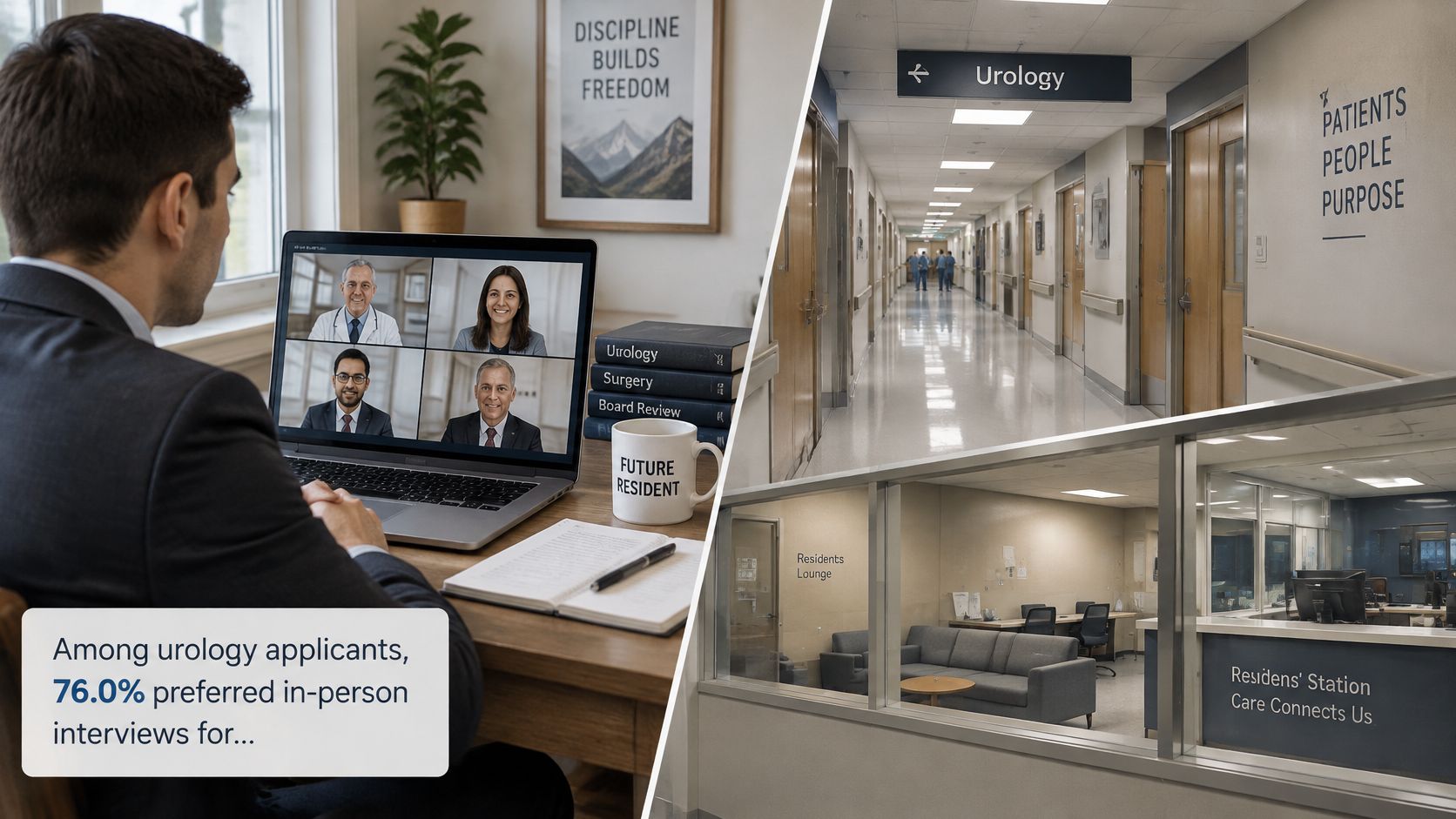
Ask for processes and examples
Ask residents how supervision works when the service is overwhelmed, how night float is staffed, and who covers unexpected absences. Request an example of a concern residents raised and what leadership did about it.
Use targeted questions for sensitive subjects:
- Attrition and progression: How are departures explained, and how does remediation work?
- Leave and coverage: What happens operationally when someone takes parental leave?
- International graduates: Who handles visa support, and what institutional confirmation is available?
- Psychological safety: Can residents disagree with a plan or report a problem without retaliation?
- Career outcomes: How do mentorship and fellowship support work in practice?
Compare accounts across resident classes. Different experiences aren't automatically evidence of dishonesty, but unexplained contradictions deserve follow-up.
Use the video alongside, not instead of, your own questions.
Check publicly available accreditation information and institutional policies. Separate what requires observation from what requires documentation: a visit can clarify hospital geography and team interactions, while written policies are better evidence for leave and sponsorship arrangements.
Treat an applicant-funded optional second look as a purchase with a purpose. Ask what uncertainty the visit would resolve, whether equivalent information is available remotely, and how attendance is handled in evaluation. Don't pay merely to relieve anxiety.
Who Still Pays When Interviews Are Virtual
Applicants don't all value the same trade-off. In a 2025 surgery-applicant survey, 283 applicants responded and 257 were included in the analysis; 68.5% preferred virtual interviews and 31.5% preferred in-person interviews.
That preference doesn't mean a remote interview is free. A candidate with private space, reliable broadband, and flexible clinical scheduling faces a different season from someone sharing housing, caring for family, or interviewing across time zones.
Check your actual constraints
- Volume: Count the clinical sessions, paid work, or caregiving arrangements each interview displaces. Removing travel doesn't remove the interview day.
- Distance: Compare the travel you avoid with the firsthand information you lose. An applicant traveling internationally faces a different calculation from someone who lives near the hospital.
- Technology and privacy: Arrange a quiet room through your school if home isn't suitable. Test audio with another person, identify a backup connection, and ask how reconnection should work.
- Money and access: Include equipment, room access, childcare, and unpaid leave in your estimate. Request disability accommodations and clarify camera expectations early rather than improvising during the interview.
Lower travel costs remove an important barrier. They don't guarantee equal conditions on camera.
Avoid treating a weak connection or crowded living space as a personal failure. Tell the coordinator what accommodation you need in practical terms, without feeling obliged to disclose unnecessary personal information.
When an invitation requires travel you can't manage, ask whether a virtual option exists. Don't assume an alternative is available, but don't reject the opportunity before checking.
Budgeting for the Interview Season
Start with a ledger, not a spending target. The study of residency interview financial burden reports the following historical emergency medicine figures and separate applicant-survey findings; these describe those applicants, not current price quotes.
Average residency interview costs and applicant behavior
| Measure | Figure | Context |
|---|---|---|
| Average programs applied | 42.8 | Emergency medicine applicants, 2015–16 cycle |
| Average interviews planned | 13.7 | Same cycle |
| Average cost per interview | $414 | Travel, lodging, and related expenses |
| Average total pursuit cost | $8,312 | Applications, travel, lodging, and related expenses |
| Applicants spending over $4,000 | More than 43% | Emergency medicine applicants |
| Applicants spending at least $2,500 | 64% | Separate applicant survey |
| Applicants spending $7,500 or more | 13% | Separate applicant survey |
| Applicants who borrowed to finance interviews | 71% | Separate applicant survey |
| Applicants who declined interviews for financial reasons | 41% | Separate applicant survey |
Control the decisions you can
- Set an application strategy: Discuss specialty competitiveness and your application with an informed advisor. The maximum number you can fund isn't automatically the right number to pursue.
- Price the whole trip: Include ground transport, baggage, meals, cancellation terms, and missed work alongside the advertised fare.
- Ask before booking: Confirm whether lodging support, travel assistance, scheduling flexibility, or virtual attendance is available.
- Track commitments: Record paid costs, refundable bookings, outstanding charges, and reimbursement requirements in a spreadsheet.
If attending would create financial hardship, evaluate whether the program offers something important enough to justify the expense. Don't confuse money already spent applying with a reason to spend more.
Keep an emergency margin for disrupted travel or necessary technology replacement. A workable budget protects your ability to attend the interviews you value, rather than rewarding the busiest possible calendar.
Score Programs and Build Your Rank List
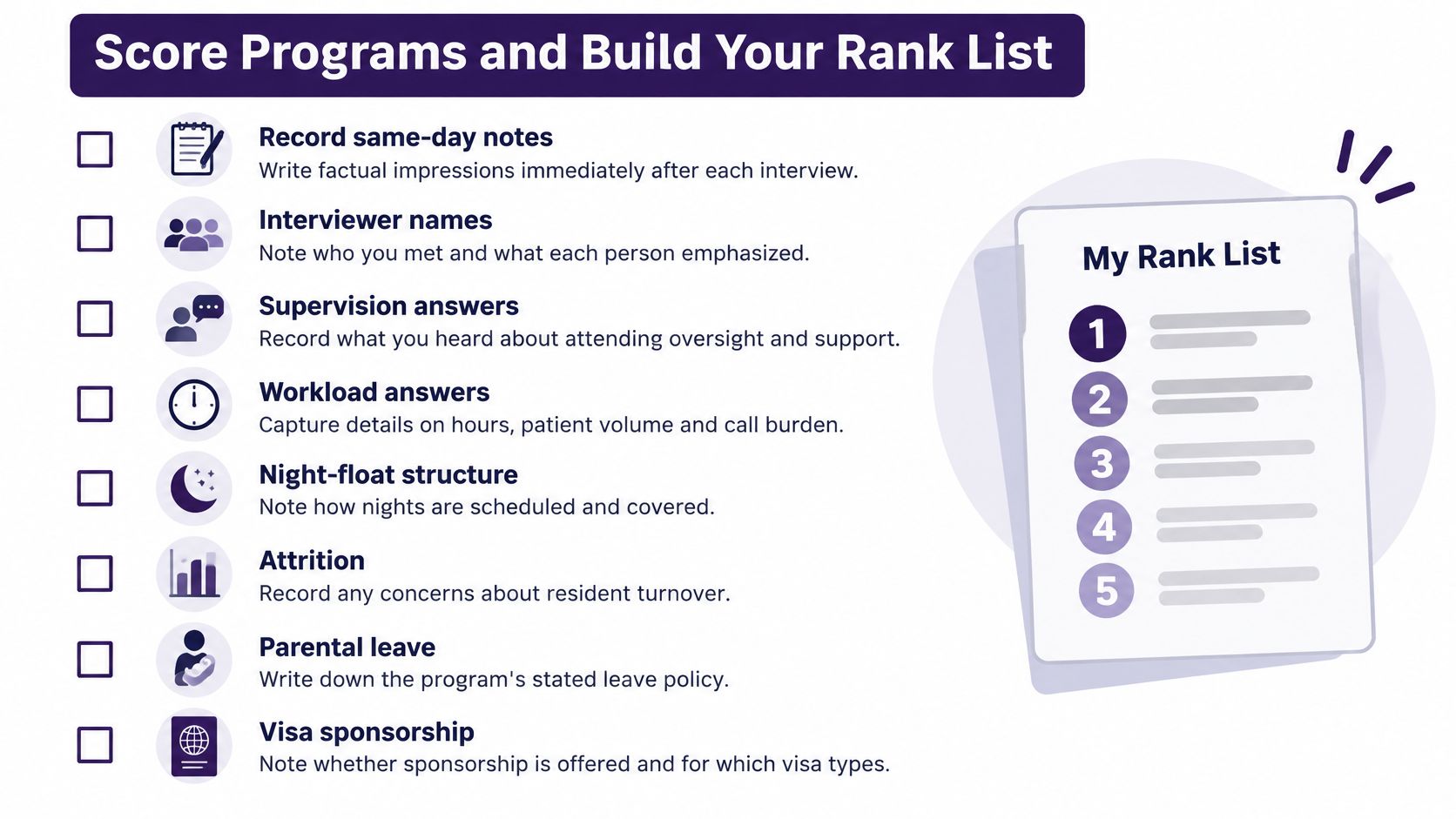
Record factual impressions while you can still distinguish who said what. Note interviewer names, concrete answers, unanswered questions, and statements that conflict with the program's published information.
Keep evidence separate from interpretation. A resident describing the overnight escalation process is evidence; your impression that everyone seemed approachable is an interpretation. Both can matter, but they shouldn't carry identical weight.
Use this checklist to capture the details that are easiest to forget.
Make the final order defensible
Score each program using your predetermined criteria and a consistent scale. Mark missing information as unresolved rather than assigning a reassuring middle score. Separate nonnegotiable requirements, such as necessary sponsorship, from preferences that allow trade-offs.
Your assessment of a program is different from its assessment of you. Don't lower a preferred program merely because you think its faculty were less enthusiastic, and don't mistake your strongest interview performance for your best training option.
Before finalizing:
- Complete every score sheet. Resolve important gaps or explicitly identify what remains uncertain.
- Compare resident accounts. Check whether junior and senior residents describe compatible supervision and working conditions.
- Verify international-graduate requirements. Confirm the sponsorship arrangements and eligibility details you would rely on.
- Audit the order. Make sure it reflects your training priorities, practical needs, and acceptable trade-offs rather than invitation timing or prestige alone.
- Confirm requirements and deadlines. Check current instructions with each program and the relevant matching system before submitting.
Medical School Programs offers a careers guide covering residency match rates, screening filters, salaries, alternative pathways, and how international medical graduates can judge a school. Visit Medical School Programs to connect your interview decisions with the wider training and licensing pathway you're planning.