
You finished a strong rotation, the attending said you did well, and the ERAS calendar is closer than it felt a month ago. The letter you still need is not a blank page someone fills in later. It is a routing item. The specialty, the program, and the cycle decide the format, the writer, and the deadline before anyone starts typing.
A residency letter of recommendation fails in two quiet ways. It arrives in the wrong form, or it arrives too late to assign. Both look the same on the program side: an incomplete file. I would treat the request like a submission checklist, not a favor you squeeze in after the last shift. Check the requirement first. Then ask.
Table of Contents
- Check Which Letter Format Each Program Expects
- Time the Request and Pick the Right Writer
- Why Program Directors Weigh Specialty Letters So Heavily
- Brief Your Writer With Materials That Produce Specifics
- Recover a Wrong or Late Letter Before You Submit
Check Which Letter Format Each Program Expects
The program's requirement sets the format. Your preference does not. The format decides who you ask and what they are allowed to write, so a polished narrative from the wrong person can still leave the file short.
Three formats show up across specialties.
| Format | Where you will see it | What to do |
|---|---|---|
| Narrative letter of recommendation | Most specialties unless the program specifies otherwise | Ask a physician who directly observed your clinical work |
| Standardized specialty letter | Dermatology, integrated plastic surgery and urology | Confirm the specialty form in ERAS before you request it |
| Standardized Letter of Evaluation (SLOE) | Programs that request it in their listing | Ask your clerkship director early, since they complete it |
How to verify the format
- Read national specialty guidance. Specialty pages say whether a narrative letter is enough or whether a designed form is expected.
- Open each program's website and listing. A national default does not override a program that asks for a SLOE or a specialty form.
- Select the specialty in MyERAS before you assign a letter. You still start the request and assign letters there. For the 2027 ERAS cycle, the AAMC letter writers FAQ says submission moves to the AAMC Letter Writer Portal, and specialty-specific standardized requests are being introduced for dermatology, integrated plastic surgery, and urology.
That mismatch is the failure that costs interviews. An excellent writer sends a conventional narrative when the program expects a standardized evaluation. The file looks finished to you and incomplete to the program.
Standard forms help programs compare applicants on the same items. They also leave less room for a story that does not fit the boxes. That pinch is sharper for international graduates, applicants changing specialties, and candidates whose best evidence is research, community work, or a nontraditional clinical path. Read each listing before you lock a writer, and keep the letter type aligned with the medical residency match process for the programs on your list.
Practical rule: If the wrong format is already drafted, ask the writer to adapt it to the required form before the deadline. Don't submit the narrative and hope a coordinator will translate it.
Time the Request and Pick the Right Writer
Start with the person, not the calendar. A residency letter of recommendation only carries what that physician watched you do. I would pick someone who supervised you in clinic or on the wards across a full rotation and can judge performance, professionalism, communication, and fit for the specialty. A famous name who met you once will not outperform a working attending who staffed your patients for weeks. I would not make a resident, a preclinical lecturer, or a non-physician the main letter. They can know you well and still not be the voice programs trust for clinical readiness.
The timeline that keeps a letter assignable
Ask while the rotation is still recent, then work backward from the submission deadline.
| Timing | What to do | Why it matters |
|---|---|---|
| End of the rotation | Ask the attending whether they can write a strong letter | Their memory of your work is freshest |
| Six weeks before the deadline | Send the request with your materials | The writer has time for a thorough letter |
| Four weeks before the deadline | Confirm the writer has started or finished | You still have time to replace a writer who cannot deliver |
| Two weeks before the deadline | Check that the letter is assigned and uploaded in MyERAS | Catches missing letters before submission |
Each row exists because attendings disappear into call schedules. A writer with six weeks can describe a specific night, not a personality trait. The four-week check is your replacement window. At two weeks you are no longer editing prose. You are confirming the letter is both uploaded and assigned to the programs that should see it.
Say you asked on the last afternoon of a month-long rotation, after the attending had already told you your presentation on rounds was the clearest of the block. That letter can still land on time. A classmate who waited until the deadline month had to ask a physician from a two-shift overlap. The page came back warm and empty, because warmth was all that writer had left.
Ask whether they can write a strong letter, not whether they can write a letter. A polite no now is cheaper than a vague yes in September.
If you have only one physician who really knows your work, line up a second request early. You are not collecting extras for show. You are protecting the file if the first writer hits a conference, a leave, or a form they cannot complete.
Why Program Directors Weigh Specialty Letters So Heavily
In the 2024 NRMP Program Director Survey, 84% of responding program directors identified specialty-specific letters of recommendation as a consideration when selecting applicants for interviews, with an average importance rating of 4.2 on a five-point scale, beside the USMLE Step 1 pass result cited by 90% of directors and the MSPE, or Dean's Letter, cited by 85%. Earlier NRMP survey materials, including the 2018 report, already listed specialty letters with examination results, professionalism evidence, interview interactions, resident feedback, and the MSPE.
A program director reading that file is comparing evidence, not collecting compliments.
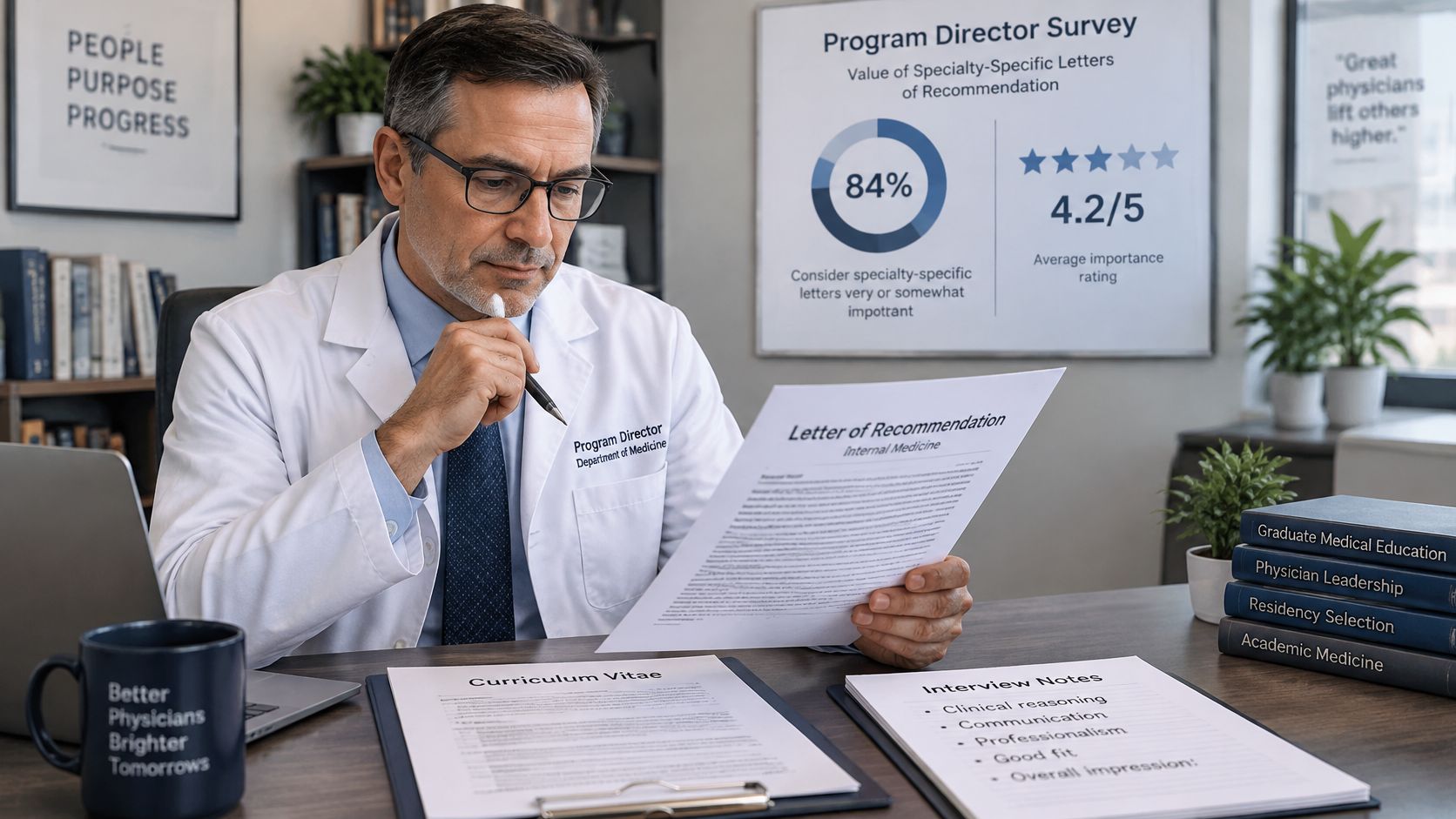
Directors use the specialty context to judge clinical readiness, professionalism, communication, work ethic, and how you treat patients and the team. A general reference from outside the field cannot do that job.
"A reliable, hardworking student" could describe half the file. "Took three admissions overnight and called each family before rounds" could describe one person. The second sentence is what separates applicants when scores look alike.
The same standard shows up when writers talk through what belongs in the letter and what does not.
For international graduates, that specialty-specific evidence is part of how programs read the rest of the file, which is why the residency match for international medical graduates is worth reading beside your letter plan. Aim the request at credibility, specialty relevance, and observations a peer letter cannot fake.
Brief Your Writer With Materials That Produce Specifics
A generic letter usually means the writer was missing the file, not that they disliked you. Hand them a packet they can write from in one sitting.
The core of that packet is short, and it should look like this before you add anything else.
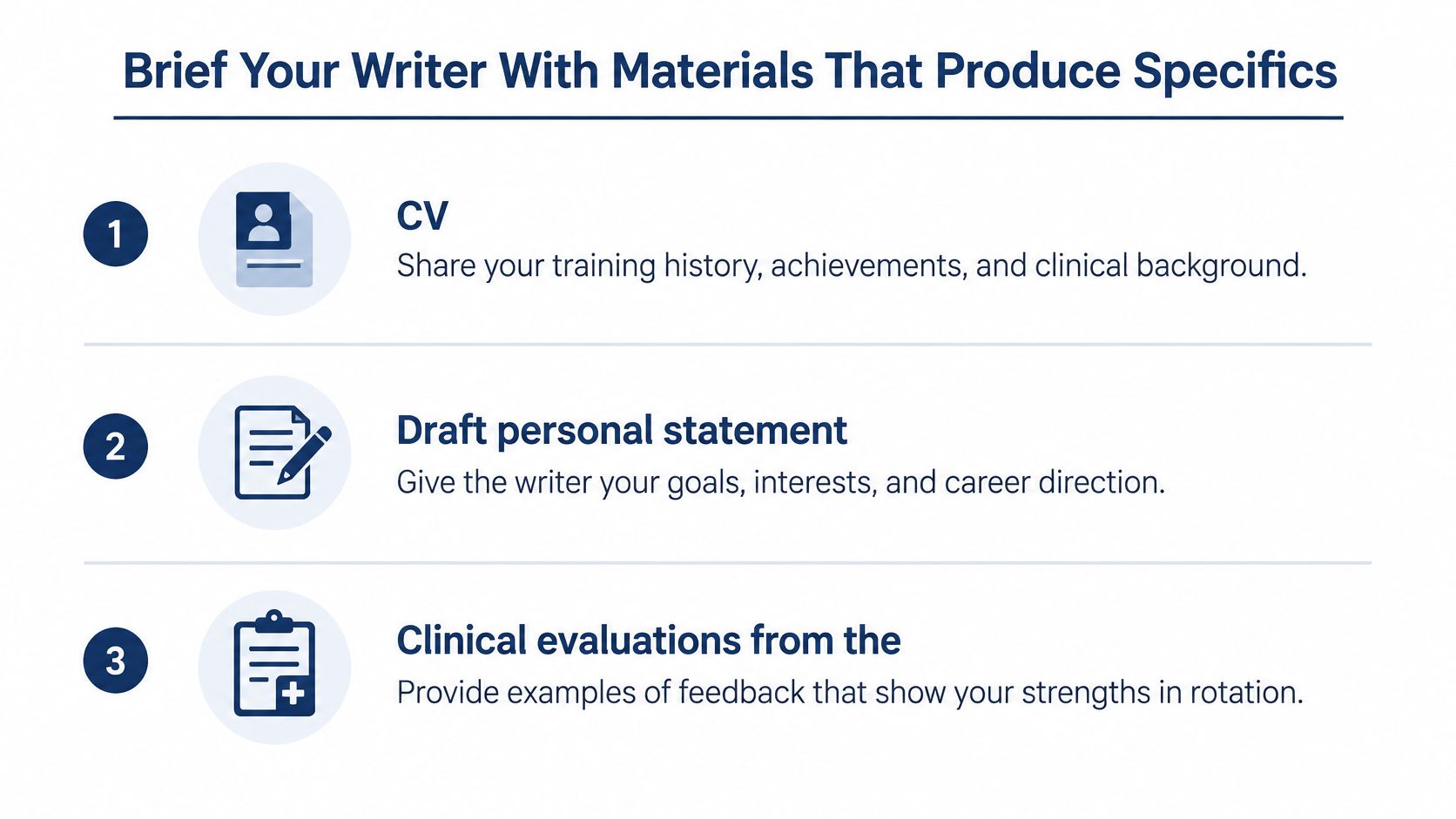
The AAMC letters of recommendation guidance for residency applicants expects more than a CV drop. Send all of this with the request.
- CV. Training history, roles, and the rotations they did not see.
- Draft personal statement. Your specialty goals in your own words, so the letter does not invent a career plan.
- Clinical evaluations from the rotation. The comments that already name what you did well.
- Transcript, when you have it. Only if a grade or clerkship comment needs context. Don't send it as filler.
- Specialty goals and program fit. Two or three sentences on why this field, not a second personal statement.
- A fifteen-minute call or meeting. Name two concrete cases and the themes you want shown. You are jogging memory, not dictating sentences.
What the letter has to show
The writer should cover their role, how long and how often they worked with you, the clinical setting, behaviors they saw themselves, what you did that others on the team did not, and whether you are ready for residency. Restating the CV wastes the only space a program cannot get from the rest of the application.
A line about catching a dosing error during a shared handoff is worth more than a list of rotations. The CV already has the rotations. Only the writer can say they watched you stop the order, tell the nurse, and document the change before rounds.
Put that material on one page and attach it to the request. A crowded inbox will not survive six separate emails. One brief, one deadline, and the format the program expects is enough for a writer to produce specifics instead of praise.
Recover a Wrong or Late Letter Before You Submit
Once a letter is wrong, late, or invisible in MyERAS, sort the fix by how long it takes. A one-day fix is confirming the letter is both written and assigned, or sending a reminder. A finished letter that was never assigned still leaves the application incomplete. A multi-week fix is asking the writer to move a conventional narrative onto the specialty form, or lining up a second physician if they cannot use that form.
| Symptom | Likely cause | Fix |
|---|---|---|
| Writer offers a narrative letter but the program requires a standardized form | Format was not checked before the request | Ask the writer to complete the specialty form; if that is not possible, find a second writer |
| Letter is generic, such as 'a good student and hard worker' | Writer lacked your materials or observed you only briefly | Send the briefing and specific cases, then request a revision |
| Writer misses the deadline | Too little lead time or a crowded schedule | Send a reminder two weeks before the deadline and keep a backup writer ready |
| Letter does not appear in MyERAS | Letter was written but never assigned | Confirm the assignment and the letter status in MyERAS |
| Writer is unsure what to include | Request came without a brief | Send the one-page brief and the list of themes you want covered |
When a revision is not enough
If the letter stays generic after one revision, language like "a good student and hard worker," ask a different physician who observed you. Submitting that page does not help. It tells a reader the writer had nothing specific to say.
If the letter will miss the deadline, email the program coordinator early and say it is pending. Don't wait for a missing-letter notice. Call the backup you lined up when you still had six weeks, and give that person the same one-page brief and the correct form.
Recheck the cycle before you click submit
Requirements move by cycle. Open each program's current listing and the current ERAS documentation again, including submission through the AAMC Letter Writer Portal from the 2027 cycle, and don't treat an unassigned or wrong-format letter as complete.
If you are an international graduate deciding whether a weak letter is worth the cycle, our careers guide covers residency match rates, screening filters, salaries, alternative pathways, and how to judge a school. A missing letter is a file problem. A pattern of screening filters is a school-choice problem, and those are not the same decision.
Medical School Programs publishes practical guides for students comparing medical degrees, admissions, and the path into residency. If you are lining up a residency letter of recommendation and need the match, screening, and school context around that file, start with the careers and residency guides on Medical School Programs. Bring your program list and the letter format each program expects, so the next step matches the cycle you are in.