
The 2026 Main Residency Match filled 41,482 of 44,344 offered training positions, a 93.5% fill rate, according to the National Resident Matching Program 2026 results announcement. That high fill rate can look reassuring until you ask a different question. How many applicants were competing, and what happened inside each applicant group? The medical residency match process rewards applicants who understand both the calendar and the denominators behind the headlines.
Table of Contents
- Residency Match Timeline at a Glance
- How to Move From Application to Interview
- How the Algorithm Turns Rank Lists into Placements
- Reading 2026 Match Results by Applicant Group
- Why International Graduates Face a Hidden Filter
- What to Do If You Do Not Match
Residency Match Timeline at a Glance
You can't plan this process forward from whenever you feel ready. You need to pick a Match Day in mid-March and count backwards, because every earlier deadline exists to feed the next one. Letters, exam scores, and transcripts are slow to collect, so they set your real starting date.
Most applicants spend the summer before their application year preparing documents. That timing isn't padding. A letter writer who needs a CV, a draft personal statement, and several weeks to write can't rescue a file you start assembling the week applications open.
| Stage | Typical timing | What happens |
|---|---|---|
| ERAS application opens | Early summer | Applicants submit CV, personal statement, letters, transcripts and exam scores |
| Programs receive applications | Late summer to early fall | Programs screen files against their own criteria |
| Interview invitations and interviews | Roughly October to February | Applicants attend interviews and follow up with thank-you notes |
| Rank order lists due | Late February | Applicants and programs certify their ranked preferences |
| Match Day | Mid-March | Applicants learn whether they matched and where |
| SOAP for unmatched applicants | Mid-March, right after Match Day | Unmatched applicants apply to unfilled positions |
How to count backwards from Match Day
Start with the March when you want to match, then set personal deadlines that sit well before the official ones. Your exam scores should be back before programs screen files, not while they're screening. Your letters should be requested early enough that a late writer doesn't leave a program looking at an incomplete file.
- Set an exam deadline first: Choose a test date that leaves time for scores to arrive and, if needed, for a change in specialty or program list.
- Set a letter deadline second: Ask clinical evaluators while they still remember your work, and give each writer your CV and goals.
- Set a document deadline third: Finish your CV and personal statement before the early summer opening, so submission becomes a check rather than a scramble.
Exact dates shift each year, so confirm the current calendar on the NRMP and ERAS websites before you lock in travel, exams, or graduation plans. Treat the table as your sequence, not as a substitute for this year's official dates.
Build your calendar around the slowest document, not the fastest form. In practice, that's usually letters and exam scores.
How to Move From Application to Interview
Think of your application as a file a program coordinator has to verify, not a story you tell. If one piece is missing, the rest may never get a careful read. The sequence below moves from collecting evidence to using interviews well, and the infographic summarizes the same path visually.
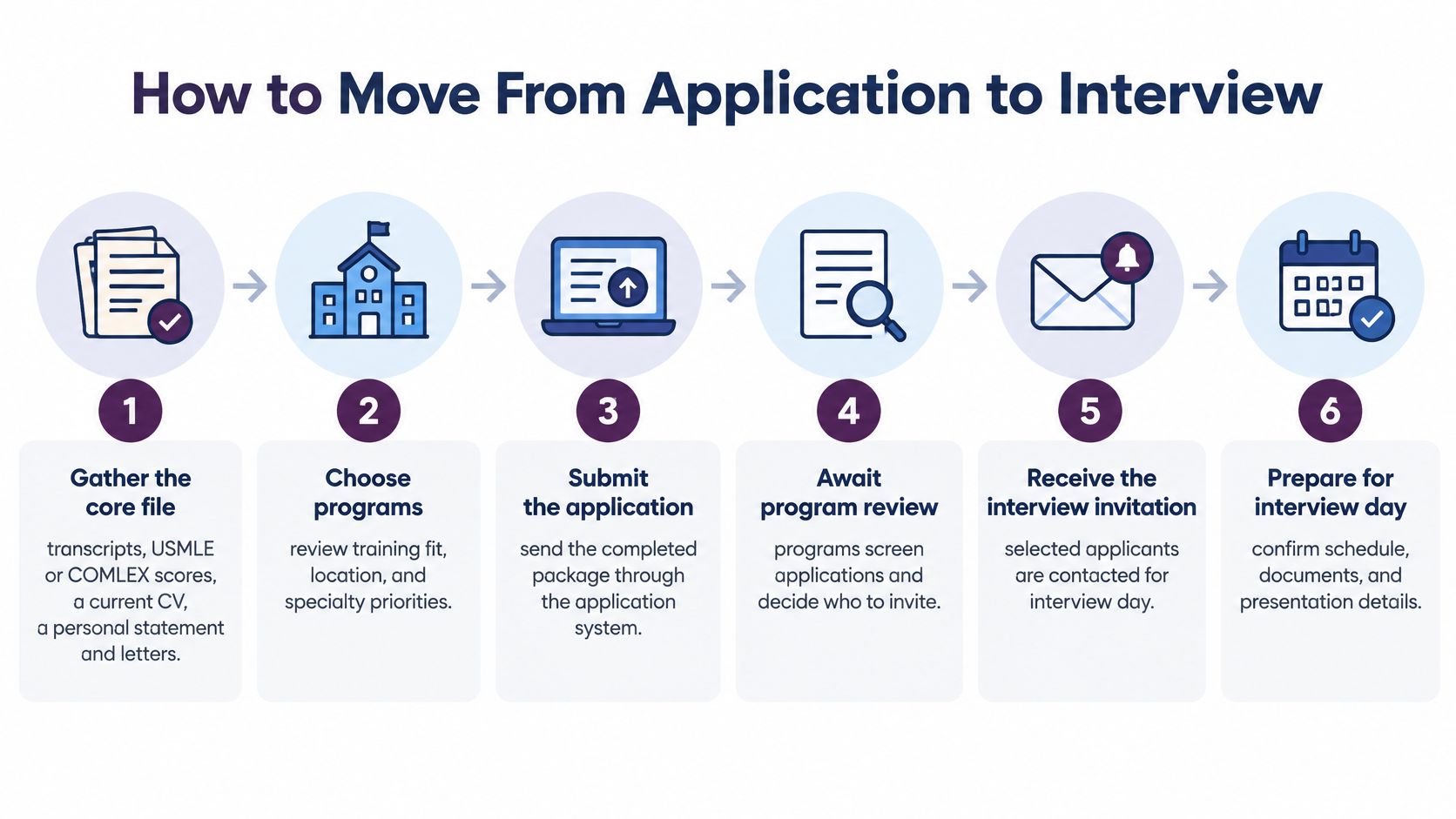
Steps before programs see your file
- Gather the core file. Collect transcripts, USMLE or COMLEX scores, a current CV, a personal statement, letters from clinical evaluators, and your Medical Student Performance Evaluation (MSPE) or dean's letter where applicable. Letters take weeks because busy clinicians write them between clinical duties, so request them early and follow up politely. The common mistake is asking a famous name who barely knows you instead of a supervisor who can describe specific clinical work.
- Choose a specialty and build a realistic program list. Match training fit, location, and your competitiveness for that specialty before you pay application fees. Budget for fees and any travel at the same time, because cost can shrink a list later. Applying only to one city is the classic error here, since geography can overrule fit and leave you with too few viable interviews.
- Submit through ERAS and verify receipt. Send the completed package through the application system, then confirm each program has every document. A transcript uploaded to the wrong place or a letter assigned to the wrong program won't fix itself. If you're an international graduate, our guide to the USMLE for international medical graduates can help you place exam timing inside this file building stage.
Steps once invitations arrive
- Respond promptly and prepare specific answers. Interview slots can fill, so reply quickly and confirm format, schedule, and presentation details. Prepare clear answers on why this specialty, why this program, and why this city, using details from rotations rather than slogans. Don't leave scheduling until the last week and then try to prepare for several programs at once.
- Record impressions the same day. Write notes on call structure, resident morale, supervision, location, and anything that surprised you while the memory is fresh. Those notes become the raw material for your rank order list. Send a brief thank-you note after each interview, then stop. Repeated messages don't improve a vague impression.
A complete file is easy to recognize. It has a transcript, exam scores, CV, personal statement, strong clinical letters, the MSPE or dean's letter, and confirmation that each selected program received the pieces it requires.
How the Algorithm Turns Rank Lists into Placements
The Match works like mutual selection, not a lottery and not a first come queue. You rank programs, programs rank applicants, and a placement only happens where both sides listed each other. The illustration below captures that two sided fit.
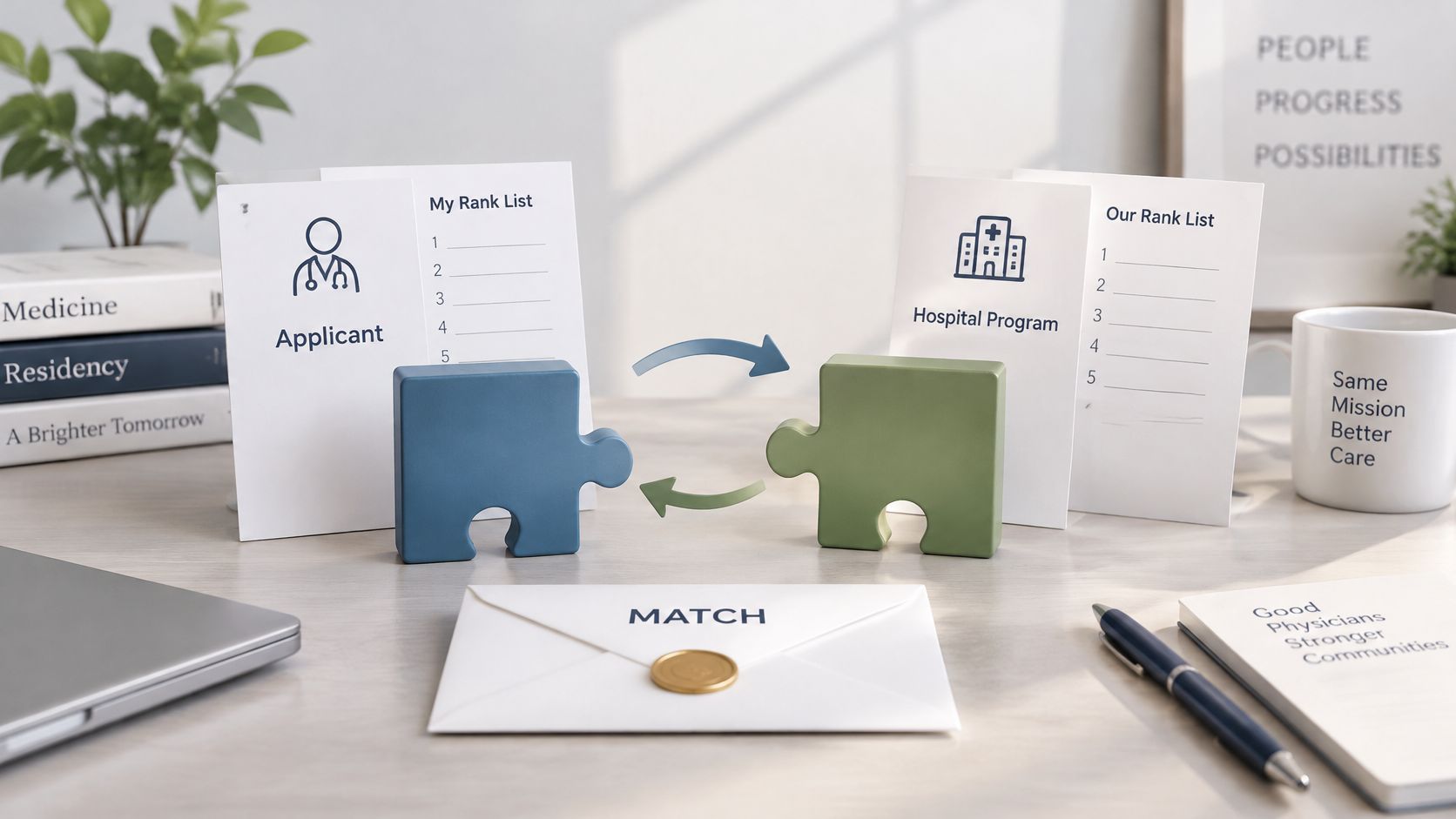
The NRMP guide to ranking in the 2026 Main Residency Match describes an applicant-proposing deferred-acceptance algorithm. Processing begins with each applicant's highest-ranked program, and a program may tentatively retain an applicant if that applicant is preferred to its current tentative match.
The four rounds in plain language
- You are proposed to your first choice. The system starts at the top of your list, not at a program you think is safer.
- The program compares you with others it is tentatively holding. If it prefers you to a current tentative match, it may hold you for now. Tentative means exactly that, not final.
- If it does not hold you, you move to your next choice. You don't lose your place in some global line. The system tries your second program, then your third, in your order.
- The cycle repeats until rank-order lists are exhausted. Only then do tentative matches become final.
Watch this short explainer before you certify, then read the practical rules that follow with your own list in front of you.
What this means for your list
Rank programs in genuine preference order. Trying to guess how a program ranked you and moving it up for strategy can push a program you like less above one you'd prefer, and the algorithm doesn't reward that guesswork. Say you loved Program A but think Program B liked you more. Put A first if you'd rather train there. If A can't take you, the system still moves you to B in order.
A program you leave off can't match you, so a very short list removes chances you might have accepted. The opposite error matters too. Don't rank a program you would not accept, because a match is a placement you are expected to take.
Couples matching adds one layer. Paired choices are evaluated together, seeking the highest-ranked pair that can place both partners, subject to available positions and the couple's submitted preference list.
Certification check: Every program you'd accept is included, no program you'd refuse is included, and the order reflects where you actually want to train.
Confirm spelling, program codes, and certification status before the deadline. An uncertified list is not a cautious list. It's no list at all.
Reading 2026 Match Results by Applicant Group
Match coverage usually leads with one number, and that number can mislead. Headlines mix three different counts: people who registered, people who participated, and people who placed. Separate those counts first, and the 2026 results become much easier to read. The image below shows that funnel at a glance.
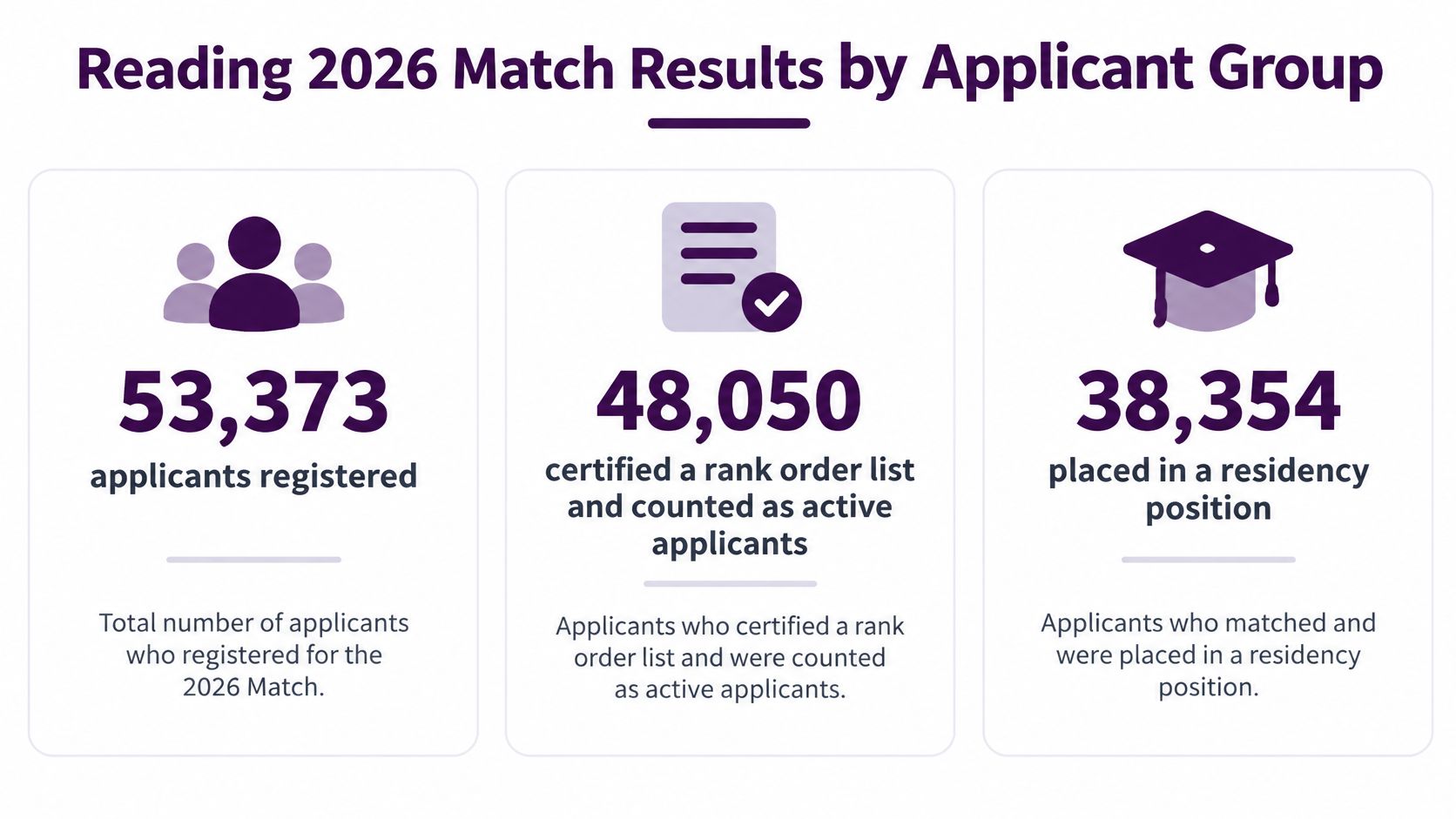
The NRMP Match Day results page reports that 53,373 applicants registered for the 2026 Main Residency Match, while 48,050 certified a rank-order list and therefore counted as active applicants. It also reports that 38,354 active applicants were placed into first-year postgraduate (PGY-1) positions, producing a 79.8% PGY-1 match rate.
Why the denominator changes the story
Registration is not participation. Divide placements by everyone who registered and you include people who never certified a list and were never eligible for the principal outcome statistics. Divide by active applicants and you measure the people who entered the algorithm. Same placements, different answer.
PGY-1 is also a specific slice. It covers first-year positions, not every residency placement across PGY-1 and PGY-2 combined. When you compare schools, advisers, or your own chances, check that both sides use the same denominator and the same position type.
The group-level figures in the table come from the NRMP Main Match Results and Data 2026 report, which reports PGY-1 outcomes separately for each applicant category.
| Applicant group | Active applicants | PGY-1 match rate | What your row suggests |
|---|---|---|---|
| All active applicants | 48,050 | 79.8% | The reference point, not any individual's odds |
| U.S. MD seniors | 20,934 | 93.5% | Nearly all place; risk concentrates in the most competitive specialties |
| U.S. DO seniors | 8,503 | 93.2% | Nearly all place; the same specialty caveats apply |
| U.S.-citizen IMGs | 4,210 | about 70% | Roughly three in ten go unmatched; widen specialty and program range |
| Non-U.S.-citizen IMGs | 11,944 | 56.4% | More than two in five go unmatched; confirm visa needs and target programs that accept IMGs |
How to use your own row
Find the row that matches your applicant category, then read only two columns first: active applicants and PGY-1 match rate. A U.S. MD senior and a non-U.S.-citizen international medical graduate are not facing the same competition pool, even in the same Match year. Giving each group its own denominator stops you from borrowing another group's odds.
Your row is still not your personal probability. Specialty choice, graduation status, examination performance, visa needs, and program preferences all move individual results. Two applicants in the same row can finish very differently: one applies only to a highly competitive specialty in a few cities, and the other builds a broader, realistic list.
Then read the last column and treat it as a decision prompt. A lower group rate calls for tighter program targeting, earlier exam readiness, and a rank list that includes every program you would accept. A higher rate is not a reason to relax. It is a reason to keep your specialty choice deliberate and your list honest.
Why International Graduates Face a Hidden Filter
International graduates are often quoted a single IMG rate, but that shortcut hides the filter that operates before ranking even starts. Citizenship and visa needs can decide whether a program reviews your file seriously at all. A strong exam score doesn't override a sponsorship policy.
The NRMP Main Match Results and Data 2026 report shows non-U.S.-citizen IMGs numbered 11,944 active applicants, 51.9% more than in 2022, whereas U.S.-citizen IMGs fell to 4,210, down 16.6% from 2022. NRMP analysis in the same report says the average rank-order-list length for unmatched non-U.S. IMGs declined by 32.8% over time.
The filter before the algorithm
Many programs sponsor certain visas, some sponsor none, and policies can differ by specialty or institution. If you need sponsorship a program doesn't offer, you may never reach its rank list, regardless of your grades or letters. That's why program level sponsorship policy functions as a hidden filter before mutual ranking begins.
Other constraints stack on top of that filter. School accreditation, graduation year, U.S. clinical exposure, and specialty choice shape how a program reads the same score. A recent graduate with U.S. rotations in the target specialty presents a different file from an older graduate with no U.S. clinical experience, even inside the same IMG category.
Rank list length needs careful reading too. A shrinking list among unmatched applicants suggests too few ranked programs can hurt, but applying everywhere doesn't automatically raise your odds. Ineligible or poorly fitted applications add cost without adding realistic interviews.
For a fuller walkthrough of eligibility and targeting, see our guide to the residency match for international medical graduates. Then apply this order to your own list.
- Confirm visa and sponsorship policy for each program before you apply, in writing where possible.
- Note accreditation and graduation year exactly as programs will see them, and close any documentation gaps early.
- Compare your U.S. clinical experience with the specialty you're targeting, and strengthen weak letters with supervised clinical work.
- Set list length by eligibility and fit, not by a wish to apply everywhere.
Policies change each year, so confirm details with each program directly. A citizenship specific risk assessment will serve you better than a headline statistic that blends groups facing different constraints.
What to Do If You Do Not Match
Going unmatched feels final in March. It is not, but recovery depends on naming exactly what happened instead of treating every unsuccessful outcome as the same problem. The right next step for a partial match differs from the right step for an applicant who never completed a viable list.
Three outcomes people blur together
- Unmatched means you certified a list and received no position through the Match.
- Partially matched means you placed in one part of a plan but not the full training path you needed, such as a preliminary year without the advanced position.
- Not placed can also describe applicants who never submitted a complete, certified list and therefore never entered the outcome they expected.
SOAP, the Supplemental Offer and Acceptance Program, is a same-week window for eligible unmatched applicants to pursue unfilled positions right after Match results. The next annual Match is a different mechanism entirely. It is a full new cycle with a new application, updated documents, new interviews, and a new rank list.
The odds of that second cycle depend on which row of the results table you occupy. NRMP international medical graduate guidance reports a 2026 PGY-1 match rate of about 70% for U.S.-citizen IMGs and 56.4% for non-U.S.-citizen IMGs. NRMP reporting that tracked applicants from 2022 to 2025 found that many who missed a position in their first Match returned in a later cycle, and a majority subsequently obtained residency positions.
Read those rates against your own denominator. A 56.4% rate means more than two in five active applicants in the non-U.S.-citizen IMG group went unmatched, so a visa-dependent applicant should diagnose sponsorship and eligibility first. A U.S.-citizen IMG in the roughly 70% group may get more from repairing interviews or specialty fit. Persistence without diagnosis can waste another expensive application year.
Diagnose the cause before you spend again
| Cause | Fix before reapplying |
|---|---|
| Rank list too short or narrow | Rank every program you would accept, in genuine order |
| No realistic backup specialty | Add a second specialty with a realistic program list |
| Limited U.S. clinical experience or weak letters | Add U.S. clinical experience and secure letters from clinical evaluators |
| Visa restrictions or sponsorship limits | Filter programs by sponsorship policy before applying |
| Exam timing missed program deadlines | Move exam dates earlier to meet ERAS and program deadlines |
Use the table as a decision tree, not a guilt list. Pick the cause that best explains your interviews and rank list, then fix that cause in a way a program can see. More applications will not repair weak specialty alignment, and a research year will not repair a visa ineligibility problem.
After diagnosis, weigh four real options: change specialty, complete additional clinical training, pursue research that produces strong letters and specialty commitment, or consider licensing and employment routes outside the United States. The careers guide at Medical School Programs covers residency match rates, screening filters, salaries, alternative pathways and how to judge a school for international medical graduates. For readers still choosing a school, its admissions guide covers eligibility, transcripts, MCAT, English tests, visas, funding and the schools that accept international students.
Don't re-enter the same cycle with only a newer personal statement. Re-enter with a visible fix for the reason programs passed the first time.
Your next cycle decision in five steps
- Check the current NRMP and ERAS calendar and set personal deadlines for exams, letters, and documents.
- Identify your applicant category and read its PGY-1 rate in the results table using active applicants, not registrations.
- Name the single cause your diagnosis points to and decide what visible fix a program will see in your next file.
- Build a rank list that includes every program you would accept, in genuine order.
- Name a backup plan for SOAP and for a possible second cycle before Match week arrives.
A clear diagnosis turns an unmatched result into a plan. An undiagnosed repeat usually turns it into a second bill.
If you're weighing medical schools by whether their graduates can realistically reach residency, visit Medical School Programs to compare English-taught programs alongside admissions requirements, licensing routes, and match pathways for international graduates. Bring your applicant category, target specialty, and visa needs to that comparison, and use the row that matches your situation to choose your next deadline and program list with confidence.