
$215,000 was the median education debt among indebted US medical school graduates in the graduating class of 2025, according to AAMC figures published by the University of Minnesota Medical School. That's a starting balance, not the total those graduates will necessarily repay.
Choosing loans for medical students means planning beyond tuition. You need to understand how much cash reaches your account, when interest starts, which borrowing options you qualify for, and what payments could look like on a resident's income.
Table of Contents
- Typical Debt Load for Medical Students
- Federal and Private Loan Options Compared
- Who Qualifies for Each Loan Type
- Repayment Options That Change Total Cost
- How to Build and Confirm a Borrowing Plan
- Scholarships and Service Programs That Reduce Borrowing
Typical Debt Load for Medical Students
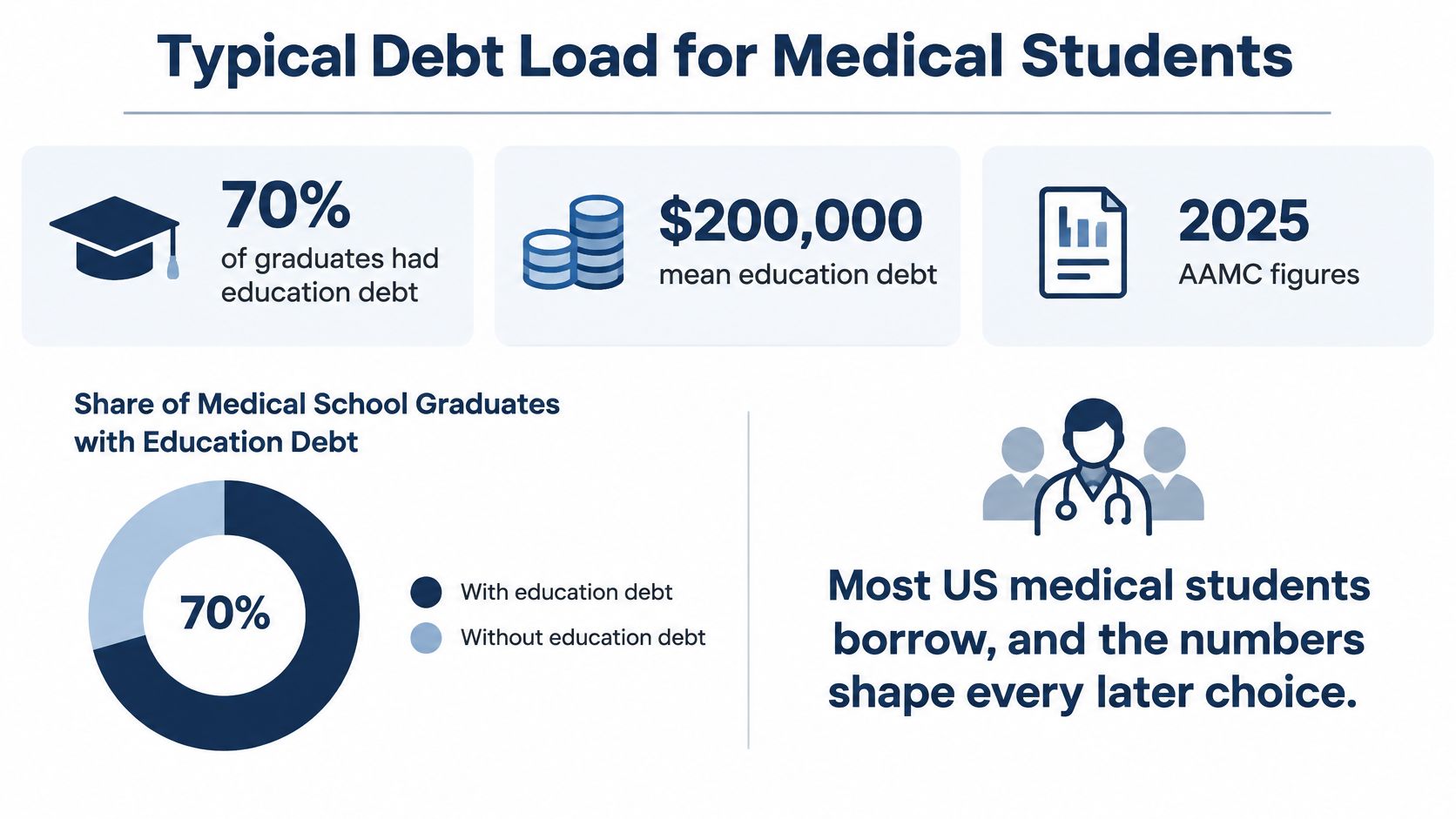
A debt statistic is only useful once you know which borrowers it counts. In the AAMC's 2025 debt fact card, 70% of graduates had education debt. Among those borrowers, mean debt was $223,130 and median debt was $215,000, including loans taken out before medical school.
The mean is the arithmetic average: all balances added together, divided by the number of borrowers. The median is the midpoint, and a few very large balances pull on it less. When the mean sits above the median, as it does here, some graduates owe far more than the typical borrower.
Education debt benchmarks for US medical graduates
The separate AAMC education debt profile reports 71% with education debt and a $205,000 median among borrowers. It describes a broader respondent group surveyed separately from the graduating class.
| Group | Share with education debt | Median debt among borrowers | Mean or other reported detail |
|---|---|---|---|
| All 2025 graduates | 70% | $215,000 | Mean $223,130; includes premedical debt |
| All graduates, latest profile | 71% | $205,000 | Mean $212,341; includes premedical debt |
| Medical-school debt only | 67% | $200,000 | Latest profile |
| Premedical debt only | 28% | $28,000 | Latest profile |
School type widens the gap. Among 2025 graduates, median education debt was $200,000 for public-school borrowers and $250,000 for private-school borrowers. The latest profile shows the same split another way: 73% of public-school graduates had education debt compared with 67% of private-school graduates, while 31% of private-school graduates owed $300,000 or more against 17% of public-school graduates.
Within the latest profile, large balances were common.
| Balance owed | Share of borrowers |
|---|---|
| At least $100,000 | 84% |
| At least $200,000 | 56% |
| At least $300,000 | 23% |
Read these as US figures only. Tuition, degree length, currency exposure and loan access work differently at European and Caribbean schools, so these benchmarks cannot predict what an international student will borrow.
Resist adding the medical-school and premedical medians together. They describe different borrower groups rather than the same person's balance.
Your own figure depends on your school, existing debt, scholarships and family resources. Build it from cost of attendance, the school's estimate of education and living expenses, rather than tuition alone; this breakdown of how much medical school costs lists the expense categories your estimate has to cover. The balance at graduation is also less than you will repay. Each year of borrowing is its own loan with its own interest rate and disbursement fee, and interest accrues while you are enrolled, so the true cost grows with every year of the program.
Federal and Private Loan Options Compared
Federal and private loans are different contracts, not just different interest rates. Compare the cash delivered each year, the fee deducted up front, interest accrued while enrolled, and the payment flexibility available when income during residency begins.
| Loan type | Fixed interest rate | Origination fee | Key trait |
|---|---|---|---|
| Direct Unsubsidized Loan, graduate or professional | 8.07% for the disbursement window in the linked guidance | 1.057% deducted from each disbursement | Interest accrues while enrolled; eligibility and borrowing limits apply |
| Direct PLUS Loan, graduate or professional | 9.07% for the disbursement window in the linked guidance | 4.228% deducted from each disbursement | A credit review applies, and published terms do not by themselves establish eligibility |
| Private medical school loan | Written lender quote; request fixed-rate terms | Any fee shown in the lender's written disclosure | Credit-based underwriting; a cosigner may be required; no federal repayment protections |
| Institutional loan or aid | Loan terms in the school's written award; a grant has no loan interest | Any charge in the school's written award terms | Separate repayable loans from scholarships and grants |
For the disbursement window covered by Federal Student Aid's interest-rate guidance, the fixed rates are 8.07% for graduate or professional Direct Unsubsidized Loans and 9.07% for graduate or professional Direct PLUS Loans, while the listed origination fees are 1.057% and 4.228%, respectively. These figures apply only to eligible US federal loans.
Understand what each offer actually provides
A Direct Unsubsidized Loan is federal debt on which you are responsible for interest while studying. Its fixed rate and federal protections make it a useful starting point when you qualify, although your approved amount still has to fit the applicable borrowing rules.
A Direct PLUS Loan is a separate federal product with a credit review. Do not build a funding plan around assumed access; confirm that your borrower status and credit result permit the loan before counting it toward school or living costs.
A private medical school loan comes from a lender that evaluates the application under its own underwriting rules. A cosigner agrees to share repayment responsibility, so asking a parent or relative to sign creates a real financial obligation for that person.
An institutional loan comes through the school under its own terms. Review the award carefully because institutional assistance can also include grants, which do not require repayment when you meet their conditions.
Compare cash received, not just principal
Principal is the amount borrowed before interest. An origination fee is a borrowing charge deducted before the lender releases funds, while a disbursement is the release of those funds.
Borrowing $50,000 through the Direct Unsubsidized example delivers approximately $49,471 after the fee, but the full $50,000 principal remains repayable. At the PLUS fee shown above, the same $50,000 principal would deliver $47,886. If a tuition invoice requires a specific cash amount, the fee changes how much you need to borrow.
A fixed rate stays unchanged for that individual loan. New borrowing can carry a different rate, creating separate rate cohorts, or groups of loans issued under different terms. Repeating a $50,000 borrowing in another year therefore does not produce one identical loan; it adds another balance with its own fee, rate and accrued interest.
Interest that accrues while you remain enrolled can also leave you entering repayment with more than the amount originally released. Before replacing federal debt with private credit, weigh the rate against the payment flexibility you may need while earning income during residency.
Practical rule: Compare net proceeds, interest, fees and repayment protections together. The lowest advertised rate is not automatically the least expensive financing package.
Who Qualifies for Each Loan Type
Before accepting an offer, complete this eligibility checklist:
- Establish your status. Ask whether your citizenship or immigration category qualifies for the funding you're considering.
- Confirm the exact program. Eligibility attaches to the institution and program, not the country or the school's reputation.
- Complete the application requirements. For US federal aid, ask about the Free Application for Federal Student Aid, commonly called the FAFSA.
- Check enrollment and progress rules. Confirm the required enrollment level and the school's definition of satisfactory academic progress.
- Request your remaining borrowing capacity. Existing loans, other aid, and applicable limits can constrain an otherwise eligible application.
Loan eligibility by student type
| Student type | Federal loans generally available | What to check | Usual route |
|---|---|---|---|
| US citizen or eligible non-citizen at a US MD school | Generally, if student, program, and enrollment requirements are met | FAFSA, academic progress, enrollment, applicable limits | Eligible federal Direct loans first |
| International student at a US MD school | Generally no, unless an eligible status applies | Whether immigration status qualifies | Institutional funding and eligible private loans |
| Student at a European medical school | Only when both student and program meet applicable requirements | Participation in US federal aid for the exact program | Obtain written confirmation from the school |
| Student at a Caribbean medical school | Only when both student and program meet applicable requirements | Participation in US federal aid, including relevant study locations | Confirm federal eligibility; investigate alternatives if unavailable |
| Any student requesting PLUS | Not automatic | Borrower-status eligibility, credit requirements, and applicable transition rules | Confirm availability before including it in the budget |
Admission and financing approval are separate decisions. An acceptance letter doesn't guarantee a loan, and approval from a private lender doesn't prove eligibility for federal aid.
For international applicants, a school's statement that financial aid is available may refer only to particular citizenship groups or scholarship categories. This guide to financial aid for international medical students can help you identify the questions relevant to your status.
Get an answer specific to you
If credit review blocks an otherwise available PLUS application, ask whether an endorser or documented circumstances can support reconsideration. Don't assume either route guarantees approval.
Suppose your award letter leaves a remaining funding gap after scholarships and savings. Ask the financial aid office which loan can legally cover that gap, whether its limit is sufficient, and when funds would arrive.
Request written answers to these questions:
- School eligibility: Is my exact program eligible for the federal aid I'm seeking?
- Approved budget: What is my certified cost of attendance?
- Personal eligibility: Which loan types are open to my status and borrowing history?
Repayment Options That Change Total Cost
Divide projected graduation debt by expected first-year resident income to get a basic debt-to-income screening ratio. Use gross annual income for consistency, then build a separate monthly budget using take-home pay.
The ratio isn't a lending verdict or an affordability guarantee. Its purpose is to show how much debt you'll carry relative to earnings during early clinical training, before you assume an attending physician's salary.
Keep the repayment documents beside your training budget when evaluating the options.

Payment relief and debt reduction aren't the same
An affordable payment can prevent a cash-flow crisis without reducing the balance quickly. Distinguish interest accrual, the accumulation of interest, from capitalization, the addition of unpaid interest to principal when the loan's rules permit it.
Unsubsidized interest can accumulate during school and residency. Ask when capitalization can occur under your particular loan and repayment arrangement rather than assuming every unpaid interest charge immediately becomes principal.
The main choices affect your finances differently:
- Grace period: A permitted interval before required repayment begins. Confirm whether your loan has one and whether interest continues.
- Deferment or forbearance: Authorized postponement or reduction of payments. These can provide breathing room, but postponement doesn't necessarily stop interest.
- Income-driven repayment: Eligible federal arrangements calculate payments using income and other plan rules. Confirm which plans your loans and borrower status permit.
- Public-service forgiveness: Eligibility depends on the applicable loan, employment, repayment, and payment requirements. A hospital job title alone doesn't establish qualification.
- Private refinancing: A private lender replaces existing debt with a new loan. Refinancing federal debt removes the federal protections attached to the replaced loans.
A smaller required payment and a smaller lifetime repayment total are different goals. Decide which problem you're solving before choosing a plan.
Stress-test the resident budget
Use the salary for the actual training location, not an assumed national figure. Subtract taxes, housing, transport, insurance, and essential family expenses before deciding what payment you can sustain.
Then test a more expensive city, an additional training period, or a household income interruption. Don't accept private refinancing solely because you expect a higher salary later.
Use the video as a discussion prompt, then verify its guidance against your own loan documents and current eligibility.
Before committing, establish which repayment plan applies during and after training, whether your employer qualifies for the forgiveness route you're considering, and whether a refinancing offer compensates for the protections you'd surrender.
How to Build and Confirm a Borrowing Plan
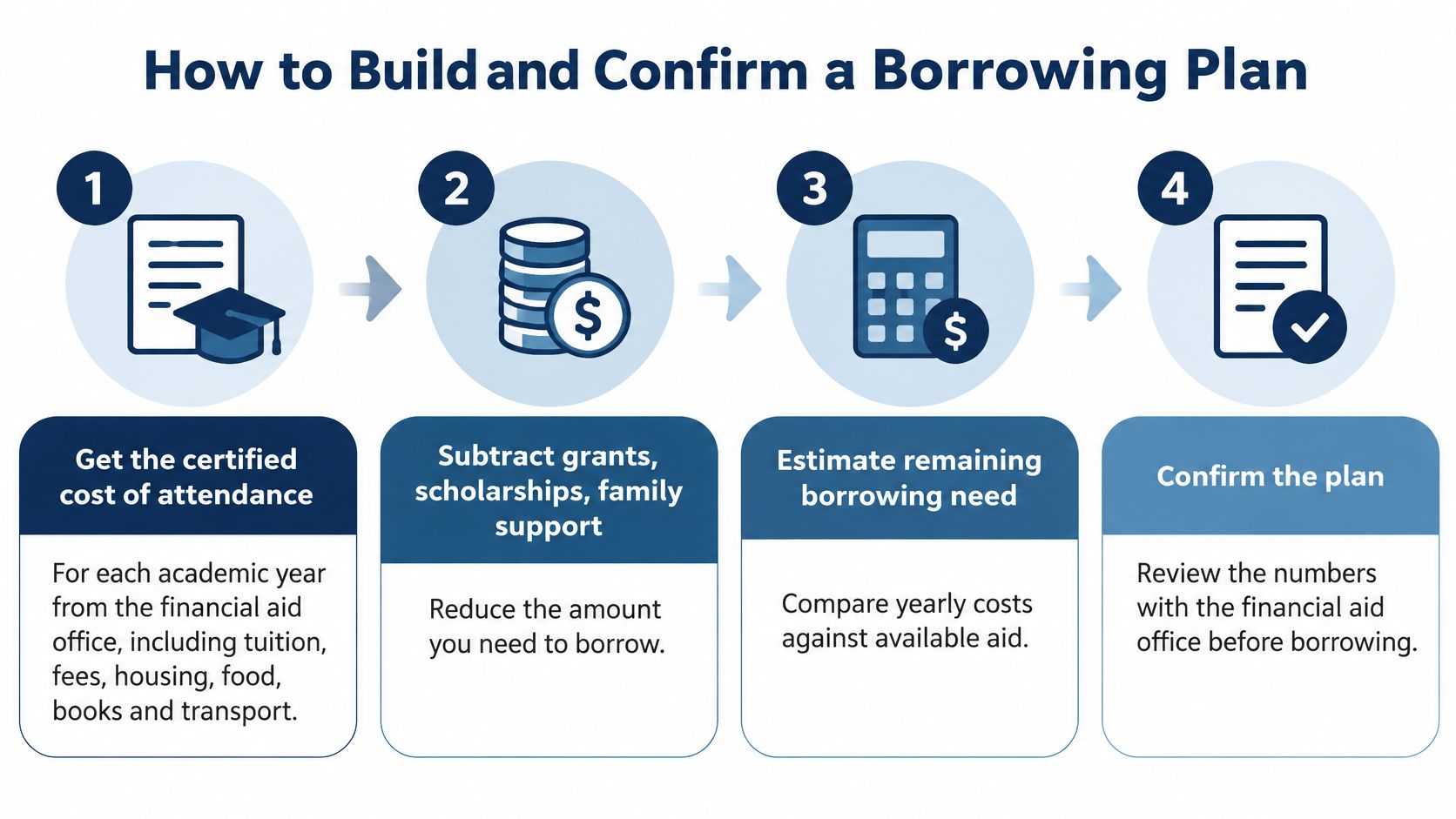
Build your plan in a spreadsheet with a separate row for each academic year and each loan. Keep the school's estimate, your own expected spending, and the lender's disclosures in separate columns so you can see where assumptions differ.
Use the process below to turn an aid offer into a financing decision.
Build the cash-flow worksheet
Get the certified cost of attendance for every academic year. Include tuition, compulsory fees, housing, food, books, equipment, and transport. For overseas study, identify travel, visa, insurance, and currency-conversion expenses, then ask which costs the approved budget recognizes.
Subtract confirmed resources. Enter grants, scholarships, available savings, and committed family support. Separate guaranteed funding from pending applications, and record any renewal conditions beside the award.
Identify the true shortfall. Match expenses to the dates they must be paid. A loan that arrives after a housing deposit is due won't solve the immediate cash problem, even if the annual totals balance.
Allocate eligible borrowing. Compare the actual federal, institutional, and private offers available to you. Don't assign an unavailable loan to the gap or assume a school can approve borrowing above an applicable limit.
Reconcile proceeds with invoices. Enter the amount borrowed, deducted charges, and cash received as distinct entries. This prevents a fee deduction from creating an unexpected unpaid balance.
Project the balance you'll graduate with
Track every loan cohort separately. Record its disbursement date, principal, rate, and interest treatment. Ask the aid office or servicer for a projection that reflects when funds are released, rather than treating all borrowing as if it happened on graduation day.
Build the training budget. Use a realistic resident salary for the location you're considering, alongside take-home pay and essential expenses. Model an affordable payment, not the amount you hope to pay once training ends.
Obtain written confirmation before signing. Confirm program eligibility, personal eligibility, borrowing limits, rates, fees, repayment timing, available income-driven arrangements, and any forgiveness considerations. Save the documents with the date and the name of the office that supplied them.
Compare schools using identical categories. Otherwise, a tuition-only estimate for one institution can appear cheaper than a complete living-and-study budget for another.
Our cost guide covers tuition by region, living costs, hidden fees, US comparisons, and ways to pay, from savings to loans. We check program facts against official school pages, date them, and update them when schools change fees or requirements.
Before accepting the package: You should be able to explain the projected graduation balance, the assumptions behind it, and the payment your training budget could support.
Revisit the worksheet before each academic year and whenever your housing, family support, scholarship award, or study location changes. Keep both a base budget and a higher-cost scenario, especially if your funding and expenses use different currencies.
Finally, check whether you can reduce an award before disbursement or return unneeded proceeds under the applicable terms. Accepting the full offered package because it's available can leave you financing spending you never needed.
Scholarships and Service Programs That Reduce Borrowing
Non-loan funding reduces both the amount you borrow and the interest that borrowing would generate. Evaluate it before treating loans as the default answer to the entire school budget.
Begin with institutional scholarships and need-based grants through the school's financial aid office. Ask whether consideration is automatic, whether a separate application is required, and what academic or financial conditions govern renewal.
Compare support with the obligation attached
Different funding sources solve different problems:
- Institutional awards: Compare the net cost across the whole degree, not just the initial scholarship offer. A renewable award needs written renewal terms.
- National Health Service Corps: Investigate service-linked support and loan-repayment opportunities connected with eligible work in underserved communities. Confirm the specific program, application stage, and service requirements.
- Armed Forces Health Professions Scholarship: Consider this only if military medical service fits your career and personal commitments. Review the service agreement before treating the scholarship as a tuition discount.
- State loan-repayment programs: Check eligible professions, practice locations, employment conditions, and how applications are assessed.
For a wider search, use this starting point for medical school scholarships, then verify each opportunity with the organization that administers it.
Service-linked funding isn't unrestricted money. Read the required work location, specialty conditions, start date, length of commitment, and consequences of failing to complete the agreement; don't assume residency automatically satisfies the obligation.
Family support and savings can also reduce borrowing, but preserve enough accessible cash for emergencies and unavoidable relocation costs. An aggressive savings contribution that leaves you dependent on expensive emergency borrowing can undermine the original plan.
Pursue non-loan funding first, then compare each offer by its total usable value over the program. Include restrictions and service commitments in that comparison, not just the headline award.
Visit Medical School Programs to compare medical pathways and use practical guidance on costs, admissions, and financing. Bring your shortlisted programs and borrowing worksheet together, then ask each school to confirm the funding assumptions before you commit.