
Where you train shapes whether you can practice, and where. The World Health Organization's World Health Statistics 2023 report found 36.6 doctors per 10,000 population in the WHO European Region and 2.9 doctors per 10,000 people in the WHO African Region, using data from 2014-2021. That gap explains why students cross borders to be a doctor, and why a degree alone doesn't settle the question. You still need licensing, supervised training, and a route that survives each checkpoint.
Table of Contents
- Your Full Route to Becoming a Doctor at a Glance
- How to Qualify and Apply to Medical School
- What Medical School Years and Clinical Rotations Involve
- How to Pass Licensing Exams and Match Into Residency
- Choosing Your Route and Confirming It
Your Full Route to Becoming a Doctor at a Glance
For most U.S. primary care paths, the route from university to independent practice takes roughly 11 to 15 years. Surgical and subspecialty training takes longer. The calendar matters less than what each stage confirms, because you can't skip a gate just by spending time at it.
| Stage | Typical Time | What It Confirms |
|---|---|---|
| Undergraduate degree and prerequisites | About 4 years | Science foundation and a competitive GPA |
| MCAT and application cycle | 6 to 12 months | Test readiness and a complete application |
| Medical school (MD or DO) | 4 years | Clinical knowledge and supervised patient care |
| Licensing exams (USMLE or COMLEX) | Across medical school and first residency year | Eligibility for a state license |
| Residency | 3 to 7 years by specialty | Independent practice in a chosen specialty |
| Fellowship (optional) | 1 to 3 years | Subspecialty expertise |
What Each Stage Actually Proves
Undergraduate study proves you can handle dense science at pace and keep grades high while doing it. The MCAT and application cycle prove something narrower, that your knowledge holds up under timed testing and that your file is complete, coherent, and submitted on time.
Medical school proves clinical knowledge and safe patient care under supervision. Licensing exams then test whether that knowledge meets a national standard for a state license. Residency is where supervised practice becomes independent judgment in one specialty, and fellowship narrows that judgment further.
A medical degree alone doesn't authorize you to practice. Licensing and supervised postgraduate training turn a graduate into a practicing doctor.
Selection Starts Before Medical School
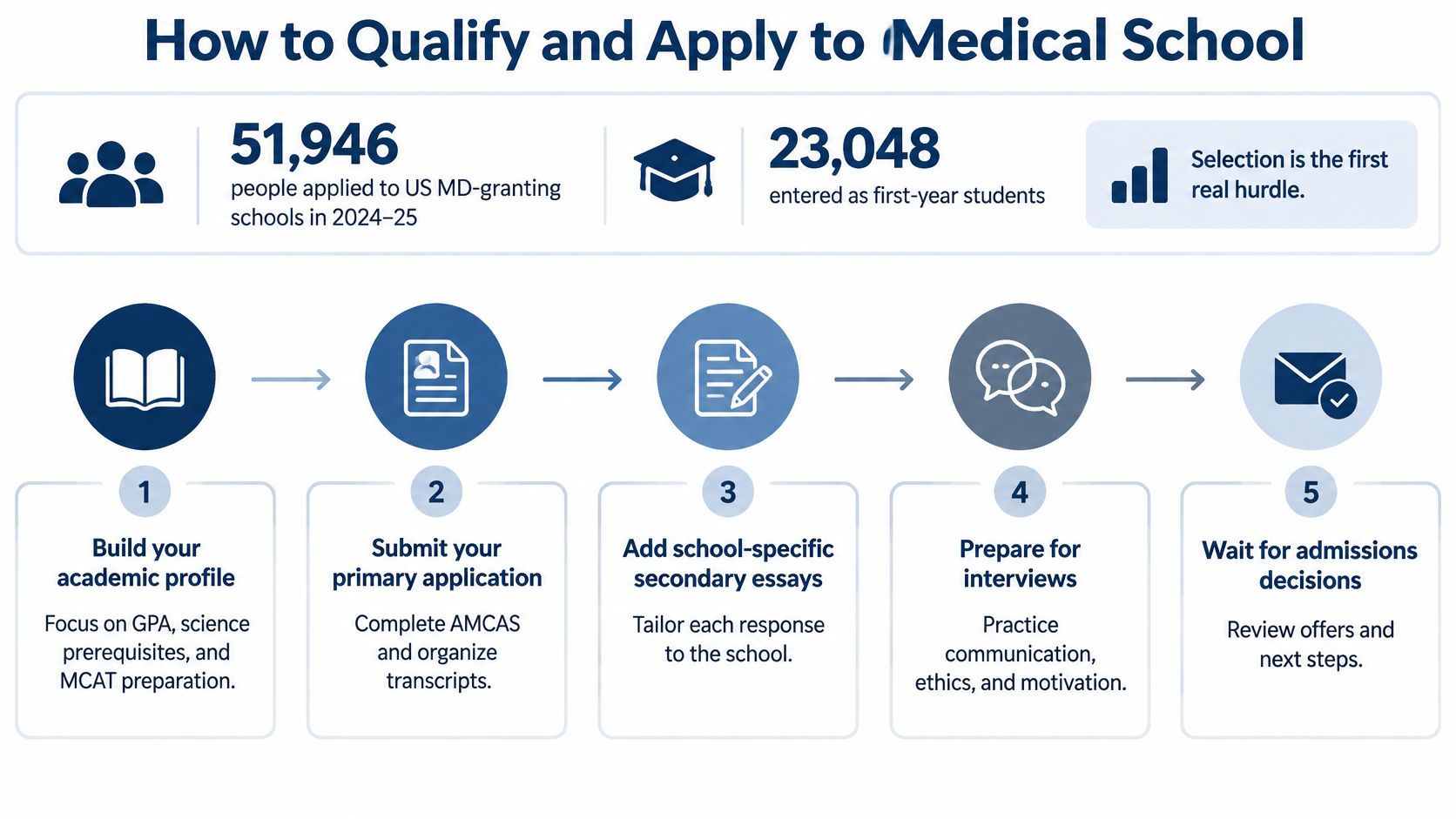
The AAMC's 2024 medical school applicants and enrollment release reported that 51,946 people applied to U.S. MD-granting medical schools in 2024-25 and 23,048 students entered as first-year matriculants. That works out to approximately 44% of applicants becoming first-year matriculants, but it isn't an acceptance rate, because applicants apply to multiple schools and outcomes vary.
Treat the table as a map of checkpoints, not a timetable. Find your current stage, then name the first one you haven't confirmed yet. That's your real starting point.
How to Qualify and Apply to Medical School
Selection is the first real hurdle, and most rejections happen before an interview is offered. Schools screen files in stages, so a weak grade trend, a late application, or missing prerequisites can end your cycle early. Work through the steps in order and fix gaps before you submit.
Build the Academic File
1. Complete prerequisite coursework and protect your GPA. Expect biology, general and organic chemistry, physics, biochemistry, and English, though each school sets its own list. Schools screen on grades because medical school moves faster than undergraduate science, and they need evidence you won't fall behind.
Practical tip for Step 1. Download each target school's prerequisite list and tick courses against it by name, not by what your advisor assumes counts. A course titled differently at your university may not satisfy a requirement without written confirmation.
2. Take the MCAT with a retake window. Schedule your first attempt early enough that a disappointing score doesn't force you to apply late or skip a cycle. Your score helps schools compare applicants from different universities on one scale.
Practical tip for Step 2. Don't book the test until timed practice scores sit near your target range. A rushed first attempt becomes part of your record, and a retake works best when you've changed how you study, not just studied longer. Our detailed guide to medical school prerequisites and the MCAT walks through course planning and test timing together.
Show You Understand Clinical Work
3. Build clinical exposure, shadowing, and service, and log it. Admissions teams want proof you've seen unglamorous, repetitive, emotionally hard patient care and still want the job. Shadowing shows you what doctors do between dramatic moments, mostly documentation, coordination, and difficult conversations.
Practical tip for Step 3. Keep a dated log with hours, setting, supervisor, and one line on what you learned. That log becomes your activity descriptions and interview material months later, when details blur.
Say you've spent weekends in an emergency department. Don't just count hours. Note the night a physician explained a poor prognosis calmly, or how a team handed over an unstable patient. Specific observations make essays credible.
Submit, Interview, and Choose Schools Wisely
4. Submit the centralized application early. MD applicants use AMCAS, and DO applicants use AACOMAS. Many schools review on a rolling basis, so equally strong files submitted later compete for fewer interview slots.
Practical tip for Step 4. Order transcripts and confirm recommendation letters before the application opens. Missing documents, not weak essays, cause many avoidable delays.
5. Prepare for school-specific interviews. Practice clear answers on ethics, teamwork, failure, and why you want to be a doctor. Interviewers test judgment and communication, not memorized science.
Practical tip for Step 5. Answer the question asked, give one concrete example, then stop. Rambling answers hide your reasoning, and rehearsed speeches sound evasive when follow-up questions arrive.
6. Build a balanced school list. Include reach, match, and safety schools based on your grades, score, and each school's mission. Applying only to highly selective schools turns a strong file into a risky one.
Practical tip for Step 6. Budget for application fees, testing, travel, and interview costs before you finalize the list. Dropping out mid-cycle because costs surprised you wastes the preparation behind every earlier step.
What Medical School Years and Clinical Rotations Involve
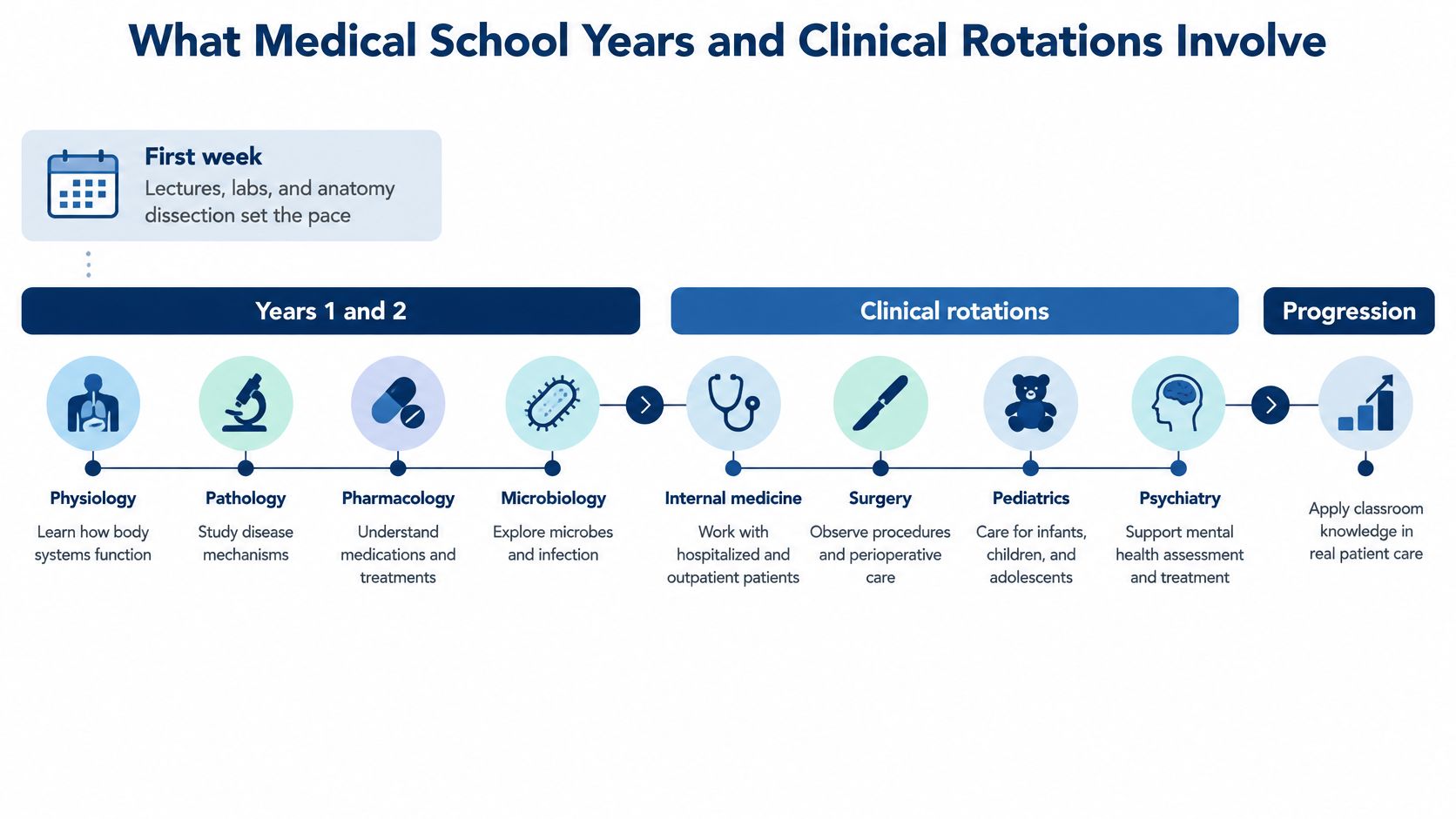
Your first week sets the pace fast. You might move from a physiology lecture in the morning to anatomy dissection after lunch, then spend the evening learning names for structures you struggled to find hours earlier. The volume feels unreasonable until your study system catches up.
Years One and Two in the Classroom
Lectures, labs, and small group work dominate the first phase. Core courses include physiology for how body systems function, pathology for disease mechanisms, pharmacology for how drugs act and interact, and microbiology for infection. You're building a framework you'll use on every ward later.
Say a lecture covers heart failure. You learn the physiology of fluid overload, the pathology in the heart muscle, and the drugs that reduce strain. Months later, that same chain explains why a breathless patient's legs are swollen and which treatment comes first.
USMLE Step 1 has been pass or fail since 2022, so this phase is about building solid foundations and passing, not chasing a ranking score. DO students also study osteopathic manipulative medicine alongside the same core sciences. Students who treat Step 1 as a reason to skim basic science usually pay for it when clinical reasoning gets harder.
Years Three and Four on the Wards
Clinical clerkships replace the lecture hall. Core rotations usually include internal medicine, surgery, paediatrics, obstetrics and gynaecology, psychiatry, family medicine, and emergency medicine, typically lasting four to eight weeks each. Every few weeks you become the newest person on a new team, and you learn its routines quickly.
On a typical internal medicine morning, you review overnight results, examine your patients, present them on rounds, and defend your assessment when a senior doctor pushes back. In surgery, you might scrub in, retract tissue, and follow the same patient through recovery. In psychiatry, your main tool is a careful conversation, and your notes carry real diagnostic weight.
You take histories, present cases, join rounds, and begin procedures under supervision. Step 2 Clinical Knowledge is usually taken during the clinical years, when that ward experience makes the questions concrete. Your performance now shapes evaluations and recommendation letters for residency.
On rotations: Ask for feedback in the first week, not the last. Early correction is private and fixable. Late surprises end up in your evaluation.
Keep a log of procedures and patient encounters as you go. Ask clerkship directors who saw your best work whether they'd write a strong letter, and choose electives in your likely specialty so you can test fit before committing. Curricula and rotation quality vary by school, so compare how programs structure these years before you enrol.
How to Pass Licensing Exams and Match Into Residency
Graduation moves you into the tightest checkpoint on the route. The ECFMG report on IMG success in the 2025 U.S. Residency Match stated that 9,761 IMGs overall secured first-year accredited graduate-medical-education positions and 4,587 active U.S.-citizen international medical graduates had a PGY-1 match rate of 67.8% in the 2025 U.S. Main Residency Match. Passing exams gets you considered. It doesn't get you a position by itself.
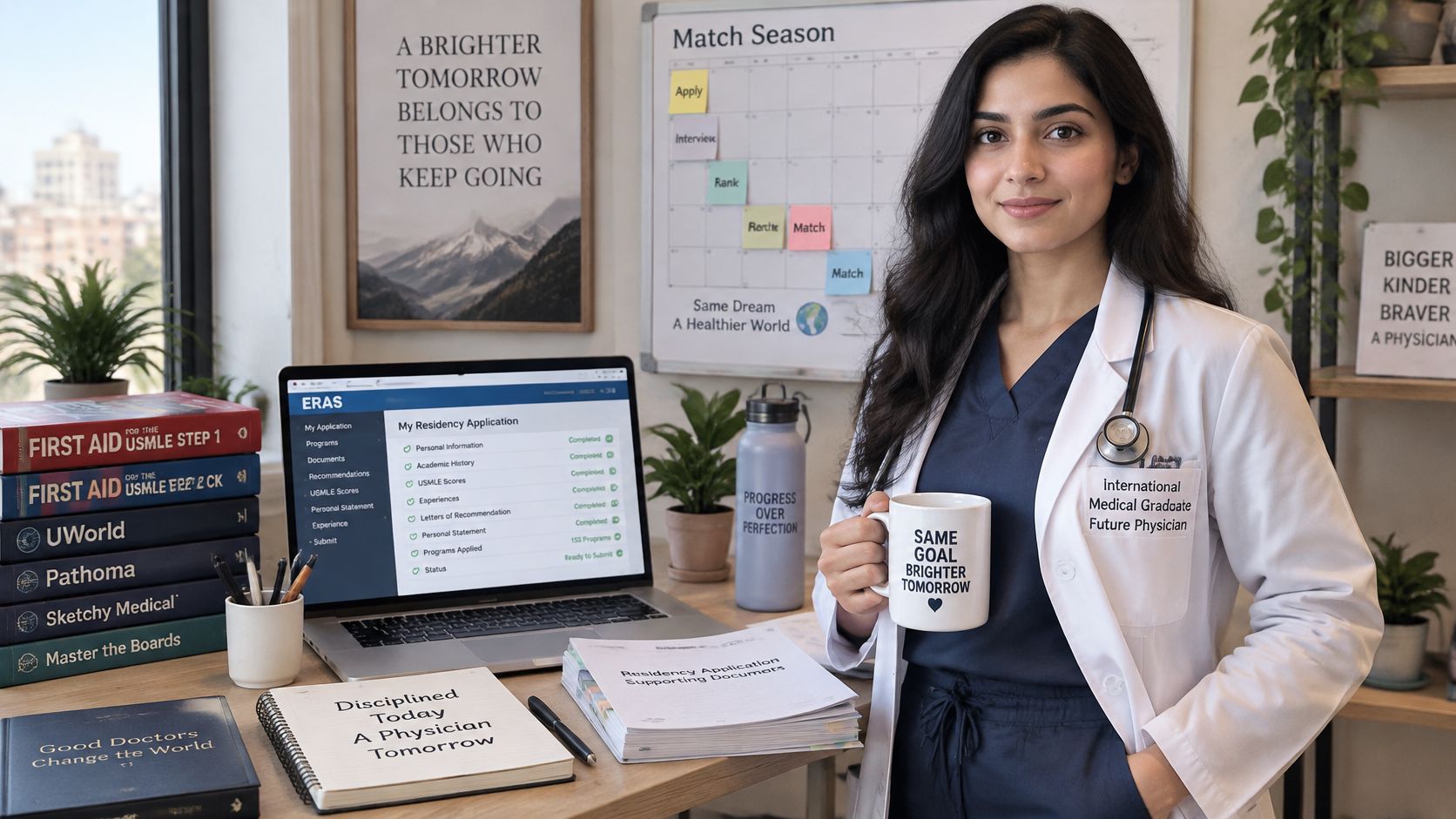
The image below captures the unglamorous side of this stage, long hours assembling applications that must be accurate, complete, and on time.
The Sequence From Exams to Match Day
1. Pass your licensing exams. Complete USMLE Step 2 Clinical Knowledge during medical school, then Step 3 during residency for license eligibility. DO graduates follow the COMLEX pathway, and some also take USMLE exams depending on their goals.
2. Get certified if you trained outside the U.S. International graduates need ECFMG certification, including primary-source verification of credentials. Start early, because document checks sit outside your control and delays can push you out of a cycle.
3. Apply through ERAS in the autumn. Submit a personal statement, recommendation letters, exam scores, and a CV that shows recent clinical experience. Programs screen for eligibility first, including visa policy, graduation year, and exam completion.
4. Interview through autumn and early winter. Programs test communication, judgement under pressure, and whether you'll function well on their team at 3 a.m. Prepare specific patient stories, not general claims about resilience.
5. Rank programs by genuine preference and fit. The matching algorithm rewards honest ranking, so don't move a program up because you think it's safer or more prestigious. Our walkthrough of the medical residency match process explains how ranking works in practice.
6. Learn your result on Match Day through the NRMP. If you match, the result is binding. If you don't, move immediately to the next step rather than waiting for informal offers.
7. Use SOAP if you're unmatched. The Supplemental Offer and Acceptance Program fills unfilled positions through formal rounds. Prepare documents and a ranked fallback strategy in advance so you can act within hours.
The short video below adds a useful visual overview of how applicants handle this process under time pressure.
Specialty Length and a Common Misreading
| Specialty | Residency Length | Note |
|---|---|---|
| Family medicine | 3 years | Broad primary care |
| Internal medicine | 3 years | Adult medicine and hospital care |
| Paediatrics | 3 years | Children's medicine |
| Emergency medicine | 3 years | Acute care and shift work |
| Psychiatry | 4 years | Mental health care |
| Obstetrics and gynaecology | 4 years | Women's health and surgery |
| General surgery | 5 years | Operative training |
| Neurosurgery | 7 years | Highly competitive match |
Don't confuse a position fill rate with an applicant match rate. A nearly full system can still leave many individual applicants unmatched, because competitiveness varies by specialty, citizenship, graduation year, and clinical history. Track exam deadlines, certification requirements, visa rules, and SOAP contingencies in one dated checklist, and review it weekly during application season.
Choosing Your Route and Confirming It
Four routes dominate the choices our readers compare. They differ in entry point, cost structure, and, above all, where the hardest checkpoint sits. A route that's easier to enter can be harder to finish, so judge each one by the full path to practice, not by the admission offer.
| Route | Degree Length | Entry Point | Main Licensing Question |
|---|---|---|---|
| US MD | 4 years | Bachelor's degree with MCAT | Direct path to USMLE and state license |
| US DO | 4 years | Bachelor's degree with MCAT | Same licensing exams, with osteopathic training |
| English-taught European MD | 6 years | Often straight from high school | Recognition for US residency through ECFMG certification |
| Caribbean US-style MD | 4 years | Bachelor's degree, often with MCAT | Most clinical rotations in the US; certification and residency needed |
How the Routes Differ in Practice
A U.S. MD keeps every checkpoint inside one system. You enter after a bachelor's degree, train in U.S. hospitals, and apply to residency with home institution support and familiar documentation. The trade-off is the fiercest entry competition and, for many students, high debt.
A U.S. DO follows the same four-year shape and leads to full practice rights, with added osteopathic training. DO graduates enter the same residency system, so your licensing question is settled early. The key work is matching your specialty ambitions to each school's match history and clinical sites.
An English-taught European MD usually runs six years from high school. You save the separate bachelor's degree and start medicine at 17 or 18, which suits students who are certain early. That certainty is also the risk, because you commit before university-level science tests your interest. If you later want U.S. practice, you become an international medical graduate and take on certification, exams, and a separate residency competition.
A Caribbean US-style MD usually runs four years after undergraduate study, with basic sciences on an island campus and most clinical rotations at affiliated U.S. hospitals. Entry can be more accessible than U.S. schools, and the curriculum targets U.S. exams. You're still an international graduate at residency stage, so the checkpoint that decides your career comes after graduation, not before it.
The Bottleneck Nobody Should Skip
The NRMP release of the 2025 Main Residency Match results reported that non-U.S.-citizen international medical graduates had a 58.0% PGY-1 match rate, while U.S.-citizen IMGs had a 67.8% rate in the 2025 U.S. Main Residency Match. It also reported that IMGs represented 25.6% of active U.S. physicians in 2025, with shares of 37.0% in New Jersey, 36.9% in Florida, and 35.9% in New York.
Read those numbers together. International graduates clearly do build U.S. careers, and some states rely on them heavily. At the same time, a large share of qualified international applicants don't match in a given cycle, and citizenship alone shifts the odds. An overseas degree can widen entry to medical school while narrowing entry to residency, which is the stage that decides whether you can be a doctor in the U.S. at all.
Ask every school for verifiable outcomes, not marketing claims. You want documented clinical placements, exam pass results, and residency placements by applicant type, in writing.
Run the Risk Checklist Before You Commit
- Licensing eligibility: Confirm the degree is acceptable to the regulator where you plan to practice, and that the school appears in recognized directories.
- Residency competitiveness for your citizenship: Separate overall match claims from results for applicants in your category and specialty.
- Immigration status: Check student visa rules for study, then work and training visa rules for residency, because they're different systems.
- Total cost: Add application, testing, travel, relocation, and repeat-cycle costs to tuition and living expenses.
- Fallback options: Decide where you'd practice or retrain if U.S. residency doesn't happen, before you enrol.
Medical School Programs has been an independent guide to medical school programs since 2009, and our program data comes from schools' official websites and authoritative bodies such as the World Directory of Medical Schools, ECFMG, NRMP and national accreditation agencies. Use that kind of sourced checking for your own shortlist too, and read our analysis of whether studying medicine abroad is worth it before treating lower entry barriers as lower overall risk.
Say you're choosing between a six-year European place now and a U.S. application after a bachelor's degree. The European route starts sooner and may cost less each year. The U.S. route delays entry but keeps licensing straightforward. Neither is automatically safer. The European route is safer only if you'd practise in Europe if a U.S. match failed.
Say instead you're comparing a Caribbean offer with reapplying to U.S. schools next cycle. One extra year improving your file may look slow, but it can be cheaper than graduating on time and spending two cycles unmatched. Time to degree and time to practice are different measures, and only the second one pays your loans.
Your Decision This Week
Write down three things today: your current stage, the route you're considering, and the first date you must confirm. Then verify that date and the licensing question for your route on each school's official site or the ECFMG site, not on a forum or an agent's page. If a school can't document its clinical rotations and graduate outcomes, treat that silence as your answer and move on to one that can.
If you're weighing domestic and international routes to be a doctor, Medical School Programs gives you sourced program listings, country guides, and practical admissions and licensing advice in one place. Compare degree length, entry requirements, costs, and residency pathways side by side, then confirm your shortlist against official school and regulator sites. Visit today and start with the programs that match the route you've just mapped out.