
You're applying from outside the EU, and you've found three Irish medicine courses that award an MB, BCh, BAO. They look similar until you compare the entry route, time in university and cost. One application goes through the school, another requires an agent, and the admissions test you've prepared for might not apply to your applicant category.
The more important question comes after admission: where will you complete internship, obtain registration and pursue specialist training? An English-language medical degree doesn't settle those questions. You need a plan for Ireland and, if you intend to return home, a separate plan for your destination country.
These seven options include a starting guide and the Irish universities to investigate, organised around decisions rather than prestige. The focus is the Republic of Ireland, not Northern Ireland's separate university and regulatory system. Use them to identify your entry route, application channel and career constraints. Confirm every fee, criterion and deadline directly with the school before applying, because nationality, residence, qualifications and fee status can change which instructions apply to you.
Table of Contents
- 1. Study Medicine in Ireland as an International Student
- 2. Royal College of Surgeons in Ireland (RCSI)
- 3. Trinity College Dublin (TCD)
- 4. University College Dublin (UCD)
- 5. University College Cork (UCC)
- 6. University of Galway
- 7. University of Limerick (UL)
- How the seven Irish medicine options differ on length, entry route and application process
- Turning This Shortlist Into a Realistic Application Plan
1. Study Medicine in Ireland as an International Student
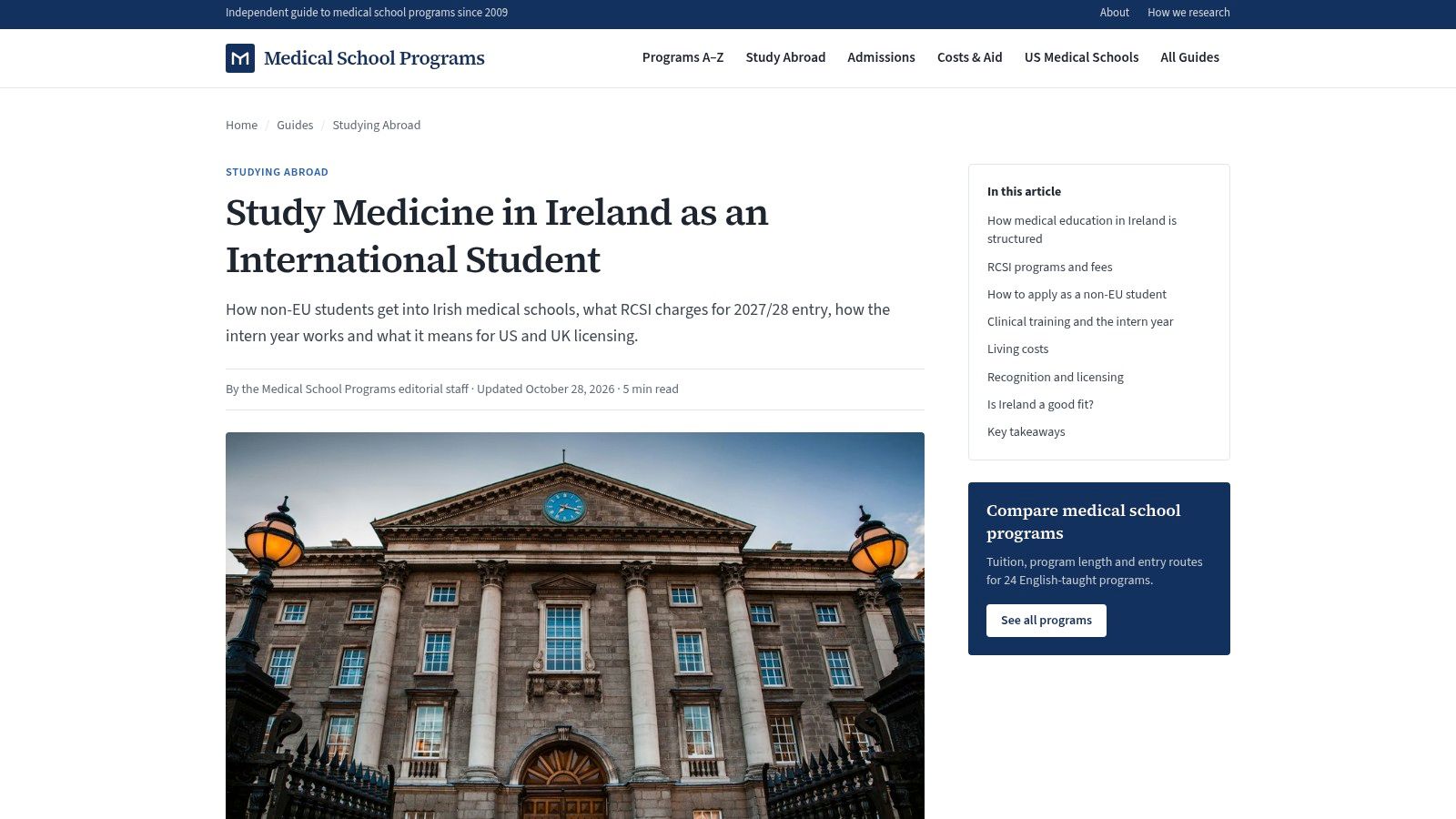
Best starting point if you haven't established which admissions route fits you. The Study Medicine in Ireland guide brings school comparisons, entry routes, tuition considerations and internship planning into one place. It also gives additional attention to RCSI without treating that institution as the default choice.
Ireland has six medical schools offering nine domestic basic medical education programmes, according to the Medical Council's quantitative annual returns report. That distinction matters: choosing a university and choosing an eligible programme aren't the same decision.
Start with your educational background, then identify the application category. A school-leaver qualification, an existing degree and non-EU status answer different questions. Holding a degree doesn't automatically mean you qualify for graduate entry, and being an international applicant doesn't identify the correct admissions test.
Use the overview to eliminate unsuitable routes
Our Ireland country guide is useful for organising the broader study-abroad decision. Keep a separate comparison document for the school-specific details that determine whether you can apply.
Record these distinctions before comparing campus photographs:
- Entry route: School-leaver or graduate entry, including whether your qualification meets the relevant academic requirements.
- Application channel: University application, designated agent or another route specified for your category.
- Whole-course cost: Tuition, living expenses, clinical travel, examinations and the transition after graduation.
- Career destination: Ireland, your home country or another jurisdiction, each with its own registration requirements.
The guide's strength is orientation. Its limit is that an overview can't replace a current admissions decision, fee assessment or immigration ruling.
Practical rule: Use a guide to build your shortlist. Use the university's current instructions to submit your application.
Before applying: Get confirmation of your entry route and fee category from each shortlisted school, then check the licensing pathway in the country where you intend to practise.
2. Royal College of Surgeons in Ireland (RCSI)
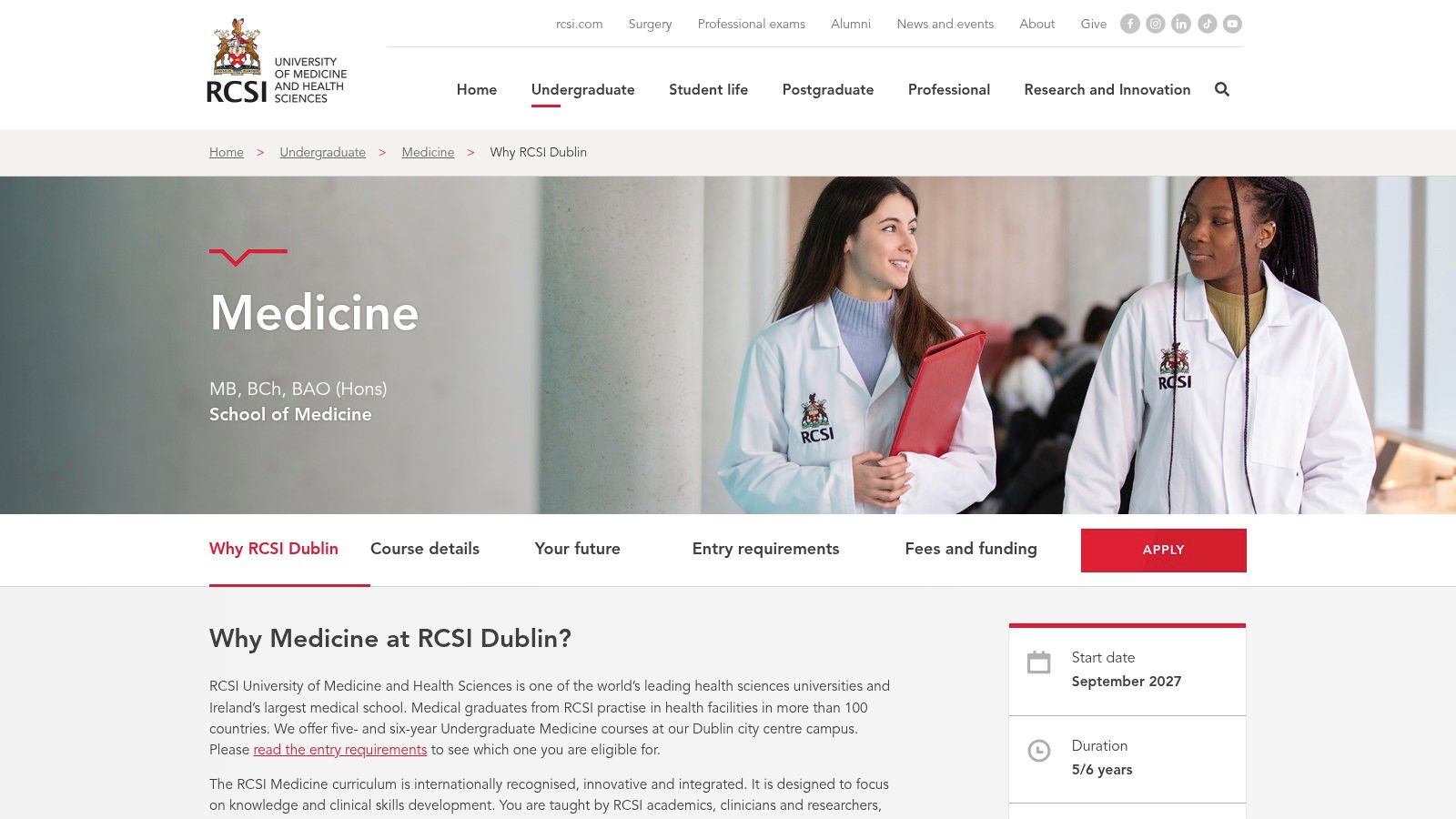
RCSI suits applicants who want a health-sciences-focused university rather than medicine within a broad university offering unrelated disciplines. Its Dublin setting and international admissions guidance make it a useful option to investigate, but the correct application channel comes first.
The RCSI Medicine course page describes five- and six-year school-leaver routes, with placement depending on prior education. It also distinguishes Irish/EU and non-EU admissions, including direct applications and Atlantic Bridge arrangements for applicants resident in the United States or Canada.
Don't assume that another school's test requirements transfer to RCSI. Its non-EU guidance includes Casper requirements, so verify whether these apply to your category and application cycle before booking a test.
The trade-off is focus versus total cost
What works: A dedicated medical and health-sciences environment can suit students who want their academic community centred on healthcare. International admissions instructions also give applicants a clearer starting point than a general university application page.
What needs scrutiny: Tuition is only part of the commitment. Use a whole-course medical school cost framework to account for accommodation, clinical travel, insurance, examination fees and currency changes.
An international student community isn't evidence that every graduate has the same postgraduate opportunities. Compare support for your intended licensing destination, not the number of countries represented on campus.
Before applying: Ask RCSI to confirm your course length, application channel, Casper requirement and current fee schedule for your residence and qualifications.
3. Trinity College Dublin (TCD)
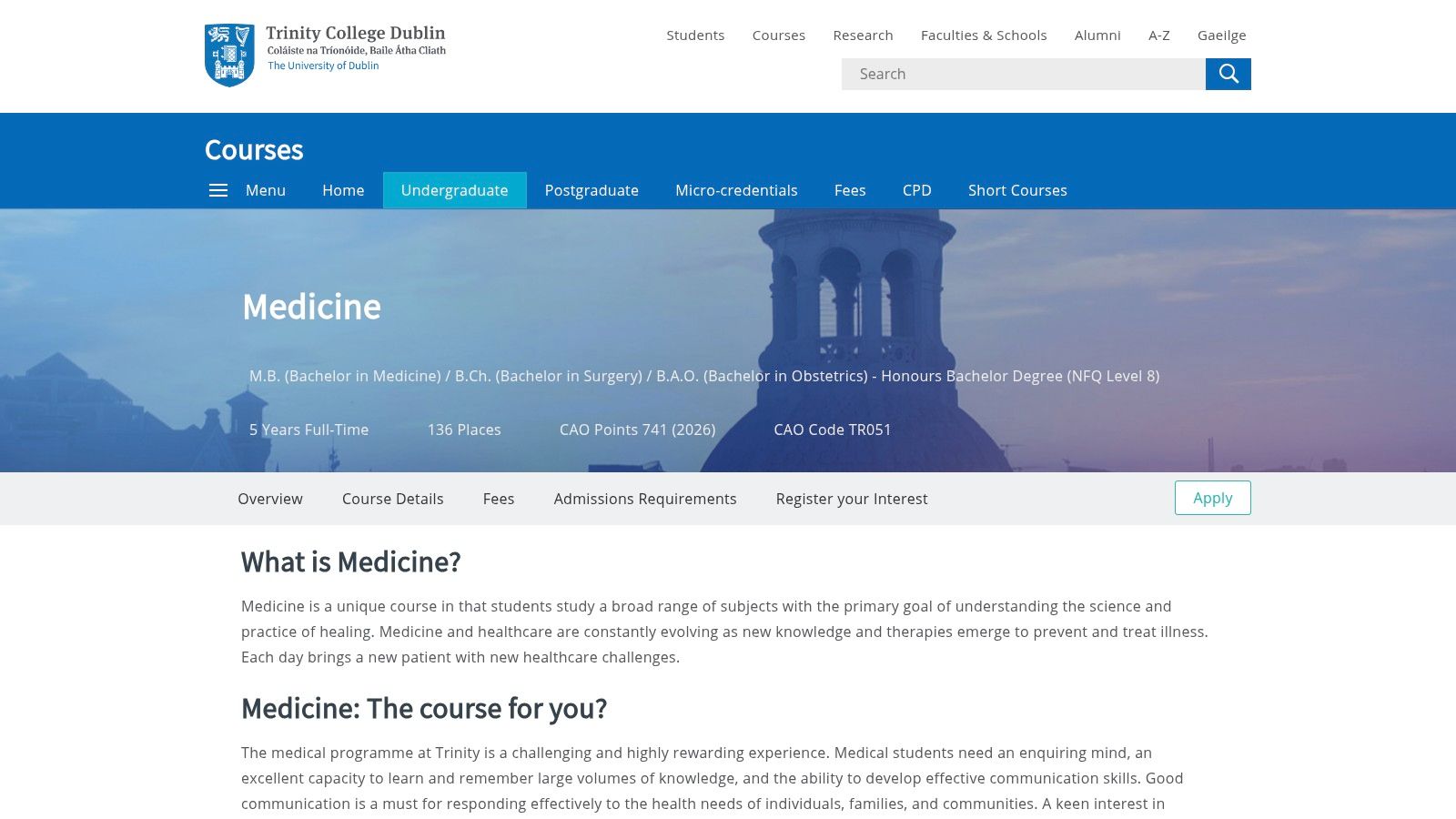
Trinity is worth considering if you want medicine within a broad academic university, with scope to explore clinical interests beyond the compulsory curriculum. Its Dublin location is relevant to daily life, but it shouldn't outweigh eligibility or affordability.
The Trinity Medicine course page describes a five-year programme with 12 weeks of clinical electives, which may be completed in Ireland or abroad. Electives can help you explore a specialty or healthcare system, but an overseas placement isn't a substitute for meeting that country's licensing and residency requirements.
For international applicants, the practical question is how the course's admissions rules apply to their qualifications. Historical CAO points aren't an estimate of a non-EU applicant's admission chances, and an earlier entry threshold isn't a promise for a later cycle.
- Academic fit: Check subject prerequisites and English-language evidence against your actual qualification.
- Clinical flexibility: Ask how elective destinations are approved and what support students receive.
- Additional expense: Budget for elective travel, accommodation and placement-related requirements where applicable.
Trinity's wider university environment is an advantage if you'll use its societies, research opportunities and academic resources. It's less persuasive as a reason to enrol if the financing or postgraduate pathway remains unresolved.
Before applying: Confirm the medicine-specific non-EU deadline, qualification requirements and fee category, then ask what arranging and funding an overseas elective would involve.
4. University College Dublin (UCD)
For UCD, identify the exact degree before comparing admissions requirements. Its undergraduate medical qualification and its separate postgraduate MD aren't interchangeable routes to becoming a doctor.
The UCD School of Medicine undergraduate pages provide the starting point for its MB, BCh, BAO pathways. International applicants should follow the relevant course and country-specific guidance, rather than assuming that a general international application page contains every medicine requirement.
UCD may suit students who want a large university alongside medical training. Research, societies and electives can broaden the experience, but availability doesn't mean every opportunity will fit around compulsory teaching and clinical placements.
Compare the route, not just the university
Ask admissions to identify the programme attached to your offer, its duration and where teaching and clinical placements take place. This is particularly important if you encounter partnership arrangements or course descriptions intended for a different applicant group.
- Strength: A broad university setting offers academic and extracurricular choices beyond medicine.
- Trade-off: More routes and information pages mean you must distinguish the instructions relevant to your application.
- Career limit: An Irish qualification doesn't remove examination, registration or residency requirements elsewhere.
A familiar degree title isn't enough. Match the programme, campus arrangements and graduate eligibility to the career you're planning.
Don't use another applicant's acceptance as evidence that your qualifications meet the same conditions. Fee status, previous education and application route can differ even when applicants hold the same nationality.
Before applying: Get written confirmation of the precise undergraduate route, duration, application channel and qualification requirements that apply to you.
5. University College Cork (UCC)
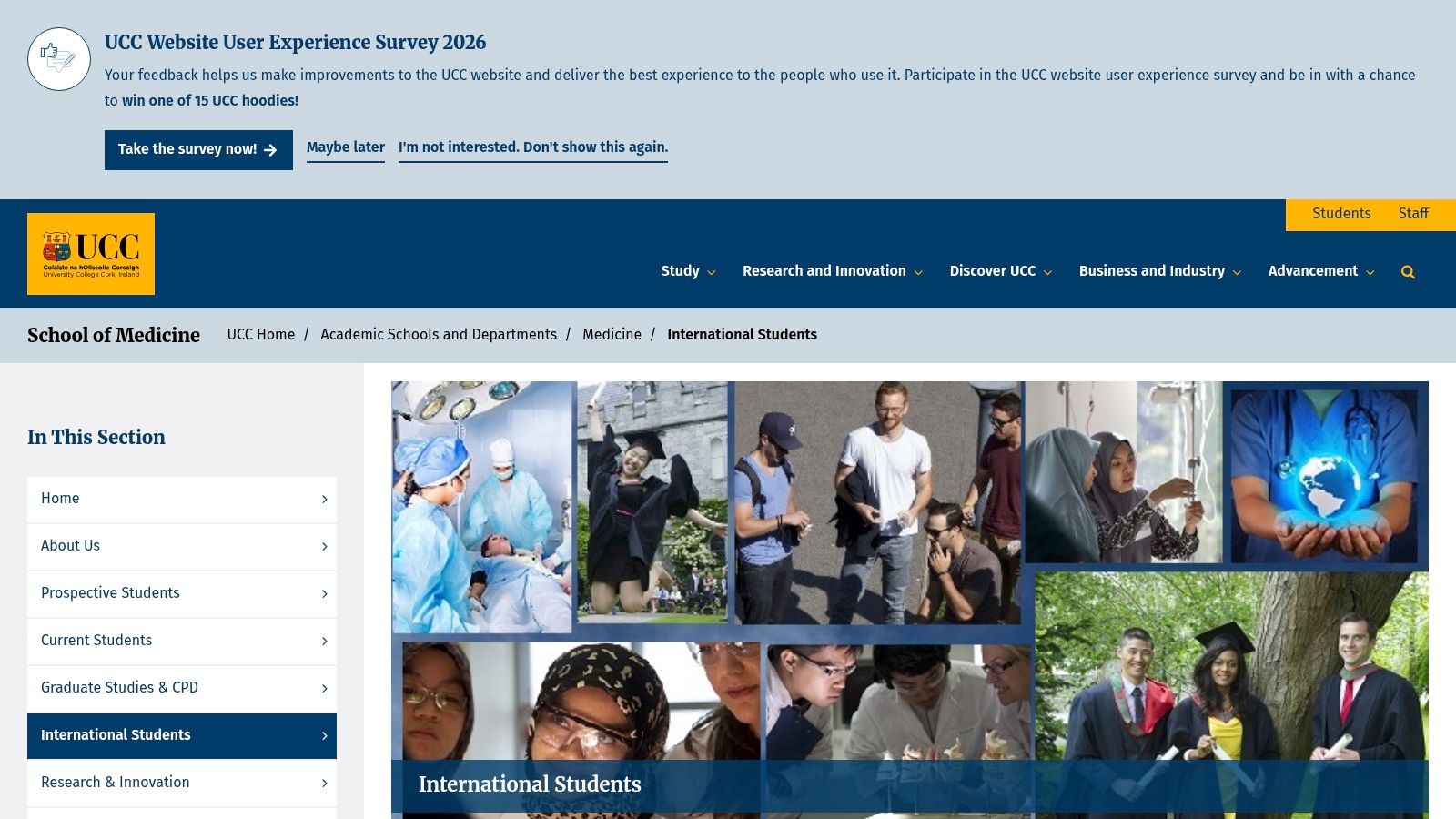
UCC is a useful comparison for applicants deciding between school-leaver and graduate entry. Its international medicine admissions guidance outlines five-year direct-entry and four-year graduate-entry programmes, alongside international qualification requirements and designated-agent procedures.
The agent requirement is an operational distinction, not a minor administrative detail. Don't start with the general international undergraduate application and assume the university will redirect it. Identify the medicine-specific route for your country before preparing the submission.
For a graduate, the shorter medical programme may look financially attractive. Compare the full cost from your current position, including required tests, tuition, living expenses and the period before you can enter paid clinical work.
Read the fee schedule alongside admissions guidance
UCC publishes international fee information, but a tuition figure without its academic year and course category is incomplete. Verify the current amount directly, including separate charges and whether the published rate applies throughout the programme.
The useful comparison is:
- Eligibility: Does your school qualification or prior degree meet the requirements for the intended route?
- Submission: Which designated agent handles your application, and what deadline governs it?
- Affordability: Can you finance the whole programme without depending on uncertain employment or postgraduate placement?
UCC's route choices are an advantage only if you qualify for the route you prefer. Don't treat the existence of graduate entry as evidence that any undergraduate degree will satisfy admissions.
Before applying: Confirm the designated agent, route-specific eligibility and current annual charges, and ask how fee changes are communicated to continuing students.
6. University of Galway
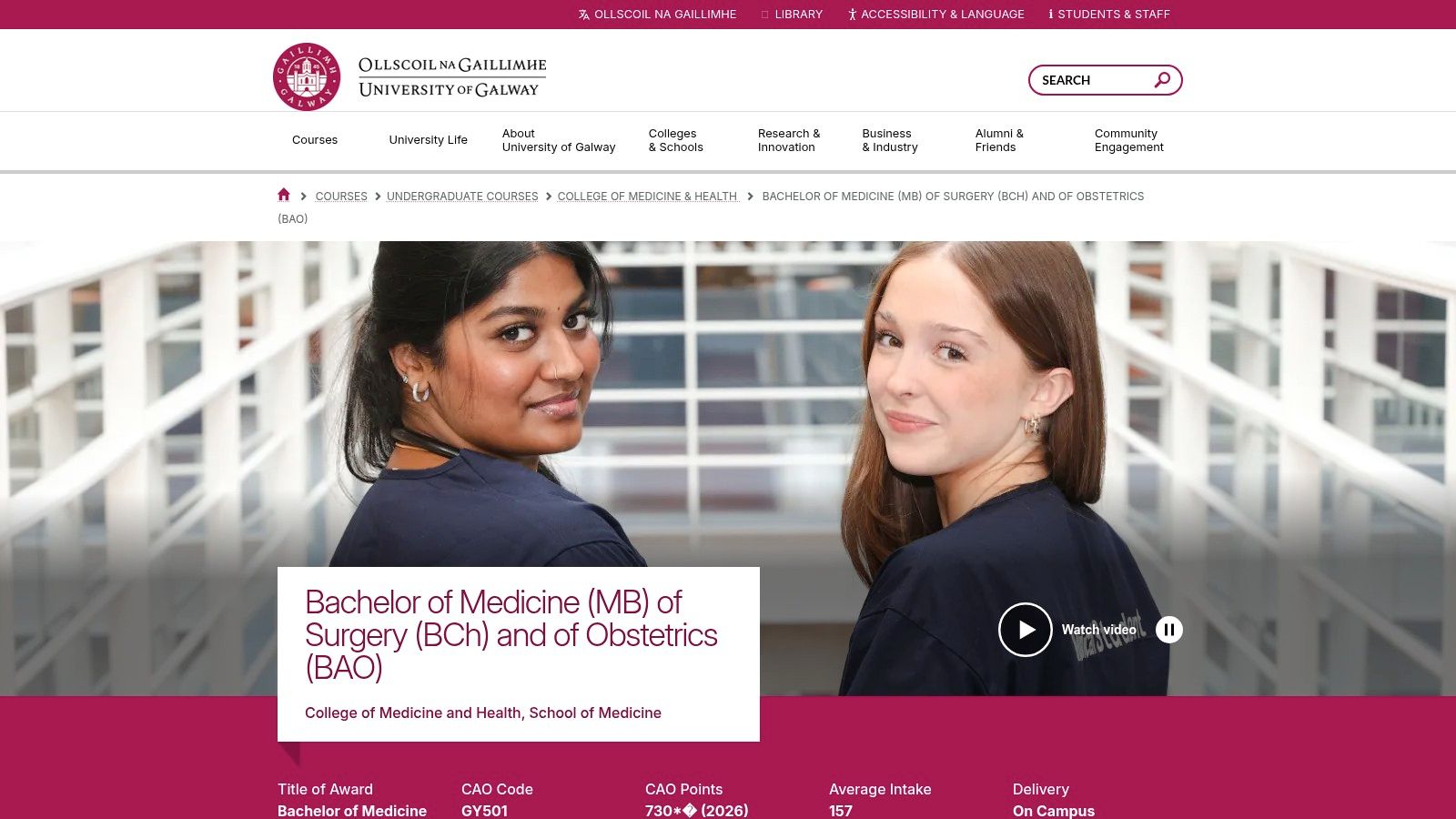
Galway offers a location alternative to Dublin and Cork, but application logistics should come before location preference. The University of Galway Medicine page provides medicine-specific guidance, including the partner-agent route for non-EU applicants rather than the general international undergraduate process.
An agent-based application can help clarify document requirements and communication. It doesn't remove your responsibility to verify course details, fees or the university's conditions. Keep copies of your submission and obtain clarification in writing when an agent's explanation differs from university information.
If you're comparing Galway with other English-taught medical schools in Europe, compare the complete route to practice. Teaching language alone won't tell you about clinical communication expectations, internship access or recognition in your intended destination.
Separate where you study from where you work
A government workforce report cites an HEA survey in which 94% of Irish medical graduates remained in Ireland nine months after graduation, compared with 41% of graduates from other countries who studied in Ireland, according to Ireland's Future Health and Social Care Workforce. These are national outcomes, not Galway-specific placement rates or an individual forecast.
They do support a practical distinction: admission and retention are different outcomes. Ask about internship eligibility and destination-specific preparation rather than assuming that studying locally guarantees the opportunity to stay.
Before applying: Confirm your authorised partner agent, applicable deadline, current tuition and course duration, then check the internship rules for your anticipated graduate category.
7. University of Limerick (UL)
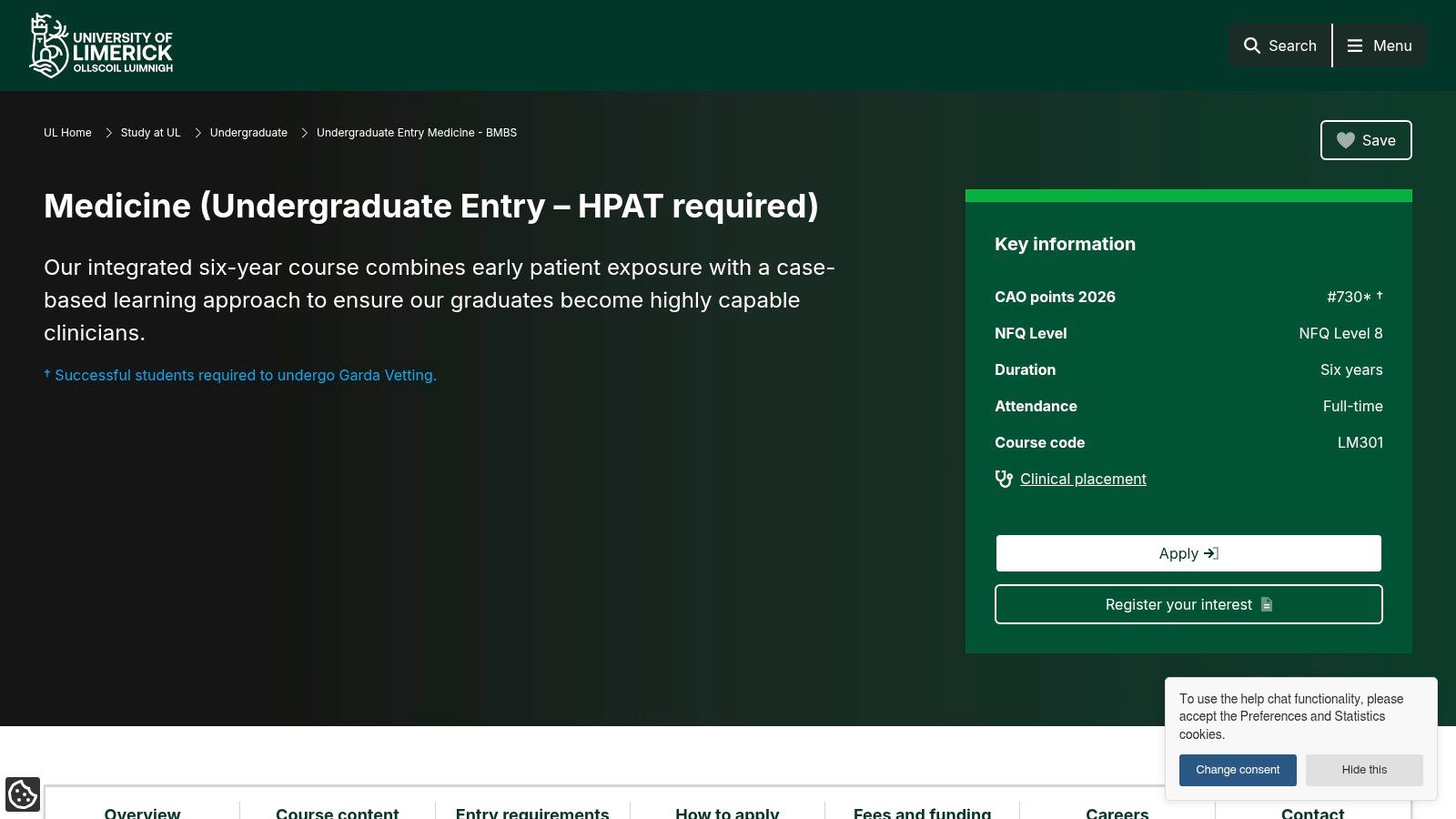
UL deserves attention for its distinction between entry routes and its explanation of learning style. The University of Limerick medicine information describes a six-year direct-entry route and a four-year graduate-entry programme, with case-based learning and early patient exposure highlighted for direct entry.
Case-based learning suits students who like applying science to clinical problems and preparing actively for discussion. Don't choose it because it sounds more practical than lectures. Ask how independent preparation, group work, assessments and clinical teaching fit together.
For graduate entry, check the prior-degree and GAMSAT requirements against the guidance for your applicant category. International support concerning North American examinations and residency preparation is useful, but support isn't a guaranteed examination result or residency placement.
- Learning fit: Review sample teaching information and assessment methods.
- Admissions fit: Confirm which degree and test requirements apply to your route.
- Career fit: Plan around internship eligibility, registration and the licensing requirements of your intended destination.
Career safeguard: Treat the warning that non-EU internship places can't be guaranteed as a planning constraint, not a footnote.
If an Irish internship isn't available to you, a viable alternative requires more than willingness to relocate. You need to establish whether another jurisdiction accepts your qualification and offers an accessible route into supervised practice.
Before applying: Ask UL to confirm route eligibility, current test requirements and fees, and obtain its latest guidance on non-EU internship access and overseas licensing preparation.
How the seven Irish medicine options differ on length, entry route and application process
| Item | Program Length | Entry Route | Non-EU Application Route | Key Watch-Out |
|---|---|---|---|---|
| Study Medicine in Ireland as an International Student | Varies by university | Routes vary by university | Check each university's process | Confirm current requirements, fees, visa and licensing rules |
| Royal College of Surgeons in Ireland (RCSI) | 5 or 6 years | School-leaver route; duration depends on prior education | Apply directly or through Atlantic Bridge if resident in the US or Canada; Casper generally required | Fees and registration requirements vary |
| Trinity College Dublin (TCD) | 5 years | Undergraduate Medicine | Separate non-EU application information | Entry is competitive; verify current deadlines and fees |
| University College Dublin (UCD) | Not specified | Undergraduate MB, BCh, BAO | International and non-EU applicants accepted; country-specific guidance available | Distinguish the undergraduate degree from the postgraduate MD |
| University College Cork (UCC) | 5-year direct entry or 4-year graduate entry | Direct entry or graduate entry | Apply through a designated agent | Confirm the correct agent and deadline; fees may change |
| University of Galway | Not specified | Undergraduate MB, BCh, BAO | Apply through a partner agent | Confirm current fees, entry requirements and availability |
| University of Limerick (UL) | 6-year direct entry or 4-year graduate entry | Direct entry or graduate entry; graduate route requires a prior degree and GAMSAT | Not specified | Internship places are not guaranteed for non-EU students |
Turning This Shortlist Into a Realistic Application Plan
Shortlist two or three schools that match your entry route, rather than applying everywhere that offers medicine. Remove programmes whose academic requirements you don't meet, whose application channel you can't use or whose full cost you can't finance. Then compare the remaining options on learning style, clinical arrangements and career preparation.
Check each official site for current tuition, deadlines, agent requirements and internship guidance. Record the academic year beside every fee and the applicant category beside every criterion. Where instructions are unclear, ask the university for a written answer before paying an application fee or deposit.
Plan beyond the admission offer
Map the stages separately: medical school, internship, registration, specialty training and eventual independent or consultant practice. The exact sequence and requirements depend on where you intend to work. Recognition of a degree doesn't establish access to every later stage.
Ireland's workforce analysis identifies specialist-training capacity as a constraint on graduates progressing to consultant careers in the country, according to the Department of Health's medical workforce analysis. That makes a destination-specific career plan essential, particularly if your financing assumes uninterrupted progression into Irish postgraduate employment.
Keep your final comparison focused on decisions:
- Application readiness: Eligible qualifications, required tests, documents and the correct submission channel.
- Financial readiness: Whole-course funding, additional charges and a contingency for changing costs.
- Career readiness: Internship eligibility, immigration permissions, licensing examinations and specialty-training access.
Medical School Programs is an independent guide, not a school or recruiting agency. Schools can't pay us to change a listing, and our programme facts are checked against official pages, dated and updated when schools change fees or requirements.
Don't rely on a figure we can't verify, or on an older figure merely because it appears precise. Choose the programme whose admissions requirements, financing and post-graduation pathway you can substantiate.
Visit Medical School Programs to compare programme details and explore practical guidance on admissions, funding and medical licensing. Use our Ireland coverage to build your shortlist, then confirm your route and current requirements with each university before submitting an application.