
Are you comparing medical schools in Hungary by teaching language and headline tuition, or by the route that will let you graduate and practise where you intend? An English-taught degree, a German-language track and a pathway to professional registration aren't interchangeable. The right choice depends on academic language, entrance requirements, payment terms and your intended country of practice.
Hungary's appeal includes established international teaching environments and a choice of university settings. But applicants need more than a familiar university name: they need the correct program page, an intake-specific fee schedule and a realistic plan for clinical communication.
The programs below include English and German options at the same institutions, not separate schools in every case. Every figure quoted comes from the universities' published materials. Confirm current fees, entrance examinations and application deadlines directly before paying, especially where different university pages show different terms. An undated deadline or a price borrowed from another language track isn't a reliable basis for applying.
Table of Contents
- 1. Semmelweis University, General Medicine in English
- 2. University of Debrecen, Medicine in English
- 3. University of Pécs Medical School, General Medicine in English
- 4. University of Szeged, Albert Szent-Györgyi Medical School, Medicine in English
- 5. Semmelweis University, Human Medicine in German
- 6. University of Pécs Medical School, Humanmedizin in German
- 7. University of Szeged, Albert Szent-Györgyi Medical School, Medicine in German
- Hungarian Medical Programs at a Glance
- Choosing Your Hungarian Program and Planning the Application
1. Semmelweis University, General Medicine in English
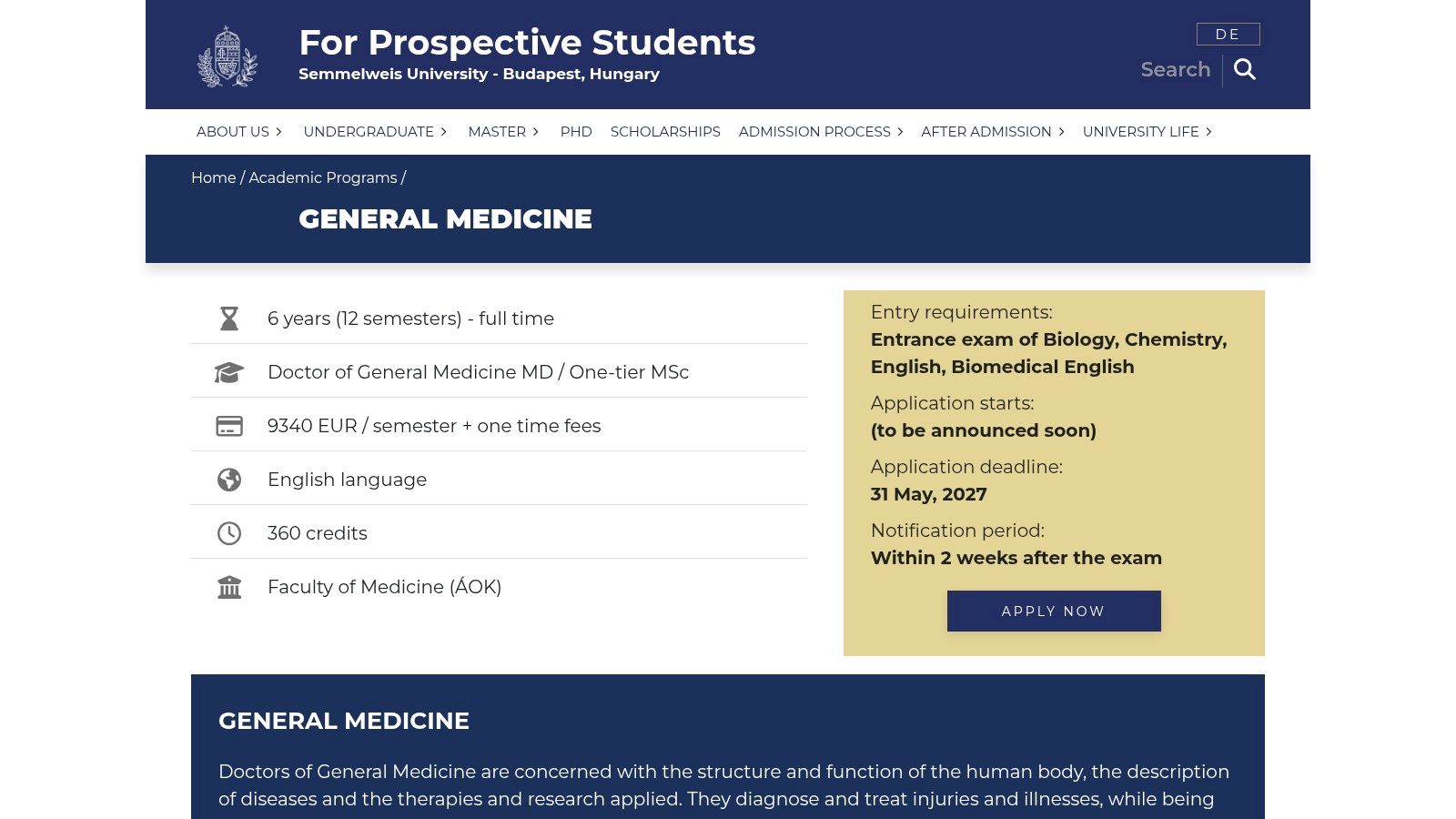
Best fit: Applicants who want English-medium medical education in Budapest and can budget beyond the advertised tuition.
The Semmelweis General Medicine program page describes a six-year, 12-semester, full-time program and lists tuition of €9,340 per semester, plus one-time fees. Treat that as a published quotation to verify for your entry cohort, not a promise that every applicant will receive identical billing terms.
The important comparison isn't whether you can afford admission. It's whether you can finance uninterrupted progression, including any additional study caused by an unsuccessful examination, interrupted enrollment or delayed completion.
Strengths and trade-offs
- Strength: The university publishes a dedicated medical-program page, giving applicants a direct starting point for checking structure and financial terms.
- Trade-off: A semester quotation doesn't describe the complete cost of attendance. Accommodation, travel, personal expenses and additional university charges need separate budget lines.
- Admissions priority: Request the current examination syllabus and confirm how the school assesses biology, chemistry, English and motivation.
Our guide to studying medicine in Hungary provides broader context for comparing the application route.
Budget rule: Ask the university to confirm the currency, entry cohort, payment schedule and consequences of interrupted study in writing.
Before committing, also ask how students learn the Hungarian needed for patient-facing training. English instruction doesn't remove the practical challenge of communicating with local patients.
2. University of Debrecen, Medicine in English
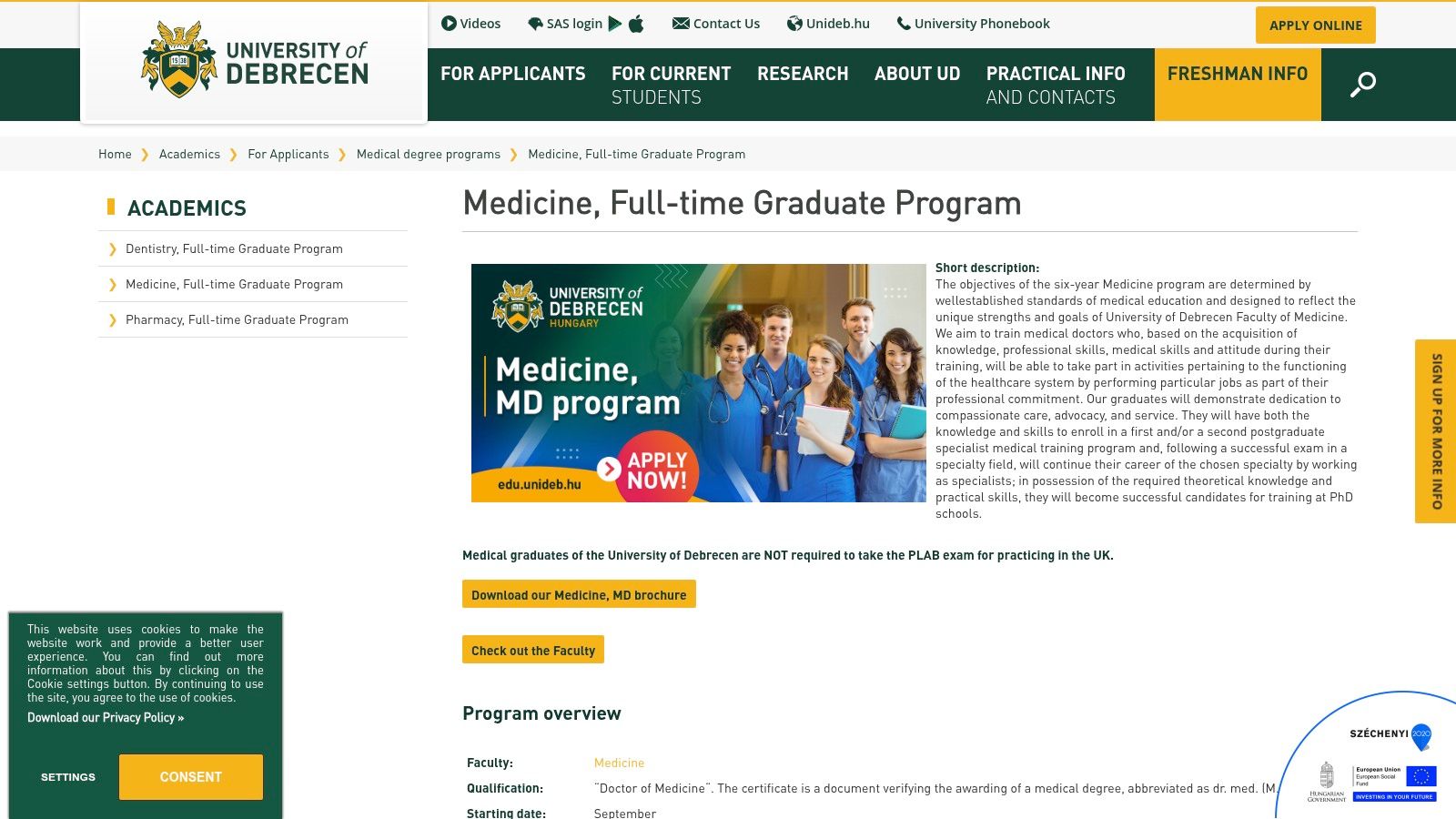
Start with the entrance process, not the city. Debrecen's medicine admissions involve science testing, so applicants should prepare from the university's current subject requirements rather than assume that preparation for another Hungarian school will transfer unchanged.
Best fit: Students seeking English-medium medicine outside Budapest who are ready to prepare specifically for Debrecen's examination.
The University of Debrecen fee schedule lists medicine tuition of US$16,900 annually for 2026/27. That dated rate is useful for comparison, but it doesn't establish the price for a later intake.
- Strength: A published annual tuition figure makes initial financial screening straightforward.
- Trade-off: Tuition alone doesn't establish how much cash you'll need before enrollment or visa processing.
- Admissions priority: Confirm the required science subjects, written and oral components, and whether a preparatory route is appropriate for your qualifications.
What to verify before applying
Use the official Debrecen Medicine page to check the live intake status and application instructions. Don't treat an application deadline as proof that places remain available, and don't pay an intermediary without confirming the university's authorized procedure.
Ask separately about application charges, examination charges, refund rules and tuition payment timing. For a student with limited available cash, the order of those payments can matter as much as the annual price.
The candid trade-off: Debrecen deserves consideration on its own admissions and financial terms, not merely as an alternative if a Budapest application fails.
3. University of Pécs Medical School, General Medicine in English
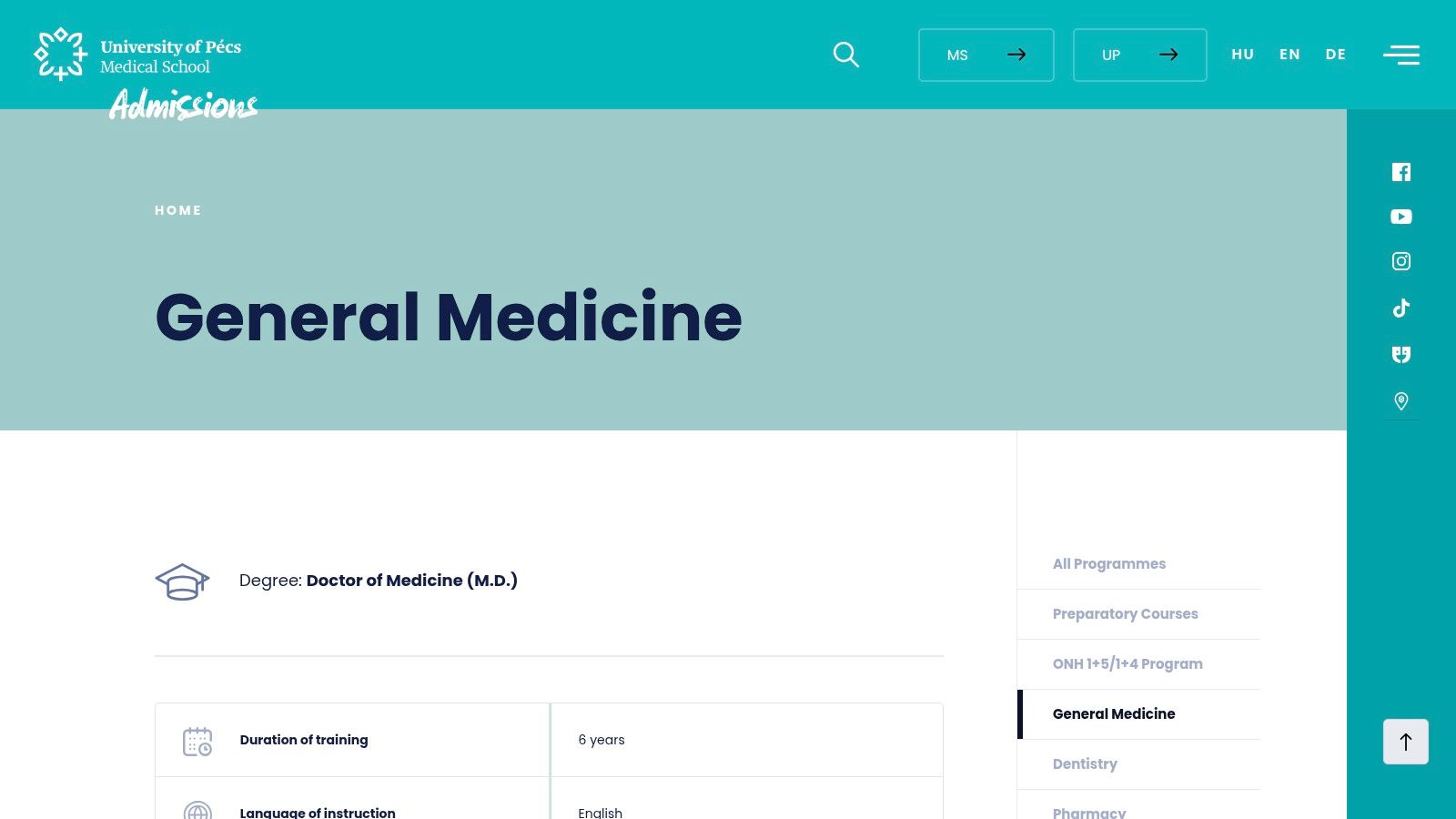
What can enrollment figures tell you about studying medicine in English at Pécs? The Pécs General Medicine admissions page shows the current English-language intake. Enrollment size indicates the scale of the program, but it cannot establish teaching quality, individual support or licensing outcomes.
Best fit: Applicants seeking an English-language medical program in Pécs who want to assess its curriculum and clinical training directly.
Compare the clinical experience
Review the admissions page for curriculum progression and application requirements, then examine the clinical-training description alongside the academic subjects. Ask what students do during placements and how those experiences fit into the program.
- Strength: Applicants can assess the English-language program through its published curriculum and admissions information.
- Trade-off: Program size does not show how much supervised patient contact each student receives.
- Admissions priority: Confirm the current examination requirements, fee schedule and deadline for your intended entry cycle.
Placement arrangements matter. Ask who organizes them, how supervision works and what language preparation comes before patient contact. The answers help clarify what the clinical experience involves.
Compare payment timing, expenses outside tuition and progression rules with your intended licensing route. A tuition quotation alone does not show the full financial commitment or whether the qualification suits your plans.
4. University of Szeged, Albert Szent-Györgyi Medical School, Medicine in English
What does Szeged's tuition cover, and which costs sit outside it? Start with the university's tuition-fee information, then ask which payment conditions apply to your intake and whether clinical practice carries separate charges. Include accommodation, textbooks and other personal expenses in your budget.
Szeged's dean's welcome describes the medical program's World Federation for Medical Education accreditation. Accreditation is distinct from eligibility for a medical licence or residency placement abroad, so check the requirements of the regulator and postgraduate training system where you plan to practise.
Strengths and trade-offs
- Strength: The university provides dedicated information on tuition and additional financial conditions.
- Trade-off: Applicants need to establish the full attendance budget, including any separately charged practice.
- Admissions priority: Check the current bulletin for examination subjects, application timing and intake availability.
For a broader comparison, review English-taught medical programs in Europe. Medical School Programs also lists German-language tracks at some of the same universities, so compare language of instruction alongside fees, entrance exams and deadlines. These details can vary by program and intake.
If you plan to practise abroad, identify the relevant regulator before accepting an offer. Confirm credential verification, examinations, language requirements and postgraduate training eligibility. An international profile does not remove the graduate's licensing obligations.
5. Semmelweis University, Human Medicine in German
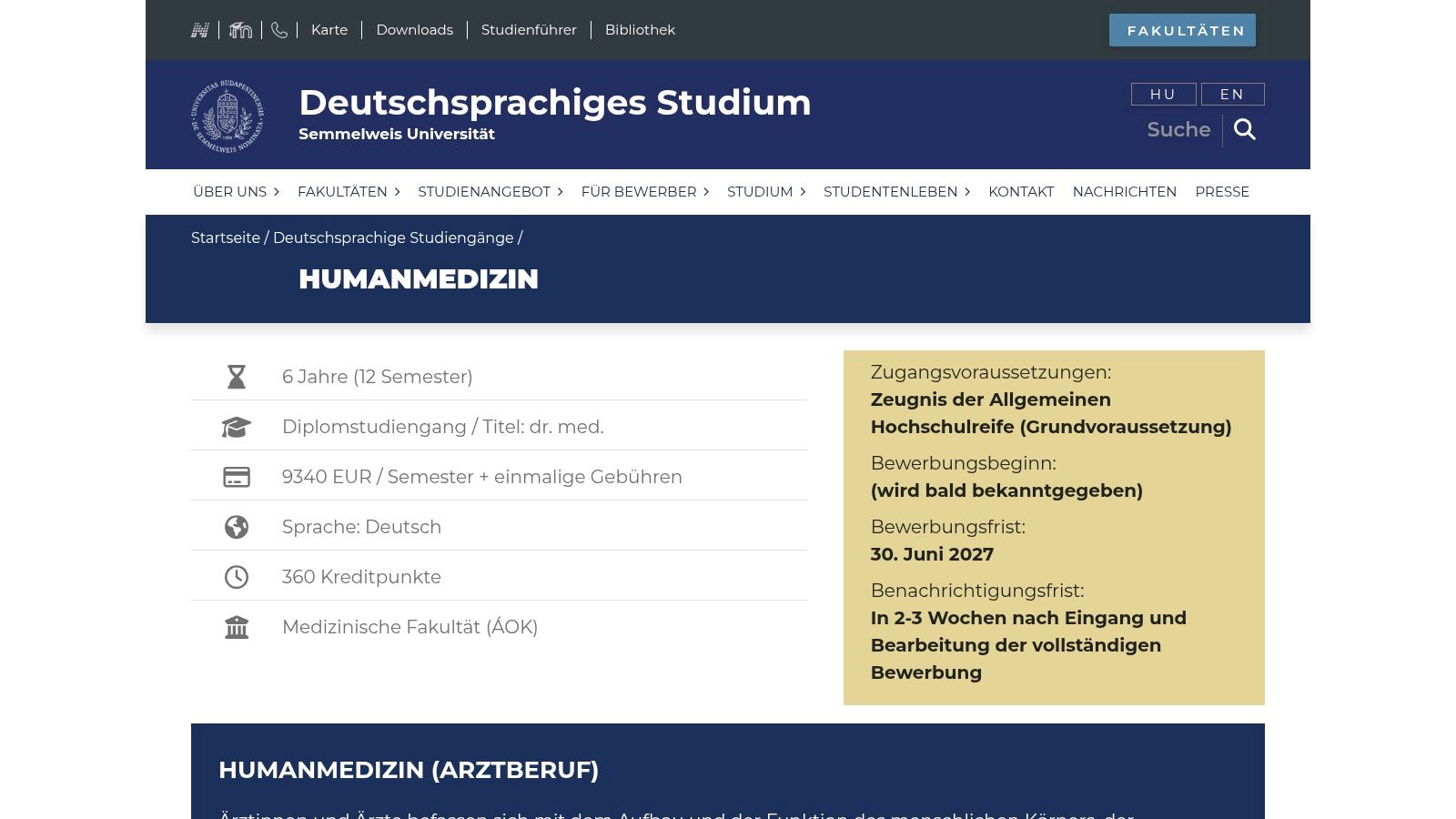
German-language medicine at Semmelweis isn't an English program with translated lectures. Applicants need to assess their ability to learn demanding scientific material, explain clinical reasoning and complete assessments in German.
The Semmelweis institutional history dates the beginning of its German-language medical training to 1983. That establishes a long-running teaching route, but it doesn't settle current admissions requirements or tuition.
Best fit: Academically fluent German speakers who want to study medicine in Budapest.
Assess language and administrative fit
Use the official German Human Medicine page for track-specific information. Don't import the English program's fee, deadline or examination arrangements into your German application unless the university explicitly confirms they apply.
- Strength: German-speaking applicants can investigate an established German-medium route within Semmelweis.
- Trade-off: Conversational fluency alone isn't a reliable test of readiness for medical examinations.
- Admissions priority: Confirm accepted qualifications, language expectations, selection procedures and current payment terms.
A useful personal test is to explain a biological process aloud in German, then answer follow-up questions without translating mentally from another language. Use that exercise to identify preparation gaps, not as a substitute for the university's language assessment.
Keep instruction language, patient language and future practice language separate in your planning. Studying in German doesn't automatically establish eligibility to practise in a German-speaking country, and it doesn't answer how local patient communication is taught.
6. University of Pécs Medical School, Humanmedizin in German
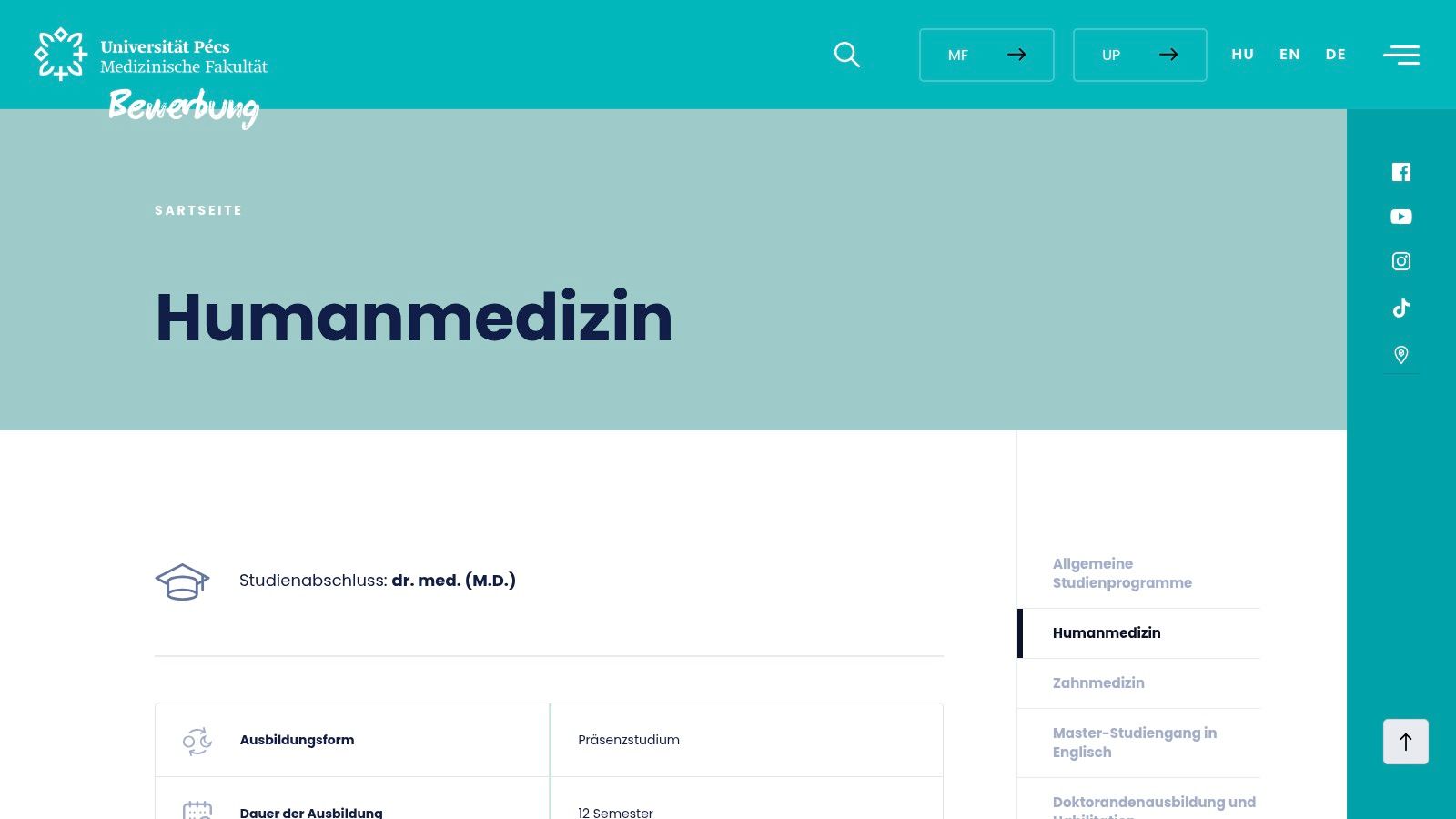
For German-speaking applicants, Pécs provides a comparison with Budapest that should go beyond location. The Pécs Humanmedizin program description emphasizes practical clinical experience, including patient contact at the bedside and in the operating room.
Best fit: Applicants comfortable studying medicine in German who want to examine a patient-oriented program in Pécs.
That clinical emphasis is worth investigating, but descriptions of patient contact need practical follow-up. Ask when students begin, what they're permitted to do and how instructors assess their clinical skills.
- Strength: Practical patient experience is explicitly part of the program's description.
- Trade-off: German-medium teaching doesn't by itself explain how communication with Hungarian-speaking patients works.
- Admissions priority: Use the German track's application materials to confirm fees, examinations and deadlines independently of the English program.
Compare the full financial commitment
Our guide to the cost of attending an international medical school explains the budget categories applicants should separate. For Pécs, request the German program's own payment schedule before making comparisons.
Include translation and certification of documents, application expenses, housing deposits, travel and possible additional study in your planning. Don't assume a scholarship, transfer credit or external clinical placement will reduce your costs until the responsible institution confirms it.
The main trade-off: A suitable teaching language and attractive clinical description still need to align with your finances and intended professional registration. Neither compensates for an unaffordable payment schedule or an unsuitable licensing route.
7. University of Szeged, Albert Szent-Györgyi Medical School, Medicine in German
Szeged's German-language option requires a particularly careful reading of program scope. Before treating it as interchangeable with another German-medium medical route, establish exactly which stages are taught in German and how students progress through clinical training.
Best fit: German-speaking applicants prepared to confirm the complete language and progression arrangements before applying.
The Szeged German-language admissions bulletin is the appropriate place to investigate the route. Ask the school to resolve any uncertainty about later teaching language, clinical placements or continuation conditions in writing.
Questions that determine comparability
- Strength: German-speaking applicants have another Hungarian medical-school option to investigate beyond Budapest and Pécs.
- Trade-off: A German-language entry route shouldn't be assumed to mean identical language arrangements throughout the degree.
- Admissions priority: Confirm program scope, entrance examinations, intake conditions, tuition and the language used in later assessments.
Ask which language you'll use at each stage of study, not just which language appears on the application page.
Don't apply the English track's published tuition to this route. Request a German-track quotation that identifies the entry cohort, payment currency, included services and additional charges.
The same caution applies to professional plans. A German-language study route may suit your academic strengths, but the regulator in your intended country decides registration requirements. Choose Szeged only after the school's written answers support your complete study plan, rather than assuming you can resolve language or progression questions after enrollment.
Hungarian Medical Programs at a Glance
Tuition and program length make the English and German tracks easier to compare, but the fee figures below should be read in their stated currencies and billing periods.
| Program | Language | Duration | Tuition (listed) | Location |
|---|---|---|---|---|
| Semmelweis University, General Medicine | English | 6 years | €9,340 per semester | Budapest, Hungary |
| University of Debrecen, Medicine | English | 6 years | $16,900 per year | Debrecen, Hungary |
| University of Pécs Medical School, General Medicine | English | 6 years | Confirm the current fee with the university | Pécs, Hungary |
| University of Szeged, Albert Szent-Györgyi Medical School, Medicine | English | 6 years | Confirm the current fee with the university | Szeged, Hungary |
| Semmelweis University, Human Medicine | German | 6 years | Confirm the current fee with the university | Budapest, Hungary |
| University of Pécs Medical School, Humanmedizin | German | 6 years | Confirm the current fee with the university | Pécs, Hungary |
| University of Szeged, Albert Szent-Györgyi Medical School, Medicine | German | 6 years | Confirm the current fee with the university | Szeged, Hungary |
The listed English programs share a six-year format, while the German tracks offer another route at the same universities. Fee schedules can differ by language, cohort and academic year, so the English-track amounts should not be applied to German programs. For a like-for-like comparison, confirm each track's current tuition and billing period with the university.
Choosing Your Hungarian Program and Planning the Application
Choose your study language first. If your German isn't strong enough for scientific study and oral assessment, a German-language track isn't a sensible fallback just because it offers another application opportunity. If you choose English, investigate patient-language preparation with equal care.
Next, compare the universities using the same financial categories. Record tuition in its published currency, then separate application charges, examination fees, deposits, accommodation and clinical-practice expenses. Keep each quotation attached to its entry cohort and date, rather than mixing prices from different academic years.
Turn a shortlist into an application plan
- Verify admissions: Download the current examination topics, identify required documents and confirm the application deadline and intake status.
- Verify payments: Establish what must be paid before admission, after an offer and before enrollment or visa processing, including refund conditions.
- Verify professional eligibility: Check the intended destination regulator's requirements before you commit to the degree.
There's no defensible universal winner among these medical schools in Hungary. The strongest option is the program whose language, entrance process, financial commitments and clinical arrangements fit your circumstances, with a credible route toward your intended professional destination.
Our independent directory brings 24 English-taught medical programs into a side-by-side comparison. We check program facts against official school pages, date them and update information when institutions change their requirements, continuing our work as an independent guide since 2009.
Use those comparisons to narrow your choices, then obtain current confirmation from each shortlisted university. Before paying, you should be able to explain which program you're entering, what you owe, how you'll prepare for admission and what remains necessary after graduation.
Visit Medical School Programs to compare Hungarian options with English-taught medical degrees elsewhere in Europe and the Caribbean. Use our admissions, cost and licensing guides to build a focused shortlist, then confirm your chosen program's latest terms directly with the university.