
The 2024–25 entering class at U.S. MD-granting medical schools had a median undergraduate GPA of 3.86, according to the Association of American Medical Colleges. Half of enrolled students were above that figure and half below it. That makes it a useful benchmark, not an admissions cutoff.
The more useful question isn't whether your GPA is good enough in isolation. It's whether your GPA and MCAT together, supported by your science coursework and recent academic performance, make a convincing case that you're ready for medical school.
Table of Contents
- Medical School GPA Benchmarks at a Glance
- Why the MCAT Changes What Your GPA Means
- Total GPA, Science GPA and Your Upward Trend
- Three Applicant Profiles and How Committees Read Them
- Reading Foreign GPAs for International Applications
- How to Strengthen a Lower GPA Before You Apply
- Confirm Your GPA Plan Before You Apply
Medical School GPA Benchmarks at a Glance
A competitive GPA for medical school starts with knowing whose grades you're comparing. An applicant submitted an application, while a matriculant enrolled. The applicant pool includes people who weren't admitted, so its academic profile isn't interchangeable with the enrolled class.
You also need to distinguish a median, the midpoint of a distribution, from an average, calculated across the group. Neither measure tells you the lowest GPA a school will consider.
Published GPA benchmarks for U.S. medical school
| Measure | Total GPA | Science GPA | Cycle |
|---|---|---|---|
| Matriculant median, students who enrolled | 3.86 | Not reported in this release | 2024–25 |
| Applicant average | 3.67 | 3.57 | 2025–26 |
| Matriculant average | 3.81 | 3.75 | 2025–26 |
The median comes from the AAMC entering-class release linked above. The applicant and matriculant averages come from the AAMC admissions document linked under the GPA–MCAT comparison below. These rows describe different cohorts and different measures, so don't interpret their differences as an annual rise or fall.
Use benchmarks without inventing a minimum
A national benchmark helps you judge academic positioning. It doesn't establish an individual school's eligibility rules, describe its entire admitted range, or account for its mission and applicant preferences.
A school may publish a minimum GPA, a class average, or an entering-class range. Read the label carefully: meeting a minimum means you satisfy that particular requirement, not that your application is competitive.
Practical rule: Compare like with like. Match your total GPA to total GPA, your science GPA to science GPA, and an enrolled-class figure to other enrolled-class figures.
International applicants can't compare a local grade-point scale directly with these U.S. figures without checking how each institution evaluates foreign transcripts.
Find your own total and science GPA before drawing conclusions. Compare each with its matching measure, then investigate the academic profiles of the schools you're considering rather than treating the national midpoint as a pass-or-fail line.
Why the MCAT Changes What Your GPA Means
Think of your GPA as a job reference describing sustained past work, and the MCAT as a live interview offering another view of your preparation. The analogy isn't exact, but it explains why the same academic record can look different when paired with a different exam result.
Your transcript documents performance across courses and terms. The MCAT adds evidence from a standardized assessment. A committee can consider both without treating either as a substitute for the other.
Find your GPA–MCAT position
In aggregated 2022–2025 admissions data, applicants with a 3.40–3.59 GPA had acceptance rates ranging from roughly 5% at lower MCAT levels to more than 50% at higher MCAT levels, according to the AAMC GPA and MCAT admissions document. For context, that document also reports 2025–2026 U.S. MD applicant averages of 3.67 total GPA and 3.57 science GPA, compared with matriculant averages of 3.81 and 3.75, respectively.
The important finding is the spread within the same GPA band. It doesn't mean raising an exam score guarantees a particular outcome, because applicants also differ in experiences, residency, academic history, and school selection.
The infographic illustrates why you should assess the pairing rather than either number alone.

Don't interpolate a middle-band acceptance rate from those endpoints. The summarized comparison doesn't specify that figure; use the current AAMC grid to locate your exact GPA and MCAT bands.
Turn the pairing into a decision
- Below-benchmark GPA, stronger MCAT. Applying may be defensible when recent coursework also supports readiness. Check school-specific screening requirements before relying on the exam to compensate for older grades.
- Stronger GPA, weaker MCAT. Investigate the test result before submitting. Content gaps, pacing problems, or inconsistent practice performance call for different preparation plans.
- Weaker GPA and MCAT. Consider academic rebuilding, a revised school list, or a later application timeline. Submitting sooner doesn't solve either weakness.
Use stronger and weaker relative to your target programs, not an invented nationwide threshold. A score that supports an application at one program may leave a substantial gap at another.
Review medical school prerequisites and the MCAT together so your course schedule supports both eligibility and exam preparation. Then write down your actual GPA and MCAT, locate the matching grid cell, and use that position to inform your school list. Treat the cell as group-level context, not your personal probability of admission.
Total GPA, Science GPA and Your Upward Trend
A cumulative GPA compresses an entire transcript into a single result. Admissions readers can still examine what you studied, when you struggled, and whether your recent work answers concerns raised by earlier grades.
The AAMC's historical GPA–MCAT acceptance tables organize outcomes by combinations of academic measures and caution that GPA and MCAT results aren't the sole determinants of admission. For your own planning, that means looking beyond the cumulative number to the coursework underneath it.
The same average can describe different students
Consider a hypothetical comparison between students who finish with the same cumulative GPA. One struggles early, changes study habits, and later earns consistently stronger grades in demanding science courses. The other starts strongly but receives progressively weaker grades as the coursework becomes more advanced.
Their averages match, but the questions differ. The improving student needs to show that the recovery is sustained. The declining student needs to explain what changed and provide evidence that the underlying problem has been addressed.
An upward trend doesn't erase earlier coursework. It gives a committee additional evidence about current preparation, especially when improvement occurs in subjects relevant to medical study.
Biology, chemistry, physics, and biochemistry deserve close attention because they support medical preparation and MCAT readiness. However, don't assume that this informal subject list is the application service's exact science GPA classification. Check its course-classification instructions, including how mathematics and interdisciplinary courses are treated.
A strong overall average can conceal a weak science record. Separate the numbers before deciding what needs repair.
Audit the transcript committees will receive
Course rigor supplies context, not an automatic adjustment. Don't assume a demanding major earns a fixed allowance for lower grades, or that choosing easier electives will answer concerns about science preparation.
Build a transcript audit with these checks:
- Separate academic categories. Calculate cumulative and science performance using the relevant application service's instructions.
- Map the trend. Review grades by academic year and mark where performance improved, flattened, or declined.
- Identify course demands. Note advanced science work, laboratory requirements, and the academic load you carried.
- Check repeated courses. Verify how the application service handles every attempt rather than assuming your university's grade-forgiveness policy carries over.
- Record relevant context. Identify disruptions or institutional grading practices that need a brief, factual explanation.
Use official calculation rules before planning additional coursework. Otherwise, you may spend time improving the GPA printed by your university while misunderstanding the standardized GPA that admissions readers will see.
Three Applicant Profiles and How Committees Read Them
The following applicants are hypothetical teaching examples, not admissions predictions. Their combinations illustrate different questions a committee might ask; none establishes a score threshold or promises an interview.
The image represents the central task: reviewing an academic record in context rather than sorting applicants by a single number.

Maya has stronger testing than science grades
Suppose Maya's cumulative record is middling, her science grades are weaker, and her MCAT is strong relative to her intended schools. She hopes the exam will settle every concern about her transcript.
The committee's question is whether she can sustain strong performance across a demanding science curriculum. Her exam helps, but recent upper-level science grades and a detailed academic recommendation would answer a different part of that question.
Before applying, Maya should examine whether her science difficulties were isolated or persistent. If an explanation is necessary, she should use the appropriate application space, such as an academic-context prompt, rather than forcing her personal statement to become a defense of her GPA.
Daniel has high grades but a weaker exam
Daniel has an excellent cumulative record but an MCAT below the typical profile of his target programs. His first instinct is to submit widely because his grades are strong.
The committee may ask whether the discrepancy reflects gaps in knowledge, difficulty applying concepts under time pressure, or circumstances surrounding the test. Daniel should review his section performance and preparation history before deciding what to change.
A retake may be sensible, but only after he can demonstrate improvement on realistic practice exams. Repeating the test without a changed preparation method creates another result, not necessarily stronger evidence.
Priya has a documented academic recovery
Priya's older undergraduate record is weak, but she has since completed sustained post-baccalaureate science study with substantially better results. Her MCAT supports the preparation demonstrated in that newer coursework.
The committee's question is whether the recovery represents a durable change. A demanding recent course load, consistent grades, and recommendations from current science instructors can help answer it.
Priya should document what changed in her study methods and circumstances, then confirm that her target schools will consider her record under their eligibility policies.
These examples show why applicants need different next steps. Schools can weigh the same evidence differently, so a credible strategy addresses the specific unresolved concern in the file rather than assuming every academic weakness has the same remedy.
Reading Foreign GPAs for International Applications
An online conversion calculator can produce a precise-looking U.S. GPA without producing a number a medical school will accept. Grading scales, degree structures, passing standards, and transcript policies differ, so copying a percentage into a conversion table isn't enough.
Start with eligibility, not arithmetic. Determine whether the program accepts your qualification, whether foreign prerequisite coursework is eligible, and whether additional study is required before you spend time estimating a converted GPA.
Build a transcript evidence file
Use each target school's official admissions pages to establish what it needs:
- Grading scale. Keep the official grading key that explains marks, classifications, and passing standards.
- Credential evaluation. Confirm whether the school or application service requires an external evaluation and which service it accepts.
- Course documentation. Retain descriptions or syllabi for science courses whose titles don't clearly identify their content.
- Study abroad records. Identify coursework taken outside your main institution and determine how it must be documented.
- Translation requirements. Check whether certified translations are necessary and who may prepare them.
Science prerequisites deserve particular care when course names, laboratory components, or credit systems differ. An MCAT result may offer an additional comparison point where required, but it doesn't replace a transcript policy or establish eligibility for foreign coursework.
Before paying for an evaluation: Confirm that the receiving institution accepts that evaluation service and requires the report you intend to purchase.
Our program data comes from schools' official websites and authoritative bodies such as the World Directory of Medical Schools, ECFMG, NRMP, and national accreditation agencies. Still, the admissions office must resolve questions about how its own program will treat your particular qualification.
For broader application planning, review the issues involved in getting into medical school as an international student. Keep transcript questions separate from visa, funding, and licensing questions so none gets overlooked.
The video below offers additional context for your planning.
Contact admissions with a specific qualification, transcript, and course question. A written answer about your actual record is more useful than an informal conversion shared online.
How to Strengthen a Lower GPA Before You Apply
A lower GPA isn't a verdict, but it changes the order of your decisions. Choose work that addresses the weakness a committee can see, rather than adding credentials to appear busy.
Strongest move by GPA and MCAT situation
| Your situation | Strongest move | Why it works |
|---|---|---|
| Strong MCAT, GPA slightly below the median | Present the MCAT alongside a clear, well-supported application | Adds evidence of current preparation |
| Low GPA, MCAT not yet taken | Prepare for and sit the MCAT before committing to an application | Establishes the academic pairing instead of relying on a hoped-for score |
| Low GPA with a flat or falling trend | Consider suitable post-baccalaureate coursework | Creates an opportunity to demonstrate recent academic ability |
| Weak science GPA | Add appropriate upper-level science courses and earn strong grades | Addresses the specific coursework causing concern |
| Low GPA and low MCAT | Delay the application and rebuild both | Allows time to resolve academic weaknesses before submission |
Establish your starting point
Take a current full-length MCAT practice test under timed conditions. Use it diagnostically: review content gaps, section balance, pacing, and fatigue. A practice result helps plan preparation, but it isn't an official score and shouldn't be treated as one.
Compare your academic measures separately. Place your cumulative GPA, science GPA, and official MCAT result alongside relevant benchmarks and the current GPA–MCAT grid. If you haven't taken the exam, keep your application strategy provisional.
The process below provides a visual planning aid.
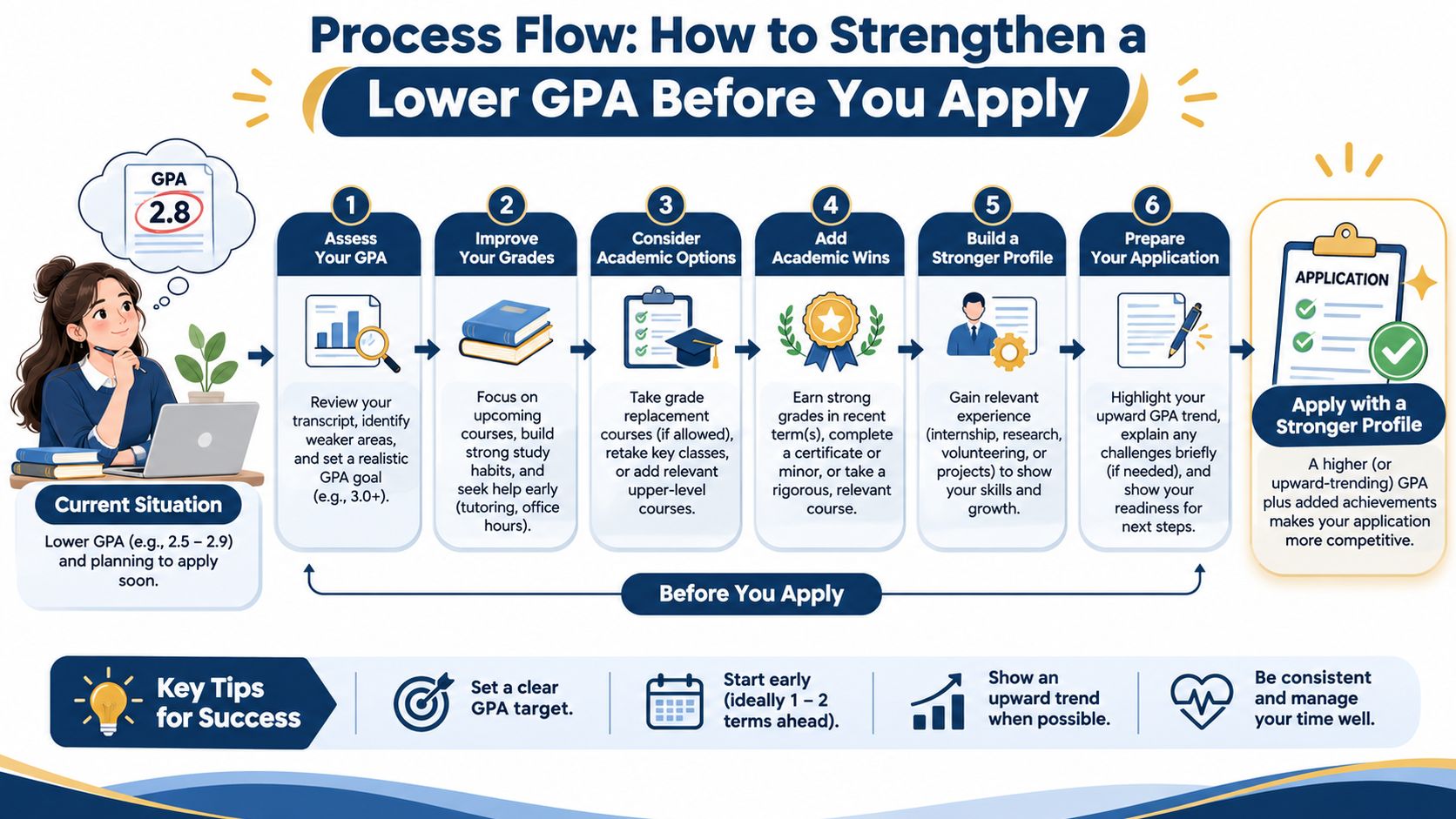
Choose additional coursework for a reason. Retaking a prerequisite may address missing foundational knowledge, while advanced coursework may better demonstrate that you can handle unfamiliar material. Check eligibility and repeat-course rules before enrolling.
Avoid expensive activity without academic progress
Don't retake a course until you know how you'll prepare differently. Replace passive rereading with retrieval practice, worked problems, regular feedback, and a schedule you can sustain alongside employment or family responsibilities.
Likewise, don't build a school list composed entirely of aspirational choices when your record needs repair. A broader list can improve alignment, but it can't make an unresolved prerequisite or screening requirement disappear.
Evaluate a post-baccalaureate option by its course access, academic support, cost, and suitability for your specific gaps. Don't assume the program name alone will strengthen your application.
A rebuilt file should make the improvement visible: stronger recent academic work, an exam result appropriate to the programs you're considering, and a concise explanation of any disrupted term. Set those evidence-based milestones before choosing a submission date.
Confirm Your GPA Plan Before You Apply
GPA is judged alongside the MCAT, science record, and academic trend; a published benchmark is a reference point, not a universal cutoff. Your final decision should rest on school-specific requirements and the evidence in your completed application.
Create a one-page record for each target school. Include the official page, the date you checked it, and any unanswered question you need admissions to resolve.
Confirm the rules that affect your file
- Current academic profile. Record the latest published GPA and MCAT ranges, clearly distinguishing minimum requirements from enrolled-class averages.
- Foreign coursework. Confirm transcript-conversion rules, credential-evaluation requirements, and whether your prerequisites are accepted.
- Science classification. Check which courses count and how the relevant application service calculates your record.
- Exam policies. Verify accepted MCAT test dates, treatment of repeated results, and any restrictions affecting your intended submission.
- Application timing. Record deadlines and when transcripts, recommendations, and exam results must arrive.
Keep eligibility separate from competitiveness. A school can permit you to apply while remaining a poor match for your current academic profile, and a seemingly suitable class average doesn't override a formal requirement.
Our medical school admissions guide covers eligibility, transcripts, the MCAT, English tests, visas, funding, and schools that accept international students. Use that broader planning context to make sure an academically plausible option is also financially and practically workable.
Before submitting, write down your cumulative GPA, science GPA, academic trend, and official exam result. Choose a short list of target schools and verify each school's posted requirements against that profile. If a critical policy remains unclear, resolve it before paying the application fee.
Medical School Programs offers a sourced program directory and practical admissions guidance to help you compare your academic profile with possible study pathways. Visit Medical School Programs to investigate programs, check their entry requirements, and build a school list grounded in your GPA, exam preparation, and qualifications.